# Mangoes and Microbes: A Journey Through Regional Wellness
Author: Neha Rao
Author URL: https://www.bugspeaks.com/blog/author/neha-rao
Published: 2026-07-23
Category: Indian Series
Category URL: https://www.bugspeaks.com/blog/category/indian-series
Meta Title: Regional Mangoes & Gut Microbiome | BugSpeaks
Meta Description: Discover how regional mangoes shape the gut microbiome through unique polyphenols, fiber, and postbiotics to support digestion and overall wellness.
Tags: Indian Foods, Mango, Gut Microbes
Tag URLs: Indian Foods (https://www.bugspeaks.com/blog/tag/indian-foods), Mango (https://www.bugspeaks.com/blog/tag/mango), Gut Microbes (https://www.bugspeaks.com/blog/tag/gut-microbes)
URL: https://www.bugspeaks.com/blog/mango-gut-health-indian-food
## Why does a mango's home change its chemistry?
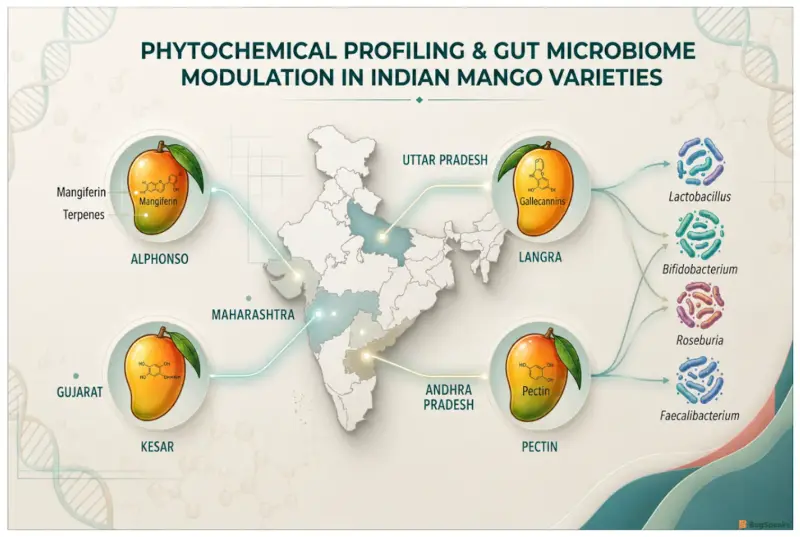
Geography and climate determine the specific types of healthy plant chemicals a mango tree produces. Every region in India has unique soil, sunlight, and rain that act as physical coordinates for the trees [Litz (2009)](https://doi.org/10.1079/9781845934897.0000). These natural conditions force different mango varieties to build unique chemical profiles to protect themselves. For example, a tree growing in the wet coastal soil of Maharashtra makes different compounds than a tree in the dry plains of Uttar Pradesh. These regional differences create a natural chemistry map across India, changing how each fruit helps your body. These specialized plant ingredients are called polyphenols, and they are very important for your health.
In Maharashtra, the warm sea air and the rocky, volcanic soil of the Deccan region create a perfect home for the Alphonso mango. This regional environment changes plant chemistry, forcing the Alphonso to produce large amounts of sweet-smelling essential oils [(Ouf, 2020)](https://doi.org/10.1007/s13197-020-04816-5). At the same time, the unique weather conditions in Uttar Pradesh cause the Langra mango to produce totally different compounds [Kim (2021)](https://doi.org/10.3390/molecules26092732). This proves that the plant's home acts like a computer program, telling the tree exactly which chemicals to build. Each mango variety becomes a specialized package of plant nutrients, ready to interact with your gut in highly effective ways.
When you eat these regional mangoes, their unique chemical packages travel down into your digestive system. Your stomach and small intestine cannot absorb most of these complex plant chemicals, so they pass directly into your colon intact [Ferreira (2026)](https://doi.org/10.1016/j.biopha.2026.119592). This unabsorbed portion is called the indigestible fraction, and it is where the real biological journey begins in your gut [Gutiérrez-Sarmiento (2020)](https://doi.org/10.3390/nu12030683). These compounds reach your large intestine safely, where they wait for your helpful resident bacteria to use them for food. This movement from the soil to your gut connects the health of Indian farms directly to your microscopic inner world.
**Climate**\- The general weather patterns of a region, like rainfall, sunlight, and temperature.
**Polyphenols**\- Healthy natural chemicals made by plants to protect themselves from stress, which also help protect our body's cells.
**Indigestible fraction**\- The part of your food that cannot be absorbed by your stomach or small intestine, passing directly into your large intestine for your gut bacteria to use.
## How does Alphonso chemistry feed your gut microbes?
The Alphonso mango from Maharashtra contains unique chemical structures that selectively feed and grow beneficial bacteria like Lactobacillus in your gut. These beneficial bacteria act like friendly responder stations along your intestinal wall, waiting for specific plant nutrients to arrive [Kim (2020)](https://doi.org/10.1016/j.nutres.2020.01.002). When you eat Alphonso mangoes, their unique chemistry fuels these bacterial stations, helping the friendly microbes multiply very quickly in your large intestine [Gutiérrez-Sarmiento (2020)](https://doi.org/10.3390/nu12030683). The [microbes](https://www.bugspeaks.com/blog/indianspices-guthealth-gutmicrobiome) use the mango's active compounds to grow stronger, which allows them to crowd out harmful bacteria. Feeding these helpful microscopic responders is a simple way to maintain balance and support your body's natural defenses.
Alphonso leaves and fruit are especially rich in sweet-smelling essential oils that contain volatile terpenes like trans-caryophyllene [Ouf (2020)](https://doi.org/10.1007/s13197-020-04816-5). These active plant compounds act like natural shields, stopping bad bacteria from growing while leaving the good bacteria completely unharmed [Ouf (2020)](https://doi.org/10.1007/s13197-020-04816-5). This selective clearing helps your gut's friendly microbes build a peaceful community without constant attacks from dangerous invaders. In scientific tests, these aromatic oils successfully stopped common food-poisoning germs from multiplying, proving their powerful protective action in food systems. Adding these natural shields to your daily diet helps keep your gut clean, safe, and ready to digest food and absorb vital nutrients.
In addition to essential oils, the Alphonso variety provides a powerful antioxidant chemical called mangiferin [Sadiea (2024)](https://doi.org/10.3389/fitd.2024.1473494). This special xanthone compound travels into the colon, where it works closely with your friendly microbes to reduce painful swelling and irritation [Ferreira (2026)](https://doi.org/10.1016/j.biopha.2026.119592). It acts like a soothing balm for the cells lining your gut, protecting them from daily stress and damage. By calming down gut inflammation, mangiferin helps your intestinal wall stay calm, healthy, and working exactly the way it should. This powerful partnership between helpful plant chemicals and friendly bacteria is what makes regional mangoes so good for your digestive system.
**Regional Soil & Climate (Maharashtra)**
**Mango Cultivar (Alphonso)**
**Dominant Chemistry (Terpenes & Mangiferin)**
**Primary Gut Responders (Lactobacillus & Bifidobacterium)**
Volcanic Rocky Soil (Deccan coordinates)
Alphonso cultivar node
Volatile terpenes (trans-caryophyllene) & active mangiferin
Stimulates Lactobacillus and Bifidobacterium, blocks food spoilage germs
Subtropical Dry Plains (Uttar Pradesh plains)
Langra cultivar node
Polymeric gallotannins & free gallic acid
Decarboxylated by tannase-expressing gut microbes to protect gut lining
Deltaic Alluvial Soil (Andhra Pradesh soils)
Banganapalli cultivar node
High-molecular weight soluble pectin fibers
Fermented by Roseburia and Faecalibacterium to produce butyrate fuel
Saurashtra Semiarid Plains (Gujarat coast)
Kesar cultivar node
Diverse flavonoids & high quercetin content
Activates Nrf2-ARE antioxidant pathways, lowering liver inflammation
**Lactobacillus**- A helpful, friendly group of gut bacteria that keep your digestive system balanced and prevent harmful germs from growing.
**Terpenes**\- Strong-smelling natural plant oils that act as natural shields against harmful microbes.
**Mangiferin**\- A powerful protective plant chemical found in mangoes that acts like a soothing balm to reduce swelling and cellular stress.
**Xanthone compound**\- A special family of protective plant chemicals that act like tiny biological shields to protect your cells, fight off stress, and lower swelling
## How does Langra chemistry protect your gut wall?
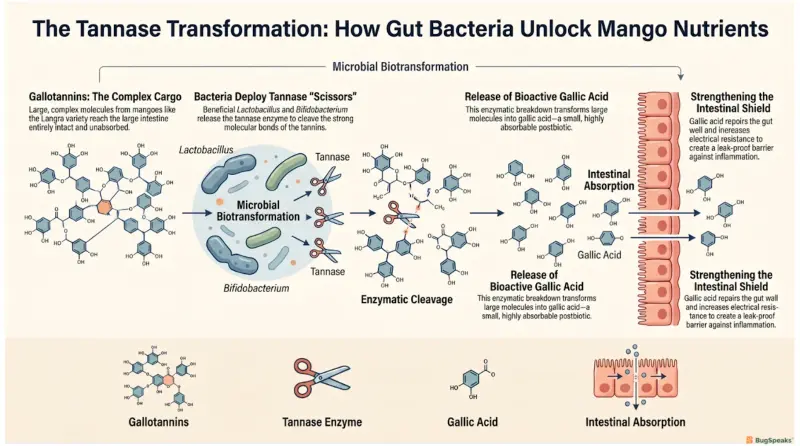
The Langra mango from Uttar Pradesh is packed with [specific chemicals](https://www.bugspeaks.com/blog/pickle-fermented-food-gut-health) that help repair and strengthen the cells lining your gut. This variety contains very high levels of gallotannins, which are large, complex molecules that act like a protective mesh over your gut wall [Kim (2021)](https://doi.org/10.3390/molecules26092732). When you eat Langra, these large molecules coat the delicate surface of your intestine, keeping bad bacteria and toxic substances from leaking through. This mesh keeps your gut barrier highly secure, which is important because a weak barrier can make you feel sick and tired. Eating Langra helps you build a solid, reliable shield against daily digestive issues.
Your gut bacteria use a special tool called tannase to break these large gallotannins down into smaller pieces [Kim (2021)](https://doi.org/10.3390/molecules26092732). This biochemical breakdown process releases a highly active, smaller plant chemical known as gallic acid directly into your colon [Barnes (2016)](https://doi.org/10.1002/mnfr.201500706). This smaller chemical is very easy for your body to use, and it is a powerful weapon against harmful inflammation. It works like a tiny repair crew, fixing damaged areas along your intestinal lining and keeping the cellular wall perfectly intact. Without the help of your gut bacteria's specialized tools, these healing chemicals would remain locked up and unusable.
Once released, these small chemicals help increase transepithelial electrical resistance, which is the scientific name for a tight, leak-proof gut wall [Ferreira (2026)](https://doi.org/10.1016/j.biopha.2026.119592). This barrier blocks toxic waste and dangerous bacteria from escaping into your blood, protecting your whole body from system-wide swelling [Ferreira (2026)](https://doi.org/10.1016/j.biopha.2026.119592). At the same time, the mango's active ingredients stop your body from making pro-inflammatory cytokines, which are warning signals that cause painful irritation. By keeping your gut wall tight and silent, these plant chemicals help prevent severe conditions like inflammatory bowel disease (IBD). A strong gut wall keeps your immune system happy and prevents your body from overreacting to daily food.
**Gallotannins**\- Large, complex plant molecules that form a protective mesh or shield over your intestinal wall.
**Tannase**\- A special biological tool or enzyme that helpful gut bacteria use to break down large plant molecules into smaller, useful parts.
**Gallic acid**\- A small, highly protective plant chemical released from gallotannins that helps repair your intestinal lining.
**Transepithelial electrical resistance**\- A scientific measurement that shows how tight, strong, and leak-proof your gut wall is.
## How do other regional mangoes create different health benefits?
Mangoes from other regions, like Banganapalli and Kesar, provide unique fibers and flavonoids that perform different protective jobs in your body. For example, the Banganapalli mango from Andhra Pradesh is rich in soluble pectin fibers that act as excellent prebiotics [Gutiérrez-Sarmiento (2020)](https://doi.org/10.3390/nu12030683). Your gut bacteria ferment these fibers to produce butyrate, which is a highly beneficial short-chain fatty acid [Kim (2021)](https://doi.org/10.3390/molecules26092732). This special fatty acid is the primary energy source for the cells lining your colon, helping them stay strong, repair quickly, and multiply normally. Choosing different regional mangoes is a great way to feed different friendly bacterial species in your gut.
In Gujarat, the Kesar mango develops a distinct chemical profile that is rich in powerful protective compounds called flavonoids [Hadidi (2024)](https://doi.org/10.3390/antiox13081001). These molecules include quercetin, a well-studied plant active ingredient that acts like an antioxidant shield in your liver and blood [Alharbi (2026)](https://doi.org/10.3389/fnut.2026.1767453). Quercetin helps clean up unstable oxygen molecules that cause cellular aging, while simultaneously reducing fat buildup in your liver cells. This antioxidant protection keeps your metabolic systems running smoothly, helping your liver process fats and sugars without getting overloaded. Eating Kesar mangoes delivers these specialized shields directly to your digestive tract, helping your internal organs stay healthy.
Together, these different regional mangoes show that eating a variety of fruits is essential for your gut microbiome. Each mango variety acts like a unique key, unlocking different helpful health benefits because of its specific geographic plant chemistry. By eating Alphonso, Langra, Banganapalli, and Kesar, you send a diverse mix of nutrients to your helpful gut bacteria. This diverse diet helps build a highly resilient microbial community, which is the secret to a healthy, happy digestive system. Your gut microbes thrive on this geographic variety, using the different plant chemicals to protect your whole body from daily illness, infection, and stress.
**Raw Plant Molecule (Unabsorbed)**
**Bacterial Tool (Microbial Enzyme)**
**Active Metabolite (Absorbed Postbiotic)**
**Cellular Destination & Biological Benefit**
Large polymeric gallotannins
Bacterial tannase enzyme
Bioavailable free gallic acid
Gut epithelial cells: raises transepithelial electrical resistance (TEER)
Active C-glycosylxanthone (mangiferin)
Microbial glycosidase enzyme
Norathyriol metabolite
Gut immune cells: suppresses pro-inflammatory interleukin-8 (IL-8) signals
Soluble dietary pectin fiber
Bacterial carbohydrate esterases
Short-chain fatty acid (butyrate)
Colonocytes: acts as primary fuel source to promote cellular repair
Flavonoid glycosides (rutin)
Microbe-driven rhamnosidase
Active free quercetin aglycone
Liver hepatocytes: down-regulates fat storage, protects from stress
**Butyrate**\- A short-chain fatty acid (SCFA) made by friendly gut bacteria that provides energy and fuel to the cells lining your colon.
**Flavonoids**\- Natural, protective plant pigments that act like antioxidant shields to keep your liver and blood vessels healthy.
**Quercetin**\- A well-studied, powerful flavonoid that cleans up cellular waste and prevents fat buildup in your organs.
## How does your gut transform mango chemistry into full-body wellness?
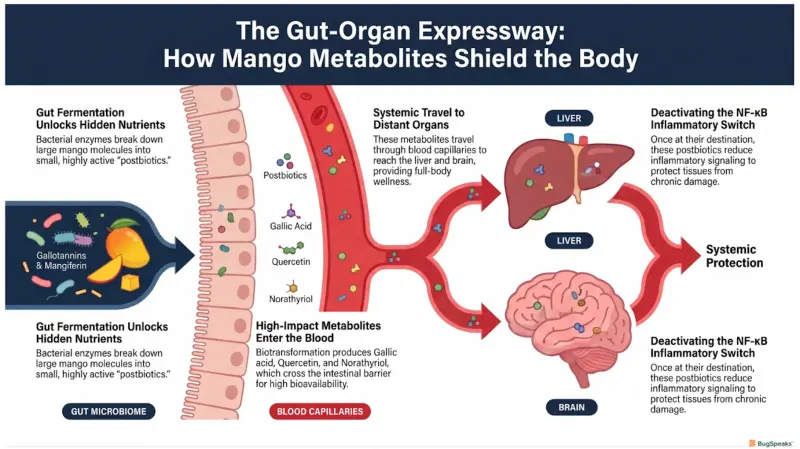
Special bacterial enzymes produced by your gut microbes break down large mango molecules into tiny, active substances that travel through your blood to protect your organs. This conversion process is called biotransformation, and it is how your gut bacteria unlock the true power of plant foods [Alharbi (2026)](https://doi.org/10.3389/fnut.2026.1767453). These newly created tiny substances are called postbiotics, and they have much higher bioavailability than the original mango compounds. Because they are so small, they can easily cross your intestinal wall and enter your bloodstream. This allows them to travel to distant organs like your liver and brain, delivering health benefits throughout your entire body.
Once in your blood, these active bacterial outputs help calm down inflammation and protect your brain from damage. For example, they help strengthen the blood-brain barrier, which is a protective wall that keeps harmful substances out of your brain [Ferreira (2026)](https://doi.org/10.1016/j.biopha.2026.119592). They also turn down your body's master inflammatory switch, a protein complex called nuclear factor kappa B, which stops chronic swelling in tissues [Arooj (2026)](https://doi.org/10.1016/j.jafr.2026.102974). By keeping this master switch turned off, the mango metabolites prevent tissue damage and support long-term brain health. This protective biological pathway shows how eating healthy food can directly support your mind, thinking, and overall cognitive performance.
This complete pathway from regional soils to your blood highlights the importance of a healthy, active gut microbiome. By choosing regional Indian mangoes, you are providing your gut microbes with the raw materials they need to make these protective compounds. Your daily food choices act like instructions for your inner garden, determining which helpful bacteria grow and thrive. Grounded in this geographic plant chemistry, your gut bacteria work hard to turn every bite of mango into long-term wellness. It is a partnership that keeps your body balanced, your mind sharp, and your gut incredibly healthy.
**Enzymes**\- Biological keys or scissors made by your body and gut bacteria to speed up chemical reactions, like breaking down complex nutrients.
**Postbiotics**\- Healthy, active compounds created when gut bacteria digest prebiotics, which travel through your blood to protect your whole body.
**Nuclear factor-kappa B**\- A master protein switch in your body that controls swelling and inflammation in your tissues.
**Biotransformation**\- A natural changing process where helpful gut bacteria transform complex plant ingredients into small, active compounds that your body can easily absorb and use.
Visualize the process- [https://youtu.be/2qwNAbZ6fxc](https://youtu.be/2qwNAbZ6fxc)
### Reference
Kim, H., Venancio, V. P., Fang, C., Dupont, A. W., Talcott, S. T., & Mertens-Talcott, S. U. (2020). Mango (Mangifera indica L.) polyphenols reduce IL-8, GRO, and GM-SCF plasma levels and increase Lactobacillus species in a pilot study in patients with inflammatory bowel disease. _Nutrition research (New York, N.Y.)_, _75_, 85–94. [https://doi.org/10.1016/j.nutres.2020.01.002](https://doi.org/10.1016/j.nutres.2020.01.002)
Gutiérrez-Sarmiento, W., Sáyago-Ayerdi, S. G., Goñi, I., Gutiérrez-Miceli, F. A., Abud-Archila, M., Rejón-Orantes, J. D. C., Rincón-Rosales, R., Peña-Ocaña, B. A., & Ruíz-Valdiviezo, V. M. (2020). Changes in Intestinal Microbiota and Predicted Metabolic Pathways During Colonic Fermentation of Mango ( _Mangifera indica_ L.)-Based Bar Indigestible Fraction. _Nutrients_, _12_(3), 683. [https://doi.org/10.3390/nu12030683](https://doi.org/10.3390/nu12030683)
Kim, H., Castellon-Chicas, M. J., Arbizu, S., Talcott, S. T., Drury, N. L., Smith, S., & Mertens-Talcott, S. U. (2021). Mango (Mangifera indica L.) Polyphenols: Anti-Inflammatory Intestinal Microbial Health Benefits, and Associated Mechanisms of Actions. Molecules, 26(9), 2732. [https://doi.org/10.3390/molecules26092732](https://doi.org/10.3390/molecules26092732)
Arooj, A., Ismail, T., Akhtar, S., Qamar, M., Sestili, P., Zeppa, S. D., ... & Esatbeyoglu, T. (2026). Mango peel extracts prevent liver injury and enhance hematopoiesis: Mechanistic insights from an in vivo study. _Journal of Agriculture and Food Research_, 102974.
Ferreira, C., Vieira, P., Figueirinha, A., Salgueiro, L., Pintado, M. M., Malva, J., ... & Viana, S. (2026). Polyphenols as next-generation prebiotics targeting intestinal mucosal tolerance. _Biomedicine & Pharmacotherapy_, _200_, 119592.
Sreenesh, B., Varghese, E., Kubatka, P., Samuel, S. M., & Büsselberg, D. (2025). Prebiotic Potential of Dietary Polyphenols in Colorectal Cancer Immunomodulation. Foods, 14(13), 2392. [https://doi.org/10.3390/foods14132392](https://doi.org/10.3390/foods14132392)
Alharbi NA (2026) Polyphenol metabolites in fermented foods: biotransformation, bioavailability, and functional roles. Front. Nutr. 13:1767453. doi: 10.3389/fnut.2026.1767453
Mendonça, D., Tan, Y. Z., Lor, Y. X., Ng, Y. J., Siyadatpadah, A., Lim, C. L., Norouzi, R., Pandey, R., Lee, W. C., Bodade, R., Brandon-Mong, G. J., Labana, R. V., Jimoh, T. O., Verma, A. K., Hailu, T., Sundar, S. S., Sherasiya, A., Oliveira, S. M. R., Girol, A. P., Nissapatorn, V., … Pereira, M. L. (2025). A Review on Phytochemistry, Ethnopharmacology, and Antiparasitic Potential of _Mangifera indica_ L. _Pharmaceuticals (Basel, Switzerland)_, _18_(10), 1576. [https://doi.org/10.3390/ph18101576](https://doi.org/10.3390/ph18101576)
Sadiea RZ, Mozumder A, Mou MJ, Hasan SMN, Sikder C, Akter S, Saha BK, Saha S, Xue M, Wang H, Zheng C and Hossain MG (2024) Evaluation of the antibacterial potential of mango (Mangifera indica) seed kernels in Bangladesh. Front. Trop. Dis 5:1473494. doi: 10.3389/fitd.2024.1473494
Ouf, S. A., Galal, A. M. F., Ibrahim, H. S., Hassan, A. Z., Mekhael, M. K. G., El-Yasergy, K. F., El-Ghany, M. N. A., Rizk, M. A., & Hanna, A. G. (2021). Phytochemical and antimicrobial investigation of the leaves of five Egyptian mango cultivars and evaluation of their essential oils as preservatives materials. _Journal of food science and technology_, _58_(8), 3130–3142. [https://doi.org/10.1007/s13197-020-04816-5](https://doi.org/10.1007/s13197-020-04816-5)
Mendonça, D., Tan, Y.-Z., Lor, Y.-X., Ng, Y.-J., Siyadatpadah, A., Lim, C.-L., Norouzi, R., Pandey, R., Lee, W.-C., Bodade, R., Brandon-Mong, G.-J., Labana, R. V., Jimoh, T. O., Verma, A. K., Hailu, T., Sundar, S. S., Sherasiya, A., Oliveira, S. M. R., Girol, A. P., ... Pereira, M. d. L. (2025). A Review on Phytochemistry, Ethnopharmacology, and Antiparasitic Potential of Mangifera indica L. Pharmaceuticals, 18(10), 1576. [https://doi.org/10.3390/ph18101576](https://doi.org/10.3390/ph18101576)
## FAQs
Q: Can the weather of a region really change how a mango affects my body?
A: Yes, environmental factors such as soil types, sunlight exposure, and rainfall patterns act as physical input coordinates that directly control the plant's secondary metabolism Litz (2009). To protect itself from local environmental stresses, the mango tree produces unique concentrations of active plant compounds. When consumed, these distinct chemical packages act as customized nutrient inputs for your gut microbiome, feeding different friendly microbes depending on the fruit's geographic origin Ouf (2020).
Q: Why do some people call mangoes natural shields for gut health?
A: Mangoes contain complex structures, like gallotannins and soluble pectin, that resist small-intestinal digestion Gutiérrez-Sarmiento (2020). This unabsorbed fraction reaches the colon intact and forms a physical, protective mesh over your delicate intestinal wall, blocking harmful substances and pathogens Kim (2021). At the same time, this layer serves as selective food that allows friendly bacteria to multiply and strengthen your immune defenses Ferreira (2026).
Q: Can eating different mangoes help stop dangerous germs from growing?
A: Yes, certain regional mangoes produce powerful plant oils and xanthone compounds that have natural antimicrobial properties. For example, Alphonso leaves and peel are particularly rich in volatile terpenes that selectively inhibit foodborne pathogens like Staphylococcus S. aureus and Escherichia coli, while leaving friendly gut microbes unharmed Ouf (2020). This selective action supports a peaceful, well-balanced gut community Kim (2021).
Q: Is eating the whole mango fruit better than taking a fiber pill?
A: Eating whole regional fruits is far superior because of the natural partnership between dietary fiber and active plant chemicals Gutiérrez-Sarmiento (2020). In whole fruit, active polyphenols are bound directly to the fiber matrix, which protects them from stomach acid and delivers them safely to your colonic microbes Kim (2021). Isolated fiber supplements do not have this rich chemical package and cannot deliver the same multi-layered health benefits Ferreira (2026).
Q: Does cooking or processing regional mangoes destroy their healthy chemicals?
A: Moderate food processing, like turning mango pulp into purees or bars, does not destroy their biological benefits. In fact, gentle processing can disrupt the fruit's microscopic cell walls, making the healthy polyphenols and fibers more accessible to your gut bacteria's enzymes Gutiérrez-Sarmiento (2020). However, excessive heat or chemical treatment can degrade sensitive oils and vitamins, so raw or minimally processed options are preferred Ouf (2020).
---
This blog is powered by Superblog. Visit https://superblog.ai to know more.
---