Live Your 5-to-9 Right: Protect Your Gut from Your 9-to-5
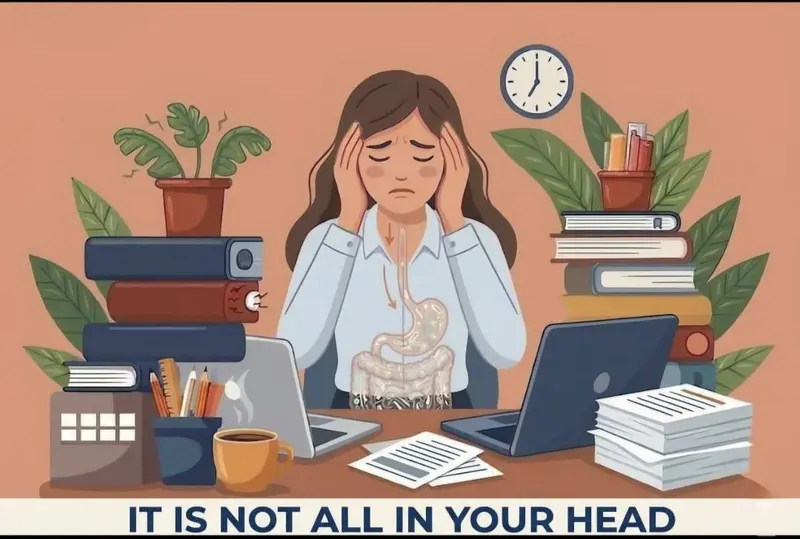
It’s 10:00 PM.
Your laptop is still open. Your mind is still racing. And even though the workday officially ended hours ago, your body hasn’t quite caught up.
You tell yourself this is normal. Everyone works like this now.
But your gut disagrees.
Deep inside, trillions of microbes are responding—not to your deadlines, but to your stress, your late meals, your disrupted sleep. And while your 9-to-5 may demand productivity, your body is quietly asking for recovery.
The human gut contains trillions of microorganisms, including bacteria, archaea, fungi, and viruses. Together they form a metabolic and signaling network that influences digestion, immune regulation, vitamin synthesis, inflammation, and even behavior through the gut–brain axis.
What makes this ecosystem especially interesting is that it does not function continuously at the same level. Like many physiological processes in the body, the microbiome operates on a circadian rhythm. It runs on a schedule.
Just like you.
And modern work culture is very good at breaking rhythms.
Long hours at a desk.
Meals eaten quickly between meetings.
Screens glowing late into the night.
Emails that stretch the workday far past five.
For people working from home, the boundary becomes even thinner. The same laptop takes you through meetings, lunch breaks, and late-night binge-watching. Your office and your kitchen are separated only by a few steps. Your brain never quite receives the signal that the workday is over.
However, your gut notices. Stress hormones stay elevated. Digestion slows. Sleep becomes irregular. Microbial cycles start drifting out of sync. This imbalance, sometimes referred to as dysbiosis, has been associated with metabolic disorders, inflammatory diseases, and altered immune responses.
But here’s the encouraging part: your microbiome is surprisingly responsive. Research shows that changes in diet, sleep timing, physical activity, and stress levels can shift microbial composition in days to weeks.
There is a hidden advantage built into the day.
While your 9-to-5 may challenge your body, your 5 PM to 9 AM window gives it time to repair.
These sixteen hours form a complete biological cycle:
Evening – stress recovery begins
Night – microbial repair and metabolic regulation occur
Morning – the microbiome prepares the body for the day
Think of it as your body’s maintenance shift.
If you use this window well, your microbiome resets each night. If you neglect it, the stress of the workday simply carries over into tomorrow.
Why Does Your Evenings Matter for Gut Health?
The hours between 5 PM and 9 PM mark an important shift from a stress-driven state to recovery. During the workday, elevated cortisol and constant stimulation keep the body in “fight-or-flight” mode, which can slow digestion and strain gut function.
Stepping away from work helps activate the “rest-and-digest” response. Light movement, a balanced dinner, and reduced screen exposure signal the body to unwind. A fiber-rich meal during this time provides fuel for beneficial gut bacteria, allowing them to produce key metabolites overnight that support gut integrity, metabolism, and immune function.
These small evening choices set the stage for effective overnight repair.
What Happens in the Gut During Sleep?
Sleep isn’t just rest; it’s when your body and gut do essential repair. The gut lining renews, immune signaling stabilizes, and metabolic hormones reset. Meanwhile, microbes ferment fiber from your meals to produce beneficial compounds like butyrate, propionate, and acetate, which strengthen the gut barrier and support overall health.
Poor or irregular sleep disrupts these processes, leading to microbial imbalance, inflammation, and metabolic stress. Consistent sleep is essential for a healthy gut.
What Happens to Your Microbiome After You Wake Up?
Morning routines shape your gut for the day ahead. Natural light helps reset your circadian rhythm, while food, hydration, and light movement activate microbial activity.
A fiber-rich breakfast supports beneficial bacteria, aids digestion, and stabilizes metabolism. By the time your workday begins, your gut has already started its day-long cycle of balance and repair.
What an Ideal Day Looks Like for Your Gut Microbiome?
Your gut microbiome responds to daily patterns of sleep, food timing, movement, and stress.
When these are aligned, your gut functions more efficiently, supporting digestion, metabolism, and overall health.
The following flow outlines key daily checkpoints to help maintain that balance.
Start your day right: Wake consistently, get light exposure, and eat a fiber-rich meal to support your gut microbes.
Fuel and move: Eat a balanced, plant-diverse meal and stay active with light movement to support digestion and metabolism. For office workers and remote workers alike, breaking up long periods of sitting is important. Prolonged inactivity can slow digestion and alter metabolic signaling.
Manage stress: Take short breaks to reduce rising stress and prevent it from impacting your gut. A quick stretch, hydration break, or short walk can prevent stress hormones from staying elevated into the evening. This matters because cortisol doesn’t just affect your brain. It influences gut permeability and microbial signaling.
Transition out of work: Create a clear boundary between work and rest to shift your body into recovery mode.
Stay active: Do moderate movement like walking, yoga, cycling, or light strength training to support microbial diversity and overall digestion.
Eat smart in the evening: Focus on fiber and plant-based foods while allowing time for digestion before sleep.
Wind down: Engage in low-stress activities to activate your “rest and digest” system. Low-stress activities include reading, conversation, music, or hobbies.
Prioritize sleep: Maintain consistent, quality sleep to support gut repair and balance. Dim lights, reduce screens, and allow your body to wind down.
The Hidden Truth About Gut Health
Many people think gut health is all about probiotics or supplements.
But most of the time, it’s about rhythm as well.
Regular sleep.
Consistent meals.
Daily movement.
Stress recovery.
Your microbiome evolved alongside these rhythms. When modern life disrupts them, problems follow.
But the solution is surprisingly simple.
You may not control every part of your workday. Meetings will run late. Deadlines will appear. Stress will happen.
But you still control what happens after 5 p.m.
Your 9-to-5 may challenge your gut.
But your 5-to-9 can rebuild it.
One day at a time.
-Sarada Nandi
Also Read: The Secret to Healthy Aging? Look at Your Gut, Plate, and Sleep.
References
Voigt, R., Forsyth, C., Green, S., Engen, P., & Keshavarzian, A. (2016). Circadian rhythm and the gut microbiome. International Review of Neurobiology, 131, 193–205. https://doi.org/10.1016/bs.irn.2016.07.002
Madison, A., & Kiecolt-Glaser, J. K. (2019). Stress, depression, diet, and the gut microbiota: human–bacteria interactions at the core of psychoneuroimmunology and nutrition. Current Opinion in Behavioral Sciences, 28, 105–110. https://doi.org/10.1016/j.cobeha.2019.01.011
Min, L., Ablitip, A., Wang, R., Luciana, T., Wei, M., & Ma, X. (2024). Effects of Exercise on Gut Microbiota of Adults: A Systematic Review and Meta-Analysis. Nutrients, 16(7), 1070. https://doi.org/10.3390/nu16071070
Smith, R. P., Easson, C., Lyle, S. M., Kapoor, R., Donnelly, C. P., Davidson, E. J., Parikh, E., Lopez, J. V., & Tartar, J. L. (2019b). Gut microbiome diversity is associated with sleep physiology in humans. PLoS ONE, 14(10), e0222394. https://doi.org/10.1371/journal.pone.0222394
Bishehsari, F., Voigt, R. M., & Keshavarzian, A. (2020). Circadian rhythms and the gut microbiota: from the metabolic syndrome to cancer. Nature Reviews Endocrinology, 16(12), 731–739. https://doi.org/10.1038/s41574-020-00427-4
Liu, P., Wang, Y., Yang, G., Zhang, Q., Meng, L., Xin, Y., & Jiang, X. (2021). The role of short-chain fatty acids in intestinal barrier function, inflammation, oxidative stress, and colonic carcinogenesis. Pharmacological Research, 165, 105420. https://doi.org/10.1016/j.phrs.2021.105420
Breit, S., Kupferberg, A., Rogler, G., & Hasler, G. (2018). Vagus nerve as modulator of the Brain–Gut axis in psychiatric and inflammatory disorders. Frontiers in Psychiatry, 9, 44. https://doi.org/10.3389/fpsyt.2018.00044
Wei, L., Yue, F., Xing, L., Wu, S., Shi, Y., Li, J., Xiang, X., Lam, S. M., Shui, G., Russell, R., & Zhang, D. (2020). Constant light exposure alters gut microbiota and promotes the progression of steatohepatitis in high fat diet rats. Frontiers in Microbiology, 11, 1975. https://doi.org/10.3389/fmicb.2020.01975
Gu, C., Brereton, N., Schweitzer, A., Cotter, M., Duan, D., Børsheim, E., Wolfe, R. R., Pham, L. V., Polotsky, V. Y., & Jun, J. C. (2020). Metabolic Effects of Late Dinner in Healthy Volunteers—A Randomized crossover clinical Trial. The Journal of Clinical Endocrinology & Metabolism, 105(8), 2789–2802. https://doi.org/10.1210/clinem/dgaa354
Foster, J. A., Rinaman, L., & Cryan, J. F. (2017). Stress & the gut-brain axis: Regulation by the microbiome. Neurobiology of Stress, 7, 124–136. https://doi.org/10.1016/j.ynstr.2017.03.001