What is food architecture, and how does cold-pressing cause it to collapse?
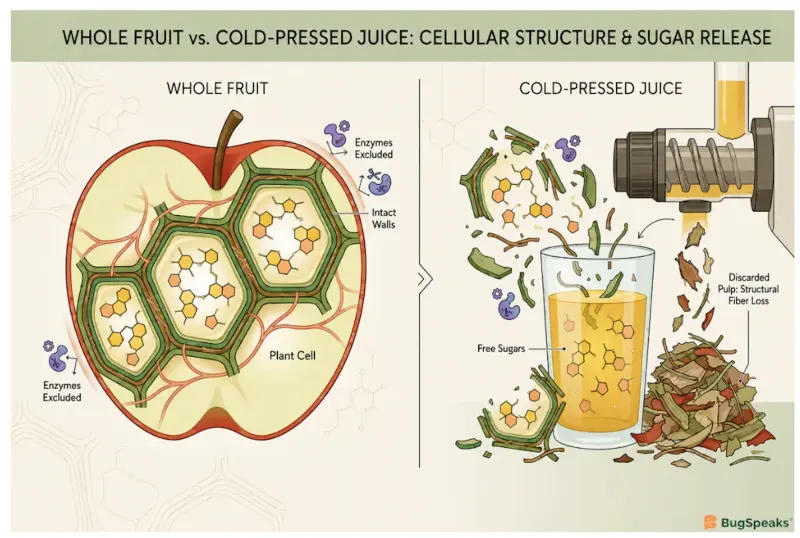
Food architecture is the natural three-dimensional shield that holds all the sugars and nutrients safely inside whole fruits and vegetablesMavadiya et al. (2025). When you eat a whole apple, you are eating a complete building with a solid structure. The outer walls are made of tough plant cell walls that act as a strong supporting framework. This framework keeps everything organized and locked up so your body has to work slowly to break it down. It is a setup designed by nature to protect the plant and help your body digest things at a normal speed.
When fresh fruits go through a juicing machine, this supporting framework undergoes a massive structural collapseHolland et al. (2020). The steel blades and heavy presses of the cold-pressed juicer act like a giant wrecking ball. They smash the solid walls of the plant cells, instantly turning a secure cellular building into a flat pile of microscopic cell pieces. All of the protective structures are torn apart, and the liquid inside is forced out. The solid structure is lost forever, and you are left with a simple liquid that lacks any natural protection.
This sudden structural collapse completely changes how the food behaves once it enters your digestive systemMavadiya et al. (2025). Without the strong cell walls to hold things back, all the sweet sugars are immediately released. The juicing process discards the solid pulp, which is actually the most important part of the plant's structure. Instead of a slow and healthy digestion process, your body receives a sudden flood of unbound sugary fluid. By drinking juice, you are removing the structural barrier that nature built to keep your digestive system balanced.
How does the collapse of plant cell walls impact nutrient release and blood sugar levels?
The collapse of plant cell walls allows sugars to enter your bloodstream too quickly because there are no physical barriers to slow them downMavadiya et al. (2025). In a whole fruit, sugar is locked inside the cells, which limits its bioaccessibility to your digestive enzymes. This means your body must slowly dismantle the plant walls to get the sugar out. But when you drink juice, those sugars are already free and floating completely free. They rush into your blood all at once, creating a sudden spike that can make you feel super energetic and then very tired.
Imagine a huge water tank on a ship that has a tiny, controlled tap to release water slowly. If the tap works properly, the water flows safely without causing any mess in the room. But if you smash the entire tank with a hammer, all the water spills out instantly and floods the deck. This is exactly what happens when you crush the plant cells to make cold-pressed juiceHolland et al. (2020). The sugar becomes free sugars that overwhelm your body, rather than being digested in a slow, healthy way.
This rapid sugar flood causes high glycemic variability, which means your blood sugar levels bounce up and down like a scary roller coasterSuh and Kim (2015). When blood sugar rises too fast, your body has to work extra hard to clear it out. Whole fruits keep your energy steady because their solid structure takes a long time to digest. Juice lacks this steady control, leaving you feeling hungry again very quickly after drinking it. Keeping the plant structure intact is the best way to maintain steady energy throughout your day.
Why does removing structural fiber leave downstream gut microbes without raw materials?
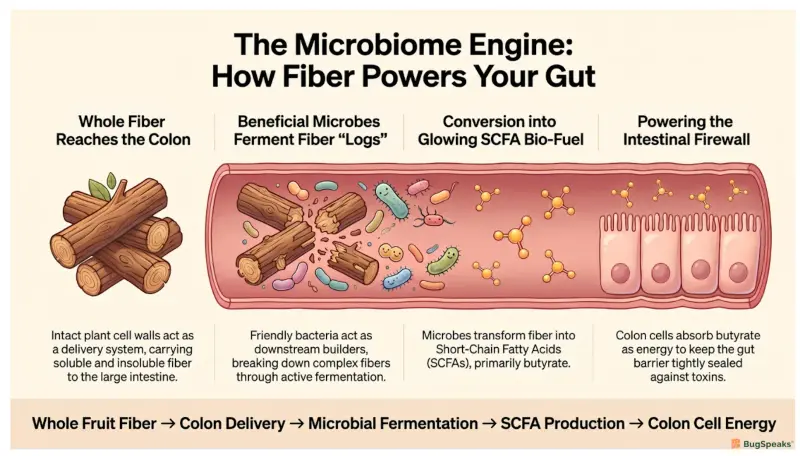
Removing the plant walls leaves your gut microbes hungry because the juicing machine throws away the solid fibers they need to surviveSankarganesh et al. (2025). These solid parts contain soluble fiber and insoluble fiber, which act as the essential raw building materials for your gut. In a whole fruit, these fibers travel all the way down to your large intestine. The friendly microbes living there are like skilled downstream builders. They wait for these fibers to arrive so they can use them as food, keeping their entire microbial community healthy.
Without these fiber building blocks, the downstream builders cannot do their jobs or maintain their living environmentNogal et al. (2021). When gut microbes ferment fiber, they create special helper molecules called short-chain fatty acids (SCFAs). These molecules act like high-quality fuel and protective oils that keep your gut lining strong and healthy. But juicing machines separate the liquid from the pulp and throw the pulp in the trash. When you toss the pulp away, you are literally throwing your microbes' favorite food directly into the garbage bin.
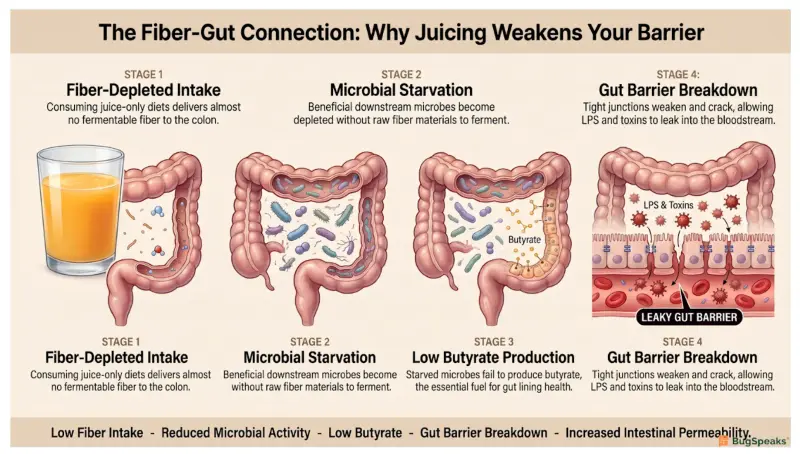
This lack of fiber causes a state of gut dysbiosis, where friendly microbes diminish and harmful ones take overSardaro et al. (2025). When the downstream builders are starved of their raw materials, they cannot produce the protective SCFAs your body needs. The microbial city inside your gut begins to break down, leaving you vulnerable to inflammation and digestive issues. To keep your microscopic workers productive, you must feed them the whole fibers found only in solid foods. Drinking juice simply starves the microbes that work hard to keep you healthy.
What happens to the gut barrier and oral environment when food architecture collapses?
When food architecture collapses, your gut barrier integrity is severely weakened because starved microbes cannot maintain the protective wallNogal et al. (2021). The cells lining your gut need a constant supply of a specific SCFA called butyrate to stay tightly locked together. This tight seal acts like a secure firewall, preventing waste and toxins from leaking into your blood. When you drink juice instead of eating fiber, butyrate production drops. The protective firewall develops small cracks and leaks, which can trigger inflammation throughout your body.
The liquid diet trap also harms your oral health by changing the environment inside your mouthSardaro et al. (2025). When you drink sugary juices, the sweet liquid washes over your teeth and gums, feeding harmful bacteria like Streptococcus speciesSardaro et al. (2025),Mavadiya et al. (2025). These bacteria produce acids that lower your salivary pH and dissolve your protective tooth enamelMavadiya et al. (2025). Even worse, these acid-producing bacteria and inflammatory germs (such as Haemophilus parainfluenzae) can multiply and travel down into your gut, causing more troubleSardaro et al. (2025)
Chewing solid food is essential because it stimulates saliva, which naturally cleans your teeth and protects your gumsMavadiya et al. (2025). Saliva acts like a natural shield that washes away bad bacteria and helps repair early enamel damage. Juice passes through your mouth too quickly to trigger this healthy saliva flow, leaving sugar behind to feed harmful germs. By choosing whole fruits that require chewing, you protect your mouth and your gut at the same time. Solid food keeps your entire digestive pipeline strong and secure.
How can we restore our food architecture to protect our metabolic and digestive health?
You can restore your health by choosing whole foods that keep their natural structure completely intactSardaro et al. (2025). Eating fresh fruits and vegetables is like upgrading from an old paper logbook to a modern digital system. Solid food gives your body the exact tools it needs to regulate sugar levels naturally and keep your energy steady. When you eat whole foods, your digestive system works in perfect harmony with nature, preventing the sudden crashes caused by sugary juices. It is a simple switch that brings massive benefits to your body.
When you preserve food architecture, your gut microbes receive the fibers they need to build a strong defense systemLi et al. (2026). These fibers allow your downstream builders to produce plenty of protective molecules, keeping your gut wall tightly sealed. This active protection helps prevent long-term metabolic issues like type 2 diabetes and heart complications. By eating whole fruits, you are actively investing in your body’s long-term health and cellular safety. Your body will feel energetic every day.
Making small adjustments to your daily meals can lead to huge improvements in how you feelLi et al. (2026). Try to replace one glass of juice with a whole, crisp apple or a handful of fresh berries. Take your time to chew your food thoroughly, which helps your mouth and stomach prepare for healthy digestion. With the natural structure of plants, you protect your body from the liquid diet trap. Feed your inner builders the right materials, and they will keep your body running smoothly and happily for life.
Reference
Sardaro, M. L. S., Grote, V., Baik, J., Atallah, M., Amato, K. R., & Ring, M. (2025). Effects of Vegetable and Fruit Juicing on Gut and Oral Microbiome Composition. Nutrients, 17(3), 458. https://doi.org/10.3390/nu17030458
Mavadiya, H. B., Roh, D., Ly, A., & Lu, Y. (2025). Whole Fruits Versus 100% Fruit Juice: Revisiting the Evidence and Its Implications for US Healthy Dietary Recommendations. Nutrition bulletin, 50(3), 411–420. https://doi.org/10.1111/nbu.70009
Nogal, A., Valdes, A. M., & Menni, C. (2021). The role of short-chain fatty acids in the interplay between gut microbiota and diet in cardio-metabolic health. Gut microbes, 13(1), 1–24. https://doi.org/10.1080/19490976.2021.1897212
Sankarganesh, P., Bhunia, A., Kumar, A. G., Babu, S., Gopukumar, S. T., & Lokesh, E. (2025). Short-chain fatty acids (SCFAs) in gut health: Implications for drug metabolism and therapeutics. Medicine in Microecology, 100139.
Hamann T. (2012). Plant cell wall integrity maintenance as an essential component of biotic stress response mechanisms. Frontiers in plant science, 3, 77. https://doi.org/10.3389/fpls.2012.00077
Holland, C., Ryden, P., Edwards, C. H., & Grundy, M. M.-L. (2020). Plant Cell Walls: Impact on Nutrient Bioaccessibility and Digestibility. Foods, 9(2), 201. https://doi.org/10.3390/foods9020201
Li, B., Ren, Z., Li, H., Li, M., Zhong, H., Nie, Q., Chen, J., Wu, R., Zheng, J. S., Deng, K., & Cai, Y. (2026). Microbiota-metabolites interaction associated with glycemic improvement following a dietary herbal intervention in type 2 diabetes. Frontiers in nutrition, 13, 1793130. https://doi.org/10.3389/fnut.2026.1793130
Suh, S., & Kim, J. H. (2015). Glycemic Variability: How Do We Measure It and Why Is It Important?. Diabetes & metabolism journal, 39(4), 273–282. https://doi.org/10.4093/dmj.2015.39.4.273