LANIAKEA
Imagine opening a screen, and instead of looking at a long scientific spreadsheet, you feel like you are standing on the command deck of a spaceship, looking out at a map of a thousand galaxies. That is the experience we wanted to create. Hence, we named it "Laniakea."
WHAT IS "LANIAKEA" AND WHY is that name?
Laniakea is our home galaxy supercluster (Collection of galaxy groups and galaxy clusters) and a massive web of over 100,000 neighboring galaxies, including our own Milky Way, stretching across approximately 500 million light-years of space. The name Laniakea was suggested by Nāwaʻa Napoleon, a Hawaiian language expert and professor at Kapiʻolani Community College. In Hawaiian, Laniakea (lani = heaven/sky; ākea = spacious, vast) means "immense heaven", which matches the huge size of the supercluster. The name also honors the Polynesian peoples who used the stars and the sky to navigate across the Pacific Ocean. Polynesians are an Austronesian ethnic group native to Polynesia, a vast region of more than 1,000 islands scattered across the central and southern Pacific Ocean.
Historically, superclusters were identified primarily by where galaxies appeared to cluster together. In the case of Laniakea, astronomers defined it using the motions of galaxies rather than their positions alone.
Because superclusters have no sharp physical boundaries, astronomers defined Laniakea by mapping the peculiar motions of its galaxies. Rather than relying on where galaxies are located, they traced their gravitational flow paths. Galaxies whose motions converge toward the Great Attractor belong to the Laniakea Supercluster, whereas galaxies flowing toward a different gravitational basin belong to another supercluster. The same principle applies to cell biology.
Metabolism is the set of all chemical reactions that keep a living organism alive. It is a dynamic network of molecular flow. Metabolites move through interconnected pathways toward specific biological outcomes such as producing energy, building cellular components, and recycling nutrients.
We chose the name Laniakea because both systems are not defined by fixed boundaries but by patterns of flow. Just as astronomers identified the Laniakea supercluster by tracing the gravitational flow of galaxies through space, we view metabolism as a network defined by the flow of metabolites through interconnected pathways rather than by pathway boundaries.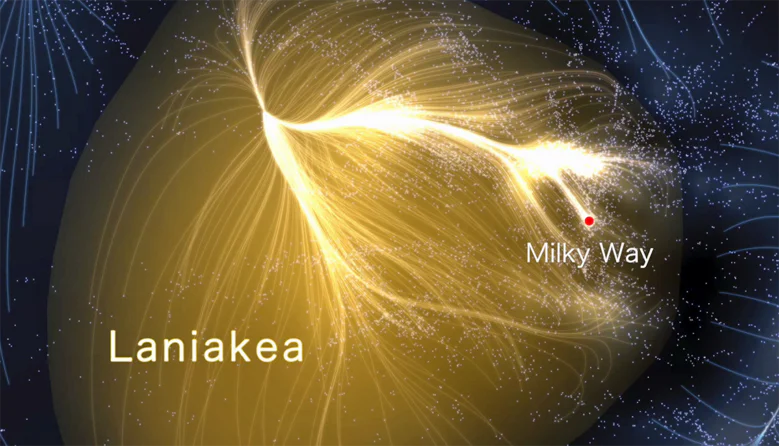
BIOCHEMICAL GALAXY: WHAT ARE YOU LOOKING AT?
When you explore the screen, think of it as navigating a stellar map.
THE METABOLITES (Circular Dots) — The Planets
These represent metabolites. They appear as white circles with a grey border, forming the basic building blocks of the system.
THE REACTION CENTERS (Squares) — The Stars
These are the hubs where chemical transformations occur. They convert compounds from one form to another while releasing the energy that sustains life.
THE ENZYMES — The Laws of Physics
Just as gravity guides the motion of celestial bodies, enzymes catalyze and regulate the speed and direction of biochemical reactions.
THE PATHWAYS — The Galaxies
Each pathway is a network of biochemical interactions where metabolites interact and transform under enzymatic control.
THE CLUSTER OF PATHWAYS — Laniakea
Just as Laniakea is a vast supercluster of galaxies connected by gravitational flows, our tool represents a cluster of biological pathways flowing together to form a complete metabolic universe.
Reference
https://www.hawaii.edu/news/2014/09/03/uh-scientist-maps-supercluster-of-galaxies-names-it-laniakea/
https://en.wikipedia.org/wiki/Laniakea_Supercluster
https://pacificspacecenter.com/2014/09/04/uh-scientist-maps-galaxy-supercluster-named-laniakea/