Exploring the Health Benefits of Kombucha vs. Supplements
Why does Kombucha represent the kitchen model of gut health?
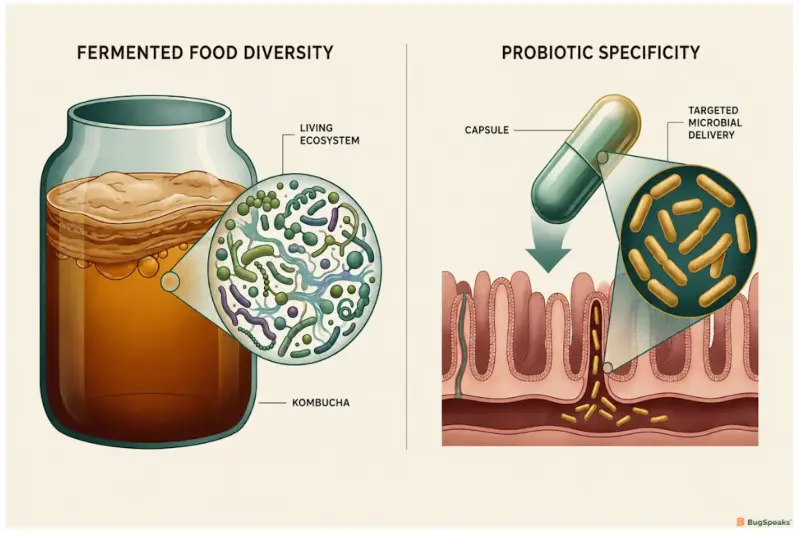
Kombucha is a fermented tea made by adding a living community of tiny microbes to sweet black or green teaRezac et al. (2018). If you look closely at this special drink, you will see it is a bubbly, sweet, and sour beverage that people enjoy cold. To make it, brewers use a thick, rubbery disc called a symbiotic culture of bacteria and yeast, which we shorten to SCOBYRezac et al. (2018). This living disc acts like a busy kitchen team that consumes the sugar in the tea, turning it into carbon dioxide bubbles and healthy organic acids (Soemarie et al., 2021).
This sweet fermented tea represents a kitchen-style approach to gut health because it contains a messy, natural mix of many different living things (Rezac et al., 2018). Instead of carrying just one single type of ingredient, it is packed with different yeasts and bacteria working together. Think of your gut like a giant playground where your body's native microbes live and play every single day. When you drink this fermented tea, you are sending in a diverse crew of helpful helpers to hand out a wide variety of tools and supplies. This kitchen approach focuses on offering wide, natural variety to support your whole belly.
Inside this natural drink, the yeasts and bacteria perform a friendly team effort to create a healthy finished beverageRezac et al. (2018). First, the yeasts break down the sweet sugar into simple parts, and then the bacteria turn those parts into healthy acids. These special organic acids act like natural shields that stop bad germs from growing in the liquid, keeping the drink safe and freshSoemarie et al. (2021). This natural process means you get a live liquid filled with B-vitamins, active nutrients, and friendly microbes. It is a simple, delicious way to drink a whole ecosystem of helpful digestive helpers.
How do probiotic capsules achieve functional specificity?
Probiotic capsules achieve functional specificity by delivering isolated, high-density, and targeted microbial inputs to fix specific digestive troublesSoemarie et al. (2021). Unlike the messy, natural mix found in fermented tea, these small pills are made in highly sterile laboratories. Each capsule carries billions of identical, high-strength bacteria that are chosen to do one exact job in your body. Think of a capsule like a single, highly trained rescue worker wearing a hard hat and holding a very specific tool. They do not provide a broad kitchen of different supplies, helping strengthen the cells of your gut wall.
These capsules usually rely on lactic acid bacteria, which we shorten to LAB, to perform their targeted tasksSoemarie et al. (2021). These specific bacteria are carefully grown by scientists because they are excellent at surviving the strong acid in your stomach. Once they pass through the stomach, they can land exactly where they are needed to support your gut health. Because they are super clean and purified, you do not get any of the yeast, sugar, or tea compounds found in food. This laboratory method ensures that your body receives a highly predictable and concentrated dose of friendly workers.
This targeted strategy is very useful when your gut experiences a severe bacterial imbalance, which scientists call dysbiosisSoemarie et al. (2021). This imbalance can happen when stress, a bad stomach bug, or strong medications wash away your friendly resident microbes. During these times, your digestive system is like a messy town that has just been hit by a big storm. Sending in a targeted team of capsule specialists helps to rebuild your gut's natural walls and clear out bad bacteria. It is a powerful, precise way to help your body recover its normal strength and get back on track quickly.
How does the gut response environment process these distinct inputs?
The gut response environment processes both options as a temporary team of helpful visitors that interact with your resident microbes instead of staying permanentlyRezac et al. (2018). Scientists call this visiting group of friendly bacteria and yeast a transient microbiome because they are just passing through. Think of your gut like a very crowded sports stadium where your native microbes are the home team playing on the field. When you drink fermented tea or swallow a capsule, these new microbes do not stay to join the team forever. They interact with your native cells briefly and then pass through.
While they are traveling through your digestive tract, these visiting microbes talk to your resident bacteria and your immune systemRezac et al. (2018). This friendly conversation is very important because it helps keep your immune system sharp, active, and ready for action. It is like having a guest teacher visit your school for a day; they do not live there, but they teach a great lesson. These visitors help your native microbes work much better, making the whole system stable, happy, and strong. This temporary teamwork is a normal, healthy process that helps protect your belly from bad bugs.
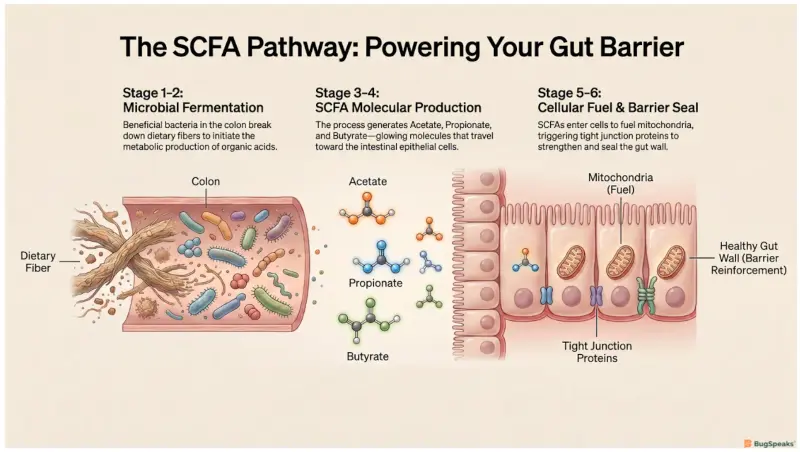
During this short journey, the visiting microbes help produce beneficial, protective chemical outputs called short-chain fatty acids, which we shorten to SCFAsWastyk et al. (2021). These healthy outputs are created when microbes ferment the fibers and other nutrients in your daily meals. These compounds act like clean power packs that fuel your gut cells and make your gut wall tighter and stronger. This tough barrier stops bad bacteria from leaking out of your stomach and into your bloodstream to make you sick. Even though the visitors leave, the helpful outputs they make will continue to support your daily energy.
What does scientific research say about how well these options work?
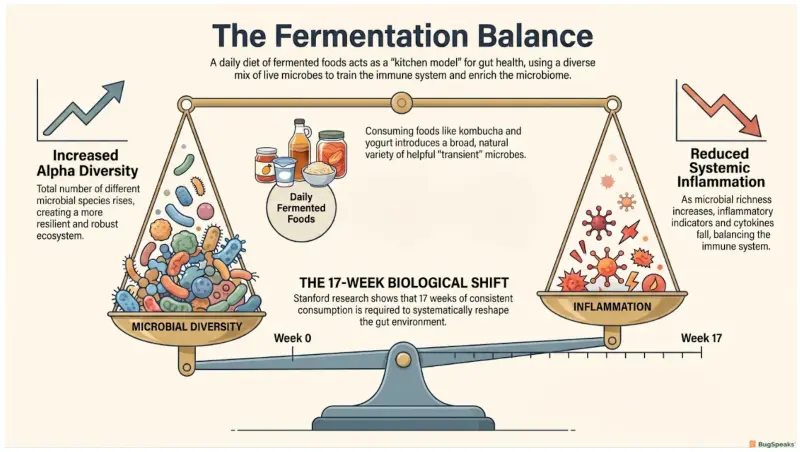
Scientific research shows that eating fermented foods every single day systematically improves your gut health and lowers inflammation throughout your bodyWastyk et al. (2021). A major study conducted at Stanford University showed that eating these foods for seventeen weeks steadily increased the number of different microbe species living in your gut. This is a big deal because having more kinds of helpful microbes protects you from many long-term health problems. These long-term problems are called non-communicable chronic diseases, which we shorten to NCCDs, like diabetes or heart issues, which are driven by chronic inflammation that irritates your systems and makes you feel tired.
To evaluate probiotic capsule strains scientifically, researchers perform detailed laboratory and animal studies before human testing Soemarie et al. (2021). These rigorous evaluations check that each isolated strain is safe, resistant to stomach acid, and does not carry harmful resistance genes. Scientists also test how well these capsule microbes adhere to human intestinal cells and interact with the local immune system to prevent infection. This high level of laboratory control means that each capsule delivers a standardized, highly predictable dose designed for precise functional tasks in your gut. This contrast highlights the main difference between natural fermentations and targeted laboratory supplements.
To keep fermented foods completely safe to consume, natural fermentation relies on friendly bacteria to protect against harmful pathogens Soemarie et al. (2021). These helpful microbes produce protective compounds like organic acids, ethanol, and natural bacteriocins that stop bad spoilage organisms from growing Soemarie et al. (2021). However, some commercial fermented foods are pasteurized or filtered after fermentation to extend shelf-life and ensure safety, which can remove these live microbes Rezac et al. (2018). Conversely, probiotic capsules are manufactured under strict, sterile conditions without any thermal processing. This ensures that you receive a highly uniform, safe, and active dose of live microbes with every single capsule.
How should health goals decide which option you choose?
Your personal health goals should decide which option you choose because fermented tea offers broad daily support, while probiotic capsules provide targeted healing for specific problemsWastyk et al. (2021). If you want to maintain a happy, everyday digestive system and support your body's immune defenses naturally, then the kitchen model is your best choice. Drinking a fermented drink or eating a cup of yogurt regularly introduces a friendly mix of temporary visitors to help out. This simple daily habit helps you build a highly resilient, robust, and happy microbiome in a very natural way over time without any stress.
However, if you are recovering from a strong round of antibiotics, probiotic capsules are a much better optionSoemarie et al. (2021). Strong medications act like a giant reset button, wiping out both the good and bad bacteria in your gut. During this vulnerable recovery phase, your body does not need a gentle mix of food visitors. Instead, it needs a high-density team of specific capsule specialists to quickly rebuild your defenses and improve your gut's alpha diversityWastyk et al. (2021). This targeted support helps your body recover its normal balance much faster so you feel great and strong again.
Ultimately, these two scientific approaches can work together beautifully as complementary tools for your long-term health journeyWastyk et al. (2021). You do not have to pick just one option and stick with it forever. You might use highly targeted probiotic capsules during times of high stress, travel, or medical recovery to protect your gut from bugs. Then, you can easily transition back to a delicious daily diet filled with diverse fermented foods to maintain your gut richness and health. This combination helps your body and mind live a happy, healthy, and energetic life every single day of your life.
Visualize the process- https://youtu.be/DVmIgyIn-7E
Reference
Wastyk, H. C., Fragiadakis, G. K., Perelman, D., Dahan, D., Merrill, B. D., Yu, F. B., Topf, M., Gonzalez, C. G., Van Treuren, W., Han, S., Robinson, J. L., Elias, J. E., Sonnenburg, E. D., Gardner, C. D., & Sonnenburg, J. L. (2021). Gut-microbiota-targeted diets modulate human immune status. Cell, 184(16), 4137–4153.e14. https://doi.org/10.1016/j.cell.2021.06.019
Ernst E. (2003). Kombucha: a systematic review of the clinical evidence. Forschende Komplementarmedizin und klassische Naturheilkunde = Research in complementary and natural classical medicine, 10(2), 85–87. https://doi.org/10.1159/000071667
Soemarie, Y. B., Milanda, T., & Barliana, M. I. (2021). Fermented Foods as Probiotics: A Review. Journal of advanced pharmaceutical technology & research, 12(4), 335–339. https://doi.org/10.4103/japtr.japtr_116_21
Rezac, S., Kok, C. R., Heermann, M., & Hutkins, R. (2018). Fermented Foods as a Dietary Source of Live Organisms. Frontiers in microbiology, 9, 1785. https://doi.org/10.3389/fmicb.2018.01785