What is keratosis pilaris and how does it affect our skin?
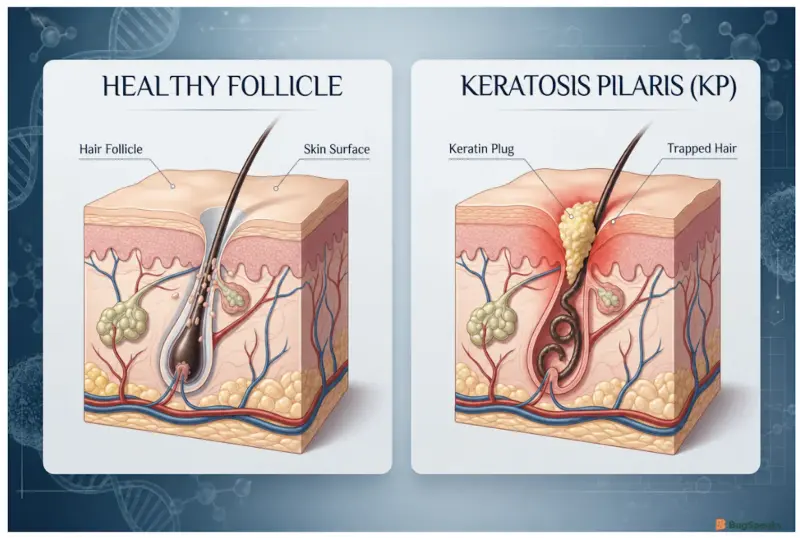
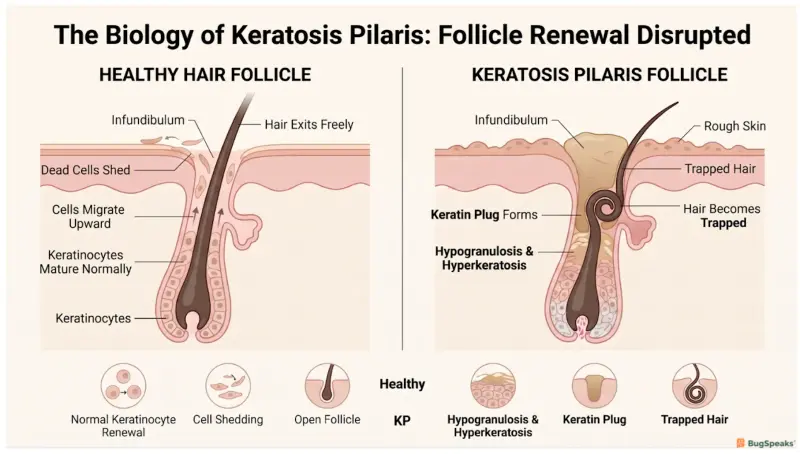
Keratosis pilaris (KP) is a common skin condition where extra keratin protein forms hard plugs inside your hair follicle openings, making your skin feel rough like sandpaperHwang (2008). You can think of each hair tube as a miniature maintenance site that needs to stay clear so skin can renew itself. Normally, older cells slide out of the tube smoothly, but here they get stuck together with tough protein glue. This buildup creates small bumps on your arms or legs, giving the skin a bumpy texture. This buildup happens in the follicle neck, known as the infundibulum, where the hair grows out.
Our skin has a team of tiny cellular workers that constantly build and clean our outer protective wall. Inside a healthy hair follicle, these workers clean up old debris and replace it with cells on a regular schedule. However, when this natural cleaning program slows down, old cells stack up instead of sheddingHwang (2008). The hair follicle gets blocked, trapping the hair underneath like a bent spring. This trapping is why you might notice a tiny, coiled hair inside the bumps when you look closely at your skin. This simple mechanical blockage makes the skin feel rough. This condition is very common and harmless.
It most often appears on the back of the upper arms and thighs, where the follicles are very active. While it is usually passed down through families, it can also happen when the body lacks certain nutrients(Vitamin A, Vitamin B12, essential fatty acids, and Zinc). These nutrients are needed by the workers to keep the renewal schedule running smoothly. When we do not get enough of these materials, the maintenance program fails, leading to dry, bumpy skin on these typical parts of the human body.
Why does our skin need Vitamin A to stay smooth?
Our skin needs Vitamin A because this nutrient serves as the supervisor that tells our skin cells how to grow and shed correctlyRoche (2021). The main building blocks are cells called keratinocytes, which act as the maintenance workers. Without clear instructions from the supervisor, these workers lose their coordination and start producing way too much keratin protein. This leads to a severe lack of organization where old cells stack up and block the exit of the hair follicles. Over time, this coordination breakdown causes the skin to become dry, hard, and covered in tiny, rough bumps.
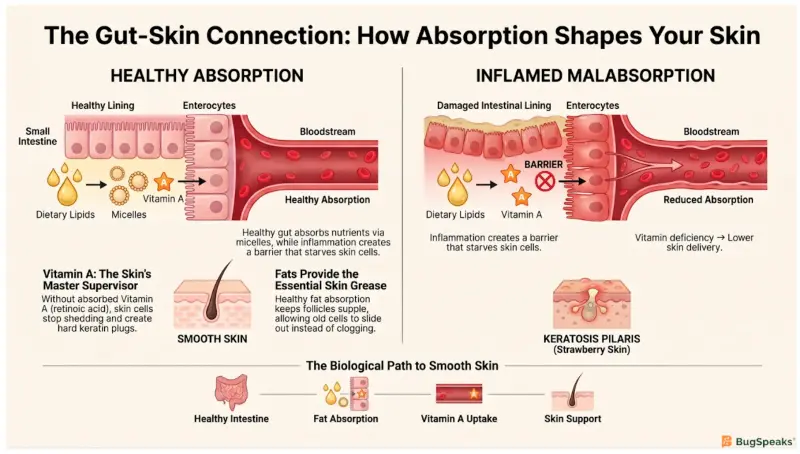
Inside our bodies, the supervisor nutrient is converted into an active chemical form called retinoic acidRoche (2021). This powerful chemical messenger speaks directly to the workers and tells them exactly when to divide, grow, and fall off. When there is plenty of this chemical signal, the skin cells renew themselves on a perfect schedule. But if this message is missing, the workers panic and build massive walls of keratin that plug up the follicle openings. This shows why a steady supply of this regulatory signal is so important for keeping our skin clear.
If the body suffers from a severe, long-term lack of this supervisor nutrient, it can lead to a condition called phrynodermaHwang (2008). The skin becomes extremely dry and covered in sharp, cone-shaped plugs that look similar to severe keratosis pilaris. This extreme condition proves how much our skin workers rely on external instructions to perform their daily duties. When the supervisor is absent, the entire workshop shuts down and the protective barrier gets damaged. Ensuring proper intake of this essential regulatory material is key to restoring normal scheduling. It helps the workers do their job right.
How does a troubled gut block our skin building blocks?
The gut causes malabsorption, which means our digestive system fails to take in and deliver the essential nutrients our skin workers need to build a smooth barrierAndrès (2024). Our bodies cannot make these materials on their own, so we must absorb them from our food. Normally, the digestion process happens in the small intestine, which acts as our main intake system for fats and vitamins. If this intestinal lining is damaged by inflammation or irritation, it cannot process incoming fats properly. This failure means the skin is starved of the building blocks it needs to function correctly. This is where the gut-skin connection begins.
Among the most critical building blocks lost in this delivery failure are essential fatty acids, which provide the structural grease to keep our skin soft and flexibleZhang (2024). These special fats act like lubricating oils, making sure the follicle walls stay supple and old cells can slide out easily. When these fats are missing due to gut trouble, the skin becomes dry and brittle. The cellular workers lose their raw materials, forcing them to build hard, rigid plugs that block the hair openings and create the rough skin texture. These fats must be absorbed from our daily meals.
One specific fat that our skin workers desperately need is called linoleic acid, which helps form the moisture-trapping shield around our cellsZhang (2024). This vital compound is a key structural ingredient that keeps water locked inside our skin, preventing extreme dryness. If we fail to absorb this fat because our gut is unhealthy, our skin loses its protective shield, and water leaks out rapidly. This dryness makes the follicle renewal program even more disrupted, causing keratin to harden into plugs. Therefore, fixing gut absorption is crucial for curing these skin bumps. It brings back the protective moisture to our cells.
How can gut bacteria cause skin maintenance problems?
An unhealthy balance of gut bacteria, known as dysbiosis, can trigger the release of harmful waste chemicals that travel through the blood and disrupt our skin's normal maintenance scheduleSingla (2025). Normally, our friendly gut microbes help us digest food and keep our intestinal walls strong. But when the bad bacteria take over, they produce toxic waste products like p-cresolSingla (2025). This particular chemical acts like environmental contamination in our body, directly slowing down the growth and differentiation of keratinocytes. This disruption leads to severe cellular dryness and prevents the skin from renewing itself properly. It halts the cleaning schedule completely.
This problem gets worse when the toxic chemicals damage the gut lining, causing intestinal permeability, which is also called a leaky gutBorrego-Ruiz (2024). Normally, the gut lining is a solid security barrier that only lets useful nutrients pass into our bloodstream. But when it becomes leaky, toxic molecules and bad bacteria leak into the circulation and travel straight to the skin. This leakage irritates and activates the body's alarm system, leading to inflammation. When this alarm sounds, the skin workers get distracted and stop cleaning the follicle tubes, causing massive keratin blockages. It makes the bumps feel even more irritated.
Furthermore, this gut imbalance can alter the production of sebum, which is the natural skin oil produced by our hair glandsBorrego-Ruiz (2024). Healthy skin oil is supposed to lubricate the skin surface and keep it slightly acidic, which protects against bad bacteria. But when gut signals are disrupted, the glands can produce too much thick oil or not enough thin oil. This change disrupts the skin's surface, making it easier for hard plugs to form and trap hair. Therefore, gut-derived contamination directly breaks down both our internal logistics and our outer skin protection.
How can we restore our skin's normal maintenance schedule?
We can restore our skin's normal maintenance schedule by using a combination of beneficial bacteria to repair our gut and special creams to clear the blocked hair folliclesBorrego-Ruiz (2024). The first step in this recovery plan is introducing live, helpful bacteria called probiotics into our digestive system. These friendly microbes act like a repair crew that patches up the leaks in our intestinal wall and crowds out the bad bacteria. By repairing the gut barrier, we stop toxic chemicals from leaking into our blood, which allows our skin workers to focus on their cleaning jobs again. This internal repair is essential.
To speed up this repair work, we can use synbiotics, which are special combinations of friendly bacteria and the healthy fibers they love to eatBorrego-Ruiz (2024). These fiber foods act like essential supplies that help the repair crew grow strong and work much faster. We can also use postbiotics, which are the useful chemical tools and lysates left behind by beneficial microbes. These cellular tools directly help lower inflammation and encourage the gut wall to heal itself. These therapies restore our internal delivery network and supply our skin with the building blocks it needs.
While the gut is healing inside, we can clear the bumps outside by using keratolytic creams, which dissolve the hard keratin plugsHwang (2008). These special creams contain gentle ingredients like urea or lactic acid that break down the protein glue holding the dead cells together. This peeling action allows trapped hairs to be released and lets soft skin surface naturally. Combining internal gut repair with external skin clearing is the most effective way to help our cellular workers succeed. By balancing both systems, we can finally achieve smooth, healthy skin.
Reference
Roche, F. C., & Harris-Tryon, T. A. (2021). Illuminating the Role of Vitamin A in Skin Innate Immunity and the Skin Microbiome: A Narrative Review. Nutrients, 13(2), 302.https://doi.org/10.3390/nu13020302
Singla, N., Singla, K., Attauabi, M., & Aggarwal, D. (2025). Gut-skin axis: Emerging insights for gastroenterologists-a narrative review. World journal of gastrointestinal pathophysiology, 16(3), 108952.https://doi.org/10.4291/wjgp.v16.i3.108952
Andrès, E., Lorenzo-Villalba, N., Terrade, J. E., & Méndez-Bailon, M. (2024). Fat-Soluble Vitamins A, D, E, and K: Review of the Literature and Points of Interest for the Clinician. Journal of clinical medicine, 13(13), 3641.https://doi.org/10.3390/jcm13133641
Zhang, H., Xie, Y., Cao, F., & Song, X. (2024). Gut microbiota-derived fatty acid and sterol metabolites: biotransformation and immunomodulatory functions. Gut microbes, 16(1), 2382336.https://doi.org/10.1080/19490976.2024.2382336
Zhu, Y., Yu, X., & Cheng, G. (2023). Human skin bacterial microbiota homeostasis: A delicate balance between health and disease. mLife, 2(2), 107–120.https://doi.org/10.1002/mlf2.12064
Borrego-Ruiz, A., & Borrego, J. J. (2024). Nutritional and Microbial Strategies for Treating Acne, Alopecia, and Atopic Dermatitis. Nutrients, 16(20), 3559.https://doi.org/10.3390/nu16203559