Why did traditional Indian kitchens naturally supply resistant starch without knowing the scientific name?
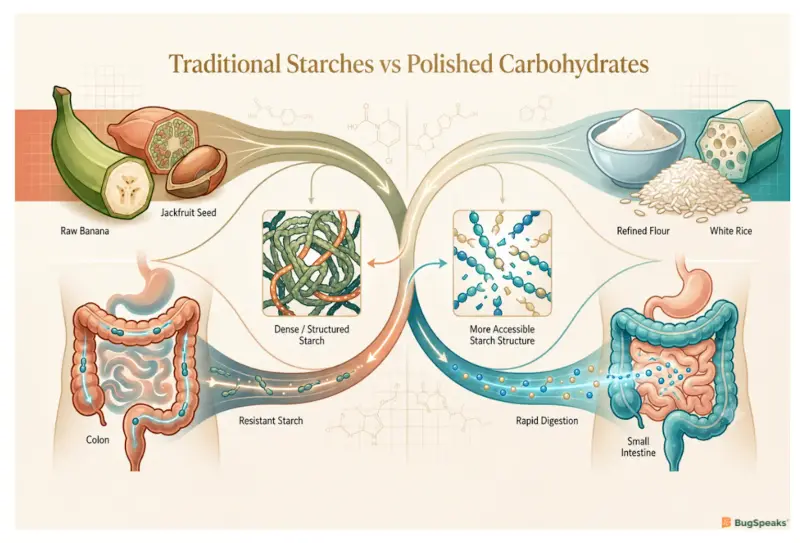
Traditional Indian kitchens naturally supplied rich sources of resistant starch long before modern science identified its health benefits, relying on whole, raw plant foods that acted as slow-release energy sources. In this traditional culinary world, meals were prepared using local, minimal processing techniques that preserved the natural structural integrity of plant fibers. The daily plate served as a balanced delivery system of complex carbohydrates designed to nourish both the human body and the gut microbiomeChen et al. (2024). By incorporating raw bananas and jackfruit seeds, ancient dietary patterns naturally supported beneficial colonic microbes that act as prebiotics that fuel essential metabolic processesDobranowski and Stintzi (2021).
This historical cooking system is that our ancestors instinctively understood how to pair slow-digesting starches with daily meals to maintain long-lasting energy and prevent sudden spikes in blood sugar. In contrast to modern refined products, traditional food patterns utilized robust plant matrices that acted as physical shields against fast enzymatic digestionDega and Barbhai (2023). Slicing raw bananas into traditional stews, or boiling jackfruit seeds for curries, provided a dense array of fiber molecules that reached the colon intact. This slow breakdown ensured stable energy, preventing insulin exhaustion while keeping metabolic systems perfectly balanced and operational throughout the entire day.
As we compare traditional Indian kitchens to modern spaces, we find a dramatic change in our dietary inputs, moving from complex, structural carbohydrates to highly polished and fast-digesting foods. Modern food processing intentionally strips away the protective outer layers of grains and seeds, removing the fibers and native starches that are critical for metabolic regulationKembabazi et al. (2025). This transition has transformed our digestive systems from highly efficient fermentation factories into rapid absorption pathways, leaving our gut microbes starved of their primary fuel sourceMarta et al. (2022). Reclaiming these forgotten starches restores this ancient biological balance, ensuring long-term cellular health.
How do raw bananas and jackfruit seeds act as structural resistant starch in our traditional diets?
Raw bananas and jackfruit seeds act as natural, structural forms of resistant starch type 2 (RS2), featuring tightly packed crystalline granules that resist early enzymatic breakdown in the small intestine. This biological resistance is determined by the unique organization of their starch molecules, which are arranged in a dense radial pattern that prevents salivary and pancreatic amylase from accessing the glycosidic bondsMarta et al. (2022). The structural starch in green bananas consists of a very high ratio of amylose, a linear polymer of glucose units, which forms tight, double-helical structures that are highly resistant to digestionJaiturong et al. (2020).
The structural differences between raw banana starch and jackfruit seed starch highlight how different botanical sources offer unique physical properties to the gut. Green banana starch granules have a smooth, unpored surface with a relatively small particle size of approximately twenty-five micrometers, which translates into a large surface-area-to-volume ratio that supports high digestive resistanceJaiturong et al. (2020). On the other hand, jackfruit seed starch granules contain between twenty-four and thirty-two percent amylose, which contributes to a high gelatinization temperature of over eighty-four degrees CelsiusKittipongpatana and Kittipongpatana (2015). This extreme thermal stability allows these starches to easily withstand cooking.
To fully understand how these starches behave inside the body, we must look at how traditional cooking and temperature changes alter their molecular structures. When cooked starchy foods are cooled, they undergo retrogradation, where the unwound polymer chains realign and recrystallize to form resistant starch type 3 (RS3)Chen et al. (2024). This cooling process creates a highly stable crystal network that is even more resistant to digestive enzymes than native starch. In traditional Indian kitchens, this retrogradation occurred naturally when cooked raw banana or jackfruit seed dishes were cooled and eaten, boosting the meal's fiber value and enhancing our metabolic health.
What biological changes happen inside our gut microbiome when we replace traditional starches with polished modern foods?
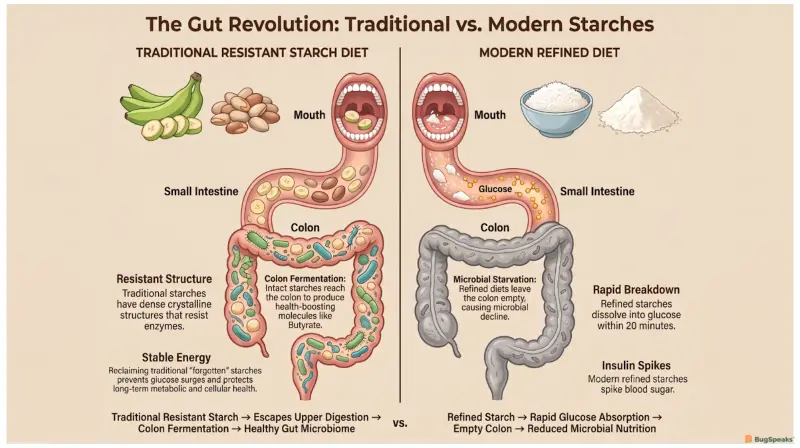
Replacing traditional, fiber-rich whole carbohydrates with polished, modern foods deprives our gut microbes of essential fermentable substrates, leading to a significant loss of microbial diversity and an increase in systemic inflammation. When the continuous stream of resistant starch is cut off, the colonic ecosystem shifts from a highly productive fermentation state to an unproductive state of resource scarcityVital et al. (2018). Without the necessary non-digestible carbohydrates, the populations of key primary degraders decline, leaving the gut microbiome less resilient, highly susceptible to pathogen colonization, and prone to developing a state of chronic gut dysbiosis within a very short time.
In a healthy traditional diet, the continuous supply of resistant starches from raw bananas and jackfruit seeds ensures that the proximal and transverse colon remain slightly acidic due to the constant production of organic acids. When a healthy diet rich in resistant starches (such as green bananas and jackfruit seeds) is consumed, the continuous production of organic acids keeps the proximal colon (where fermentation is most active) slightly acidic at a low pH of approximately 5.5 to 6.2, naturally restricts the growth of opportunistic pathogens like Escherichia coli and Clostridium perfringens, and maintains a stable community of beneficial species. However, when we consume polished rice and refined wheat flour, these fast-digesting carbohydrates are fully absorbed in the small intestine, leaving the colon virtually empty of growth substratesDega and Barbhai (2023). Consequently, the starved microbial community is forced to ferment host proteins, generating toxic metabolites like ammonium.
This dietary transition from complex structural starches to empty-calorie processed foods is closely linked to the global rise of metabolic and inflammatory disordersPinheiro et al. (2024). When the gut barrier is compromised by a lack of microbial fuel, inflammatory molecules like lipopolysaccharides escape into the bloodstream, triggering low-grade systemic inflammation and insulin resistance. Restricting complex whole-fruit fiber intake does not improve glycemic control in type 2 diabetes patients, but instead deprives the body of essential antioxidants and prebiotics that reduce vascular inflammationChristensen et al. (2013). Nourishing our internal garden with these ancient complex starches is therefore essential for our survival and well-being.
How does colonic fermentation convert these starches into short-chain fatty acids?
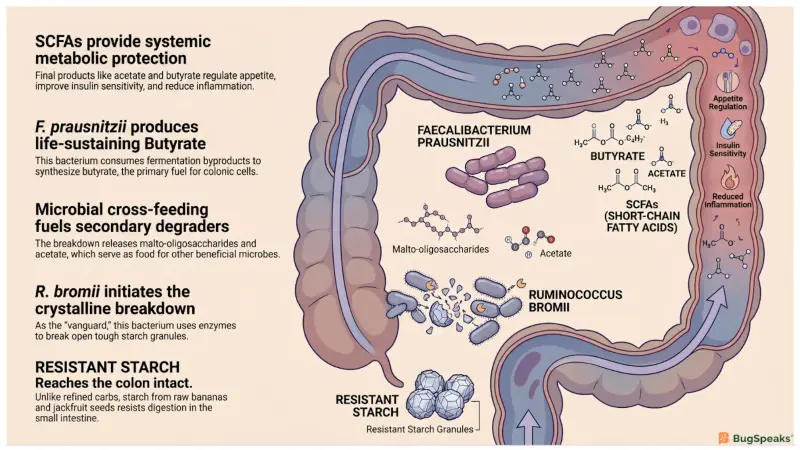
Colonic fermentation converts starches into health-promoting short-chain fatty acids (SCFAs) through a complex anaerobic breakdown process carried out by the resident gut microbiome. The primary anaerobic breakdown process that initiates the metabolism of these starches is glycolysis, specifically referred to as the Embden–Meyerhof–Parnas (EMP) pathway. When resistant starches from raw bananas and jackfruit seeds reach the large intestine, they serve as a vital energy source for the dense microbial populationKembabazi et al. (2025). The primary end products of this fermentation are acetate, propionate, and butyrate, which collectively represent ninety to ninety-five percent of the volatile fatty acids found in the human colonVital et al. (2018). These molecules maintain colon health, support metabolic function, and strengthen the intestinal barrier.
The conversion of resistant starch into these beneficial molecules relies on a highly coordinated cooperative cascade among specialized groups of gut bacteria. The primary degraders, such as Ruminococcus bromii, act as the vanguard, using specialized extracellular amylases to break open the tight crystalline starch granulesVital et al. (2018). This initial breakdown releases simpler sugars and acetate into the surrounding environment, which are then consumed by secondary degraders and cross-feedersDobranowski and Stintzi (2021). Through this metabolic teamwork, bacteria like Faecalibacterium prausnitzii utilize the available acetate to produce butyrate, providing essential fuel and nourishment for the cells lining the colon, keeping them highly resilient.
Once synthesized, these short-chain fatty acids exert profound systemic effects on human health, far beyond the boundaries of the digestive tract. Acetate travels through the bloodstream to regulate appetite and lipid synthesis in peripheral organs, while propionate is processed by the liver to support gluconeogenesis and control glucose homeostasisChen et al. (2024). Most importantly, butyrate maintains gut barrier integrity by upregulating tight junction proteins, preventing toxins from entering the bloodstream and triggering systemic inflammationDobranowski and Stintzi (2021). This elegant chemical conversion represents the scientific foundation of traditional dietary therapies that protect our entire body from metabolic diseases and keep us healthy.
How can reclaiming raw bananas and jackfruit seeds help control our blood sugar levels and protect our metabolism?
Reclaiming raw bananas and jackfruit seeds helps control our blood sugar levels by acting as low glycemic index (GI) foods that digest slowly and do not cause rapid glucose spikes. When these traditional starches are introduced into our meals, their unique crystalline structures act as natural physical barriers, slowing the release of glucose into the bloodstreamDega and Barbhai (2023). This slow absorption profile stands in sharp contrast to polished modern carbohydrates, which break down within twenty minutes and cause massive postprandial insulin surges. Reintroducing these traditional foods helps maintain steady energy levels, prevents fatigue, and keeps our metabolism running efficiently.
The metabolic benefits of these starches extend to improving insulin sensitivity and enhancing the body's natural capacity to process carbohydrates. Clinical studies indicate that consuming resistant starch improves glucose tolerance and enhances the function of insulin-producing pancreatic cellsKembabazi et al. (2025). Furthermore, the short-chain fatty acids produced from colonic fermentation stimulate the secretion of gut hormones like glucagon-like peptide-1, which significantly enhances insulin release and promotes a lasting feeling of fullness. These combined physiological responses protect against type 2 diabetes and metabolic syndromeChen et al. (2024). They also help protect our vital organs from chronic damage.
Incorporating raw banana flour and jackfruit seed flour into our diets represents a highly practical approach to restoring the biological balance of our ancestral kitchens. These unconventional starches can easily substitute for refined wheat flour in daily products like biscuits, breads, and traditional rava preparations without compromising tasteDega and Barbhai (2023). Reclaiming these forgotten king and queen of carbohydrates is not merely a return to culinary nostalgia; it is a scientifically validated strategy to optimize our metabolic health, reduce tissue inflammation, and protect our organsTrejo Rodríguez et al. (2021), representing a simple way to stay healthy and support our gut bacteria daily.
Visualize the process- https://youtu.be/HiSgWQ2sFYs
Reference
Kembabazi, S., Mutambuka, M., Shukri, R., Anwar, F., & Zawawi, N. (2025). Unlocking the potential of resistant starches from underutilized tropical fruits as substrates for fermentation into short-chain fatty acids. Journal of Functional Foods, 124, 106630.
Dega, V., & Barbhai, M. D. (2023). Exploring the underutilized novel foods and starches for formulation of low glycemic therapeutic foods: a review. Frontiers in nutrition, 10, 1162462. https://doi.org/10.3389/fnut.2023.1162462
Vital, M., Howe, A., Bergeron, N., Krauss, R. M., Jansson, J. K., & Tiedje, J. M. (2018). Metagenomic Insights into the Degradation of Resistant Starch by Human Gut Microbiota. Applied and environmental microbiology, 84(23), e01562-18. https://doi.org/10.1128/AEM.01562-18
Chen, Z., Liang, N., Zhang, H., Li, H., Guo, J., Zhang, Y., Chen, Y., Wang, Y., & Shi, N. (2024). Resistant starch and the gut microbiome: Exploring beneficial interactions and dietary impacts. Food chemistry: X, 21, 101118. https://doi.org/10.1016/j.fochx.2024.101118
Christensen, A. S., Viggers, L., Hasselström, K., & Gregersen, S. (2013). Effect of fruit restriction on glycemic control in patients with type 2 diabetes--a randomized trial. Nutrition journal, 12, 29. https://doi.org/10.1186/1475-2891-12-29
Pinheiro, D. F., Maciel, G. M., Lima, N. P., Lima, N. F., Ribeiro, I. S., & Haminiuk, C. W. I. (2024). Impact of fruit consumption on gut microbiota: Benefits, contaminants, and implications for human health. Trends in Food Science & Technology, 154, 104785.
Dobranowski, P. A., & Stintzi, A. (2021). Resistant starch, microbiome, and precision modulation. Gut microbes, 13(1), 1926842. https://doi.org/10.1080/19490976.2021.1926842
Lyte, M., Chapel, A., Lyte, J. M., Ai, Y., Proctor, A., Jane, J. L., & Phillips, G. J. (2016). Resistant Starch Alters the Microbiota-Gut Brain Axis: Implications for Dietary Modulation of Behavior. PloS one, 11(1), e0146406. https://doi.org/10.1371/journal.pone.0146406
Kittipongpatana, O. S., & Kittipongpatana, N. (2015). Resistant starch contents of native and heat-moisture treated jackfruit seed starch. TheScientificWorldJournal, 2015, 519854. https://doi.org/10.1155/2015/519854
Trejo Rodríguez, I. S., Alcántara Quintana, L. E., Algara Suarez, P., Ruiz Cabrera, M. A., & Grajales Lagunes, A. (2021). Physicochemical Properties, Antioxidant Capacity, Prebiotic Activity and Anticancer Potential in Human Cells of Jackfruit (Artocarpus heterophyllus) Seed Flour. Molecules, 26(16), 4854. https://doi.org/10.3390/molecules26164854
Jaiturong, P., Laosirisathian, N., Sirithunyalug, B., Eitssayeam, S., Sirilun, S., Chaiyana, W., & Sirithunyalug, J. (2020). Physicochemical and prebiotic properties of resistant starch from Musa sapientum Linn., ABB group, cv. Kluai Namwa Luang. Heliyon, 6(12), e05789. https://doi.org/10.1016/j.heliyon.2020.e05789
Marta, H., Cahyana, Y., Djali, M., & Pramafisi, G. (2022). The Properties, Modification, and Application of Banana Starch. Polymers, 14(15), 3092. https://doi.org/10.3390/polym14153092