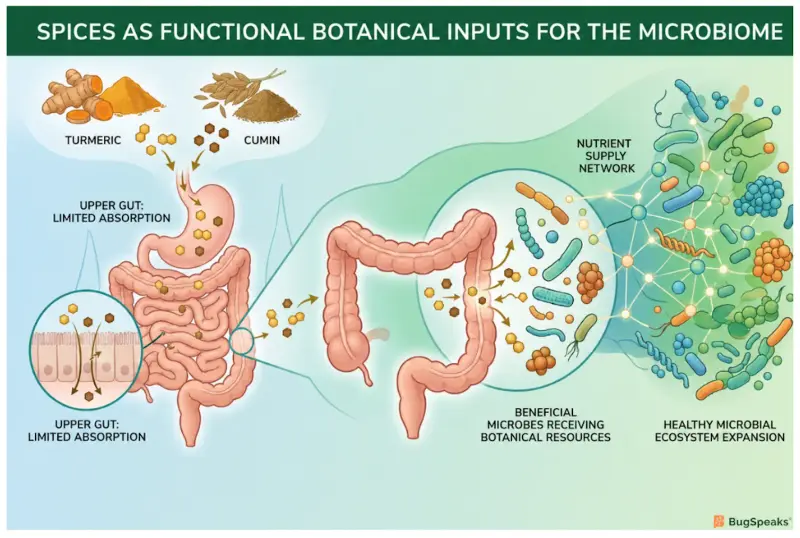
How do traditional spices like turmeric and cumin act as functional botanical inputs for our gut microbes?
Traditional spices act as functional botanical inputs that pass through the human digestive system largely intact, reaching the large intestine to provide raw, biologically active substrates for our microbial populations to process. When we consume traditional Indian diets, we are engaging in a highly evolved biological exchange rather than simply flavoring our food. Turmeric and cumin are packed with complex plant molecules known as phytochemicals, which serve as the primary fuel for this exchange. Turmeric, for instance, contains a vibrant yellow compound called curcumin, which is a powerful polyphenol. For decades, scientists have noted that curcumin has very low bioavailability, meaning that when a human eats it, very little is absorbed directly from the stomach or small intestine into the bloodstream (Zhu & He, 2024). While this was initially viewed as a pharmacological flaw, biological mapping reveals it is actually a precise delivery mechanism. By resisting early absorption in the acidic stomach, the vast majority of these biologically active resources survive the journey through the upper gastrointestinal tract.
Reaching the lower digestive system is incredibly critical because this is exactly where our biological processing partners live in their highest concentrations. The human colon houses trillions of microorganisms that have co-evolved with dietary plants over thousands of years. Because human cells lack the specific genetic equipment required to break down and digest these complex botanical structures, we rely entirely on these microbial populations. When functional botanical inputs from spices arrive safely in the colon, they create a nutrient-rich environment that directly feeds these specific microbial workersScazzocchio et al. (2020). This environment naturally explains why spices became such essential staples in traditional diets; they were never just culinary additions, but rather deliberate, recurring nutrient supply systems intended to nourish our microbial partners. Modern diets that lack these spices often leave the gut microbes starved of their preferred biologically active resources.
Daily dietary exposure to these spices, rather than taking them as occasional, high-dose medicinal supplements, ensures that the biological processing partners are never deprived of their essential raw materials. This constant, steady supply allows the gut microbes to maintain a highly active, robust, and stable population. By acting as reliable functional botanical inputs, spices lay the biological foundation for long-term gut health, initiating a continuous manufacturing process that ultimately dictates the health of the entire human bodyZhu & He (2024). The microbes depend on us to swallow the spices, and in return, we depend on the microbes to unlock the hidden health benefits trapped inside the plant structures.
Why do our biological processing partners need to transform these biologically active resources?
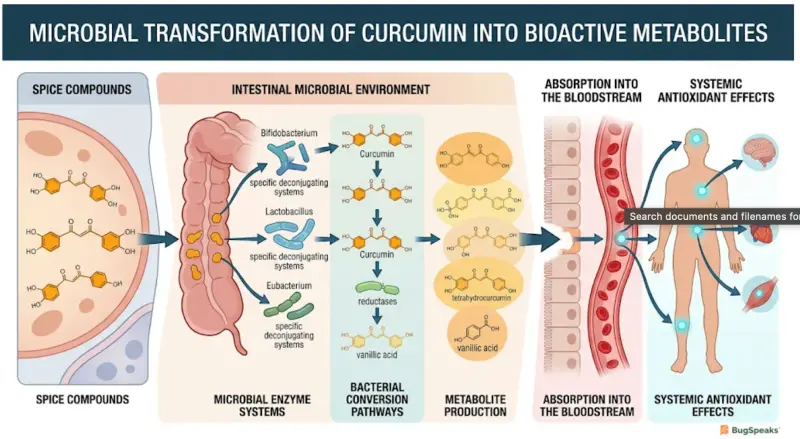
Our biological processing partners need to transform these biologically active resources to break down large, unusable plant molecules into smaller, highly effective partnership outputs that our human cells can easily absorb and utilize. Once functional botanical inputs safely reach the large intestine, they undergo a vital chemical conversion process known as biotransformation. The original plant compounds, such as the curcumin found in turmeric, are structurally too large and complex for human tissues to absorb or use directly. Our gut microbes act as an advanced biological factory, deploying enzymes to physically dismantle and reshape these moleculesScazzocchio et al. (2020). Without this essential microbial intervention, the biologically active resources would simply pass through the digestive system and be expelled as waste, completely taking their potential health benefits with them.
Within this highly organized microbial partnership system, different bacterial strains are assigned specific manufacturing tasks. For instance, bacteria such as Escherichia coli utilize specific enzymes called reductases to add hydrogen atoms to the spice molecules. This specific biological action transforms the raw curcumin into highly active new microbial metabolites like tetrahydrocurcuminScazzocchio et al. (2020). Other biological processing partners, such as the Blautia species, perform entirely different chemical alterations, such as stripping away methyl groups (demethylation), to produce completely distinct partnership outputs. This division of microbial labor ensures that the complex raw materials provided by traditional diets are fully broken down into a massive, diverse array of usable compounds that the human body requires.
The newly manufactured partnership outputs are often far more powerful and absorbable than the original raw spices. The exact difference comes down to how they dissolve and move through your gut. Tetrahydrocurcumin has a flexible structure that dissolves easily in water, allowing it to glide straight through the watery lining of your intestines and rapidly enter your bloodstream for full-body use. On the other hand, Demethylcurcumin carries a slight chemical charge that makes it stickier and harder to pass through cell walls; instead of rushing into the blood, it stays local, hanging around your gut to protect the cells right there.
These new microbial metabolites exhibit profound antioxidant properties, meaning they can easily travel throughout the human bloodstream to neutralize harmful, unstable oxygen molecules and protect distant organs from microscopic cellular damageZhu & He (2024). This perfectly illustrates the microbiome's specific role in unlocking spice benefits; the human host provides the recurring nutrient supply systems, the microbes extract the biological value using their enzymes, and the resulting partnership outputs regulate local tissue health and widespread system stability.
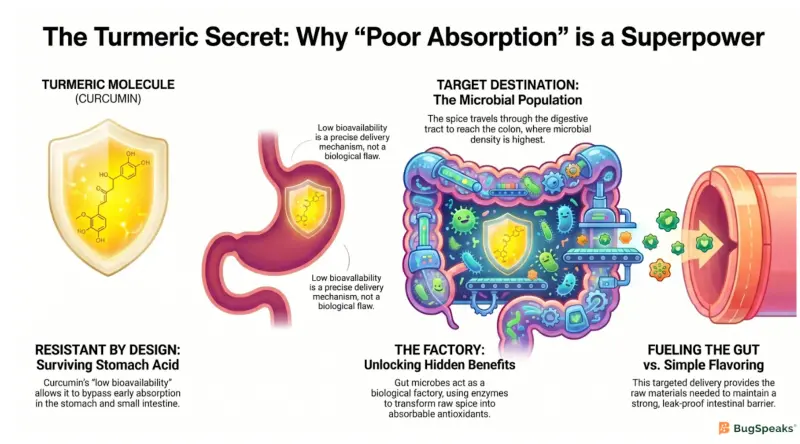
How does this microbial partnership system protect the structural walls of the intestinal barrier?
This microbial partnership system protects the intestinal barrier by generating specific partnership outputs that physically reinforce the cellular walls of the gut and actively block harmful bacterial toxins from leaking into the bloodstream. The intestinal barrier is a highly sophisticated, four-layered security system that separates the digested food inside the gut from the body's internal blood supply. The first layer utilizes alkaline phosphatase enzymes to safely neutralize incoming bacterial toxins. The second layer is a thick mucus shield that keeps hostile microbes away from delicate human tissues. The third layer relies on microscopic mechanical clasps called tight junctions to lock intestinal cells firmly together. The final layer deploys antimicrobial peptides to actively neutralize approaching threatsZhu & He (2024). The functional botanical inputs provided by turmeric directly fuel the biological processing partners to maintain and constantly upgrade all four of these critical defense layers.
When a traditional diet lacks these recurring nutrient supply systems, the microbial ecosystem can quickly collapse into a state of dysbiosis. In this highly unbalanced state, the protective mucus shield thins out, and the tight junctions begin to break apart, creating microscopic holes in the gut wall. This structural failure allows dangerous bacterial toxins, specifically Lipopolysaccharides (LPS), to leak directly into the bloodstreamServida et al. (2024). Once inside the blood, Lipopolysaccharides (LPS) trigger severe, widespread inflammatory alarms throughout the body by binding to specialized immune sensors called Toll-Like Receptor 4 (TLR4), completely compromising the overall system stability outcomeZhu & He (2024).
By continuously supplying the gut with biologically active resources, we empower our biological processing partners to halt this structural breakdown and silence these cellular alarms. The partnership outputs generated from spices like turmeric and cumin actively signal the human intestinal cells to increase the production of structural tight junctions like ZO-1, claudin-1, and occludin, effectively sealing the microscopic leaksZhu & He (2024). Furthermore, these outputs block the Toll-Like Receptor 4 (TLR4) alarm pathways, shutting down local tissue inflammation. This process highlights exactly how microbes and dietary plants co-evolved functionally to ensure that the physical boundaries of the human host remain intact, resilient, and perfectly secure against internal threats.
How do different functional botanical inputs team up to improve partnership outputs?
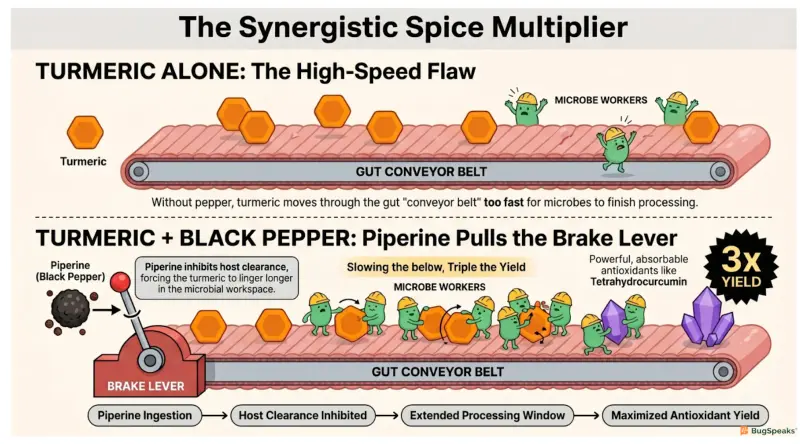
Different functional botanical inputs team up by creating a synergistic biological effect, where one spice slows down the body's natural clearance processes to give the biological processing partners much more time to digest and utilize the primary resources. In the context of traditional diets, spices are rarely consumed in isolation; they are carefully blended to create highly efficient, multi-target recurring nutrient supply systems. A prime biological example of this teamwork is the pairing of turmeric with black pepper. Black pepper contains an active alkaloid known as piperine, which acts as a powerful natural bioenhancerKumar & Banswal (2025). When these two functional botanical inputs enter the digestive system together, their combined interaction mathematically multiplies the overall efficiency and yield of the microbial partnership system.
Piperine achieves this synergistic effect by temporarily inhibiting specific digestive enzymes and cellular pumps in the human host that are normally responsible for rapidly clearing plant compounds out of the digestive tractKumar & Banswal (2025). By gently applying the brakes to this rapid clearance process, the biologically active resources from turmeric are forced to linger much longer in the large intestine. This extended biological window provides the gut microbes with ample time to perform intensive biotransformation, breaking down the complex raw materials into massive quantities of valuable partnership outputs before they can be swept away. The result is a much higher concentration of outputs that reduce oxidative stress throughout the body.
Furthermore, blending spices introduces a wider variety of biologically active resources that simultaneously feed completely different microbial workers. For example, adding fenugreek or cardamom to a spice blend alters lipid and cholesterol metabolism by supplying specific raw materials that the microbes use to synthesize energy-regulating moleculesJones et al. (2022). Cardamom specifically helps the microbes regulate genes related to fat storage, like PPAR-gammaYahyazadeh et al. (2021). This multi-spice approach aggressively suppresses the growth of hostile microbes while actively feeding friendly ones. Ultimately, this demonstrates that the traditional dietary pattern of mixing spices is not just a culinary preference, but a highly sophisticated biological strategy to maximize the system stability outcome.
What happens to system stability when we consume these botanical resources regularly?
Consuming these botanical resources regularly establishes profound system stability by steadily expanding the populations of highly beneficial bacteria, neutralizing harmful invaders, and continuously generating vital energy molecules for the entire body. When traditional diets act as recurring nutrient supply systems, they fundamentally and permanently reshape the microscopic ecology of the gut over time. Providing a daily, steady stream of functional botanical inputs like turmeric and cumin consistently feeds highly beneficial biological processing partners, particularly Bifidobacteria and LactobacilliZhu & He (2024). As these helpful microbial populations thrive and multiply on the biologically active resources, they naturally outcompete and crowd out harmful, disease-causing bacteria, keeping the entire digestive environment firmly anchored in a resilient state of homeostasis.
As massive populations of Bifidobacteria and Lactobacilli process these daily inputs, they manufacture enormous quantities of Short-Chain Fatty Acids (SCFAs). These specific fatty acids represent the ultimate partnership outputsServida et al. (2024). They serve as the primary, direct energy source for the human cells lining the colon, keeping the barrier walls incredibly strong and highly active. By constantly feeding the good bacteria, regular spice consumption actively fixes the broken ratio of Firmicutes to Bacteroidetes in the gut, ensuring that the biological factory is staffed by the right workers.
Beyond local gut health, these specific outputs travel deeply into the human body to regulate distant metabolic operations. For example, Short-Chain Fatty Acids (SCFAs) bind to special receptors (like GPR41 and GPR43) on intestinal cells, signaling them to release Glucagon-Like Peptide-1 (GLP-1). This vital hormone travels to the pancreas and helps the body naturally and efficiently regulate blood sugar levelsServida et al. (2024). Ultimately, this continuous, daily cycle proves that consistent dietary exposure is vastly superior to sporadic medicinal supplementation. By honoring the exact mechanisms through which human biology and dietary plants co-evolved functionally, we achieve the ultimate system stability outcome: a resilient, deeply nourished, and perfectly balanced biological ecosystem.
-Varsha V
Visualize the process- https://youtu.be/jNX9fl8gGwM
Reference
Servida, S., Piontini, A., Gori, F., Tomaino, L., Moroncini, G., De Gennaro Colonna, V., La Vecchia, C., & Vigna, L. (2024). Curcumin and Gut Microbiota: A Narrative Overview with Focus on Glycemic Control. International Journal of Molecular Sciences, 25(14), 7710. https://doi.org/10.3390/ijms25147710
Zhu, J., & He, L. (2024). The Modulatory Effects of Curcumin on the Gut Microbiota: A Potential Strategy for Disease Treatment and Health Promotion. Microorganisms, 12(4), 642. https://doi.org/10.3390/microorganisms12040642
Scazzocchio, B., Minghetti, L., & D'Archivio, M. (2020). Interaction between Gut Microbiota and Curcumin: A New Key of Understanding for the Health Effects of Curcumin. Nutrients, 12(9), 2499. https://doi.org/10.3390/nu12092499
https://www.ijcrt.org/papers/IJCRT2501861.pdf
Shi, X., Zhou, X., Chu, X., Wang, J., Xie, B., Ge, J., Guo, Y., Li, X., & Yang, G. (2019). Allicin Improves Metabolism in High-Fat Diet-Induced Obese Mice by Modulating the Gut Microbiota. Nutrients, 11(12), 2909. https://doi.org/10.3390/nu11122909
Mahalak, K. K., Narrowe, A. B., Firrman, J., Lemons, J. M. S., & Liu, L. (2026). The ginger polyphenol 6-gingerol elicits minimal changes in an ex vivo human gut microbiome. Frontiers in nutrition, 12, 1711783. https://doi.org/10.3389/fnut.2025.1711783
Jones, K. A., Richard, A. J., Salbaum, J. M., Newman, S., Carmouche, R., Webb, S., Bruce-Keller, A. J., Stephens, J. M., & Campagna, S. R. (2022). Cross-Omics Analysis of Fenugreek Supplementation Reveals Beneficial Effects Are Caused by Gut Microbiome Changes Not Mammalian Host Physiology. International journal of molecular sciences, 23(7), 3654. https://doi.org/10.3390/ijms23073654
Naaz, S., Ahmad, N., Qureshi, M. I., Hashmi, N., Akhtar, M. S., & A Khan, M. M. (2022). Antimicrobial and antioxidant activities of fennel oil. Bioinformation, 18(9), 795–800. https://doi.org/10.6026/97320630018795
Yahyazadeh, R., Ghasemzadeh Rahbardar, M., Razavi, B. M., Karimi, G., & Hosseinzadeh, H. (2021). The effect of Elettaria cardamomum (cardamom) on the metabolic syndrome: Narrative review. Iranian journal of basic medical sciences, 24(11), 1462–1469. https://doi.org/10.22038/IJBMS.2021.54417.12228
Xiao, Y., Zhang, F., Xu, H., Yang, C., Song, X., Zhou, Y., Zhou, X., Liu, X., & Miao, J. (2022). Cinnamaldehyde microcapsules enhance bioavailability and regulate intestinal flora in mice. Food chemistry: X, 15, 100441. https://doi.org/10.1016/j.fochx.2022.100441