Navigating the Great Inner Trade Network: Understanding India's Microbiome
How Does the Great Inner Trade Network Work?
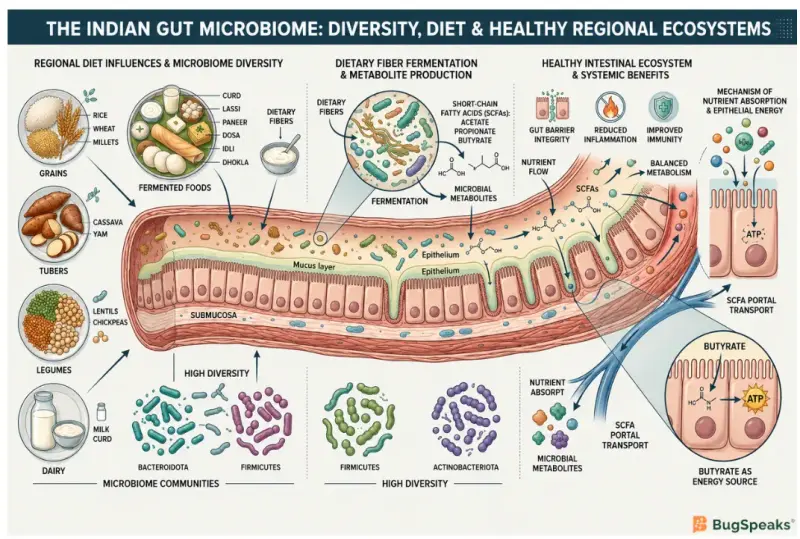
The great inner trade network is a massive system of trillions of tiny workers called microbes that live in your stomach and intestines to help process your food and keep your body running smoothly. In the scientific world, we call this the human intestinal tract, and it functions like a giant continent where different trade routes move goods from one end to the other to ensure every cell stays healthyKhalil et al. (2024). Every single gram of material moving through your gut holds up to 1 trillion tiny living things, most of which are anaerobes that live in the deep, dark, oxygen-free holds of your biological cargo ships. In a healthy state called eubiosis, these workers keep the harbor peaceful and efficient, acting as the primary workforce for the Indian microbiome. Understanding this network is the key to seeing how your body turns a simple meal into the fuel that powers your life.
Imagine that your body is a vast landscape, and your digestive system is the primary river allowing trade to flourish across the land. The microbiome represents the billions of people living along this river, managing the boats, checking the cargo, and ensuring that no "Pirate" microbes take over the valuable docks. When you are in a state of eubiosis, it means the entire trade network is perfectly balanced; the workers have enough food, the shipping lanes are clear, and everyone is working together toward the same goal. Because many of these workers are anaerobes, they don't need oxygen to breathe, which allows them to live in the deep, quiet corners of your intestines where they can work on breaking down the toughest cargo without being interrupted by the outside world.
To understand this network, scientists use metagenomics, which is like having a high-tech satellite that can see every single worker in a city at the same time and read their ID cards. This technology allows us to look at the Deoxyribonucleic Acid (DNA) of the microbes to see what their "Special Skills" are and how they help you stay fit. In India, our trade network is unique because our regional diets and the different types of cargo we eat have trained our workers to be some of the most specialized and diverse in the world. Whether you are eating a spicy curry in the South or a buttery flatbread in the North, your inner traders have a plan. They act as sensors, constantly adjusting their "Trading Rules" based on what you put into the harbor to ensure the economy of your body stays booming through the power of metagenomics.
What Happens Inside the High-Mountain Caravan of the North?
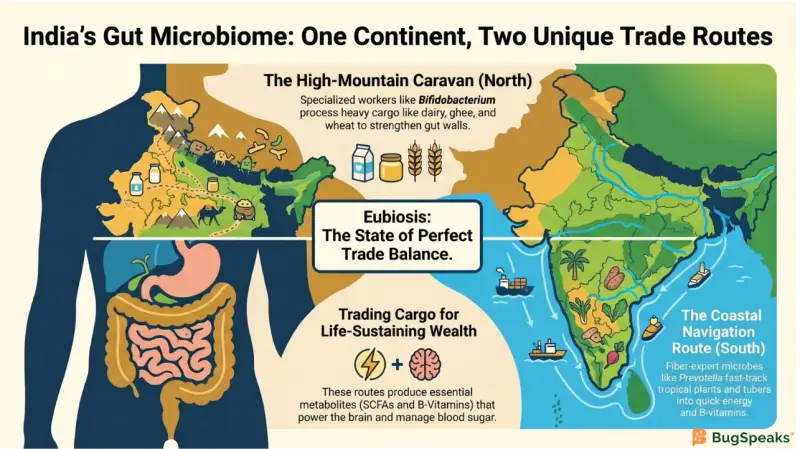
The high-mountain caravan of the North is a trade route built to carry heavy cargo like thick wheat, creamy ghee, and rich dairy products that are common in Northern Indian diets. Because these diets are full of dense grains and proteins, the gut needs a special team of workers with high endurance to perform lactose hydrolysis, which is the act of breaking down milk Khalil et al. (2024). This caravan relies on a team led by a group called Bifidobacterium, which breaks down milk so you don't get a tummy ache or feel bloated after a heavy meal. As they work, they perform fermentation to turn heavy food into energy and create butyrate, a special fuel that keeps the walls of your trade route strong and healthy even when the cargo is very heavy.
Supporting this caravan is a complex logistics system involving your liver, which acts like a production factory for specialized liquids. When you eat heavy fats like ghee or butter, the liver sends out bile acids to act like a biological soap, melting the fat into tiny bubbles so the microbial workers can process them more easily. This teamwork ensures that even the heaviest "Solid Cargo" is turned into something useful for your health rather than sitting in the harbor and causing a massive backup. One specific hero of the North, a microbe called Megasphaera, takes the leftovers from other workers and turns them into even more high-quality fuel, ensuring that the "Mountain Caravan" stays energized during the long trek through your digestive system.
If these workers go on strike or get lost, the caravan stalls, and heavy dairy and grains become very difficult to process, leading to a state of internal chaos. This can cause the gates of the harbor to become weak, allowing Lipopolysaccharides (LPS) toxic parts of bad bacteria to leak out into your bloodstream. This leakage is like a "Security Breach" that causes your body's alarm system to go off, leading to redness and swelling throughout your system. By keeping the High-Mountain Caravan well-fed with traditional grains and healthy fats, you ensure that these specialized workers stay on the job. This prevents the network from becoming clogged and keeps the North Indian gut capable of handling its unique, dairy-rich regional menu through the process of fermentation.
Table 1: Harbor Cargo Logs: Comparing the Trade Routes
How Does the Coastal Navigation Route Manage Tropical Cargo?
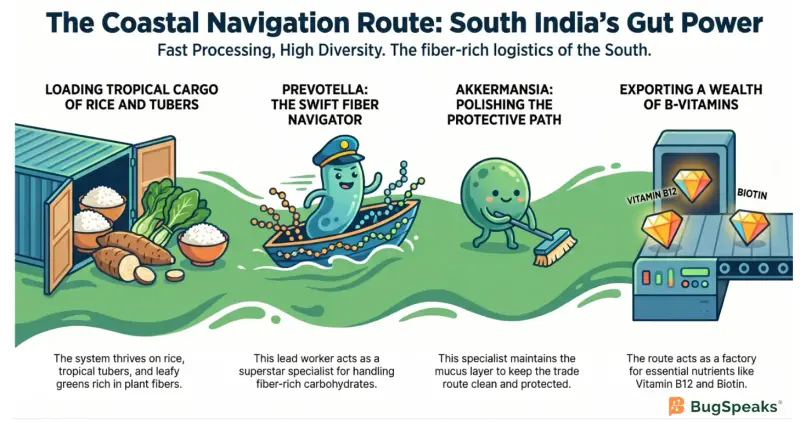
The coastal navigation route manages tropical cargo by moving moisture-rich plants, tubers, and fermented rice through the system very quickly to provide rapid energy. This pathway is fueled by microbiome-accessible carbohydrates (MACs), which are parts of plants like fiber that your body cannot digest on its own without help from the Master Saucier. In the South, specialized workers like Prevotella use their tools to break down hemicellulose, a tough fiber found in the walls of tropical plants. This route is unique because it has high functional redundancy, meaning many different types of microbes can do the same job to ensure the system never fails, even when the daily diet changes slightly.
This route relies on a diverse range of workers because the "Tropical Cargo" is very multifaceted and changes with the seasons along the coast. People in the South often eat wild tubers, tapioca, and leafy greens that are full of water and complex plant fibers that require specialized tools to dismantle. The microbes here must be highly saccharolytic, meaning they love to eat and break down these sugars and starches to turn them into quick bursts of energy for the body. One specific worker, Parasutterella, is like a local guide that you almost only find in Southern trade routes, helping to navigate the unique plants found in that region, because Southern diets historically had less dairy, they make up for it with a super-sized population of these fiber-experts.
Keeping this route slippery and clean is the job of another worker called Akkermansia muciniphila, who acts like the harbor's maintenance crew. This microbe polishes the floor of the harbor by eating a little bit of the protective mucus, which forces your body to keep making fresh, clean layers of protection. This keeps the pathway protected from germs and ensures tropical plants can move along without getting stuck or causing a "Cargo Jam" in the lanes. Additionally, the Coastal Route is a factory for wealth in the form of vitamins, with some "hidden" workers carrying genes for making Vitamin B12. This provides the host with steady energy and a sharp brain even in the humid coastal heat, thanks to the high functional redundancy of the Southern team.
What Kind of Goods Do These Trade Routes Produce and Trade?
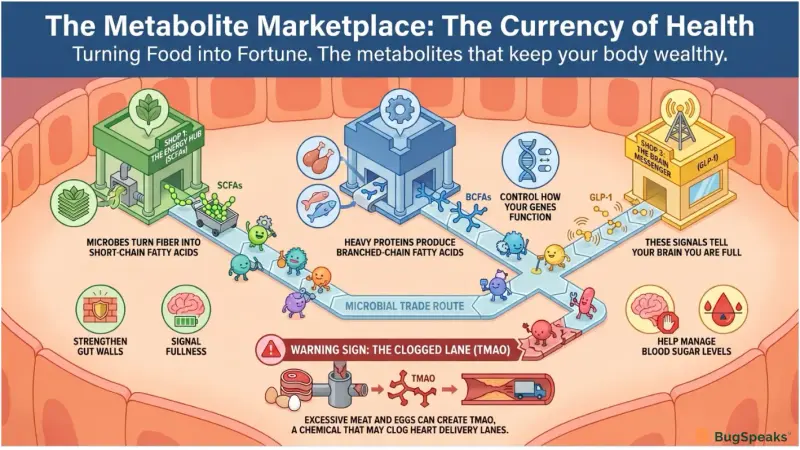
These trade routes produce essential goods called metabolites, which act like the internal currency or the letters telling your body how to feel and act. Every time you eat, you send raw materials to the harbor, which the workers turn into "Happy Messengers" or essential vitamins that your body cannot make on its own. For example, your gut cells, known as enterocytes, receive signals from these goods to manage your energy and keep the walls of the harbor strong. To keep everything running smoothly, the gut also releases glucagon-like peptide-1 (GLP-1), a hormone that tells your brain you are full and helps manage your blood sugar levelsGootenberg et al. (2024).
When the High-Mountain Caravan processes heavy proteins, it creates unique tools called branched-chain fatty acids (BCFAs), which are like high-tech signals for the base. These are special signals that can change how your genes are read by your body, helping you adapt to colder or tougher environments in the North. However, if there is too much "Solid Cargo" like red meat, the microbes might make a chemical that turns the liver into TMAO (Trimethylamine N-Oxide). If you have too much of this in your cargo hold, it can start to clog your body’s delivery lanes, which is why balancing your "cargo" with plenty of plant fiber is so important for keeping the shipping lanes clear and the enterocytes happy.
The trade network has even revealed a hidden "Bio-Electric Grid" where certain workers, known as "Electricians," can plug directly into the harbor walls to share power. This process involves sending tiny pulses of electricity into your cells, which acts like a "Power Boost" for the entire harbor system through the trade of metabolites. Maintaining a healthy workforce ensures that this grid stays online, providing the steady electrical energy required for a high-performing Indian body. When the "currency" is moving and the electricity is flowing, the trade network is at its most profitable and healthy state. This coordination of glucagon-like peptide-1 (GLP-1) and microbial electricity is what allows you to feel balanced throughout the day.
Table 2: Harbor Cargo Logs: Microbial Worker Outputs
Why are the Ancient Trade Routes Changing and How Do We Protect Them?
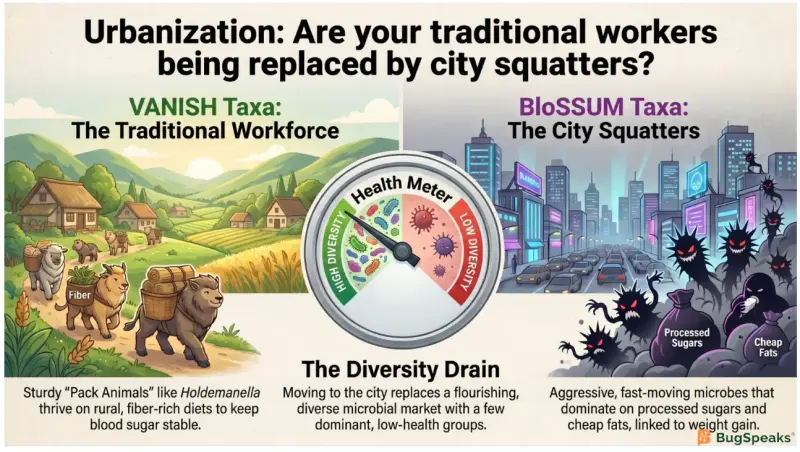
Ancient trade routes are changing today because urbanization and modern life are making our traditional "Pack Animals" disappear from the landscape. When people move from small villages to big cities, they often stop eating regional tubers and home-grown grains, which causes VANISH taxa, the good microbial workers found in rural areas to leave the gutAchudhan et al. (2026). In their place, BloSSUM taxa move in, which are microbes that grow too fast when we eat lots of processed sugar and cheap fats. This shift is linked to health problems like high blood sugar and an increased body mass index (BMI), making it harder for our internal trade network to stay stable.
This problem is a major focus of studies like SAMBAR, which looks at how the gut changes as people move from traditional lifestyles to the city. Superstar workers like Holdemanella are being lost in urban environments, which is a tragedy because they are masters of blood sugar balance in the Indian gut. When we lose these specialized workers, our inner trade network becomes much less diverse and less resilient to the stress of modern life. Instead of a flourishing market with many different shops, the urban gut can become dominated by a few aggressive groups of BloSSUM taxa that don't contribute much to our health but take up all the valuable space in the harbor docks.
To keep these trillions of workers in line, the harbor utilizes "Security Inspectors" known as the Gut Virome, which are billions of tiny viruses that monitor the workforce. These inspectors don't eat your food; instead, they "check the licenses" of the bacteria, ensuring the workforce remains diverse and balanced. In the future of Indian health, we will use "Precision Inspection" to help these security guards remove the bad workers and restore the harbor to its ancient state. By monitoring your body mass index (BMI) and eating traditional, regional foods, you can help these inspectors do their jobs. Staying connected to our roots and protecting our VANISH taxa is the best way to secure our biological future for years to come.
Table 3: The Urban Shift: Microbial Demographics
Visualize the process- https://youtu.be/Dk06jmSICIg
Reference
Achudhan AB, Parthiban R, Ramasubramanian T, Mukesh K and Saleena LM (2026) Synergistic analysis of genome-resolved metagenomics and language-based machine learning reveals hidden probiotic genomes in the Indian healthy human gut microbiome. Front. Microbiomes 5:1779767. doi: 10.3389/frmbi.2026.1779767
https://journals.asm.org/doi/pdf/10.1128/msystems.01458-25
Khalil, M., Di Ciaula, A., Mahdi, L., Jaber, N., Di Palo, D. M., Graziani, A., Baffy, G., & Portincasa, P. (2024). Unraveling the Role of the Human Gut Microbiome in Health and Diseases. Microorganisms, 12(11), 2333. https://doi.org/10.3390/microorganisms12112333
https://www.biorxiv.org/content/10.64898/2026.01.22.701183v1.full