What Is the Main Difference Between IBS and IBD?
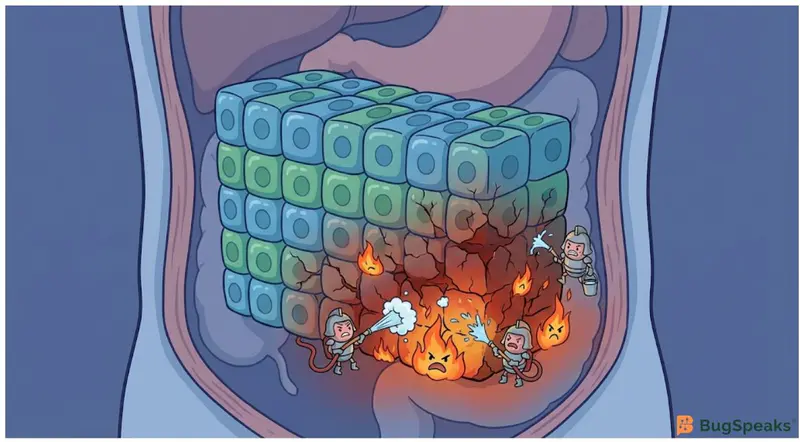
The main difference is that Irritable Bowel Syndrome (IBS) is a functional sensitivity issue acting like a "Faulty Alarm" in your gut, while Inflammatory Bowel Disease (IBD) is a structural disease acting like an "Actual Fire" involving chronic, physical tissue damage.
To understand this easily, imagine your digestive system is a large, busy factory:
The Faulty Alarm (IBS): In this scenario, the factory is perfectly built and structurally safe. However, the smoke detectors are overly sensitive and constantly ringing even when there is no danger. The workers panic, and operations speed up or slow down randomly, causing chaos like cramps, bloating, and unpredictable bowel habits. Even though you feel terrible, the building itself is not actually burning or damaged.
The Fire in the Building (IBD): In this scenario, there is a real, raging fire inside the factory. The walls are crumbling, and the structure is taking a massive hit. This represents your immune system mistakenly attacking your own intestines, causing severe, physical destruction.
According toUnderstanding Inflammatory Bowel Disease: An Integrative Framework of Microbiome, Metabolome, and Immunological Biomarkers, IBD (which primarily includes ulcerative colitis and Crohn's disease) causes chronic inflammation of the gastrointestinal tract and leads to severe complications like strictures, abscesses, gastrointestinal bleeding, malnutrition, and weight loss,. Because there is physical damage, doctors can use a camera (endoscopy) to look inside the gut and visibly see the inflammation.
In contrast, as highlighted inPathophysiological Mechanisms and Nonpharmacological Interventions in Irritable Bowel Syndrome: Current Insights and Future Directions, IBS is a functional gastrointestinal disorder where patients suffer from altered bowel habits and abdominal pain, but there is no structural damage or increased mortality risk,. Endoscopy scans for IBS patients will look completely normal because there is no single diagnostic biomarker and no physical "fire" to see.
How Do The "Faulty Alarm" and "Actual Fire" Compare Diagnostically?
These two conditions compare diagnostically through distinct physical markers, where IBS shows normal test results despite severe pain, and IBD shows visible tissue destruction and inflammatory markers.
Because IBS and IBD require entirely different treatments, distinguishing between them is critical. Here is a simple comparison to help you tell them apart:
How Does "Static on the Phone Line" Trigger The Faulty Alarm in IBS?
"Static on the phone line" triggers the Faulty Alarm in IBS by scrambling the communication between your brain and gut, causing normal digestion to be misinterpreted as an extreme emergency.
The brain and the gut communicate constantly through a network called the gut-brain axis. In a healthy person, this communication line is crystal clear. However, in someone with IBS, the "Faulty Alarm" goes off because this two-way superhighway is severely disrupted. When there is massive static on this line, everyday digestive functions—like a normal amount of gas or food moving through the intestines—are heavily exaggerated, and the brain registers them as intense, severe pain.
According toPathophysiological Mechanisms and Nonpharmacological Interventions in Irritable Bowel Syndrome: Current Insights and Future Directions andThe microbiota-gut-brain axis in irritable bowel syndrome: expert guidance on diagnosis and management, here are the 5 common triggers that cause this scrambling and static:
Chronic Stress and Anxiety: When you are under constant stress, your body activates its "fight or flight" response, flooding your system with cortisol, the primary stress hormone,. This excessive stress suppresses your vagus nerve (the nerve responsible for your "rest and digest" functions), significantly increasing your gut's sensitivity to pain,.
Chemical Imbalances (Neurotransmitters): Over 90% of your body's serotonin—a vital chemical messenger—is actually produced in the cells of your gut, not your brain. If the levels of serotonin or histamine become imbalanced, it creates heavy static that disrupts how fast or slow your gut muscles squeeze, directly triggering the Faulty Alarm to cause severe cramps and unpredictable bowel habits,.
Childhood Trauma and Early Life Adversity: Experiencing severe stress or traumatic events during childhood can alter the way your gut and brain connect. This early life adversity changes the development of your stress response system and gut microbial composition, leaving the communication line sensitive and highly prone to triggering IBS later in adulthood.
Loss of Good Gut Bacteria (Dysbiosis): Trillions of friendly bacteria live in your digestive tract and act as peacekeepers for the gut-brain phone line. If you lose this microbial diversity, the resulting bacterial imbalance sends incorrect, inflammatory chemical texts to the brain, adding severe static to the connection.
Dietary Irritants (High-FODMAP Foods): Certain tricky carbohydrates, known as FODMAPs, are hard to break down and end up fermenting in the gut, producing extra gas and pulling in excess water. While a normal gut handles this effortlessly, a gut with a scrambled phone line overreacts to this stretching, translating a simple bloated feeling into a painful emergency.
What Non-Pharmacological Interventions Help Silence The Faulty Alarm?
Non-pharmacological interventions silence the Faulty Alarm by restoring clear communication on the gut-brain axis through targeted dietary changes, stress management, and microbiome support.
Because IBS is a functional disorder, medications often only provide temporary relief. The most effective long-term strategies involve fixing the static on the phone line:
The Low-FODMAP Diet: By temporarily eliminating highly fermentable carbohydrates and carefully reintroducing them, patients can stop the excessive gas production that triggers visceral hypersensitivity.
Cognitive Behavioural Therapy (CBT): Psychological interventions like CBT help rewire the brain's response to gut signals. By lowering psychological distress and transforming how the brain interprets abdominal sensations, CBT effectively lowers cortisol levels and calms the gut-brain axis.
Targeted Probiotics: Introducing beneficial bacteria, particularly strains like Bifidobacterium and Lactobacillus, can help restore microbial diversity. These peacekeepers improve the gut barrier, regulate serotonin levels, and reduce the heavy static causing the Faulty Alarm.
How Does "The Fire in the Building" Destroy Your Gut's City Wall?
The "Fire in the Building" destroys your Gut's City Wall by unleashing chronic immune inflammation that physically breaks down the protective lining of your intestines.
Unlike the "Faulty Alarm" of IBS where the wall remains perfectly safe, IBD involves severe, structural internal damage.. Imagine your intestinal lining is a thick, protective City Wall keeping out invaders like bad bacteria and toxins. In IBD, your body’s own defence system gets confused and attacks this wall, leading to severe chronic inflammation and altered gut permeability.
According toUnderstanding Inflammatory Bowel Disease: An Integrative Framework of Microbiome, Metabolome, and Immunological Biomarkers, this pathophysiological breakdown happens through a cascade of destructive events:
Loss of the Peacekeepers: A healthy gut has good bacteria (like Faecalibacterium prausnitzii and Bifidobacterium) that produce Short-Chain Fatty Acids, specifically butyrate. Butyrate acts like the mortar holding the City Wall together, providing mucosal protection and anti-inflammatory functions. In IBD, these peacekeepers die off, leaving the wall incredibly weak.
Invaders Breaching the Gates (Leaky Gut): Because the good bacteria are depleted, harmful bacteria like Escherichia coli (E. coli) multiply rapidly. These bad bacteria release toxins called Lipopolysaccharides (LPS), which directly damage the tight junctions of the wall, causing a "leaky gut" where invaders easily slip inside the barrier.
The Fire Spreads (Cytokine Storm): Once the wall is breached, the immune system panics and releases severe inflammatory chemical messengers, including Interleukin-1 beta (IL-1β), Interleukin-8 (IL-8), and Tumor Necrosis Factor-alpha (TNF-α). This creates the literal "Fire in the Building," amplifying local inflammation and destroying the surrounding tissues.
Physical Destruction: This raging internal fire results in severe physical wounds. The intestinal tissue becomes swollen and ulcerated, leading to the gastrointestinal bleeding, severe malnutrition, and weight loss commonly seen in IBD patients.
How Does The Indian Gut React Differently to These Conditions Compared to a Western Gut?
The Indian gut reacts differently because our unique baseline microbiome, shaped by high-fibre vegetarian diets, creates a distinct pattern of bacterial changes when the "Actual Fire" of IBD strikes.
Generally, a healthy Indian digestive tract is heavily populated with Prevotella bacteria, which thrive on the plant-based, fibre-rich diets common across the country. However, when the structural disease of IBD begins, the bacterial shift in an Indian patient does not look exactly the same as the shift in an American or European patient.
According to theCross-ethnic evaluation of gut microbial signatures reveal increased colonization with oral pathobionts in the north Indian inflammatory bowel disease cohort, researchers compared Indian IBD patients to Dutch (Western) IBD patients and found fascinating differences in how their gut environments collapsed. While both groups experienced a shared loss of the protective "peacekeeper" bacteria that make butyrate, the Indian gut showed unique vulnerabilities, especially regarding bacteria migrating from the mouth to the intestines.
During an IBD flare-up in the Indian cohort, there is an extreme invasion of unique oral pathobionts (bacteria normally found in the mouth). These specific invaders include:
Scardovia
Oribacterium
Actinomyces dentalis
Klebsiella pneumoniae
Here is a summary table of how the Indian gut compares to the Western gut during an IBD flare-up:
Because of these ethnic and regional differences, treating the "Actual Fire" in Indian patients requires an understanding of our unique biology—such as controlling oral pathobionts—to help put out the flames and rebuild the city wall.
What Is the Ultimate Takeaway for Your Digestive Health?
The ultimate takeaway is that while both conditions cause severe discomfort, identifying whether you have a Faulty Alarm or an Actual Fire is the critical first step to healing.
If you are experiencing chronic digestive distress, do not ignore it. A Faulty Alarm (IBS) requires calming the nervous system, managing stress, and tweaking the diet to reduce sensitivity,. An Actual Fire (IBD), however, requires urgent medical intervention to stop immune destruction, rebuild the City Wall, and prevent long-term complications,. By understanding what is happening inside your gut, you can work effectively with your doctor to find the right treatment strategy and reclaim your quality of life.
- Neha Rao
Visualize the process- https://youtu.be/ZbNFCePmEl0
Reference
Singh, A., Juyal, G., Gacesa, R., Joshi, M. C., Midha, V., Thelma, B. K., Weersma, R. K., & Sood, A. (2025). Cross-ethnic evaluation of gut microbial signatures reveal increased colonization with oral pathobionts in the north Indian inflammatory bowel disease cohort. Intestinal research, 10.5217/ir.2024.00216. Advance online publication. https://doi.org/10.5217/ir.2024.00216
Cheung, S. L. Y., & Kenway, L. C. (2026). Pathophysiological Mechanisms and Nonpharmacological Interventions in Irritable Bowel Syndrome: Current Insights and Future Directions. Journal of nutrition and metabolism, 2026, 4520019. https://doi.org/10.1155/jnme/4520019
Palaniswamy, K. R. (2025). The microbiota-gut-brain axis in irritable bowel syndrome: expert guidance on diagnosis and management. International Journal of Research in Medical Sciences, 13(2), 958–966. https://doi.org/10.18203/2320-6012.ijrms20250287
Prabhu PS, Kalita R, Sharma V, Prakash T. Understanding Inflammatory Bowel Disease: An Integrative Framework of Microbiome, Metabolome, and Immunological Biomarkers. J Transl Gastroenterol. 2025;3(1):24-38. doi: 10.14218/JTG.2024.00030.
Visualize the process- https://youtu.be/ZbNFCePmEl0