Secret to a Thriving Microbiome: Effortless Hydration
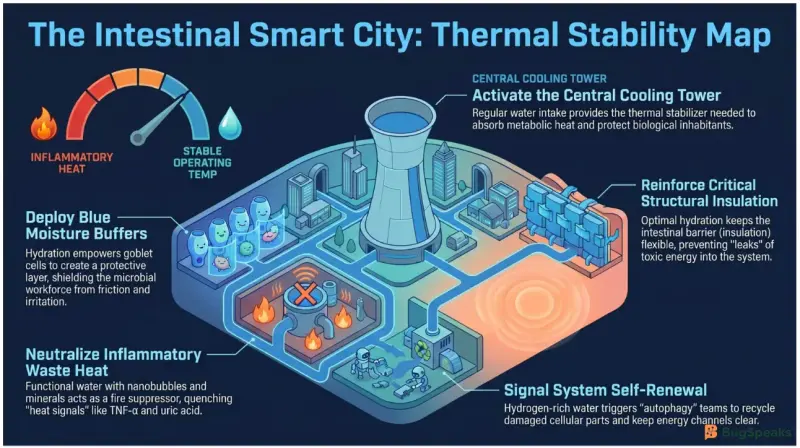
Why is water the essential thermal stabilizer for the intestinal smart city?
Water is the essential thermal stabilizer because it provides the necessary moisture buffer to absorb metabolic heat and protect the smart city’s biological inhabitants from the stress of rising internal temperatures. Within this architectural system, every nutrient processed generates a specific thermal output, and without a continuous supply of high-quality stabilization fluid, the delicate intestinal infrastructure would suffer from structural weakening and physical expansion stress. Research into the molecular properties of hydration indicates that the physicochemical structure of water, including its molecular cluster size, determines how effectively it can saturate the energy channels of the gut to lower the basal operating temperature Men et al. (2026). When the smart city is adequately hydrated, the movement of energy occurs without friction, ensuring that the microbial residents can perform their specialized biological tasks without triggering the distress signals of low-grade inflammation. This hydration is not a passive filler; it is the active medium through which the smart city regulates its internal climate and reinforces the integrity of its defensive barriers.
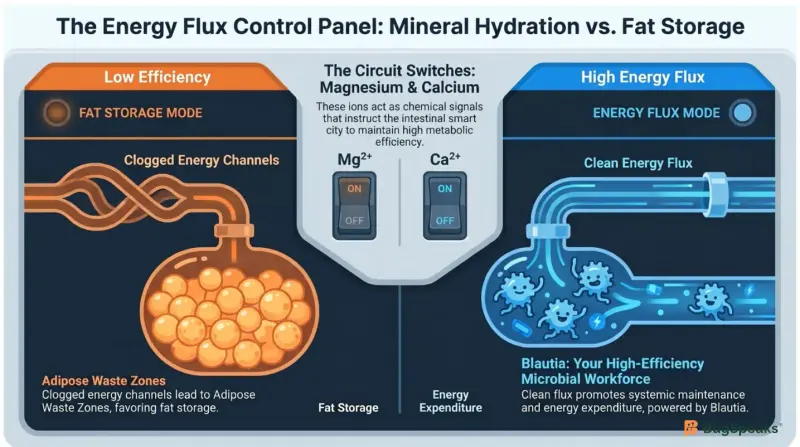
How does mineral water regulate the energy flux to mitigate obesity?
Mineral-rich hydration regulates energy flux by acting as a specialized ionic balancer that adjusts the metabolic units of the intestinal smart city to prevent the excessive energy storage commonly identified as obesity. By introducing specific ions into the intestinal environment, mineral water influences the microbial workforce, favoring the growth of residents that promote energy expenditure over those that prioritize high-calorie accumulation. According to Li et al. (2024), this specialized fluid shifts the demographic of the intestinal smart city, significantly increasing the presence of beneficial residents like Blautia while suppressing microbes that demonstrate lower metabolic efficiency. This demographic shift ensures that the energy flux through the smart city is utilized for systemic maintenance rather than being diverted into the waste storage zones of adipose tissue. Effectively, the mineral content acts as a chemical signal that instructs the smart city to maintain a state of high metabolic efficiency and minimal storage.
Can the smart city survive a surge of hyperuricemic waste heat?
The intestinal smart city survives uric acid surges by utilizing mineralized stabilizers to neutralize and export the metabolic residue that would otherwise lead to a systemic collapse. Hyperuricemia acts like an accumulation of chemical debris within the smart city’s energy channels, creating friction and localized heat that degrades the intestinal lining and stresses the resident microbial communities. Data suggests that natural mineral water from high-quality sources enhances the smart city’s capacity to process these toxic concentrations, preventing the inflammatory distress that uric acid typically ignites Li et al. (2024). By flushing the environment and supporting the intestinal residents responsible for waste management, this hydration strategy prevents the thermal stress that results in long-term metabolic decay. Maintaining a clean, well-flushed environment is essential for preventing the structural breakdown of the intestinal barrier under the persistent pressure of chemical waste.
How does functional water act as a fire suppressor for intestinal inflammation?
Functional water acts as a fire suppressor by utilizing nanobubbles as microscopic quenching agents that actively lower pro-inflammatory signals within the intestinal microbial colony. These ultra-small bubbles provide a potent antioxidant effect that penetrates deep into the smart city's infrastructure, reaching recessed areas where standard fluids might not circulate with enough efficiency. As evidenced by Men et al. (2026), this specialized hydration significantly lowers the basal temperature of the gut by reducing the presence and activity of inflammatory markers like TNF-α. This stabilization process prevents the "fires" of chronic inflammation from spreading across the smart city, allowing the beneficial microbial residents to maintain their essential metabolic positions. By lowering the thermal stress on the intestinal lining, functional water ensures the long-term structural resilience of the entire smart city.
Why is the intestinal barrier considered the critical insulation of the smart city?
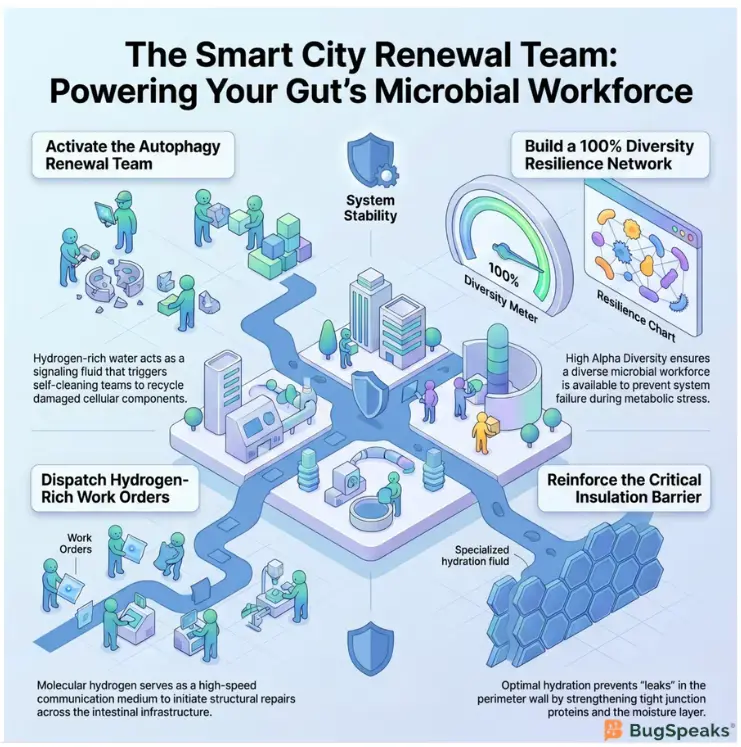
The intestinal barrier is considered critical insulation because it prevents the leakage of metabolic energy and the dangerous migration of toxins into the surrounding areas of the smart city. This insulation is maintained by a complex network of tight junction proteins that act like a protective structural seal on a high-energy channel, keeping the internal contents contained within their designated boundaries. When hydration levels drop, this biological insulation becomes brittle and develops fissures, leading to the condition known as leaky gut or a breach in the smart city's perimeter defenses. Research into hydrogen-rich water indicates that optimal hydration reinforces this insulation by stimulating the production of a protective moisture layer Zeng et al. (2026). A well-insulated system remains stable and secure, ensuring that the microbial workforce remains properly segregated from the sensitive systemic tissues of the host.
How does hydrogen-rich water activate the self-renewal processes of the city?
Hydrogen-rich water activates the smart city’s autophagy processes, which function as a natural renewal team that recycles damaged cellular components and prevents disruptions in the flow of metabolic energy. In a high-demand smart city, the cellular units and energy channels eventually experience wear, and if this damaged biological material is not replaced, the entire system becomes inefficient and vulnerable. Molecular hydrogen acts as a signaling agent that triggers these self-cleaning mechanisms, as highlighted in the study of intestinal-to-neural pathways Zeng et al. (2026). This process ensures that the energy channels of the gut remain clear of debris, allowing for the smooth transmission of nutrients and signals throughout the system. Without this active renewal cycle, the smart city would eventually succumb to the structural friction caused by aging and chronic metabolic stress, often occurring in the micro-structures known as organelles.
What role do bile acids play as metabolic intensity sensors in the hydrated city?
Bile acids function as the smart city’s advanced intensity sensors, monitoring the pressure of energy flow and signaling the smart city's maintenance teams through receptors like TGR5. These sensors respond directly to the chemistry of the hydration fluid; when the water is hydrogen-rich or mineral-dense, the bile acids shift their signaling to favor repair and stabilization rather than inflammatory distress signals. Zeng et al. (2026) demonstrate that this bile acid-mediated sensing is crucial for alleviating the distress signals of neuropathic pain originating in the gut. By keeping these sensors properly balanced, the intestinal smart city can adjust its energy output to match its current stabilization and cooling capacity. A malfunction in these sensors would lead to an over-pressure scenario, causing systemic metabolic distress and chronic physical discomfort for the host.
How does the protective moisture layer prevent friction between microbes and the city?
The protective moisture layer of the intestines acts as a vital barrier that prevents physical and chemical friction between the microbial residents and the smart city's cellular infrastructure. This barrier is produced by specialized goblet cells that require consistent hydration to maintain the correct thickness and density needed to coat and protect the smart citywalls. Research shows that advanced hydration strategies, such as the use of hydrogen-rich water, significantly increase the density of these goblet cells, ensuring the smart city remains well-protected from irritation Zeng et al. (2026). Without this moisture, the movement of nutrients and microbes would cause physical damage to the intestinal lining, leading to localized areas of inflammatory heat. A well-hydrated smart city operates efficiently and quietly, protecting its delicate biological structures from the daily wear and tear of nutrient processing.
Why is microbial diversity essential for the city's resilience network?
Alpha diversity acts as the smart city's resilience network, ensuring that if one group of microbial specialists fails, others are available to maintain the smart city's energy flow and thermal stabilization. In a low-hydration environment, the demographic shrinkage of the smart city leaves only the most aggressive microbial residents, which can lead to a total system failure during times of environmental stress. Functional water has been shown to increase this alpha diversity, effectively recruiting a wider range of unique microbial specialists to manage the complex requirements of the intestinal smart city Men et al. (2026). This diversity ensures that the smart city can handle various diet types and environmental shifts without experiencing metabolic overheating. A diverse microbial workforce is the best defense against a system shutdown, as it provides the stability needed to keep the energy flowing under all physiological conditions.
How does the SGLT1 loop function as the smart city’s hydraulic logistics pump?
The SGLT1 absorption loop functions as a logistics pump by using a precise ratio of hydration fluid and sodium to lift glucose and raw materials across the city’s perimeter walls. This transporter acts as a biological hydraulic elevator, ensuring that nutrients move efficiently from the gut lumen into the systemic circulation grid Li et al. (2024). When hydration levels are insufficient, these elevators stall, leaving nutrient-loaded trucks idling in the logistics zone. This logistical failure causes energy shortages throughout the smart city, while unabsorbed nutrients begin to ferment prematurely, leading to a backup of gas and internal pressure. A well-hydrated pump ensures that energy is moved into the city’s central grid efficiently and without delay.
Why is hydration the primary power source for the smart city’s waste conveyor?
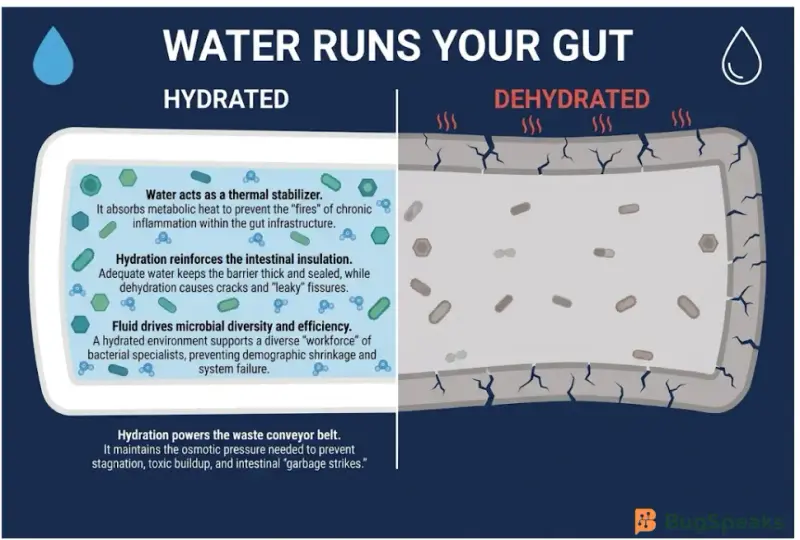
Hydration is the primary power source for the waste conveyor because it utilizes osmotic pressure to keep metabolic trash pliable and moving at a consistent speed through the city’s channels. This process, biologically known as peristalsis, ensures that waste materials do not stagnate and cause chemical erosion against the city’s insulation Men et al. (2026). In a state of dehydration, the "conveyor belt" slows down significantly, a condition recognized as a garbage strike. This stagnation allows toxic trash to sit against the city’s insulation for excessive durations, inviting rogue scavengers, or pathogens, to set up camp in the waste. Maintaining the fluid power on the conveyor belt is the only way to ensure the smart city remains clean and structurally sound.
How does alkalinity act as a pH safety switch for the microbial workforce?
Alkalinity acts as a pH safety switch by calibrating the acidity levels of the internal environment to match the specific employment contracts of the city’s microbial residents. Every microbial specialist has a strict requirement regarding the pH of their workspace to perform their high-performance biological tasks Li et al. (2024). If the city becomes too acidic due to poor hydration or low-quality fluids, it triggers an automatic lockout where beneficial microbes go dormant. This environmental shift allows acid-tolerant "hardened rogue agents" to take over the infrastructure, leading to system-wide inefficiency. Utilizing specific functional waters with controlled alkalinity acts as a filtration system, ensuring the pH remains optimized for the city’s high-performing microbial workforce.
How can we optimize our personal smart city through hydration management?
Optimizing the intestinal smart city requires a proactive hydration management strategy that treats water as a functional tool for internal stabilization rather than just a passive beverage. By selecting waters with specific mineral profiles or high hydrogen concentrations, we can actively manage our internal stabilization system to prevent the metabolic heat that leads to obesity and chronic pain. The integrated findings of Li et al. (2024), Men et al. (2026), and Zeng et al. (2026)provide the architectural framework for maintaining a high-performance intestinal smart city. Consistent, high-quality hydration ensures that the energy channels remain clear, the insulation stays thick and flexible, and the infrastructure maintenance continues to support a productive and diverse microbial workforce. Ultimately, the health of our personal smart city depends on our ability to maintain the flow of life-sustaining stabilization fluid through our intestinal infrastructure.
Visualize the process- https://youtu.be/ML-QbtUQxP8
Reference
Li, M., Guo, K., He, Y., Li, H., Sun, W., Yuan, X., Liu, Z., Li, X., Merriman, T. R., Li, C., & Zhang, H. (2024). Natural Changbai mineral water reduces obesity risk through regulating metabolism and gut microbiome in a hyperuricemia male mouse model. Frontiers in nutrition, 11, 1308882. https://doi.org/10.3389/fnut.2024.1308882
Men Y, Yue L, Zhang M, Wang B and Ying W (2026) A novel functional water significantly modulates the gut microbiota and decreases the basal level of inflammation in mice. Front. Nutr. 12:1718745. doi: 10.3389/fnut.2025.1718745
Zeng, X., Lin, J., Liu, B., Su, Z., Yu, Y., Li, X., Duan, W., Liu, C., Hou, Q., Zhang, J., Yang, L., Liu, X., Fan, B., & Liao, L. (2026). Hydrogen-rich water alleviates neuropathic pain through the modulation of bile acid/Takeda G-protein-coupled receptor 5-mediated autophagy. Pain, 167(3), 663–677. https://doi.org/10.1097/j.pain.0000000000003830