How Travel and Geography Shape the Human Gut Microbiome
Introduction
The human gut microbiome, a highly complex community of trillions of microbes, plays a crucial role in overall gut health and wellbeing. While diet and genetics are well-known factors influencing gut microbial composition, recent research shows that travel and geography also significantly impact the gut microbiome. As people move across different regions and environments, their microbiome diversity shifts in response to new foods, climate, water sources, and microbial exposures. This dynamic change highlights how strongly travel and gut microbiomes are interconnected and if you want to understand your own gut’s current state, a gut microbiome test can provide personalized insights: https://bugspeaks.com/test/gut-microbiome-test/
Geographic Influence on Gut Microbiota Composition
The geographical position plays a major role in shaping the structure and diversity of the human gut microbiota. Research consistently shows that populations from different regions have distinct microbial communities influenced by dietary habits, lifestyle, sanitation, environmental exposures, and access to healthcare.
Urban vs. Rural Gut Microbiota (Kazakhstan Study)
A detailed investigation of 651 individuals from urban and rural areas of Kazakhstan revealed clear differences:
Urban population:
Lower alpha diversity
Higher Firmicutes-to-Bacteroidetes ratio
Reduced levels of Coprococcus and Parasutterella
Higher abundance of Lachnospiraceae and Dorea formicigenerans
Diet: More processed and high-fat foods.
Higher presence of antibiotic-resistance and virulence genes due to higher population density and easier access to hospitals/medications.
Rural population:
Increased microbial richness.
Higher abundance of Ligilactobacillus, Sutterella, Paraprevotella, and Klebsiella.
Diet: High-fiber, plant-based foods, whole grains, vegetables, fermented dairy.
More toxicity-associated genes, likely due to agricultural practices, livestock exposure, and sanitation challenges.
These findings highlight how diet and lifestyle linked to geographical settings deeply influence microbial diversity.
High-Altitude vs. Lowland Populations (Indian Study)
A comparative analysis between healthy adults from Leh (high-altitude rural region) and Ballabhgarh (lowland urban area) showed:
Rural high-altitude individuals had:
Higher Bacteroidetes
Lower Proteobacteria
Greater overall diversity
Elevated levels of Prevotella, Megasphaera, and Bacteroides faecis
This demonstrates that traditional diets, altitude, environment, and lifestyle significantly shape the gut microbiota of different Indian populations.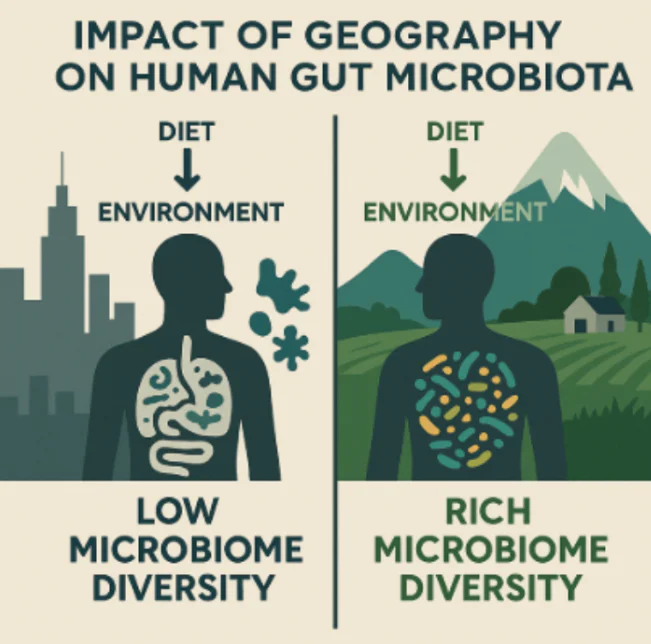
Fig 01: Illustrating how geographical factors—diet and environment—shape gut microbiota diversity in urban versus rural (high-altitude).
Impact of International Travel on Gut Microbiota
Travel exposes individuals to new environments, foods, microbes, and hygiene conditions, often causing temporary but significant shifts in gut microbiota. For a deeper dive into how your gut microbiome impacts daily life and health, read more here: https://www.bugspeaks.com/blog/gut-microbiome-its-impact-on-our-lives/
Study on 159 International Students (Cusco, Peru)
718 stool samples collected before, during, and after travel.
Overall diversity stayed stable, but microbial composition shifted during travel.
Students who developed diarrhea:
Lost microbiome stability.
Showed increased diarrheagenic E. coli with antimicrobial-resistance genes.
These changes persisted weeks after recovery.
Study on Travellers to LMICs (Low- & Middle-Income Countries)
About 40-fold increase in Escherichia/Shigella
89% tested positive for diarrheagenic E. coli upon return
Pre-travel microbiome patterns mattered:
High Ruminococcaceae and Coprococcus → higher risk of DEC colonization.
Higher Anaerostipes → reduced risk.
Overall, international travel leads to transient microbiota disruptions, especially involving pathogenic strains, while long-term diversity often remains stable.
Fig 02: A flat-style infographic illustrating how international travel affects the gut microbiota, showing shifts from stable diversity pre-travel to increased resistome gene enrichment and E. coli/Shigella presence post-travel.
Ethnicity and Gut Microbiota Diversity
Ethnicity combined with cultural food habits, cooking traditions, and lifestyle also significantly influences gut microbiota composition.
A study from Malaysia’s multi-ethnic population found that:
Distinct ethnic groups had different microbial signatures.
This variation existed even within the same geography.
Cultural diets and traditional habits strongly shaped microbial patterns.
This proves that ethnicity, food culture, and lifestyle choices are critical determinants of gut microbial structure.
Strategies to support gut microbiota during travel
Dietary Choices: Consume a variety of fibre-containing foods to promote healthy microbes.
Probiotics: Consider probiotic supplements to maintain microbial balance.
Hydration & Sanitation: Drink safe water and maintain good hygiene to avoid contact with harmful pathogens.
Wise Antibiotic Use: Consume antibiotics only when prescribed by the physicians as they can disrupt gut microbial equilibrium.
Conclusion
The geographical and travel factors have great impacts on the human gut microbiome, reflecting the dynamic interaction between our environment and internal microbial ecosystems. Research indicates that even brief travel can affect the microbial balance, with long-term geographical variation imparting lasting impressions. Understanding these influences can guide strategies to protect and sustain gut health amid changing environmental and lifestyle conditions.
-Shravya B U
References
Boolchandani, M., Blake, K. S., Tilley, D. H., Cabada, M. M., Schwartz, D. J., Patel, S., ... & Dantas, G. (2022). Impact of international travel and diarrhea on gut microbiome and resistome dynamics. Nature communications, 13(1), 7485.
Das, B., Ghosh, T. S., Kedia, S., Rampal, R., Saxena, S., Bag, S., ... & Ahuja, V. (2018). Analysis of the gut microbiome of rural and urban healthy Indians living in sea level and high altitude areas. Scientific reports, 8(1), 10104.
Dwiyanto, J., Hussain, M. H., Reidpath, D., Ong, K. S., Qasim, A., Lee, S. W. H., ... & Rahman, S. (2021). Ethnicity influences the gut microbiota of individuals sharing a geographical location: a cross-sectional study from a middle-income country. Scientific Reports, 11(1), 2618.
Mlangeni, T., Jian, C., Häkkinen, H. K., de Vos, W. M., Salonen, A., & Kantele, A. (2025). Travel to the tropics: Impact on gut microbiota. Travel Medicine and Infectious Disease, 102869.
Smits, S. A., Leach, J., Sonnenburg, E. D., Gonzalez, C. G., Lichtman, J. S., Reid, G., ... & Sonnenburg, J. L. (2017). Seasonal cycling in the gut microbiome of the Hadza hunter-gatherers of Tanzania. Science, 357(6353), 802-806.
Vinogradova, E., Mukhanbetzhanov, N., Nurgaziyev, M., Jarmukhanov, Z., Aipova, R., Sailybayeva, A., ... & Kushugulova, A. (2024). Impact of urbanization on gut microbiome mosaics across geographic and dietary contexts. Msystems, 9(10), e00585-24.