A Comprehensive Guide to Understanding Histamine Intolerance
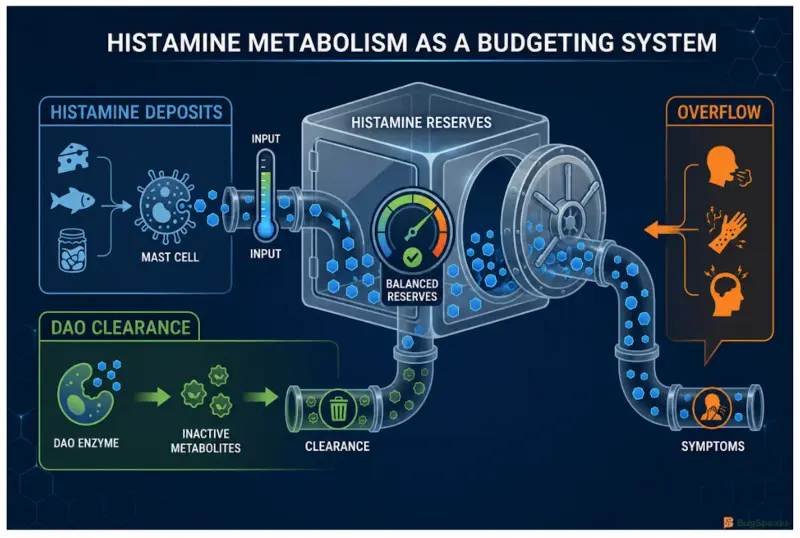
What is a histamine budget and how does your body manage its biological transactions?
Your body manages histamine like a daily money budget, where this chemical acts as a tiny biological currency. In our body, histamine is a natural alarm bell chemical that helps us breathe, wakes us up, and tells the stomach to digest foodSmolinska et al. (2022). Normally, special immune cells called mast cells act as locked vaults, keeping this chemical safely stored inside until there is a real emergencySmolinska et al. (2022). To stay healthy, your body must keep a balanced ledger, making sure you do not accumulate too much histamine currency at once, which could overload your biological budget.
To help you clear out excess histamine from your food, your body uses a wonderful gut budget regulator called diamine oxidase (DAO)Schnedl et al. (2019). This regulator is a helpful digestive enzyme made by enterocytes, which are the tiny absorption cells lining your small intestineSmolinska et al. (2022). As food travels through your gastrointestinal (GI) tract, these helper cells release the DAO, a histamine-degrading enzyme, to vacuum up and break down histamineSchnedl et al. (2019). Inside your cells, another cleanup worker called histamine N-methyltransferase (HNMT) also helps to process this chemical, acting as a secondary regulator in other organsSmolinska et al. (2022).
Every single person is born with a different available histamine budget, meaning some people can easily handle big expenses while others have tiny allowances. If your enterocytes do not produce enough DAO, due to genes or gut irritation, your ability to clear histamine decreasesSmolinska et al. (2022). When your clearing capacity is low, even small transactions can quickly cause a massive budget deficitSchnedl et al. (2019). This unbalanced state is called histamine intolerance (HIT), which is like your body's bank account going into the red and triggering warning sirens because you have run out of metabolic savings.
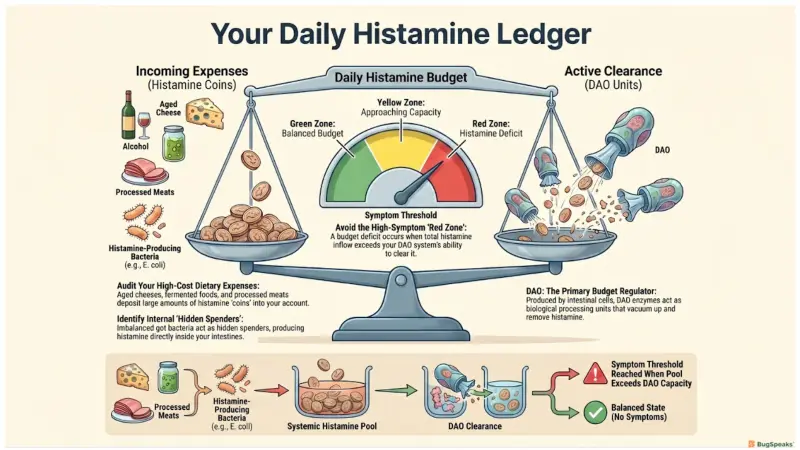
How do the foods you eat act as daily expenses in your histamine budget?
The foods you eat act as daily expenses on your biological budget because many delicious items are packed with high amounts of pre-formed histamine. When food is aged, fermented, or stored for a long time, bacteria break down proteins to produce biogenic aminesSmolinska et al. (2022). Eating aged cheese, chocolate, tomatoes, spinach, and aged meats represents a major transaction, depositing dietary histamine straight into your small intestineSmolinska et al. (2022). Under normal conditions, these food expenses are cleared easily by your gut's budget regulator, but piling too many costly foods into one single meal will quickly exhaust your daily available budget and trigger symptoms.
This dietary inflow can be tricky because different foods carry very different transaction sizes on your daily balance sheet. For instance, fresh, unprocessed foods are completely free transactions that put absolutely zero strain on your DAO budget regulatorSchnedl et al. (2019). On the other hand, fermented products like sauerkraut or aged sausages represent high-cost transactions because microbes have already spent weeks pre-generating huge amounts of histamine inside themSmolinska et al. (2022). If you stack too many of these high-cost items in a short time, you will exceed your personal tolerance limit and experience painful symptoms and a major biological budget crisis.
Furthermore, certain dietary compounds do not contain histamine themselves but act as budget regulator blockers that temporarily freeze your clearing power. For example, drinking alcohol or taking certain medicines directly stops the synthesis of your DAO budget regulator, meaning your cleanup workers cannot do their jobsSmolinska et al. (2022). Other competing amines, like putrescine and cadaverine, found in canned fish, also crowd out histamine, creating a massive biological traffic jamSchnedl et al. (2019). This enzymatic blockade means that even a low-cost food item can cause a budget deficit because your body's cleanup system has been temporarily shut down.
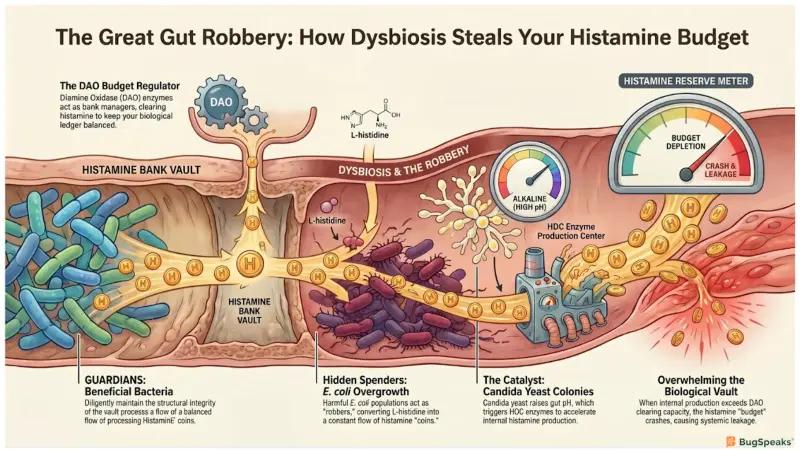
How do bad gut microbes act as hidden spenders that steal your histamine budget?
Bad gut microbes act as hidden spenders that steal your budget by pumping out extra histamine directly inside your intestines without your permission. Normally, your gut is home to a friendly community of microbes and highly protective bacteria that help you digest food safely. However, a state of microbial imbalance called dysbiosis can occur, allowing harmful, histamine-producing bacteria to take over your digestive tractSmolinska et al. (2022). These histamine-producing gut bacteriaconstantly drain your budget from the inside, making it absolutely impossible to balance your daily ledger even if you are eating a very clean diet with zero high-histamine food items.
This internal overgrowth is led by specific, histamine-making gut bacteriathat use their own special biological tools to synthesize histamine from protein foods. Scientific studies show that bacteria like Escherichia coli (E. coli), Enterobacter spp., and Clostridium spp. are highly active histamine producers in the gutRuța et al. (2025). When these microbes digest your food, they convert L-histidine amino acids into histamine currency, creating a constant biological expenditureSmolinska et al. (2022). This continuous internal production acts like a leaky pipe in your biological vault, constantly draining your available funds, creating digestive discomfort, and completely overworking your protective DAO enzymes.
Fungal overgrowths also join forces with these bad bacteria to increase your internal expenditures and damage your protective gut wall. An opportunistic yeast called Candida albicans (C. albicans) is often found growing alongside these histamine-producing bacteria in unbalanced gutsRuța et al. (2025). By releasing alkaline metabolites, this yeast raises the fecal pH, which directly stimulates bad bacteria to produce even more histamineRuța et al. (2025). This bad teamwork weakens your delicate protective gut wall, allowing the undegraded histamine currency to leak easily into your circulating bloodstream, triggering body-wide sensitivity, painful irritation, and a massive biological budget deficit.
What happens to your body when a histamine budget deficit triggers a systemic power surge?
A histamine budget deficit triggers a systemic power surge because excess histamine enters your blood and attaches to receptors in many different organs, causing multiple symptoms. When the undegraded chemical leaks out of the gut, it travels through your entire bodySmolinska et al. (2022). Once in circulation, this free-floating histamine binds to four distinct receptors, which are cellular keyholeslabeled H1R, H2R, H3R, and H4RSmolinska et al. (2022). Because these antennas are located in your skin, brain, heart, and lungs, a single budget deficit can cause skin rashes, headache, and stomach aches all at once, like a power surge blowing out your household electrical fuses.
This multi-system power surge is very clear in your gut, where high histamine levels irritate sensitive nerves and cause painful cramping. In patients suffering from irritable bowel syndrome (IBS), active immune cells release too much histamine right next to sensitive gut nervesSmolinska et al. (2022). This localized chemical surge excites these nerves, causing severe stomach pain, bloating, sudden diarrhea, and hyper-sensitive feelingsSmolinska et al. (2022). The physical pain of IBS is a real electrical response triggered when histamine binds to H1 and H2 receptors on your gut nerves, turning up the pain volume and completely draining your personal energy.
This same gut-based histamine surge can even travel far beyond your gut to affect the sensitive tissue of your bladder. Studies show that young women with recurrent lower urinary tract infections (LUTIs) frequently have the exact same unbalanced gut microbesRuța et al. (2025). The chronic inflammation caused by these histamine-producing gut bacteria weakens the body's natural mucosal defenses, making it easier for urinary infections to take holdRuța et al. (2025). This surprising link shows that an overloaded gut budget creates a body-wide crisis, making other areas of your body sensitive to painful infections and disrupting your daily quality of life.
How can you rebuild your metabolic savings and restore your gut's budget regulator?
You can rebuild your metabolic savings and restore your gut's budget regulator by eating healthy and highly beneficial fresh foods, using enzyme supplements, and supporting your friendly bacteria. First, following a temporary low-histamine diet acts as an excellent cost-cutting plan that lowers your incoming dietary expensesSchnedl et al. (2019). By avoiding expensive items like aged cheese and fermented wine, you let your overworked DAO cleanup enzymes rest, heal, and successfully catch upSmolinska et al. (2022). This diet is highly effective, helping nearly eighty percent of patients successfully balance their biological accounts, lower their daily symptoms, and restore metabolic peace.
Second, you can directly boost your gut's budget regulator by taking helpful and highly potent diamine oxidase enzyme capsules before your meals. Clinical tests prove that taking oral DAO enzyme supplements derived from natural sources significantly improves all of your histamine-related symptomsSchnedl et al. (2019). When patient volunteers took these capsules, their overall symptom scores dropped, and they felt rapid relief from bloating, headache, and abdominal painSchnedl et al. (2019). Taking this supplement before eating acts like a temporary injection of budget-regulating cash, vacuuming up histamine inside your gut before it can spill over and leak into your bloodstream.
Finally, you must support your friendly, acid-loving, and protective gut bacteria to keep the bad, histamine-producing spenders from growing. Nourishing beneficial species like Lactobacillus and Bifidobacterium helps maintain a healthy, slightly acidic environment in your intestineRuța et al. (2025). This natural acid acts as an effective lock, stopping bad bacteria and yeast from overgrowing and secretly spending your budgetRuța et al. (2025). By restoring these protective species, you repair your gut lining and rebuild your long-term metabolic savings and budget balance, allowing you to comfortably enjoy a wide variety of delicious, healthy foods with absolute peace of mind and happiness.
Visualize the process- https://youtu.be/OS3ozpDxQ0E
Reference
Smolinska, S., Winiarska, E., Globinska, A., & Jutel, M. (2022). Histamine: A Mediator of Intestinal Disorders-A Review. Metabolites, 12(10), 895. https://doi.org/10.3390/metabo12100895
Schnedl, W. J., Schenk, M., Lackner, S., Enko, D., Mangge, H., & Forster, F. (2019). Diamine oxidase supplementation improves symptoms in patients with histamine intolerance. Food science and biotechnology, 28(6), 1779–1784. https://doi.org/10.1007/s10068-019-00627-3
Ruța, F., Avram, C., Mardale, E., Maior, R., Filip, C., & Nemeth, S. (2025). Histamine-Producing Intestinal Dysbiosis and Its Role in Lower Urinary Tract Infections and Irritable Bowel Syndrome in Young Women. Nutrients, 18(1), 16. https://doi.org/10.3390/nu18010016
Stuivenberg, G., Daisley, B., Akouris, P., & Reid, G. (2022). In vitro assessment of histamine and lactate production by a multi-strain synbiotic. Journal of food science and technology, 59(9), 3419–3427. https://doi.org/10.1007/s13197-021-05327-7