A Comprehensive Guide to HIIT and Yoga: Impact on Gut Transit Time
How does HIIT affect your digestive transit time?
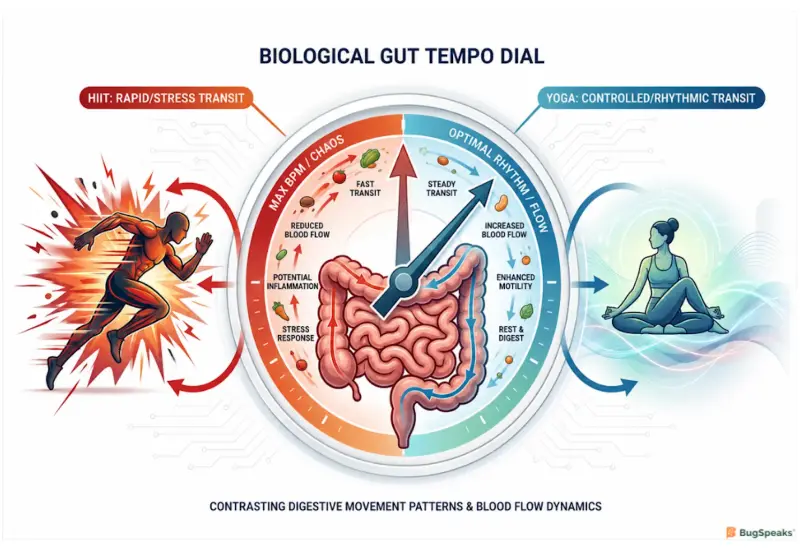
High-intensity interval training (HIIT) creates a rapid biological operating tempo that accelerates your gut transit time by triggering sudden shifts in your nervous system and blood flow redistributionvan Wijck (2011). Think of your digestive system as a musical instrument that plays a song, and different movements change the speed of that song's drumbeat. When you sprint, your body tells your heart to pump most of your blood to your running legs, which means your gut suddenly gets much less blood and oxygen. This quick shift makes your gut change its normal rhythm and operate at a super-fast speed to keep up with your moving legs.
This temporary loss of blood in your digestive organs is called splanchnic hypoperfusion, and it occurs when blood is redirected away from your gut to your active musclesvan Wijck (2011). Just as your leg muscles need extra energy to run fast, your intestinal lining cells, called enterocytes, need oxygen from blood to do their jobs properly. When blood is redirected away from your gut, these cells get a little bit stressed, which can make the gut barrier slightly leaky for a brief moment. This shift forces your body to adapt by speeding up the transit of everything inside your stomach very quickly.
As a result of this quick blood shift, your gut motility, which is how your gut muscles squeeze to push food along, switches to a very rapid operating tempoClauss (2021). This fast squeezing action reduces your overall transit time, meaning food spends less time in your gut and gets pushed out much faster than normal. Knowing how this fast beat affects your digestive system is important because it helps you understand how physical movement acts like a tuning dial. By sprinting, you are telling your gut to move at a faster speed to keep up with your body's heavy exercise.
Why does high-intensity interval training trigger a rapid biological tempo in the gut?
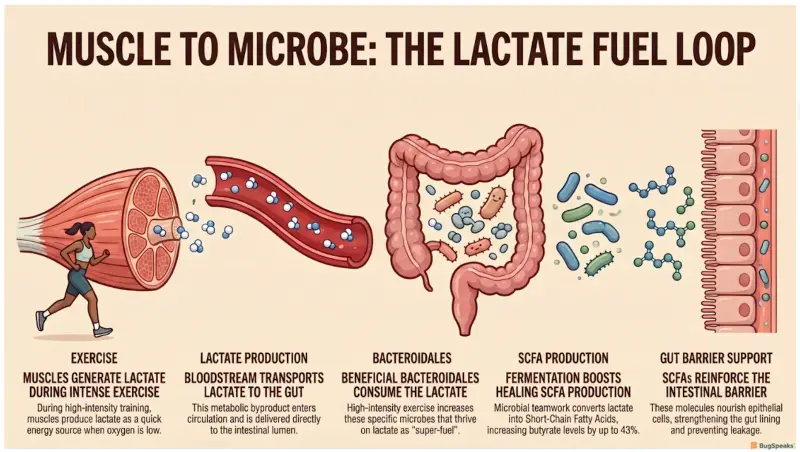
High-intensity interval training triggers a rapid biological tempo in your gut because your hard-working muscles produce a special chemical called lactate that travels to your gutReljic (2025). When you exercise extremely hard, your muscles cannot get enough oxygen, so they make this chemical as a quick source of energy. This muscle fluid flows through your bloodstream and enters your digestive tract, acting like an alarm clock that wakes up the entire gut environment. This sudden chemical arrival signals to your digestive system that your body is moving at a highly energetic speed, urging your gut to match that fast pace.
Once this chemical reaches your gut, it acts like super-fuel for a group of helpful, fast-tempo bugs living inside your microbiomeReljic (2025). These friendly little microbes love to eat this muscle byproduct, and they quickly consume it to produce healthy compounds called short-chain fatty acids that keep your body energized. This fast-paced chemical teamwork shows that your gut is not just a passive tube that sits there while you run. Instead, your gut actively communicates with your muscles, adjusts its own work rhythm, and creates useful energy molecules to match the heavy exercise you are currently doing in your workouts.
This rapid metabolic tempo also tells your brain and nerves to prepare for quick energy usage by speeding up how your intestines process nutrientsClauss (2021). The blood shift and chemical signals work together to ensure that your digestive system does not waste energy on slow digestion when your legs need to run. This fast tempo is extremely helpful for building stronger muscles and a highly responsive body over time. However, to keep your gut healthy and perfectly balanced, you also need to practice slow, relaxing movements that bring back a normal digestive rhythm. This balance keeps your body strong.
How does yoga establish a controlled, restorative biological tempo for digestion?
Yoga establishes a controlled, restorative biological tempo for digestion by turning on your body's rest-and-digest system and bringing blood back to your gutMath (2025). When you stretch your body, bend deeply, and breathe slowly in yoga, you are turning off the stressful fight-or-flight response that hard workouts trigger. This calm state allows your blood vessels to open up wide, sending a steady, nourishing flow of oxygen directly to your gut. This gentle, nourishing blood delivery helps your digestive organs relax, heal from exercise stress, and function at a very smooth, steady pace. This is how we keep our gut.
This peaceful, calm state of your nervous system is called parasympathetic tone, and it acts like a soothing brake pedal that slows down your body's speedMath (2025). While fast exercises push the gas pedal and accelerate your digestion, mindful stretching tells your gut muscles to squeeze in a very gentle and regular rhythm. This controlled squeezing greatly improves your transit time, making sure food moves slow enough for your body to absorb all the vital nutrients and vitamins. By practicing these calm, gentle poses daily, you allow your gut to rebuild its strength, lower inflammation, and recover completely.
Furthermore, this slow, peaceful tempo gives your enterocytes plenty of time to repair themselves and rebuild a strong intestinal barrierMath (2025). With plenty of blood flow and no stress, these gut cells can stick tightly together to prevent bad germs and toxins from entering your bloodstream. This natural healing process is why yoga is so wonderful for keeping your gut from feeling bloated, sore, or upset after you eat meals. It proves that giving your gut a quiet, relaxing break is just as important for your health and digestion as working out hard in the gym.
In what ways does the gut microbiome adapt its community structure to different exercise intensities?
The gut microbiome adapts its community structure by changing the types and balance of tiny bugs that live inside your gut depending on your exercise intensityDenou (2016). Your gut is home to trillions of helpful, tiny bacteria that act like a small, busy community. When you change how hard you exercise, you are changing the environment of this inner garden, which helps certain bugs grow while others do not. This natural shift helps your whole body stay healthy and energetic by ensuring you have the right team of microbes to match your daily activity and energy levels.
For example, high-intensity exercise like HIIT helps increase a friendly, active group of fast-tempo bugs known as Bacteroidales, which love fast environmentsDenou (2016). Sprinting regularly helps increase the ratio of Bacteroidetes to Firmicutes bacteria, which is a sign of a highly active and healthy digestive system in both humans and animals. These fast-paced, helpful bugs are excellent at converting exercise byproducts and lactate into quick energy for your body to use. This means that pushing your body hard during your workouts actually helps cultivate a strong, active, and highly cooperative team of microbes inside your gut. This team works hard to keep you healthy.
On the other hand, relaxing, gentle exercises like yoga support calm, fiber-loving bacteria like Akkermansia and Faecalibacterium, which protect your gut wall from damageMath (2025). These friendly microbes feed on your gut's natural mucus and dietary fiber to create a thick, protective shield that blocks bad germs from entering. By combining fast-running sessions and slow stretching, you feed both types of helpful bugs, making your microbial garden highly diverse and strong. This balance ensures that your gut can handle any stress, lower inflammation, and digest your meals with complete ease every single day. These bugs are like tiny guards for your gut
How can we actively tune our internal digestive tempo for long-term metabolic health?
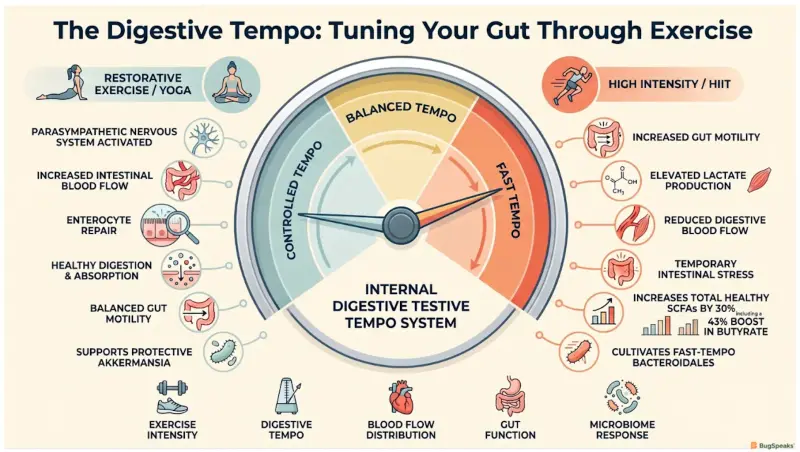
We can actively tune our internal digestive tempo for long-term metabolic health by strategically alternating between high-intensity intervals and relaxing, mindful stretching like yogaClauss (2021). While sprinting builds a fast, active digestive system, slow stretching repairs the gut lining and stabilizes your overall gut motility. Each type of movement trains a completely different speed of digestion in your body. Strategically choosing your weekly workouts allows you to balance physical fitness with gut comfort for a happy gut and a strong, healthy body.
This protective power of an active, healthy gut is shown in gnotobiotic research, where scientists transplant microbes from fit, active animals into germ-free onesAllen (2017). Remarkably, the animals that received the active, exercised bugs were highly protected against gut swelling, possessed much thicker protective mucus, and maintained a much healthier body weight. This exciting, modern science proves that the exercise habits we choose actually program our tiny gut bugs to protect us from sickness. It highlights why keeping your gut bugs fit and active is so vital for your overall health, digestion, and daily energy. These little bugs work hard to keep you safe.
To find your perfect balance of speed and rest, you can keep a simple food and exercise diary to track how your gut feelsJia (2020). Writing down when you run fast or stretch gently acts like a map that shows whether your gut tempo is running too fast or too slow. With this helpful information, you can easily choose the exact physical activities and foods needed to balance your entire system. By actively tuning your internal digestive speed, you can protect your delicate gut lining, support your friendly microbes, and unlock long-term energy for a healthy and highly active life.
Visualize the process- https://youtu.be/L34eeTRJF_Q
Reference
Denou, E., Marcinko, K., Surette, M. G., Steinberg, G. R., & Schertzer, J. D. (2016). High-intensity exercise training increases the diversity and metabolic capacity of the mouse distal gut microbiota during diet-induced obesity. American journal of physiology. Endocrinology and metabolism, 310(11), E982–E993. https://doi.org/10.1152/ajpendo.00537.2015
Reljic, D., Hermann, H. J., Dieterich, W., Neurath, M. F., & Zopf, Y. (2025). Exercise improves gut microbial metabolites in an intensity-dependent manner: a pooled analysis of randomized controlled trials. Gut microbes, 17(1), 2579354. https://doi.org/10.1080/19490976.2025.2579354
Clauss M, Gérard P, Mosca A and Leclerc M (2021) Interplay Between Exercise and Gut Microbiome in the Context of Human Health and Performance. Front. Nutr. 8:637010. doi: 10.3389/fnut.2021.637010
Math, R. K., Javaregowda, P. K., & Patil, S. G. (2026). Effect of Yoga and Meditation on Human Gut Microbiota: A Systematic Review. International journal of yoga, 19(1), 41–53. https://doi.org/10.4103/ijoy.ijoy_15_25
van Wijck, K., Lenaerts, K., van Loon, L. J., Peters, W. H., Buurman, W. A., & Dejong, C. H. (2011). Exercise-induced splanchnic hypoperfusion results in gut dysfunction in healthy men. PloS one, 6(7), e22366. https://doi.org/10.1371/journal.pone.0022366
Allen, J. M., Mailing, L. J., Cohrs, J., Salmonson, C., Fryer, J. D., Nehra, V., Hale, V. L., Kashyap, P., White, B. A., & Woods, J. A. (2018). Exercise training-induced modification of the gut microbiota persists after microbiota colonization and attenuates the response to chemically-induced colitis in gnotobiotic mice. Gut microbes, 9(2), 115–130. https://doi.org/10.1080/19490976.2017.1372077