How does wearing high heels disrupt our pelvic alignment and digestive flow?
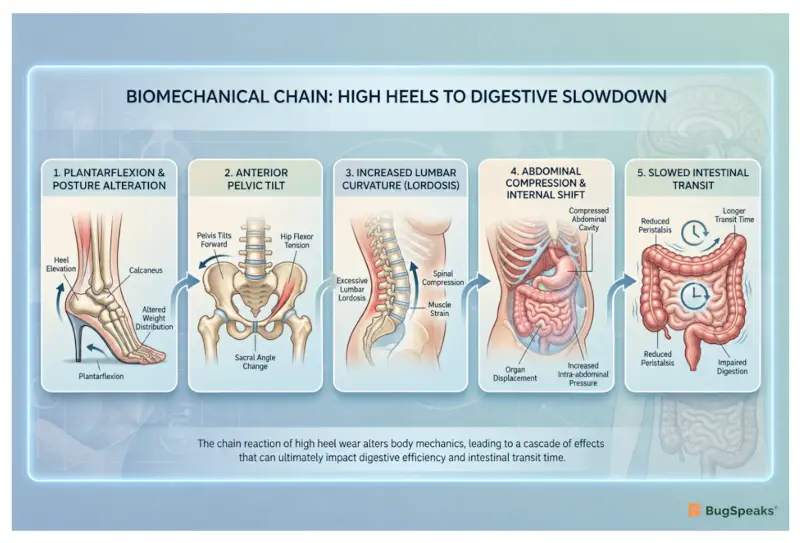
Wearing high heels disrupts pelvic alignment and digestive flow by forcing postural adjustments that tilt the pelvis and squeeze the intestines. Elevated heels hold the feet in a position called ankle plantarflexion that points the toes downward and shifts weight forwardRussell (2010). To remain upright, your body pulls your torso backward, altering your pelvic angleRussell (2010). This shift causes an increased anterior pelvic tilt or exaggerated lumbar lordosisRussell (2010). This postural change is not just about bone alignment; it actually narrows the physical space inside your lower abdomen. These structural changes compress your lower belly and place continuous physical pressure on your internal digestive organs.
This constant pressure from altered posture compresses the lower abdominal cavity and restricts the natural pathways that your food must travel. The human body is designed to stand on flat ground where muscles can relax and work in harmonyHolowka et al. (2018). When the heels are raised, the muscles in your lower back and thighs must tighten continuously to keep you standing uprightRussell (2010). This constant tightness acts like an external band squeezing your belly, reducing the space available for your food to move. Because of this pelvic tilt, the lower intestines are squished together, making the transit of waste slow down.
In addition to mechanical squeezing, the altered pelvic angle disrupts the electrical signals that coordinate the entire movement of your gut. The nervous system that controls digestion is deeply connected to your pelvic alignment and muscular balanceTang et al. (2025). When the pelvis is tilted forward, it stretches the nerves in your lower spine and irritates the surrounding tissuesRussell (2010). This chronic nerve stretch can slow down the speed of the signals that tell your intestines when to contract. As a result, the natural flow of digestion is interrupted, laying the foundation for long-term waste stagnation and bowel sluggishness.
How do posture and breathing mechanics build our internal digestive environment?
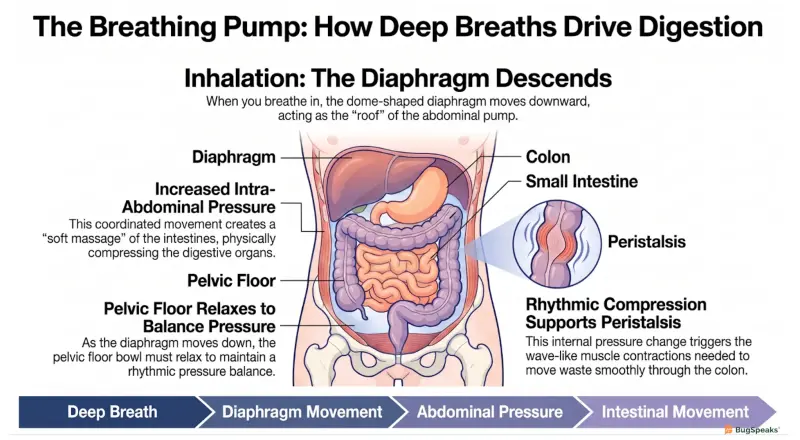
Our posture and breathing mechanics build our internal digestive environment by acting as a natural pump that moves food through our intestines. At the top of this breathing pump is the diaphragm, a large dome-shaped muscle located right under your ribsTang et al. (2025). When you breathe in deeply, this muscle moves down and gently pushes on your stomach and intestines. This downward motion acts like a soft massage that keeps your food moving smoothly. Good posture allows this breathing muscle to move up and down fully, creating the healthy pressure needed for your entire digestive tract to operate every single day of your life.
At the bottom of this dynamic pump is the pelvic floor, a muscle that supports your bladder and gutTang et al. (2025). For the digestive pump to work well, this muscle must relax when your breathing muscle moves down, creating a balanced rhythm. However, standing on high heels tilts the pelvis forward and forces these lower muscles to stay tight to help you balanceLee and Yoo (2011). This constant tightness blocks the downward motion of your breathing muscle, stopping the gentle massage your organs need. Without this coordinated movement, your internal pressure balance is broken, which slows your digestive system down.
This lack of coordinated pressure from proper breathing and posture stops the rhythmic squeezing called peristalsis that moves waste through your intestines. In a healthy body, the rhythmic squeezes of your digestive tube are helped by the natural motion of your breathing and walkingTang et al. (2025). But when your posture is stiff from high heels, the abdominal muscles must work too hard to keep you balancedRussell (2010). This extra muscle tension squishes the intestines and completely stops the natural muscular waves. As a result, the food remains stuck in one place for too long, leading directly to a complete digestive slowdown and constipation.
What happens when the pelvic floor and core muscles lose their coordination?
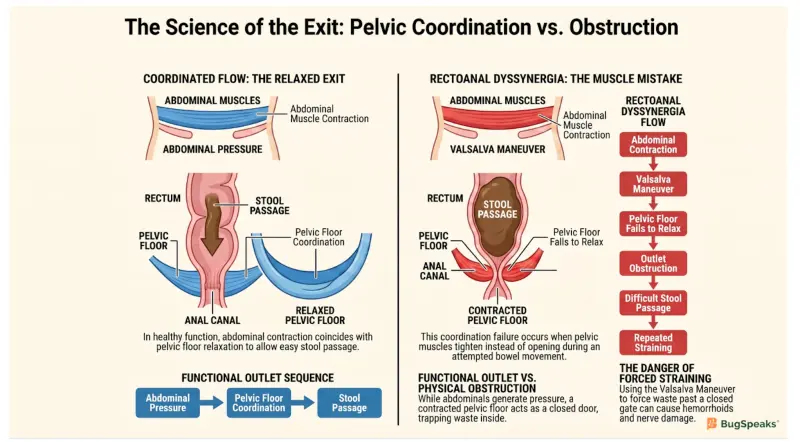
When the pelvic floor and core muscles lose their coordination, they create a physical blockage that traps digestive waste inside the lower body. To release waste, your belly muscles must gently push while your lower muscle bowl relaxes (Tang et al. (2025). But wearing high heels forces your pelvic muscles to stay contracted to keep you balanced, preventing them from relaxingLee and Yoo (2011). This tension causes a coordination failure called rectoanal dyssynergia, where the exit muscles squeeze shut instead of opening during a bowel movement. This mistake blocks the path for waste, making normal defecation very difficult and painful.
Because of this muscle blockage, many people resort to a forced breathing method called the Valsalva maneuver to push waste out. This action involves holding your breath and straining down hard, using your chest and belly muscles to force the waste past the closed muscle gateTang et al. (2025). While this straining might feel necessary, it places huge pressure on your lower abdomen and the blood vessels in your rectum. Over time, this excessive pressure can cause painful swelling, hemorrhoids, and even damage to your pelvic nerves. It also makes the pelvic muscles even tighter, worsening the coordination problem instead of fixing it.
The lack of coordination between these core muscles also prevents the natural reflex that tells your brain when it is time to go. Normally, when waste enters the lower colonic area, it stretches the walls and signals your nervous system to relaxTang et al. (2025). But when your pelvis is tilted from high heels, the constant muscle squeezing confuses these sensory nerves, making them less sensitive over time. The body eventually forgets how to coordinate the pushing and relaxing movements naturally. This severe loss of coordination ensures that waste stays trapped inside, making constipation a difficult daily struggle for many people.
How does slow transit time lead to serious gastrointestinal discomfort?
Slow transit time leads to serious gastrointestinal discomfort because waste stays in your body too long, causing it to dry out and stretch your intestines. When waste remains in the large intestine for more than seventy-two hours, a condition called slow transit constipation occursTang et al. (2025). Your colon continually absorbs water from the waste, so the longer it sits there, the drier and harder it becomes. These hard lumps stretch the sensitive walls of your gut, causing painful cramps, severe bloating, and abdominal gas. This continuous stretching also irritates your gut lining, leading to a constant feeling of fullness.
Over time, this slow movement damages the specialized electrical pacemakers called interstitial cells of Cajal that keep your intestines squeezing. These tiny pacemaker cells are responsible for generating the regular electrical waves that coordinate your gut musclesTang et al. (2025). When dry waste stretches the gut wall for days, it puts massive stress on these pacemaker cells and causes them to break down. Without these pacemakers, your intestines lose their ability to make rhythmic squeezes, meaning they cannot push waste forward at all. This severe cellular damage turns a temporary slowdown into a long-lasting, highly stubborn, and painful digestive problem.
The constant stretching also damages the myenteric plexus, the local network of nerves located inside your intestinal walls that controls digestion. This network acts like a local brain, telling your gut muscles exactly how and when to squeezeTang et al. (2025). Long-term stretching and pressure from trapped waste can cause these nerve fibers to thin out or break apartTang et al. (2025). When these nerves are damaged, they cannot release the chemical messengers such as Acetylcholine, substance P needed to stimulate healthy muscle contractions. This lack of nerve communication keeps your gut muscles completely relaxed and inactive, making it even harder to clear the trapped waste from your body.
How can we restore our pelvic balance and core coordination to improve transit?
We can restore our pelvic balance and core coordination to improve transit by wearing flat shoes and practicing exercises that realign the pelvis. Transitioning away from elevated heels to flat, minimal shoes allows your weight to distribute evenly across your feetHolowka et al. (2018). This flat foundation immediately unloads the tense muscles in your lower back and allows your pelvis to tilt back into its natural, relaxed position. Once the pelvis is straight, your breathing muscles and lower pelvic muscles can work together in harmony again. This relieved muscle tension removes the physical squeeze on your gut, allowing waste to travel normally.
To help support this proper alignment, we can use a physical therapy method called anterior pelvic tilt taping on our lower back skin. This technique uses flexible tape applied to the lower back and hips to gently pull and hold the pelvis in a straight positionLee and Yoo (2011). The tape acts as a physical reminder, keeping your body from slumping or tilting forward while you sit and stand. Research shows that this taping helps tired core muscles maintain proper posture over timeLee and Yoo (2011). By keeping your hips straight, the tape stops your gut muscles from tightening up and squeezing your digestive organs
Rebuilding our foot strength by walking barefoot or in minimal sandals also helps support this pelvic alignment by strengthening key foot muscles like the abductor hallucisHolowka et al. (2018). This arch-supporting muscle, called the abductor hallucis, runs along the inside of your foot to keep you balanced, helps support your arch, and keeps your entire body stable from the ground upHolowka et al. (2018). When you strengthen your feet, your walk becomes more stable, reducing the need for your pelvis to tilt forward to keep balance. This stable ground support prevents your lower back from arching excessively and keeps your core muscles relaxed. By making your feet strong to straighten your whole body, you give your intestines the relaxed space they need to work
Visualize the process- https://youtu.be/TCnpZIN9AL0
Reference
Lee, J. H., & Yoo, W. G. (2011). The mechanical effect of anterior pelvic tilt taping on slump sitting by seated workers. Industrial health, 49(4), 403–409. https://doi.org/10.2486/indhealth.ms1230
Takahashi T. (2013). Interdigestive migrating motor complex -its mechanism and clinical importance. Journal of smooth muscle research = Nihon Heikatsukin Gakkai kikanshi, 49, 99–111. https://doi.org/10.1540/jsmr.49.99
Russell B. S. (2010). The effect of high-heeled shoes on lumbar lordosis: a narrative review and discussion of the disconnect between Internet content and peer-reviewed literature. Journal of chiropractic medicine, 9(4), 166–173. https://doi.org/10.1016/j.jcm.2010.07.003
Tang, X., Huang, Y., Jiang, T., Wu, J., Wang, K., & Wu, W. (2025). Pathophysiological mechanisms, diagnostic innovations, and multimodal therapeutic strategies for slow transit constipation. BMC gastroenterology, 25(1), 810. https://doi.org/10.1186/s12876-025-04387-9
Zhou, Q., & Verne, G. N. (2025). Molecular Mechanisms and Pathways in Visceral Pain. Cells, 14(15), 1146. https://doi.org/10.3390/cells14151146
Holowka, N. B., Wallace, I. J., & Lieberman, D. E. (2018). Foot strength and stiffness are related to footwear use in a comparison of minimally- vs. conventionally-shod populations. Scientific reports, 8(1), 3679. https://doi.org/10.1038/s41598-018-21916-7