Why Does Your Gut Ignore the "Healthy" Labels on Trendy Foods?
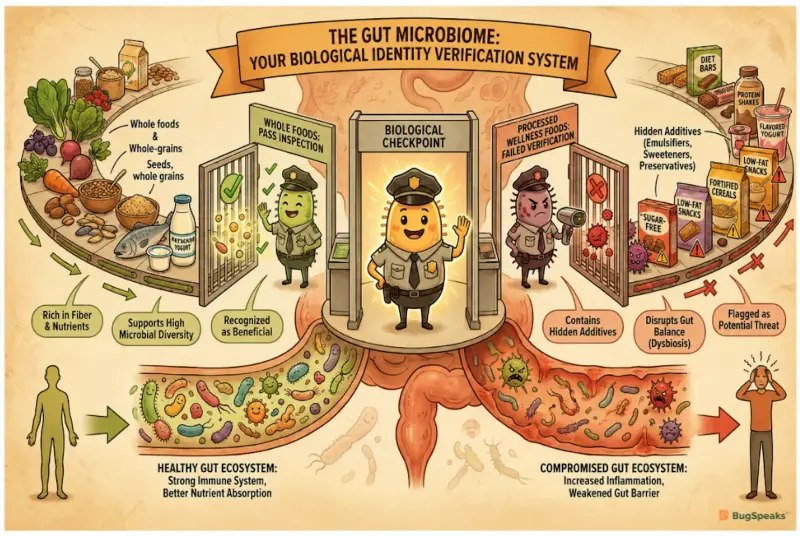
Your gut microbiome ignores the friendly marketing labels on trendy wellness foods because it only responds to the actual chemical ingredients that enter your bodyZhou et al. (2023). To understand how this works, we can look at your digestive system as a Biological Identity Verification System. In this system, the colorful front of the package is just a public identity, which is often a misleading badge designed to make you feel goodZhou et al. (2023). Your gut bacteria act as the objective evaluator, ignoring the front cover entirelyZhou et al. (2023). They examine the back of the package, which is the real biological identity of the food, to decide if it is safeZhou et al. (2023).
When you swallow food, your gut microbiome immediately inspects the incoming molecules to see how they affect your living microscopic environmentZhou et al. (2023). Processed wellness items like protein bars often use high-tech marketing labels to bypass your conscious safety checksZhou et al. (2023). However, your microscopic evaluators do not care about trendy health claims or clean packaging designsZhou et al. (2023). They only read the raw physical structure of the food to see if it supports or harms your internal balanceZhou et al. (2023). If the ingredients are artificial, the evaluators flag the food as a mismatch, which instantly changes your gut response and leads to a failed verification outcomeZhou et al. (2023). Indeed, your tiny gut bacteria are highly selective.
Eating foods with a mismatched biological profile can cause your helpful bacteria to struggle, allowing harmful bacteria to grow (Zhou et al. (2023). When you eat whole foods like apples, your gut bacteria easily recognize the natural fibers and pass them through the security gateZhou et al. (2023). Processed foods, however, often contain hidden chemical additives that act as disruptive chemical features Zhou et al. (2023). This confuses your gut bacteria, which can rapidly lower your overall microbial diversity and cause serious digestive issuesZhou et al. (2023). Choosing foods based on their real biological identity ensures your gut remains a stable and healthy environmentZhou et al. (2023).
How Do Chemical Mixers in Protein Bars Damage Your Protective Gut Wall?
Chemical mixers called emulsifiers damage your protective gut wall and wash away your natural defensive mucus layerChassaing et al. (2015). These mixers are added to creamy protein shakes and healthy-looking snack bars to stop ingredients from separatingChassaing et al. (2015). In your body's verification system, this mucus layer acts as a crucial safety barrier that keeps unscreened bacteria from directly touching your sensitive tissue Chassaing et al. (2015). When you consume these detergent-like food additives, they dissolve this physical barrier immediatelyChassaing et al. (2015). This allows bacteria to get too close to your intestinal walls, causing a dangerous security breach known as microbiota encroachment in your gutChassaing et al. (2015).
When gut bacteria break through the protective mucus barrier, they touch your intestinal cells and trigger a wave of gut inflammationChassaing et al. (2015). This unwanted contact activates special alarm sensors on your cells called toll-like receptor 4 (TLR4) and toll-like receptor 5 (TLR5)Chassaing et al. (2015). These sensors detect bacterial parts like flagellin and lipopolysaccharide (LPS), which are segregated away from the intestinal wallChassaing et al. (2015). Once these alarms go off, your body releases inflammatory chemicals, leading to low-grade intestinal inflammation and increased intestinal permeabilityChassaing et al. (2015). This means your gut barrier becomes leaky, allowing harmful substances to enter your bloodChassaing et al. (2015).
A leaky gut barrier caused by consuming emulsifiers can eventually lead to weight gain, high blood sugar, and metabolic syndromeChassaing et al. (2015). When your intestinal cells are constantly irritated, your body's metabolic controls stop working properly, causing you to feel hungry and eat moreChassaing et al. (2015). Research shows that common mixers like carboxymethylcellulose (CMC) and polysorbate-80 (P80) can easily cause these metabolic problemsChassaing et al. (2015). Even tiny amounts of these food additives can trigger inflammation and alter your gut's microbial compositionChassaing et al. (2015). Removing these chemical mixers from your daily diet is a very simple and effective way to protect your delicate gut wall and keep your metabolism running smoothlyChassaing et al. (2015).
Why Do Low-Calorie Sweeteners Cause Painful Gas and Belly Bloating?
Low-calorie sweeteners cause painful gas and bloating because your body cannot absorb them easily, leaving them for bacteria to fermentLenhart and Chey (2017). These alternative sweeteners, also known as polyols, are popular in sugar-free chocolates, protein bars, and keto treatsLenhart and Chey (2017). Unlike normal sugars, they have a unique molecular structure that makes them very difficult for your body to digestLenhart and Chey (2017). Because they travel through your small intestine without being absorbed, they arrive completely intact in your large intestineLenhart and Chey (2017). Here, gut bacteria quickly gather around these leftover sweeteners, using them as easy fuel and creating a large amount of trapped, painful gasLenhart and Chey (2017).
The slow absorption of these sweeteners in the small intestine is caused by their relying on slow, unassisted passive diffusionLenhart and Chey (2017). Because your body lacks specific transport gates for these molecules, they can easily overwhelm your digestive tractLenhart and Chey (2017). When you consume large amounts, this slow movement creates a strong osmotic effect, which means the sweeteners draw water into your bowelLenhart and Chey (2017). This excess water speeds up your digestion, resulting in loose stools and an uncomfortable laxative effectLenhart and Chey (2017). The combination of trapped gas and excess water stretches your intestines, altering your visceral sensation and causing painful cramps, as reviewed byLenhart and Chey (2017).
While some sugar alcohols can act as prebiotics to help good bacteria grow, they still present a high risk of digestive upsetLenhart and Chey (2017). For example, moderate amounts of sweeteners like isomalt and lactitol can increase the abundance of beneficial bifidobacteriaLenhart and Chey (2017). However, the physical distress they cause often outweighs these minor benefits, especially for people with sensitive digestive tractsLenhart and Chey (2017). Different sweeteners have different molecular weights, meaning some draw more water than othersLenhart and Chey (2017). Understanding how these sugar replacers behave inside your body helps you make better dietary choicesLenhart and Chey (2017). Avoiding these fake sweeteners prevents painful fermentation and keeps your stomach feeling calm and comfortableLenhart and Chey (2017).
How Does Sweet Juice Overpower Your Body's Sugar Highway?
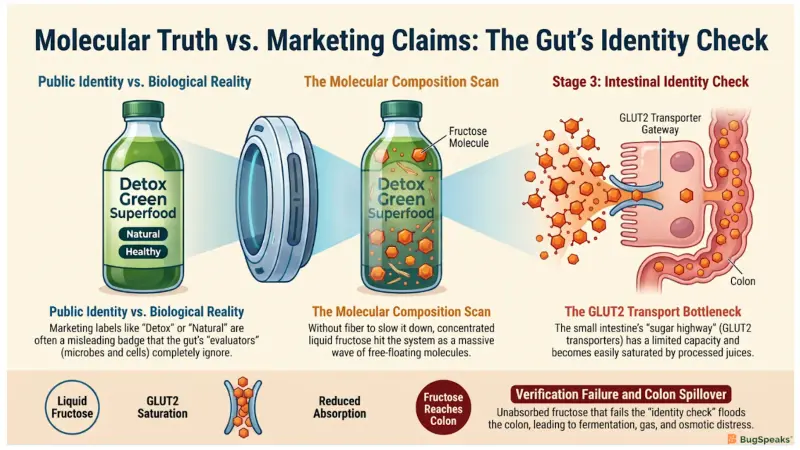
Sweet green juices and agave syrups overwhelm your body's sugar highway because they contain highly concentrated fructose that your intestine cannot absorbDiNicolantonio and Lucan (2015). Many people believe that liquid fruit sugars are always healthy, but your body can only process small amounts at a timeDiNicolantonio and Lucan (2015). The absorption of fructose in your small intestine relies on a specific transport gateway called glucose transporter 2 (GLUT2)DiNicolantonio and Lucan (2015). When you drink concentrated green juices, a massive wave of sugar suddenly hits this gateway and completely clogs the systemDiNicolantonio and Lucan (2015). This bottleneck causes a major verification failure, leaving large amounts of unabsorbed fructose floating freely inside your digestive tractDiNicolantonio and Lucan (2015).
This unabsorbed fruit sugar travels directly into your large intestine, where colonic bacteria ferment it and cause severe abdominal symptomsDiNicolantonio and Lucan (2015). This rapid fermentation process produces short-chain fatty acids (SCFAs), hydrogen gas, and carbon dioxide, which stretch your sensitive gutDiNicolantonio and Lucan (2015). This excess sugar also draws water into your colon, leading to osmotic diarrhea, painful cramps, and embarrassing bloatingDiNicolantonio and Lucan (2015). These painful gastrointestinal symptoms closely mimic irritable bowel syndrome (IBS), making many people believe they have a chronic illness when they are simply experiencing sugar overloadDiNicolantonio and Lucan (2015). This direct link between fruit sugar malabsorption and digestive distress was explained in detail byDiNicolantonio and Lucan (2015).
To protect your sugar highway from getting clogged, you should consume whole fruits instead of highly concentrated liquid juicesDiNicolantonio and Lucan (2015). Whole fruits contain natural fibers that slow down digestion, allowing your transport gateways to process the fructose without getting overwhelmedDiNicolantonio and Lucan (2015). When you drink processed juices, the protective fiber is completely removed, turning a healthy snack into a sugary waveDiNicolantonio and Lucan (2015). Liquid sweeteners like agave syrup are especially risky because they contain very high concentrations of fructoseDiNicolantonio and Lucan (2015). Choosing whole, unprocessed foods keeps your sugar transport system running smoothlyDiNicolantonio and Lucan (2015). This simple change prevents painful fermentation and helps maintain a balanced, diverse, and healthy gut microbiomeDiNicolantonio and Lucan (2015).
Why Does Combining Fake Fibers and Chemicals Fail Your Gut's Safety Check?
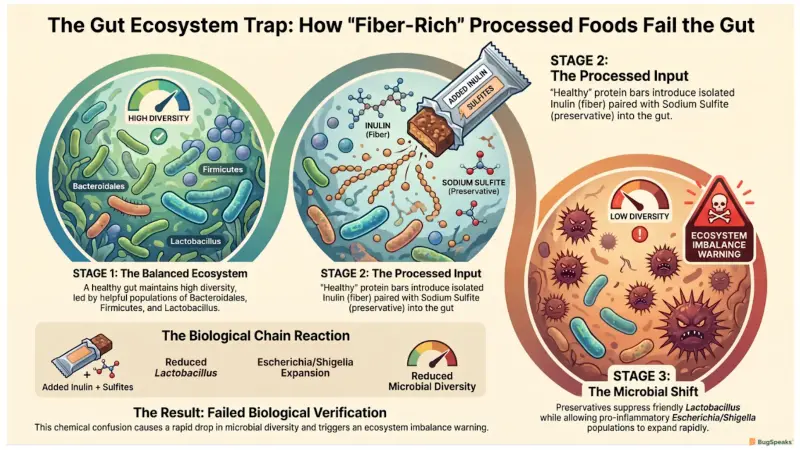
Combining added fibers like inulin with chemical additives in processed foods fails your gut's safety check and causes severe digestive chaosZhou et al. (2023). Many commercial wellness brands add isolated fibers to protein bars to make their marketing labels look healthierZhou et al. (2023). However, these fake fibers are highly fermentable, meaning your gut bacteria eat them much faster than natural fibers found in real plantsZhou et al. (2023). When these synthetic fibers are combined with harsh chemical preservatives like sodium sulfite, they create a confusing biological identityZhou et al. (2023). Your gut bacteria cannot process this strange mixture properly, which quickly disrupts your microbial diversity and alters the delicate balance between Bacteroidales and Firmicutes phylaZhou et al. (2023).
This chemical confusion can significantly alter the species composition of your gut, reducing helpful bacteria while encouraging harmful microbes to growZhou et al. (2023). For instance, helpful bacteria like Lactobacillus and Bifidobacterium are highly sensitive to food additives and can be easily destroyed by themZhou et al. (2023). At the exact same time, chemical preservatives can promote the growth of pro-inflammatory bacteria like Escherichia/Shigella, as shown byZhou et al. (2023). This shift in your gut community increases the overall pro-inflammatory potential of your microbiomeZhou et al. (2023). Instead of supporting your health, these processed wellness items can trigger low-grade intestinal inflammation, increase gut permeability, and weaken your immune systemZhou et al. (2023).
The best way to pass your gut's biological check is to choose simple, whole foods that do not contain complex chemical mixturesZhou et al. (2023). Real wellness comes from eating a variety of whole plants, which provide natural fibers that your gut bacteria loveZhou et al. (2023). These natural foods support your intestinal barrier integrity and help produce beneficial metabolites like short-chain fatty acidsZhou et al. (2023). Processed items with long, confusing ingredient lists will always struggle to pass your internal security checksZhou et al. (2023). By understanding the difference between marketing claims and biological reality, you can feed your body what it truly needsZhou et al. (2023). Your gut microbiome will reward you with excellent digestion and lasting healthZhou et al. (2023).
Visualize the process- https://youtu.be/R-WdjzHec_Q
Reference
Chassaing, B., Koren, O., Goodrich, J. K., Poole, A. C., Srinivasan, S., Ley, R. E., & Gewirtz, A. T. (2015). Dietary emulsifiers impact the mouse gut microbiota promoting colitis and metabolic syndrome. Nature, 519(7541), 92–96.https://doi.org/10.1038/nature14232
Lenhart, A., & Chey, W. D. (2017). A Systematic Review of the Effects of Polyols on Gastrointestinal Health and Irritable Bowel Syndrome. Advances in nutrition (Bethesda, Md.), 8(4), 587–596.https://doi.org/10.3945/an.117.015560
DiNicolantonio, J. J., & Lucan, S. C. (2015). Is fructose malabsorption a cause of irritable bowel syndrome?. Medical hypotheses, 85(3), 295–297.https://doi.org/10.1016/j.mehy.2015.05.019
Zhou, X., Qiao, K., Wu, H., & Zhang, Y. (2023). The Impact of Food Additives on the Abundance and Composition of Gut Microbiota. Molecules (Basel, Switzerland), 28(2), 631.https://doi.org/10.3390/molecules28020631