Understanding Your Skin's Natural Shield: The Importance of Gentle Cleansing
How Does the Skin Naturally Regulate Its Moisture and Maintain a Stable Surface Climate?
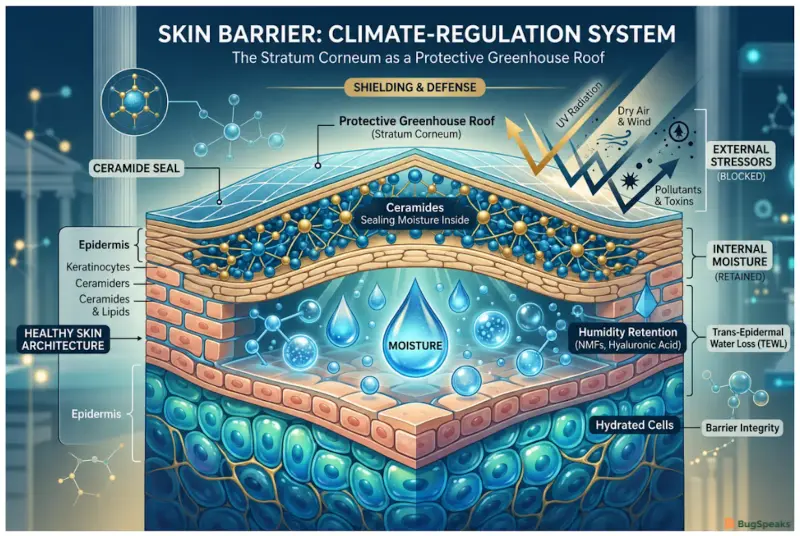
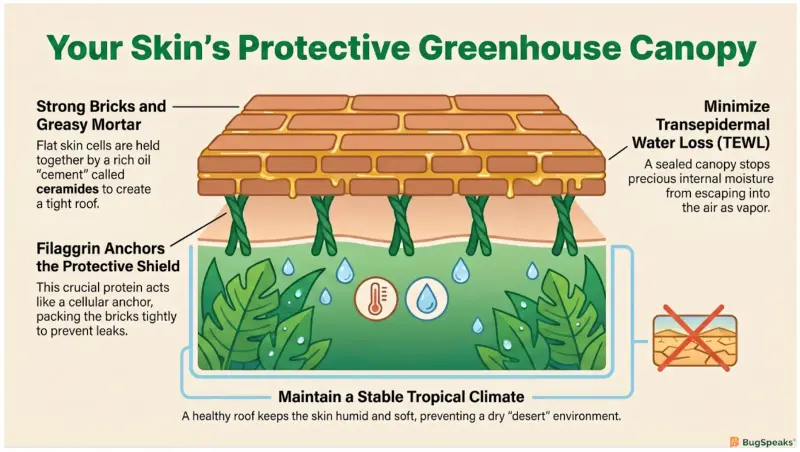
The skin keeps its moisture inside by using a natural, protective wall made of tiny biological bricks and greasy mortar that acts like a greenhouse ceiling. In science, we call this outer shield the stratum corneum [SC], and it acts as our body's personal surface climate canopyPrescott et al. (2017). The bricks are flat cells, and the mortar is made of special oils called ceramidesPrescott et al. (2017). Just like a roof keeps rain from leaking in and warmth from escaping, this canopy keeps water from floating away into the dry air, ensuring our skin's local weather stays perfectly balanced, humid, and healthy every day.
This special canopy gets its strength from a tiny protein that acts like a cellular anchor inside the bricks. This building block is called filaggrin, and it helps flat skin cells pack together tightly to block harsh wind, hot sun, and microscopic dust to guard our bodyPrescott et al. (2017). Without this protein, our skin's barrier becomes weak and leaky, letting precious humidity escape too quickly into the atmosphere. When the ceiling is strong, it traps water below the surface, creating a steady and comfortable tropical climate that lets our skin look soft and smooth instead of rough and dry.
When this canopy is damaged, we experience a major climate problem where water leaks out of our cells constantly. Scientists measure this water loss and call it transepidermal water loss [TEWL], which is like a constant vapor leak in our skinDraelos et al. (2023). If the TEWL level rises too high, our skin's balanced climate collapses, and we start to feel uncomfortable dryness, irritation, and peeling. By protecting our natural SC shield and keeping our ceramides safe, we stop this vapor leak from happening to keep us healthy, ensuring that our skin's climate remains rich in moisture and completely stable.
What Happens to the Skin’s Surface Climate When We Wash With Aggressive Cleansers?
Aggressive cleansers strip our skin's shield by using harsh washing chemicals that dissolve the lipid mortar and cause dryness and irritation. These chemical washing agents are called surfactants, and while they help wash away dirt, strong ones like sodium dodecyl sulfate [SDS] behave like sudden, violent weather storms on our skin. Instead of gently sweeping away dust, these harsh storms break apart the protective lipid layers and wipe out the skin's essential humidity regulators, forcing our face to suffer. This massive disturbance leaves the skin completely dry and highly vulnerable, turning a healthy, moist environment into a severely damaged barrier.
This serious damage happens because harsh cleansing chemicals have tiny, free-floating parts that can easily penetrate our skin's barrier. These active parts are called monomers and sub-micellar aggregates, which are very tiny and small enough to slip through the tight spaces between our skin cells. Once inside, they push apart the healthy ceramides and structural proteins, causing the protective wall to crack and fall apart completely. The total amount of cleanser does not cause the main irritation; instead, it is these tiny, aggressive chemical pieces floating in the soap that disrupt our skin's natural surface climate.
When our skin's natural shield is stripped away by these harsh washing storms, we enter a severe dry season. Without the protective oil barrier to trap moisture, the skin experiences extreme dryness and a total loss of hydration, which causes our cells to feel thirsty. The skin surface becomes parched and cracked, much like a dry, dusty desert soil that has not seen rain for months. This drought environment on our delicate face causes the cells to shrink and flake off, which triggers painful irritation, redness, and a feeling of tight discomfort, making us look very red every time we wash.
How Do Intense Cleansing Disturbances Affect the Climate-Adapted Residents on Our Skin?
Cleansing disturbances harm our skin's helpful bacteria by wiping out their humid environment and food, causing bad microbes to take over. Millions of tiny, friendly microbes live on our skin, forming a protective community called the skin microbiome that we needPrescott et al. (2017). These tiny residents are perfectly adapted to live in a moist, slightly acidic environment, where they help defend our skin. But when harsh cleansers sweep through, they destroy this local climate and wash away our friendly microbes, leaving the skin landscape empty and completely unprotected, making us very prone to annoying skin problems.
Our most important friendly resident is a bacterium called Staphylococcus epidermidis, which acts like a natural peacekeeper on our skin's surface to protect our facePrescott et al. (2017). This helpful microbe releases special natural shields that are very gentle to stop bad germs from growing and keep our skin's barrier strong. However, when aggressive washing storms dry out the skin, these friendly residents lose their humid homes and start to die off quickly. This loss of friendly bacteria creates a major ecological imbalance on our skin, leaving our skin completely helpless and without our best natural biological defenders.
When friendly bacteria disappear, the skin's surface climate enters a state of ecological disaster called dysbiosis, making us feel very itchy. In this dry and unbalanced environment, harmful germs like Staphylococcus aureus can easily move in, take over, and cause painful skin infections that can make us sickPrescott et al. (2017). These bad microbes thrive in the cracked, irritated spaces of a damaged barrier, releasing harmful toxins that trigger redness and itching, which we want to avoid. Wiping out our skin's friendly residents destroys its natural defense system, turning a calm, healthy surface climate into an active zone of constant irritation and redness.
How Can We Restore a Damaged Surface Climate and Reverse the Cleansing-Induced Drought?
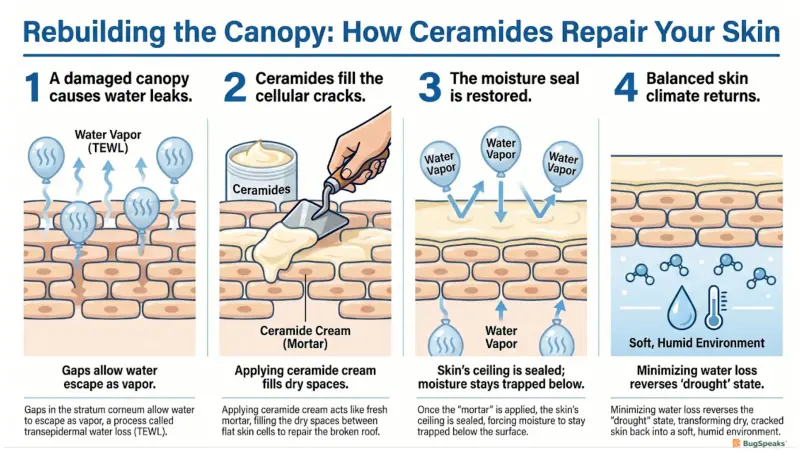
We can restore a damaged skin barrier by using gentle cleansers and creams containing ceramides to rebuild the protective wall, which helps our skin stay healthy. Clinical studies show that applying ceramides directly to our face helps repair the broken stratum corneum canopy that we needDraelos et al. (2023). These protective fats act like fresh mortar, filling in the dry cracks between our flat skin cells and locking in moisture. By replacing the oils that were lost during harsh washing, we can quickly reverse the dryness, lower TEWL levels, and bring back a healthy, humid, and balanced skin environment to make our face soft again.
Scientists have also discovered in their laboratories that mixing different washing agents together can make cleansers much gentler on our skin to create a safe soap. For example, adding a milder co-surfactant like dodecyl trimethylammonium bromide [C12TAB] to SDS makes the washing solution far less irritating. This happens because these opposite chemicals attract like magnets, locking into large, calm clusters that are physically too bulky to squeeze past our protective skin cells. By stabilizing these washing chemicals, we can clean away dirt, sweat, and oil without harming the delicate lipid layers that keep our skin's climate safe and fresh.
Using a ceramide-rich washing routine that we do every day has been clinically proven to protect the skin from becoming dry, red, and flaky. In dermatological tests, people using ceramide-based cleansers and moisturizers maintained significantly higher skin hydration and lower TEWL levels than those using basic soapDraelos et al. (2023). This gentle approach prevents the skin barrier from breaking down, allowing the natural surface climate to heal and remain perfectly balanced. Choosing mild, skin-compatible products ensures that we can wash our face daily without stripping away our body's essential biological shield, helping our skin stay healthy and strong.
How Does the Internal Gut Environment Influence Our External Skin Surface Climate?
The internal gut environment influences our external skin climate and face by sending helpful immune signals and nutrients through the bloodstream. This active, two-way connection is known as the gut-skin axis, and it acts like a biological weather stationMahmud et al. (2022). Trillions of helpful, tiny microbes in our digestive system work hard to help break down food, train our immune cells, and protect our overall health. When our digestive system is healthy and balanced, it sends calming signals up to our face, helping to keep our external skin climate stable, moist, comfortable, and completely free from painful irritation.
This active immune conversation relies on specialized tissues in our digestive system called the gut-associated lymphoid tissues [GALT]Mahmud et al. (2022). These special tissues contain a large portion of our body's defender cells, which learn how to spot good and bad germs from our gut microbes. When these important immune cells are trained correctly, they release helpful protective proteins like secretory immunoglobulin A [sIgA] to maintain a healthy balanceMahmud et al. (2022). These friendly signals travel to the skin, where they quiet down unnecessary inflammation, helping to protect our external skin canopy from becoming red, raw, and itchy.
Additionally, our helpful gut bacteria produce healthy molecules called short-chain fatty acids [SCFAs] that strengthen both our gut and skin barriersMahmud et al. (2022). These molecules act like natural climate signals on our face, traveling through our warm blood to help skin cells grow correctly and maintain healthy moisture levels. Eating a fiber-rich diet of fruits and vegetables helps our gut bacteria produce more SCFAs, which naturally boost our skin's defense systems and prevent dry skin problems. Therefore, keeping our gut microbiome happy is a wonderful and easy way to ensure that our external skin climate remains soft, hydrated, and clear.
-Varsha V
Visualize the process- https://youtu.be/wBn_QrAE5OI
Reference
James-Smith, M. A., Hellner, B., Annunziato, N., & Mitragotri, S. (2011). Effect of surfactant mixtures on skin structure and barrier properties. Annals of biomedical engineering, 39(4), 1215–1223. https://doi.org/10.1007/s10439-010-0190-4
Draelos, Z. D., Baalbaki, N., Colon, G., & Dreno, B. (2023). Ceramide-Containing Adjunctive Skin Care for Skin Barrier Restoration During Acne Vulgaris Treatment. Journal of drugs in dermatology : JDD, 22(6), 554–558. https://doi.org/10.36849/JDD.7142
Mahmud, M. R., Akter, S., Tamanna, S. K., Mazumder, L., Esti, I. Z., Banerjee, S., Akter, S., Hasan, M. R., Acharjee, M., Hossain, M. S., & Pirttilä, A. M. (2022). Impact of gut microbiome on skin health: gut-skin axis observed through the lenses of therapeutics and skin diseases. Gut microbes, 14(1), 2096995. https://doi.org/10.1080/19490976.2022.2096995
Christou, D., Stevanovic, K., Evers, S., Weide, M., & Zuberbier, T. (2024). Evaluating the Impact of Laundry Detergents on the Skin Microbiome of Atopic Dermatitis Patients-A Clinical Study. Health science reports, 7(12), e70261. https://doi.org/10.1002/hsr2.70261
Prescott, S. L., Larcombe, D. L., Logan, A. C., West, C., Burks, W., Caraballo, L., Levin, M., Etten, E. V., Horwitz, P., Kozyrskyj, A., & Campbell, D. E. (2017). The skin microbiome: impact of modern environments on skin ecology, barrier integrity, and systemic immune programming. The World Allergy Organization journal, 10(1), 29. https://doi.org/10.1186/s40413-017-0160-5