What Happens to Your Gut When You Eat Ultra-High Protein?
Why Does an Ultra-High Protein Diet Create a Biological Blind Spot in Your Gut?
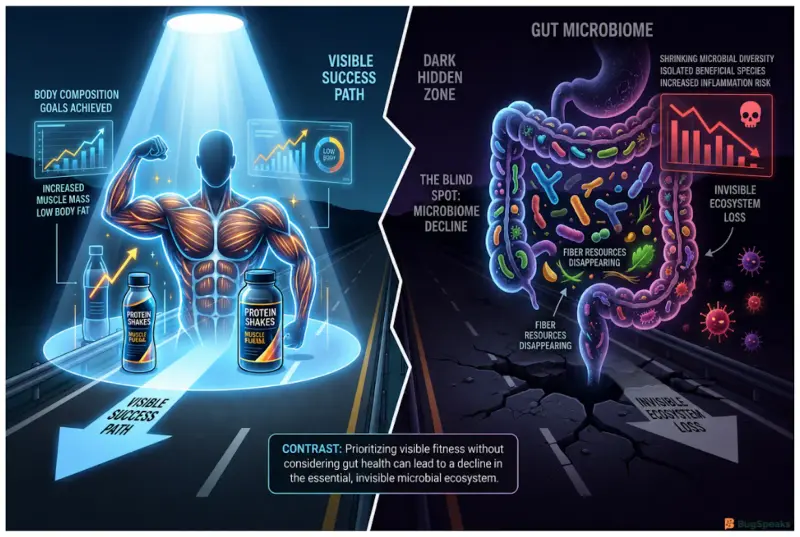
An ultra-high protein, zero-carbohydrate diet isolates your gut because it shines a bright spotlight on muscle growth while leaving your microscopic gut bacteria starving in the dark. We can think of your diet like a car driving down a dark highway at night. Your powerful headlights are focused entirely on the road ahead, which represents your visible muscle building and fat loss. But because you are only looking at what your headlights illuminate, you completely ignore the dark blind spot directly behind your vehicle. This narrow focus means you neglect the massive microbiome highway running quietly through your stomach.
This hidden blind spot develops because we assume that what builds our muscles must be good for our gut. When you eat a massive amount of animal protein, your small intestine cannot absorb it all. This unabsorbed protein is pushed down the highway into the large intestine, also called the distal colon. Usually, dietary fiber acts as a protective shield that guides microbial traffic safely. Without this fiber shield, the colon experiences a severe resource drought, leaving your tiny bacterial drivers with no food. To survive, they must adapt by changing their entire microscopic lifestyle and metabolic system.
This dietary shift causes a complete breakdown in your gut highway's signaling systems. For instance, in a clinical trial examining the effects of a low-carbohydrate diet, researchers observed a dramatic drop in gut microbial diversity in six weeksGüzey Akansel (2024). While the participants lost weight and showed good insulin levels, their underlying microbiome collapsed. This human study proves that tracking only your outer physical progress creates a dangerous biological blind spot. To stop a quiet health crash, we must learn to shine our headlights on our gut and feed our microscopic bacterial allies every single day to keep them healthy and strong.
How Does the Total Absence of Dietary Fiber Blindside Short-Chain Fatty Acid Producers?
The complete absence of dietary fiber blindsides short-chain fatty acid-producing bacteria by depriving them of the complex plant fuels they need to survive. In our visual system, these friendly bacteria are like the essential maintenance trucks that repair the roads. Under healthy conditions, these organisms ferment complex plant fibers like nonstarch polysaccharides and resistant starch through a process called saccharolytic fermentationBach Knudsen (2015). This fermentation process creates energy-rich compounds that keep your gut lining strong. However, when you stop eating carbohydrates, you turn off the headlights for these beneficial trucks, leaving them starving, stranded, and completely unable to do their job.
When these beneficial maintenance trucks run out of fuel, the production of butyrate, acetate, and propionate crashes. In a healthy human, these short-chain fatty acids represent the primary currencies of your intestinal ecosystem, providing energy and supporting metabolic healthBach Knudsen (2015). A six-week ketogenic diet study showed that fecal levels of acetate, propionate, and butyrate all decreased significantlyGüzey Akansel (2024). In fact, total SCFA levels plummeted from 534.21 to 212.59 micromoles per gram of dry matter. This massive drop proves that a zero-carbohydrate diet starves your gut's primary protective team, leaving the highway completely unmaintained and full of cracks.
This decline in beneficial bacteria leads to a fragile, unbalanced gut ecosystem. Without plant materials, the populations of fiber-loving bacteria like Prevotella and beneficial lactic acid producers like Bifidobacterium contract in a major way Güzey Akansel (2024). These tiny engineers are responsible for keeping the colon's pH acidic, which stops bad germs from growing. When we starve them, we reduce our gut's diversity, meaning the bacterial community loses its healthy variationBach Knudsen (2015). This loss of diversity leaves your digestive system highly vulnerable to damage, much like a road network with no maintenance crews to fix the many deep potholes that constantly appear.
What Happens When Excess Protein Floods the Colonic Highway Without a Fiber Shield?
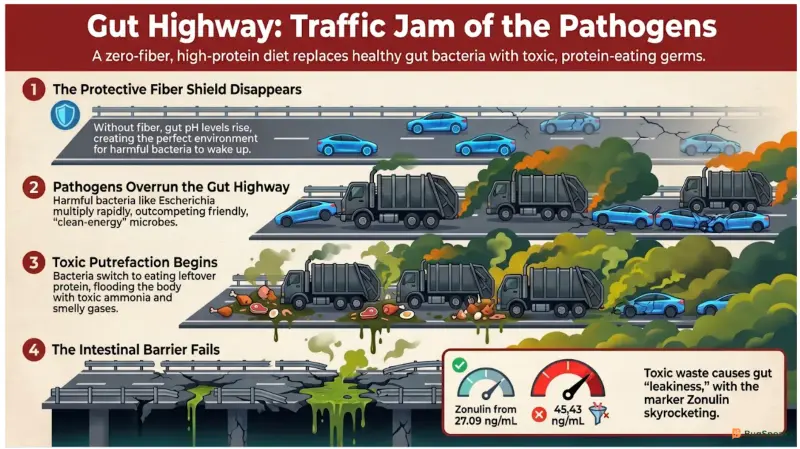
When excess protein floods your gut without a protective fiber shield, the resident bacteria are forced to switch from fermenting carbohydrates to fermenting amino acids, a toxic process called microbial protein fermentation. This represents a failure to maintain the highway's acid boundaries, causing a dangerous traffic rerouting. Under normal conditions, fermenting plant carbohydrates keeps the intestinal pH acidic, ranging between 5.4 and 6.4Bach Knudsen (2015). This acidity acts as a barrier that stops harmful bacterial enzymes. But when carbohydrates are gone, this protective barrier dissolves, pH rises, and proteolytic bacteria are unleashed.
This shift in gut chemistry lets bad, opportunistic pathogens multiply rapidly and take over the highway. Dangerous bacteria like Escherichia and Klebsiella multiply, outcompeting your beneficial speciesGüzey Akansel (2024). These protein-eating microbes use special tools to break down the incoming flood of animal protein into free amino acidsDiether and Willing (2019). This explosion of bad bacterial drivers is a direct consequence of isolating your gut ecosystem. By focusing only on the visible muscle-building spotlight, you accidentally give a huge advantage to the pathogens that destroy your health, and these bad drivers quickly cause massive traffic jams.
The catabolism of these aromatic amino acids creates a smelly cocktail of toxic putrefaction byproducts along the colon. Instead of producing healthy acids, microbial protein fermentation generates dangerous compounds like ammonia, hydrogen sulfide, and branched-chain fatty acidsDiether and Willing (2019). These compounds act like corrosive chemical spills on our gut highway, damaging local cells and irritating the delicate lining. Without a fiber shield, continuous exposure to free ammonia disrupts the gut's metabolism, creating a highly inflamed environment. This localized inflammation is the first step toward a major breakdown of your gut's security checkpoints that protect your entire body from harmful invaders.
How Does an Isolated Gut Ecosystem Cause the Intestinal Wall Barrier to Fail?
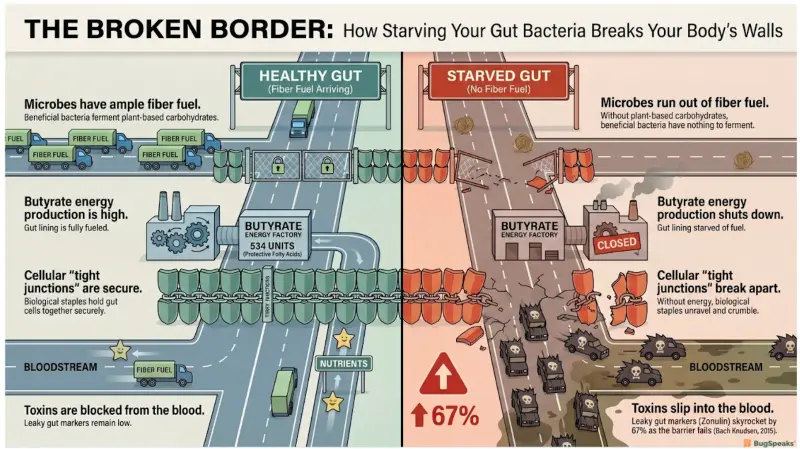
An isolated, fiber-starved gut ecosystem causes the intestinal wall barrier to fail because toxic protein byproducts directly damage the cellular tight junctions that keep the gut sealed. This represents a major physical collision on our highway. The intestinal wall acts like a secure border checkpoint, letting good nutrients pass while keeping dangerous toxins locked inside. When you starve your friendly bacteria, you stop the production of butyrate, which is the primary fuel needed to keep these checkpoint cells healthy, active, and fully able to guard the physical borders of your body and protect your healthBach Knudsen (2015).
Without this energy, the checkpoint cells starve and shrink, leaving your border security system weak and broken. At the same time, the accumulation of toxic ammonia damages the cells' absorption machinery. Specifically, high levels of ammonia turn down the activity of monocarboxylate transporter 1, the cellular doorway through which cells absorb what little butyrate is leftDiether and Willing (2019). This blocks the cell's energy source, causing the tight junctions, the biological staples holding the cells together, to completely unravel. This cell damage allows harmful toxins to leak directly into your bloodstream, creating a massive toxic leak that triggers a massive warning signal across the system.
This structural breakdown leads to intestinal permeability, commonly known as leaky gut, which triggers inflammation throughout the body. To measure this barrier collapse, clinical researchers track a specific regulatory protein called zonulinGüzey Akansel (2024). In a six-week high-protein diet study, serum zonulin levels skyrocketed from 27.09 to 45.43 nanograms per milliliter. This chemical surge is the ultimate proof that the security gates at your gut wall have broken down and are letting leaks slip through. When you focus only on your bright muscle-building spotlight, you ignore this hidden checkpoint failure, proving that a high-performance body cannot survive without a protective fiber shield to keep things safe.
How Can We Calibrate Our Nutritional Focus to Protect Both Muscles and Microbiome?
We can calibrate our nutritional focus to protect both muscles and the microbiome by adding diverse prebiotics and fibers to illuminate our gut's blind spot without losing muscle progress. This simple adjustment is like adjusting your mirrors to clear your field of view. You do not need to turn off your powerful protein spotlight; you simply need to widen your headlights. By reintroducing complex carbohydrates, you establish a robust fiber shield that flows deep into the colon, feeding your starved microbial drivers and restoring balance to your entire intestinal highway system so everything runs smoothly again.
By adding high-quality prebiotics like oats and barley to your diet every morning, you feed your gut's protective maintenance crews and quickly lower the intestinal pH. These friendly plant fibers easily resist digestion in the small intestine and travel safely to the large intestineBach Knudsen (2015). Once there, they restart saccharolytic fermentation and shut down the pathways of microbial protein fermentationDiether and Willing (2019). This healthy shift helps suppress the growth of opportunistic pathogens like Escherichia and Klebsiella, helping to rebuild your gut barrier, lower intestinal permeability, and stop systemic inflammation throughout your entire bodyGüzey Akansel (2024).
Learning to balance your daily food choices is the best way to keep your body performing at its peak. You do not have to eat less protein to make your tiny gut microbes happy; you just need to add a few spoonfuls of oats, beans, or seeds to your meals. These healthy plant foods restore your inner microbiome highway and help your good bacteria create plenty of protective butyrate. By taking care of your gut, you can build strong muscles while keeping your intestinal walls safe and fully sealed, completely eliminating your dangerous nutritional blind spot for good, ensuring total physical health.
-Varsha V
Visualize the process- https://youtu.be/JDK_XwkytkY
Reference
Güzey Akansel, M., Baş, M., Gençalp, C., Kahrıman, M., Şahin, E., Öztürk, H., Gür, G., & Gür, C. (2024). Effects of the Ketogenic Diet on Microbiota Composition and Short-Chain Fatty Acids in Women with Overweight/Obesity. Nutrients, 16(24), 4374. https://doi.org/10.3390/nu16244374
Bach Knudsen K. E. (2015). Microbial degradation of whole-grain complex carbohydrates and impact on short-chain fatty acids and health. Advances in nutrition (Bethesda, Md.), 6(2), 206–213. https://doi.org/10.3945/an.114.007450
Diether, N. E., & Willing, B. P. (2019). Microbial Fermentation of Dietary Protein: An Important Factor in Diet⁻Microbe⁻Host Interaction. Microorganisms, 7(1), 19. https://doi.org/10.3390/microorganisms7010019