How to Protect Your Gut Microbes from the Effects of Artificial Sweeteners
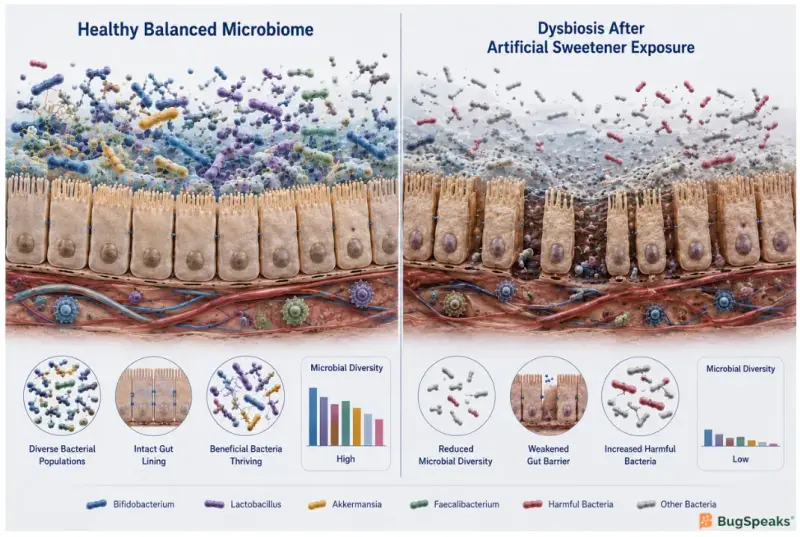
Is Your Gut Truly a Giant Global Marketplace?
The human gastrointestinal tract functions as a high-stakes trade hub where trillions of tiny residents, known collectively as the microbiome, manage the body’s internal economy. This complex city is home to 25-50 different phyla of microbial traders that must collaborate to ensure the host’s immune system and energy levels remain stableRuiz-Ojeda et al. (2019). In a healthy system, these residents live in a symbiotic relationship with human cells, exchanging vitamins and defense signals for a safe place to reside. Maintaining homeostasis within this marketplace is essential for global health, as it ensures every biological deal contributes to the body's overall prosperityHetta et al. (2025).
Traders in this marketplace rely on a steady supply of real currency, represented by natural sugars and complex carbohydrates, to fuel their daily operations. When real sugar enters the city, the microbes recognize its value, accept it eagerly, and produce the essential goods the body requires. However, the introduction of counterfeit currency in the form of artificial sweeteners disrupts this trust, leading to a state where the traders cannot properly invest in the host’s health. If the currency is fake, the traders become confused, causing the entire trade hub to crumble and affecting everything from mood to metabolic regulation.
How Do Your Body’s Scanners Get Fooled by Fake Money?
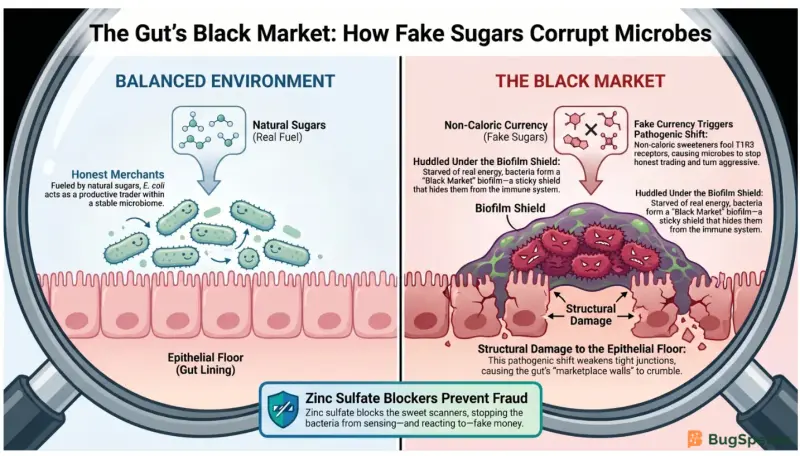
The body’s currency scanners, specifically the T1R3 Receptor units, are fooled by artificial sweeteners because they are programmed to detect the molecular signature of sweetness without verifying its caloric value. These scanners are found on the intestinal walls and are designed to signal the release of incretins whenever energy is detected. When artificial sweeteners bind to these sensors, they trigger a false alarm that ripples through the digestive system, causing the body to prepare for a massive influx of energy that never arrivesShil et al. (2024).
False alarms at the scanner level cause a profound decoupling of sweetness from actual metabolic utility, leading to widespread confusion in the marketplace. The microbial traders upregulate their internal machinery in anticipation of a feast, only to find themselves starving when the fake money provides no actual fuel. This sabotage of the epithelium interface deranges the body’s natural rhythm, making it increasingly difficult for the system to manage real energy when it eventually appears. Over time, these scanners become less reliable, leading to a metabolic glitch that hinders the body's ability to regulate appetite and blood sugar effectively.
Table 1: Harbor Cargo Logs: Sweetener Impact on Biological Scanners
Why Do the Good Traders Leave When Fake Money Floods the Market?
The good traders leave the marketplace because artificial sweeteners actively suppress the populations of beneficial microbes that cannot thrive on non-caloric currency. In a healthy gut, scientists monitor the Firmicutes/Bacteroidetes Ratio to ensure the microbial neighborhoods are balanced and productiveConz et al. (2023). When counterfeit bills dominate the circulation, specialized maintenance crews like Akkermansia muciniphila often go out of business. This loss of diversity triggers a state of dysbiosis, where the marketplace is no longer resilient enough to handle stress or protect the host from pathogenic invaders who exploit the economic vacuum.
How Does Counterfeit Currency Ruin the Production of Vital Goods?
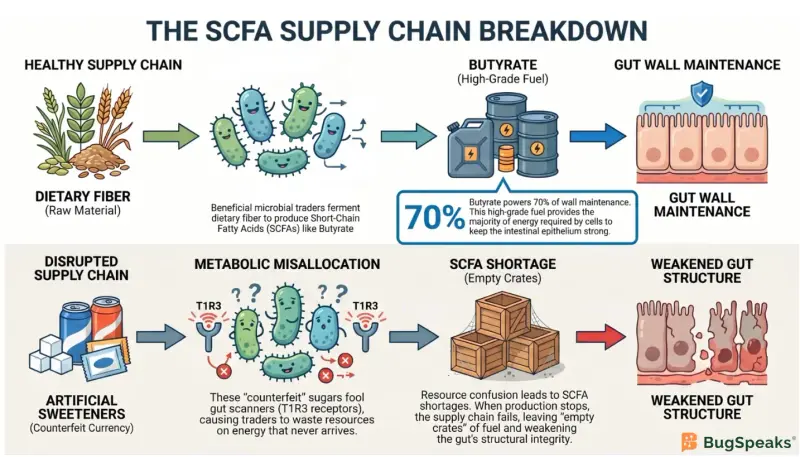
Counterfeit currency ruins production by forcing microbial traders to misallocate their resources, leading to a critical shortage of Short-Chain Fatty Acids (SCFAs). These high-quality goods, such as acetate and propionate, are usually produced through the fermentation of real fiber and sugars. Butyrate is particularly essential, as it provides roughly 70% of the energy needed by the cells that form the marketplace walls. When the traders are fooled by fake money, they fail to produce these vital goods, which can lead to insulin resistance and a total breakdown in the body’s global supply chain of energyRuiz-Ojeda et al. (2019).
Why Does Fake Money Physically Break the Marketplace Walls?
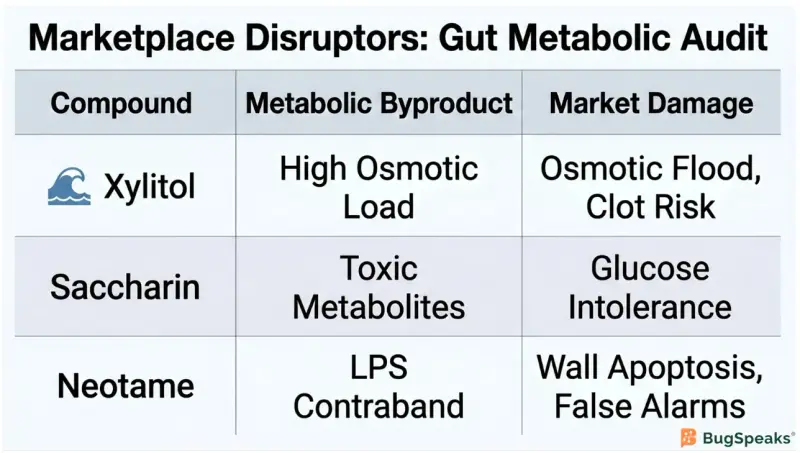
Fake money physically breaks the marketplace walls by acting as a corrosive agent that weakens the tight junctions holding the intestinal cells together. When these security locks disappear, the resulting leaky gut allows dangerous contraband to slip into the host’s internal cathedral. Research into sweeteners like neotame has demonstrated that they can trigger apoptosis, a form of programmed cell death where the wall cells essentially destroy themselvesShil et al. (2024). This structural sabotage is often mediated by the body's own sweet scanners, which become so confused by the fake money that they accidentally signal the cells to dismantle their own security.
How Do the Traders Form Gangs When the Economy Fails?
Traders form dangerous gangs, known as a biofilm, when the lack of real energy forces them into a defensive and aggressive state of survival. In this black market environment, bacteria like E. coli huddle under a sticky shield to hide from the body's immune police. These syndicates are characterized by high pathogenicity, meaning the microbes stop being honest merchants and begin to invade the marketplace walls for resourcesShil et al. (2024). Scientists have noted that zinc sulfate can be used to block the sweet scanners, preventing the bacteria from sensing the fake money and forming these destructive gangs.
Table 2: Trade Hub Disruptions: Pathogenic Adaptations
Why Do Police Invasions Make the Market Chaos Even Worse?
Police invasions make the market chaos worse because the immune system triggers chronic inflammation in an attempt to stop the contraband leaking through the broken walls. When bits of bacterial debris like LPS enter the body, the police release powerful chemical signals like TNF-alpha to call for backup. While this response is meant to protect the cathedral, it often results in a state of endotoxemia, where the constant fighting makes the entire environment toxic for the remaining good tradersCrakes et al. (2025). This vicious cycle of damage and defense ensures the marketplace remains in a state of perpetual instability.
How Do Microbes Try to Launder Fake Money into Toxic Chemicals?
Microbes try to launder fake money by using specialized enzymes to break down synthetic compounds in a desperate bid to find hidden energy. This process often produces a dangerous metabolite that is far more toxic than the original sweetener. For example, when bacteria attempt to process certain xenobiotic additives, they can create a byproduct called cyclohexylamine, which acts like poisonous gas in the colonic neighborhoodsConz et al. (2023). This metabolic misallocation ensures that the traders spend their time washing synthetic chemicals rather than producing the vitamins and health-promoting goods the host needs.
Is the Sugar Alcohol Paradox Flooding Your Marketplace?
The sugar alcohol paradox floods the marketplace by introducing heavy, low-value polyols like xylitol that are difficult for the body to absorb, leading to a massive osmotic load. These substances pull water into the gut, creating a flash flood that causes bloating and a violent laxative effect. Furthermore, research indicates that high concentrations of xylitol can be prothrombotic, meaning they increase the risk of blood clots and cardiovascular distressWitkowski et al. (2024). Balancing these bulk currencies is essential to ensure that your internal trade hub does not turn into a disaster zone of physical and systemic instability.
Table 3: Global Trade Risks: Cardiovascular and Osmotic Impact
Can We Use Market Correction to Save Your Unique Gut?
We can use market correction by identifying whether an individual is among the responders who are most vulnerable to metabolic crashes caused by fake money. By utilizing metagenomic profiling, scientists can map the baseline configuration of your microbial city and predict how your traders will react to specific additives. This move toward precision nutrition allows for a personalized management plan where we can identify exactly which counterfeit bills are causing your economic failureCrakes et al. (2025). In some cases, a Fecal Microbiota Transplantation (FMT) may be used to bring in a new guild of traders to restore the economy and repair the broken marketplace walls.
-Varsha V
Visualize the process- https://youtu.be/5ELSMYZVlLQ
Reference
https://www.frontiersin.org/journals/nutrition/articles/10.3389/fnut.2024.1366409/full
Shil A, Ladeira Faria LM, Walker CA and Chichger H (2024) The artificial sweetener neotame negatively regulates the intestinal epithelium directly through T1R3-signaling and indirectly through pathogenic changes to model gut bacteria. Front. Nutr. 11:1366409. doi: 10.3389/fnut.2024.1366409
https://academic.oup.com/eurheartj/article/45/27/2439/7683453?login=false
Marco Witkowski, Ina Nemet, Xinmin S Li, Jennifer Wilcox, Marc Ferrell, Hassan Alamri, Nilaksh Gupta, Zeneng Wang, Wai Hong Wilson Tang, Stanley L Hazen, Xylitol is prothrombotic and associated with cardiovascular risk, European Heart Journal, Volume 45, Issue 27, 14 July 2024, Pages 2439–2452, https://doi.org/10.1093/eurheartj/ehae244
https://pmc.ncbi.nlm.nih.gov/articles/PMC12020452/
Crakes, K. R., Questell, L., Soni, S., & Suez, J. (2025). Impacts of non-nutritive sweeteners on the human microbiome. Immunometabolism (Cobham, Surrey), 7(2), e00060. https://doi.org/10.1097/IN9.0000000000000060
https://pubmed.ncbi.nlm.nih.gov/30721958/
Ruiz-Ojeda, F. J., Plaza-Díaz, J., Sáez-Lara, M. J., & Gil, A. (2019). Effects of Sweeteners on the Gut Microbiota: A Review of Experimental Studies and Clinical Trials. Advances in nutrition (Bethesda, Md.), 10(suppl_1), S31–S48. https://doi.org/10.1093/advances/nmy037
https://pmc.ncbi.nlm.nih.gov/articles/PMC10144565/
Conz, A., Salmona, M., & Diomede, L. (2023). Effect of Non-Nutritive Sweeteners on the Gut Microbiota. Nutrients, 15(8), 1869. https://doi.org/10.3390/nu15081869
https://pmc.ncbi.nlm.nih.gov/articles/PMC12025785/
Hetta, H. F., Sirag, N., Elfadil, H., Salama, A., Aljadrawi, S. F., Alfaifi, A. J., Alwabisi, A. N., AbuAlhasan, B. M., Alanazi, L. S., Aljohani, Y. A., Ramadan, Y. N., Abd Ellah, N. H., & Algammal, A. M. (2025). Artificial Sweeteners: A Double-Edged Sword for Gut Microbiome. Diseases (Basel, Switzerland), 13(4), 115. https://doi.org/10.3390/diseases13040115