Why Is Glutamine Described as the Primary Fuel for Your Gut Lining?
Glutamine is the favorite food and primary fuel for your gut lining cells because it provides the instant cellular fuel they need to rebuild themselves and keep your gut strong. In our cellular energy economy, the microscopic cells that line your stomach and intestines are called enterocytes. These tiny workers are very busy because they form the main wall that protects your body from bad germs and digests your food. Because your gut wall is a busy, high-turnover tissue, these cells are replaced every 4-5 days. This means your gut lining needs a steady stream of fresh resources to power its growth (Kim and Kim, 2017).
Most of the cells in your body like to eat sugar for energy, but your gut lining cells have a special biological preference for glutamine fuel. To turn this fuel into power, your cells use a special pathway called glutaminolysis, which happens inside their tiny energy factoriesCruzat et al. (2018). Through this process, glutamine is broken down to enter a metabolic loop called the tricarboxylic acid cycle, or TCA cycle. This cycle burns the fuel and produces adenosine triphosphate, or ATP, which is the tiny energy coin cells spend to do their daily jobsCruzat et al. (2018).
Besides making energy coins, burning this fuel provides your cells with the building blocks they need to make new genetic instructions. These instructions are called Deoxyribonucleic Acid, which we call DNA, and Ribonucleic Acid, which we call RNA. When your cells divide to make new gut lining, they need lots of DNA and RNA, which they cannot build without the nitrogen and carbon from glutamineCruzat et al. (2018). Since your gut lining cannot make this fuel on its own, it relies on your blood to deliver itRao and Samak (2012). This makes your gut lining very sensitive to your body's overall fuel supplies.
How Does the Gut Lining Manage Its Energy Budget Under Stress?
During times of severe stress or sickness, your body's energy budget changes completely because competing consumers like immune cells and the liver use up your glutamine fuel. Normally, your muscles act as a main storage tank, keeping a steady supply of this fuel in your bloodCruzat et al. (2018). But when you get very sick or hurt, your body enters a stressful hypercatabolic state. Your body's demand for fuel is so high that your muscles must quickly break down their own proteins to release glutamine, which can make you feel weak if it goes on for too longKim and Kim (2017).
While your muscles are trying to supply more fuel, your immune system becomes an aggressive competing consumer that grabs the resource first. Your immune system has active defender cells like lymphocytes, neutrophils, and macrophages, which use glutamine even faster than glucose to power their fight against germsCruzat et al. (2018). As these busy defenders use up your body's circulating supplies, blood glutamine levels drop very low, causing a deficit called hypoglutaminemiaCruzat et al. (2018). This leaves your body with a severe fuel shortage, meaning there is less energy available to support other tissues like your gut wall.
To make matters worse, your liver also switches roles during stress, moving from a helper that produces fuel to a massive consumer. The liver begins grabbing circulating glutamine from your blood to make glucose through a process called gluconeogenesis, which helps keep your brain fueled during an emergencyCruzat et al. (2018). This double drain by immune cells and the liver means the energy supply lines to your gut lining are cut off. Without its favorite fuel, your gut wall cannot get the daily resources it needs to stay healthy and strong under high demandKim and Kim (2017).
How Does Cellular Fuel Protect the Structural Integrity of the Gut Barrier?
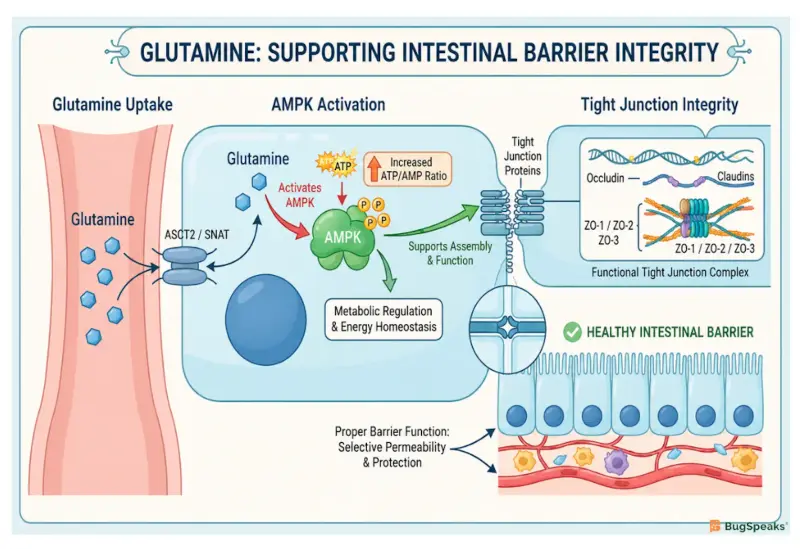
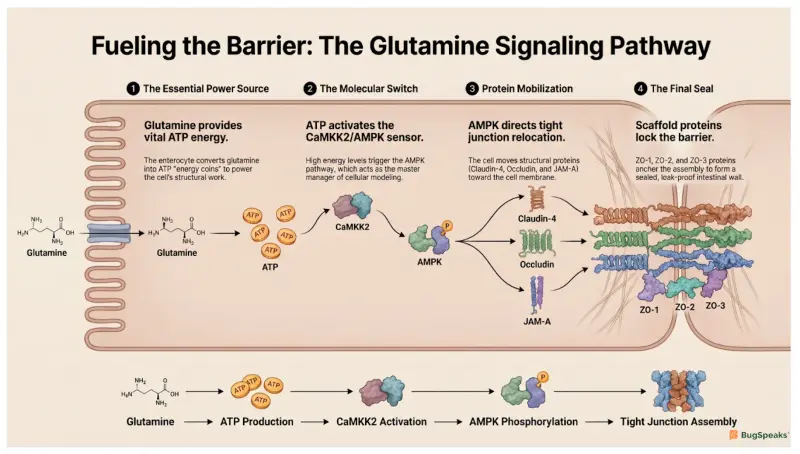
Glutamine provides the essential cellular fuel required to assemble and maintain tight junctions, the protein-based structural seals that hold your intestinal cells together to prevent leaks. Your gut wall is made of a single layer of cells that must stay tightly boundKim and Kim (2017). The primary structures that lock these cells together are tight junctionsWang et al. (2016). These microscopic locks are built from transmembrane proteins like claudin-4, occludin, and junctional adhesion molecules, which connect to internal anchors like zonula occludensWang et al. (2016). Proper function of these locks is required to prevent toxins and pathogens from leaking into your blood.
This defense wall is controlled by energy sensors inside each cell. When glutamine fuel is abundant, it activates a biological switch pathway called calcium/calmodulin-dependent kinase kinase 2 (CaMKK2), which then turns on an energy sensor called AMP-activated protein kinase (AMPK)Wang et al. (2016). AMPK acts as a manager that directs cells to build and maintain their physical barriersWang et al. (2016). Under this pathway's direction, the cell moves its structural proteins out to the membrane, anchoring them in place to create a highly effective physical seal that keeps the barrier closed to dangerous wasteWang et al. (2016).
Additionally, this fuel helps cells defend their wall from outside toxins by activating the epidermal growth factor receptor (EGFR). Harmful compounds, such as acetaldehyde from alcohol, can attack and break these cell seals, causing a leaky gutRao and Samak (2012). However, if the cells have enough glutamine, it triggers the transactivation of EGFR, which sends an immediate protective signal to keep the barrier stableRao and Samak (2012). To measure this wall tightness, scientists use a test called Transepithelial Electrical Resistance (TEER)Wang et al. (2016). High TEER values show a strong barrier, proving that fuel is key to keeping the gut wall closed.
What Happens to the Energy Economy When Glutamine Supplies Run Low?
A severe shortage of glutamine leads to a breakdown of the gut's physical defense system, allowing bacteria, toxins, and waste products to leak directly into your bloodstream. When your body's energy economy experiences a long fuel shortage, your enterocytes run out of the energy they need to survive and rebuildKim and Kim (2017). Without fuel, the tight junctions lock systems disassemble, opening up large gaps between your gut cellsRao and Samak (2012). This allows waste, food particles, and bad toxins to cross into your blood in a dangerous process called bacterial translocationPerna et al. (2019). This can trigger body-wide inflammation and serious health problems.
At the microscopic level, a severe deficit of glutamine causes an emergency inside the cell's protein-building factories, known as endoplasmic reticulum stress, or ER stressKim and Kim (2017). This stress prevents proteins from folding correctly, which triggers a biological self-destruct signal called apoptosis, or programmed cell deathKim and Kim (2017). Normally, your body balances cell division and cell death; however, without fuel, your gut cells die much faster than they can growKim and Kim (2017). This causes physical holes in your gut lining, such as ulcers and small, shrunken villi, leaving the gut lining weak and damagedRao and Samak (2012).
As your gut's energy levels drop, the balance of your friendly gut bacteria is also disrupted, which can harm your overall health. In a healthy gut, resident microbes live in harmony with your body, but an under-fueled, damaged wall cannot secrete enough protective moleculesPerna et al. (2019). This allows bad bacteria to multiply, throwing off the healthy balance of your microbiomePerna et al. (2019). To check for this damage, doctors measure sugar markers (lactulose and mannitol) in urine or look for leaked enzymes like diamine oxidase in your blood, which confirm if your barrier has become leakyShu et al. (2016).
Does Supplementing Your Cellular Energy Economy Actually Help?
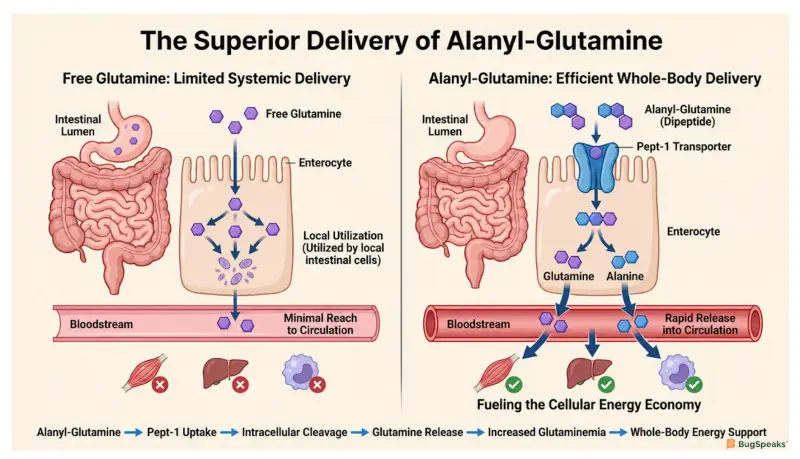
Providing supplemental glutamine acts as an additional resource that can help restore your body's energy balance and accelerate gut barrier repair during periods of high demand. However, the chemical form of your supplement matters a lot because free glutamine is easily eaten up by your digestive tractCruzat et al. (2018). Free glutamine is easily eaten up because it is the absolute favorite food of the gut cells themselves! Since the cells lining your stomach and intestines get "first dibs" on everything you eat, they absorb and digest about 75% (three-quarters) of this free glutamine right away to power their own heavy daily workloadCruzat et al. (2018). To solve this, scientists use a special double amino acid called alanyl-glutamineCruzat et al. (2018). This stable dipeptide escapes early digestion and is quickly absorbed by your gut using a specialized door called Oligopeptide Transporter 1 or Pept-1, which successfully delivers this vital fuel directly to your tissuesCruzat et al. (2018).
Clinical trials show that this extra fuel helps post-surgery patients recover much faster by reducing body-wide inflammatory markers and healing their gut barriers. Patients who receive glutamine dipeptides show much lower levels of inflammatory markers like C-reactive protein, tumor necrosis factor-alpha, and interleukin-6 in their bloodShu et al. (2016). This shows that the body is finally calm and its alarm systems are turning offShu et al. (2016). Supplementation also lowers urine sugar leakage and completely prevents endotoxins from entering the bloodstream, which is clear visual proof that the physical gut wall has been successfully repaired and sealedShu et al. (2016).
This targeted energy support is also incredibly helpful for children recovering from stomach bugs and cancer patients undergoing chemotherapy. In children with severe diarrhea, adding this dipeptide to rehydration drinks helps rebuild their damaged gut walls, which shortens their illnessRao and Samak (2012). For cancer patients, chemotherapy can damage rapidly dividing gut cells, but glutamine provides the fuel these cells need to recover, preventing painful mouth sores and diarrheaCruzat et al. (2018). It shows that while healthy eaters do not need extra supplements, feeding your cellular energy economy during crisis is a proven way to protect your healthCruzat et al. (2018).
Visualize the process- https://youtu.be/KD0jcP_ajv0
Reference
Rao, R., & Samak, G. (2012). Role of Glutamine in Protection of Intestinal Epithelial Tight Junctions. Journal of epithelial biology & pharmacology, 5(Suppl 1-M7), 47–54. https://doi.org/10.2174/1875044301205010047
Kim, M. H., & Kim, H. (2017). The Roles of Glutamine in the Intestine and Its Implication in Intestinal Diseases. International journal of molecular sciences, 18(5), 1051. https://doi.org/10.3390/ijms18051051
Wang, B., Wu, Z., Ji, Y., Sun, K., Dai, Z., & Wu, G. (2016). L-Glutamine enhances tight junction integrity by activating CaMK kinase 2–AMP-activated protein kinase signaling in intestinal porcine epithelial cells. The Journal of nutrition, 146(3), 501-508.
Cruzat, V., Macedo Rogero, M., Noel Keane, K., Curi, R., & Newsholme, P. (2018). Glutamine: Metabolism and Immune Function, Supplementation and Clinical Translation. Nutrients, 10(11), 1564. https://doi.org/10.3390/nu10111564
Perna, S., Alalwan, T. A., Alaali, Z., Alnashaba, T., Gasparri, C., Infantino, V., Hammad, L., Riva, A., Petrangolini, G., Allegrini, P., & Rondanelli, M. (2019). The Role of Glutamine in the Complex Interaction between Gut Microbiota and Health: A Narrative Review. International journal of molecular sciences, 20(20), 5232. https://doi.org/10.3390/ijms20205232
Shu, X. L., Yu, T. T., Kang, K., & Zhao, J. (2016). Effects of glutamine on markers of intestinal inflammatory response and mucosal permeability in abdominal surgery patients: A meta-analysis. Experimental and therapeutic medicine, 12(6), 3499–3506. https://doi.org/10.3892/etm.2016.3799
Kumar, M. A., Baba, S. K., Khan, I. R., Khan, M. S., Husain, F. M., Ahmad, S., Haris, M., Singh, M., Akil, A. S. A., Macha, M. A., & Bhat, A. A. (2025). Glutamine Metabolism: Molecular Regulation, Biological Functions, and Diseases. MedComm, 6(7), e70120. https://doi.org/10.1002/mco2.70120