A Comprehensive Guide to Ghee and Butyrate-Unlocking Ayurvedic Wisdom for Gut Health
How does your gut lining get its daily energy?
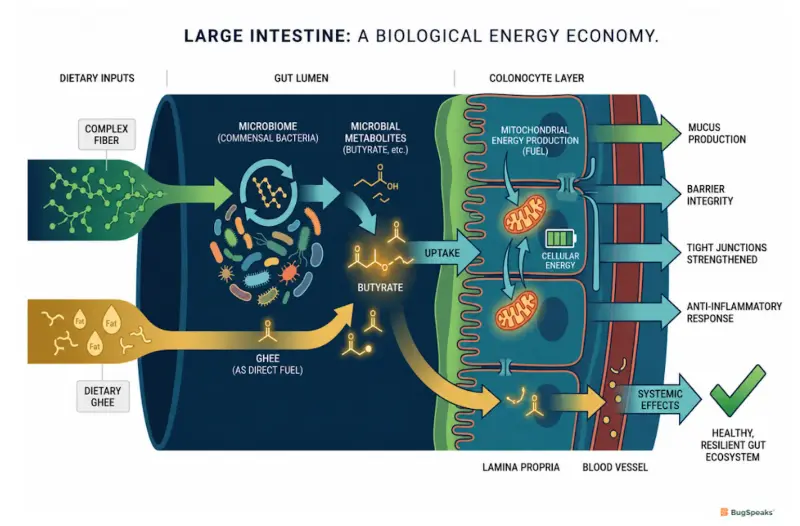
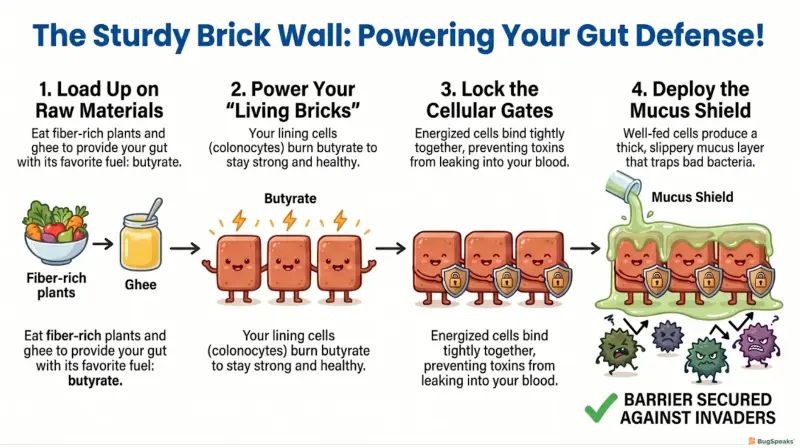
Your gut lining cells, called colonocytes, get most of their daily energy by burning a special bacterial fuel called butyrate instead of using sugar from your bloodKarłowicz et al. (2026). These tiny cells line the inside of your large intestine and act like very hungry energy consumers that must stay powered up to protect your bodyOrnelas et al. (2026). Without a constant supply of this fuel currency, your gut cells will starve, become weak, and allow harmful toxins to leak into your bloodstreamKarłowicz et al. (2026). Keeping these cells fully energized is the most important step to maintaining a healthy gut every single day.
Think of your large intestine as a busy neighborhood where your gut cells are the houses that need electricity to keep their security systems runningKarłowicz et al. (2026). The primary power source they prefer is this short-chain fatty acid, which acts as a clean, highly efficient energy currencyOrnelas et al. (2026). When these cells are well-fed, they build strong walls and produce a thick, slippery layer of mucus that keeps bad bacteria awayKarłowicz et al. (2026). This protective mucus shield acts like a sturdy fence, ensuring that nothing dangerous crosses from the digestive tube into the rest of your body.
When your cells do not get enough of their favorite fuel, the entire energy system breaks down and causes the cell walls to crumbleKarłowicz et al. (2026). This power shortage leads to a weak barrier, a condition that doctors often refer to as a leaky gutKarłowicz et al. (2026). To measure how strong this barrier is, scientists use a special test called transepithelial electrical resistance, which checks the electric strength of the cell connectionsKarłowicz et al. (2026). Keeping your gut cells well-nourished with their favorite biological fuel ensures that this protective cellular wall remains unbroken and highly resistant to outside invaders.
Where does this special gut fuel come from?
This vital fuel is manufactured inside your body by friendly bacteria that digest the dietary fiber you eat every dayKarłowicz et al. (2026). Your gut is home to trillions of tiny, helpful microbes that act like a team of busy fuel producersSingh and Rao (2026). These microbes take the complex carbohydrates that your human body cannot digest and break them down through a natural process called fermentationKarłowicz et al. (2026). This process turns everyday foods like oats, grains, and green bananas into the valuable energy currency your cells need to survive and protect you from harmful diseases.
The helpful microbes in your gut are very organized and work together like a highly efficient factory systemKarłowicz et al. (2026). One of the most famous and hardworking fuel-producing bacteria in this system is named Faecalibacterium prausnitziiKarłowicz et al. (2026). This friendly microbe is a true champion of gut health because it specializes in producing high amounts of this protective acid from the raw food materials you swallowKarłowicz et al. (2026). When you eat a diet rich in diverse plants, you are directly feeding these tiny microbial workers so they can manufacture more healing fuels for you.
This natural and healthy fuel production also helps maintain a perfectly balanced environment by lowering the pH acidity levels inside your large intestineKarłowicz et al. (2026). A slightly acidic digestive tube is excellent because it makes the environment very uncomfortable for bad germs to survive inKarłowicz et al. (2026). At the same time, this healthy environment encourages even more friendly, fuel-producing microbes to grow and multiply (Karłowicz et al. (2026). By eating plenty of healthy plant-based foods, you provide the essential raw materials that keep this beautiful, protective natural energy economy running smoothly for your entire lifetime.
Can you get this vital fuel directly from your diet?
You can get this fuel directly from your food by eating ghee, which is a traditional clarified butter fat that naturally contains high amounts of butyric acidKataria and Singh (2024). This means you do not have to wait for your gut bacteria to make all the fuel from scratchSingh and Rao (2026). By eating a spoonful of this golden fat, you are importing a direct supply of ready-to-use energy directly into your digestive systemSingh and Rao (2026). This dietary fat acts like an emergency fuel delivery truck, bringing fresh energy supplies to support your hardworking cells whenever they need an extra boost.
Different animal milks have different amounts of this energy-boosting acid, but traditional cow and buffalo fats are the absolute richest sources availableKataria and Singh (2024). For instance, cow fat contains about three percent of this helpful acid, while buffalo fat can have even moreKataria and Singh (2024). Other animal fats, like those from camels or horses, contain almost none of this special fuel currencyKataria and Singh (2024). Because of this unique fat mixture, choosing the right kind of milk fat is very important for giving your gut cells the exact fuel they need to keep their barriers strong.
This golden fat is also packed with healthy fat-soluble vitamins, such as vitamins A, D, and E, which help protect your bodyKataria and Singh (2024). These vitamins work like a shield, defending your cells from wear and tear while helping them absorb energy much betterKataria and Singh (2024). Unlike other oils, this special fat is very stable and does not burn or create bad chemicals when you cook with itKataria and Singh (2024). Adding this traditional fat to your daily meals is a simple and delicious way to fuel your gut cells and keep them strong and happy.
Why does a lack of this fuel cause gut trouble?
When your gut cells run out of their favorite fuel, the protective wall breaks down, causing painful swelling known as inflammatory bowel disease (Karłowicz et al., 2026). This chronic condition is often abbreviated as IBD (Inflammatory Bowel Disease) and includes issues like ulcerative colitis and Crohn's diseaseKarłowicz et al. (2026). In a sick and inflamed gut, the team of fuel-producing bacteria becomes severely depleted, causing a major energy fuel shortageKarłowicz et al. (2026). Without their preferred daily fuel currency, the colonocytes cannot maintain their tight physical connections, creating a leaky barrier that allows bad germs to invade and irritate your delicate intestinal tissue.
To solve this critical gut fuel crisis, scientists have created special oral supplements called sodium butyrateKarłowicz et al. (2026). Because normal butyric acid has a very strong, smelly odor and is digested far too quickly in the stomach, scientists use microencapsulation to protect itKarłowicz et al. (2026). This technology wraps the valuable fuel inside tiny lipid bubbles so it can travel safely past your stomach and release its energy directly into your lower intestineKarłowicz et al. (2026). This smart digestive delivery system is like sending a secure armored car to deliver vital energy fuel directly to the areas that need it most.
Giving your body this extra external fuel helps soothe the painful mucosal inflammation and supports much faster tissue healingKarłowicz et al. (2026). In recent scientific clinical studies, this supplementary fuel has helped many sick patients feel much better by lowering their fecal calprotectin levelsKarłowicz et al. (2026). These inflammatory biomarker levels show doctors exactly how much active swelling and damage are currently occurring inside your gut walls (Karłowicz et al., 2026). By delivering a fresh, powerful supply of daily energy, your body gets the essential resources it needs to repair the broken fences and restore peace, comfort, and perfect balance to your tummy.
How does ancient wisdom explain this digestive fire?
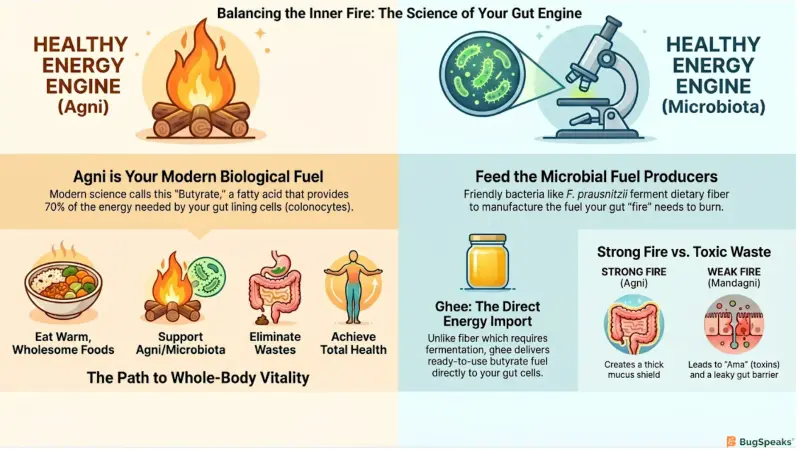
Ancient Indian medicine explains this cellular energy economy through the concept of Agni, which represents the digestive fire needed to transform food into life forceSingh and Rao (2026). This traditional worldview teaches that a strong digestive fire is the absolute foundation of your health, strength, and immune defenseSingh and Rao (2026). When this inner fire burns brightly, your body easily converts food into pure energy and useful nutrientsSingh and Rao (2026). However, when the digestive fire becomes weak, a condition called Mandagni, your body cannot digest food properly, which creates toxic leftovers known as Ama that can make you feel tired and sickSingh and Rao (2026).
Modern scientists are now finding that this ancient concept of a weak digestive fire perfectly describes what happens during gut dysbiosisSingh and Rao (2026). When your inner fire is weak, your microbial fuel producers disappear, leading to a major shortage of protective fatty acidsSingh and Rao (2026). This lack of fuel causes the toxic buildup of bad wastes, showing that ancient healers and modern doctors are actually describing the same biological systemSingh and Rao (2026). Supporting your digestive fire with warm, easy-to-digest foods like clarified butter helps feed both your cells and your friendly bacteriaSingh and Rao (2026).
Ayurveda recommends eating clarified butter daily because it is considered a supreme rejuvenator that gently rekindles your digestive fireKataria and Singh (2024). This traditional practice helps your body absorb nutrients much better while strengthening the natural protective barriers in your intestineSingh and Rao (2026). By looking at your gut as a busy cellular energy economy, it becomes easy to see why eating this traditional fat is so beneficialKataria and Singh (2024). Balancing your inner fire with the right everyday fuel keeps your gut lining strong, your helpful microbes happy, and your whole body feeling energized and healthy.
Visualize the process- https://youtu.be/UGOGeNnZ6SY
Reference
Singh, V., & Rao, M. V. (2026). Agni (Digestive Factor) and Gut Microbiota: Bridging Ancient Ayurvedic Knowledge with Contemporary Science. Int J Ayurvedic Med, 17(1), 32-37.
Ornelas, A., Countess, J. A., Kim, J. Y., Cohen, R. H., Gomez, B. D., Roer, R. L., Minhajuddin, F., Yenugudhati Vijaya Sai, K., Zhou, L., Dunn, J. L. M., Reigan, P., Cartwright, I. M., Hall, C. H. T., Bhagavatula, G., Onyiah, J. C., Dowdell, A. S., & Colgan, S. P. (2026). Metabolite mimicry identifies butyrate analogs with select protective functions in the intestinal mucosa. bioRxiv : the preprint server for biology, 2026.01.07.697087. https://doi.org/10.64898/2026.01.07.697087
Karłowicz, K., Lewandowski, K., Tulewicz-Marti, E., & Rydzewska, G. (2026). A comprehensive review of usefulness of sodium butyrate for the management of inflammatory bowel disease: from molecular mechanisms to clinical application. Przeglad gastroenterologiczny, 21(1), 29–37. https://doi.org/10.5114/pg.2026.159719
Kataria, D., & Singh, G. (2024). Health benefits of ghee: Review of Ayurveda and modern science perspectives. Journal of Ayurveda and integrative medicine, 15(1), 100819. https://doi.org/10.1016/j.jaim.2023.100819