Understanding Acid Reflux: Why Suppressing Stomach Acid Can Worsen Digestion
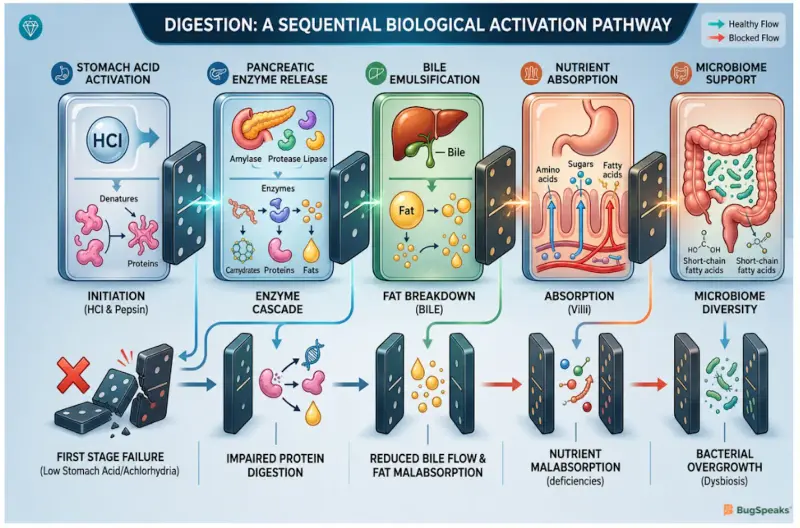
What is the Sequential Digestion Cascade?
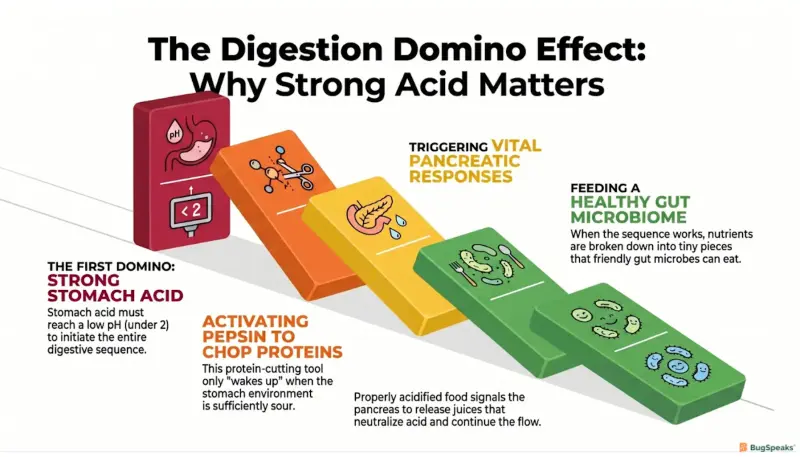
The Sequential Digestion Cascade is a step-by-step biological process in which each stage of digestion acts like a falling domino, triggering the next step in a perfect sequence (Kiecka and Szczepanik, 2023). To understand this, imagine a long row of colorful toy blocks standing on your playroom floor. When you push the first block, it bumps into the second one, which then knocks over the third. In your gut, the very first domino is strong stomach acid. When you eat yummy food, this special acid must turn on first to start the whole digestive cascade. If this first block does not fall, the rest cannot either.
The second domino in our belly is the activation of a chemical helper called pepsin, which chops up foodKiecka and Szczepanik (2023). This tiny helper is a protein-cutting tool, but it only works when the surrounding water is very sour, meaning it has a low pH (potential of hydrogen)Kiecka and Szczepanik (2023). If the first domino of stomach acid fails, the second domino of pepsin cannot wake up. This means the third domino, which is the breakdown of big nutrients into tiny pieces, is completely stopped. Your body gets stuck with giant, uncut pieces of food that are too big for your tummy to use.
The final steps of our journey involve pancreatic responses and our helpful gut microbiome that lives downstairsKiecka and Szczepanik (2023). Normally, when sour food leaves the stomach, it signals your pancreas to release acid-balancing juices to neutralize the acid. But if the first domino is weak, the pancreas does not get this message, which stops correct digestive flow. Down in your large intestine, the tiny microbes in your gut microbiome are waiting to eat. They rely on properly broken-down food to stay happy. When giant, unchewed food pieces arrive instead, these good bugs starve, causing big, uncomfortable digestive troubles in your gut.
How do reflux medications act as cascade modifiers?
Reflux medications act as cascade modifiers by turning off the tiny proton pumps in your stomach cells to stop them from making acidYadlapati and DeLay (2018). Think of these medications as a giant plastic hand that reaches down and stops the very first domino from falling over. The most common type of these medicines is called Proton Pump Inhibitors (PPIs), which are very strongKiecka and Szczepanik (2023). While they are great at stopping painful acid burn in your chest, they also stop your stomach from keeping its low pH level. Because they freeze the first domino, the entire digestive cascade is modified, and the normal steps of breakdown cannot happen.
Another type of medication is called Histamine-2 Receptor Antagonists (H2RAs), which work like volume knobs to turn down the acid signals in your stomachYadlapati and DeLay (2018). There is also a newer, super-strong medicine class called Potassium-Competitive Acid Blockers (P-CABs) (Yadlapati and DeLay, 2018). Both of these block the tiny molecular pump inside stomach cells known as the H+/K+ ATPase pump, which normally squirts acid outKiecka and Szczepanik (2023). By locking this pump, these medications completely stop the stomach's natural acid flow. When the acid cannot escape into your stomach chamber, the first domino remains locked, and the whole digestion cascade is permanently frozen.
Many people around the world take these strong acid-suppressing medications for years and years without a clear reason or proper medical checkupKiecka and Szczepanik (2023). This long-term use completely alters the normal conditions inside your belly, making the environment much less acidicKiecka and Szczepanik (2023). Doctors call this change a modification of the intraluminal environment. When the stomach loses its natural acid shield, the stomach's environment becomes a place where normal digestion is deeply disrupted. This lack of acid allows different types of foreign bacteria to survive and multiply, setting off a chain reaction of digestive problems that travels deep into your lower gut.
What happens to nutrients when the first domino fails?
When the first domino of stomach acid fails, your body cannot absorb essential nutrients properly, which can make your bones and blood very weakKiecka and Szczepanik (2023). Your body needs strong stomach acid to unlock important minerals and vitamins from the foods you eat every single day. For example, without enough acid, your intestines cannot absorb calcium, which is a building block for strong, healthy bones. This lack of mineral absorption can lead to a condition called hypophosphatemia, which is low phosphate in your blood. Without these minerals, proper bone mineralization fails, meaning your bones do not get hard and can break easily.
Stomach acid is also necessary to unlock the mineral iron from your mealsKiecka and Szczepanik (2023). Your red blood cells use iron like a tiny shopping cart to carry fresh oxygen from your lungs to the rest of your body. When you take strong acid-suppressing medications for too long, the lack of acid prevents your gut from picking up this mineral. Over time, this leads to a condition called iron deficiency anemia, which means you do not have enough healthy red blood cells. When this happens, your body does not get enough oxygen, leaving you feeling extremely tired and weak.
Another major victim of a locked digestion cascade is vitamin B12, which your body needs for energy and a healthy brainKiecka and Szczepanik (2023). This vitamin is tightly bound to the proteins in your food, and only strong stomach acid can break that bond. When acid is missing, the vitamin stays glued and passes right through you unused, resulting in vitamin B12 deficiencyKiecka and Szczepanik (2023). This deficiency can make your arms and legs feel tingly, cause memory problems, and make you feel sleepy. Locking the first gastric domino can starve your cells of these crucial, life-supporting elements.
How does suppression of stomach acid cause gut dysbiosis?
Suppression of stomach acid causes gut dysbiosis by removing your stomach's natural germ shield, allowing swallowed mouth bacteria to survive the trip into your intestinesKiecka and Szczepanik (2023). Normally, your stomach acid acts like a hot security gate, destroying any bad germs that slide down your throat. When you take acid-blocking pills, this gate is left wide open, and oral bacteria travel down into your intestines. This causes gut dysbiosis, which means a dangerous imbalance in your gut's microbiome. The helpful microbes are crowded out of their space, and the bad bugs start taking over.
One of the biggest losses during this gut imbalance is a very friendly genus of bacteria called FaecalibacteriumKiecka and Szczepanik (2023). This helpful bug acts like a tiny firefighter, calming down inflammation in your belly and keeping your gut wall healthy and strong. When stomach acid is blocked, the number of Faecalibacterium decreases dramatically, leaving your gut without its best defendersKiecka and Szczepanik (2023). Without these firefighters, your gut can become irritated and leaky, which lets bad elements enter your bloodstream. Keeping this helpful microbe around is absolutely vital for a happy, peaceful gut and a healthy immune system.
As the helpful microbe disappears, different families of bacteria start to grow way too muchKiecka and Szczepanik (2023). For instance, the family Streptococcaceae, which normally lives harmlessly in your mouth, can flood your feces and crowd out your natural, healthy microbesKiecka and Szczepanik (2023). This dramatic shift in your intestinal population can lead to long-term health problems and make it much easier for dangerous, harmful intestinal germs to make you sick. This gut dysbiosis is like having weeds take over a beautiful park. Stopping the first domino of acid can completely reorganize your gut's biological system, transforming it into an unbalanced, chaotic world.
What are the risks of bacterial overgrowths like SIBO and IMO?
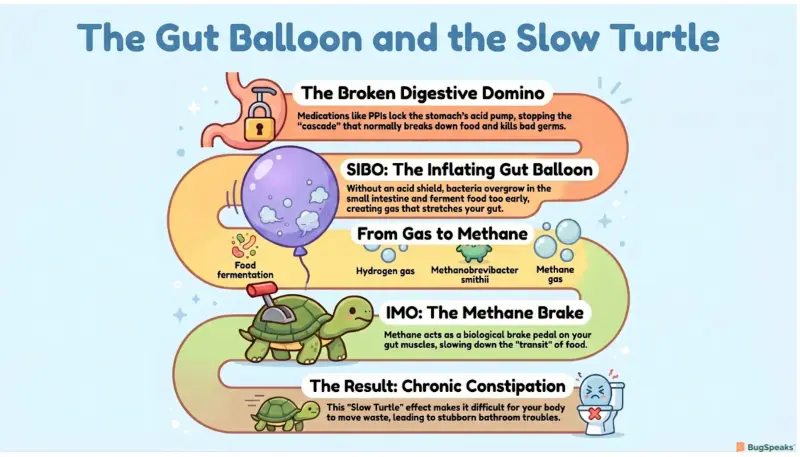
The risks of bacterial overgrowths like SIBO and IMO include painful bloating, gas, and severe constipation because bad bugs multiply in places they should not beLo and Chan (2013),Wawrzeńczyk et al. (2025). When stomach acid is blocked, bacteria can travel down and grow in massive numbers in your small intestine, creating a condition called Small Intestinal Bacterial Overgrowth (SIBO). These bacteria ferment your food too early, making a lot of gas that stretches your gut like an over-inflated balloon. This can make eating normal meals very uncomfortable, which can lead to daily stomach aches and chronic bathroom troubles.
Another risk is Intestinal Methanogen Overgrowth (IMO), where ancient organisms called archaea make a gas that makes your poop move too slowlyWawrzeńczyk et al. (2025). The main culprit is a tiny microbe named Methanobrevibacter smithii, which acts like a hydrogen sponge inside your gut. It eats up hydrogen gas made by other bacteria and breathes out methane gas. Methane is highly sluggish and acts like a biological brake, slowing down your gut's muscle squeezing. This slow transit makes it very hard to go to the bathroom, leading to painful constipation that does not want to go away.
Finally, locking your acid cascade makes you much more vulnerable to dangerous, opportunistic bugs like Clostridioides difficileKiecka and Szczepanik (2023). This germ can cause severe, watery diarrhea and is very hard to defeat. Scientists are studying how probiotics can help restore your gut's natural flow and produce helpful short-chain fatty acids (SCFAs)Kiecka and Szczepanik (2023). These fatty acids are like healthy food for your gut cells, rebuilding your protective walls and boosting your local defenses. By using probiotics to restart the cascade, you can help your gut's biological garden bloom beautifully and stay safe from bad germs.
-Varsha V
Visualize the process- https://youtu.be/Tz6JYY_eMWA
Reference
Kiecka, A., & Szczepanik, M. (2023). Proton pump inhibitor-induced gut dysbiosis and immunomodulation: current knowledge and potential restoration by probiotics. Pharmacological reports : PR, 75(4), 791–804. https://doi.org/10.1007/s43440-023-00489-x
Wawrzeńczyk, A., Czarnowska, M., Darwish, S., Ćwirko-Godycka, A., Lis, K., Szota, M., Treichel, P., Wojtkiewicz, A., & Napiórkowska-Baran, K. (2025). Methane, Bacteria, Fungi, and Fermentation: Pathophysiology, Diagnosis and Treatment Strategies for Small Intestinal Bacterial Overgrowth, Intestinal Methanogen Overgrowth and Small Intestinal Fungal Overgrowth. Current issues in molecular biology, 47(9), 713. https://doi.org/10.3390/cimb47090713
Lo, W. K., & Chan, W. W. (2013). Proton pump inhibitor use and the risk of small intestinal bacterial overgrowth: a meta-analysis. Clinical gastroenterology and hepatology : the official clinical practice journal of the American Gastroenterological Association, 11(5), 483–490. https://doi.org/10.1016/j.cgh.2012.12.011
Yadlapati, R., & DeLay, K. (2019). Proton Pump Inhibitor-Refractory Gastroesophageal Reflux Disease. The Medical clinics of North America, 103(1), 15–27. https://doi.org/10.1016/j.mcna.2018.08.002
Vitale, M., Costabile, G., Testa, R., D'Abbronzo, G., Nettore, I. C., Macchia, P. E., & Giacco, R. (2024). Ultra-Processed Foods and Human Health: A Systematic Review and Meta-Analysis of Prospective Cohort Studies. Advances in nutrition (Bethesda, Md.), 15(1), 100121. https://doi.org/10.1016/j.advnut.2023.09.009