The Science Behind the Microbe Fueling Footballers' Energy
Why do your legs burn when you run fast?
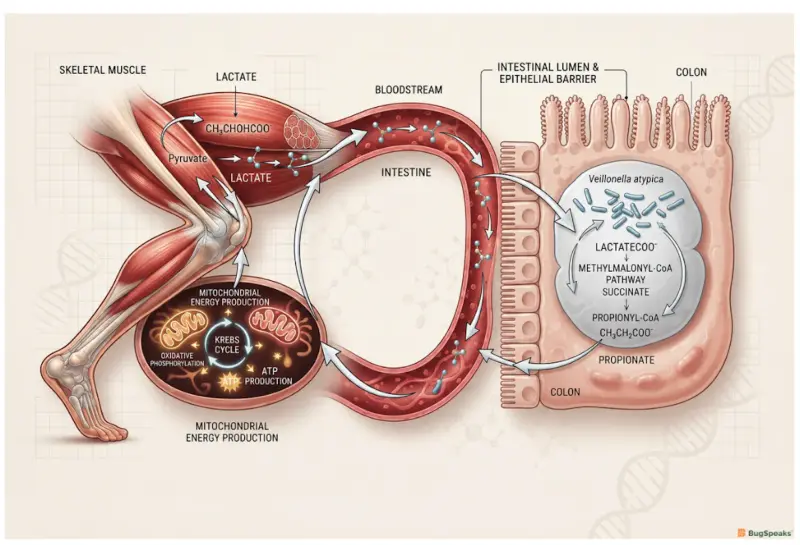
Your legs feel a burning sensation during fast running because your hardworking muscles produce a temporary chemical called lactateYao et al. (2024). When a football player sprints down the field in the final minutes of a tough match, their body demands immediate power. To meet this urgent physical demand, the muscle cells initiate a rapid chemical process called glycolysis to break down stored sugarsSales and Reimer (2022). This crucial process generates quick energy but also produces acidic muscle waste. This sour byproduct is lactic acid, which can build up and make your lower leg muscles feel very heavy and sore.
In the past, many scientists believed that this acidic compound was simply a useless waste product that caused muscle fatigue and soreness. However, modern research shows that lactate is actually a valuable energy currency that the body can recycle and use againYao et al. (2024). During intense physical exercise, your active muscles release this molecule directly into your bloodstream so it can travel to other vital organs. The human heart and other muscles can absorb this circulating molecule and use it as a secondary fuel. Your body treats this molecule like a precious resource rather than throwing it away like useless trash.
This system behaves exactly like a metabolic relay race where different parts of your body work together as teammates. Your active muscles act as the first runner, sprinting forward and carrying the chemical message representing the newly produced lactate. The bloodstream serves as the handoff route, allowing the first runner to transport this chemical message toward the gut area. Instead of letting this valuable message pile up and cause a metabolic traffic jam, the handoff route quickly delivers it to a waiting teammate inside your body. This is where your helpful inner gut microbes step in to keep your physical engine running smoothly.
How does a tiny gut helper catch muscle fatigue?
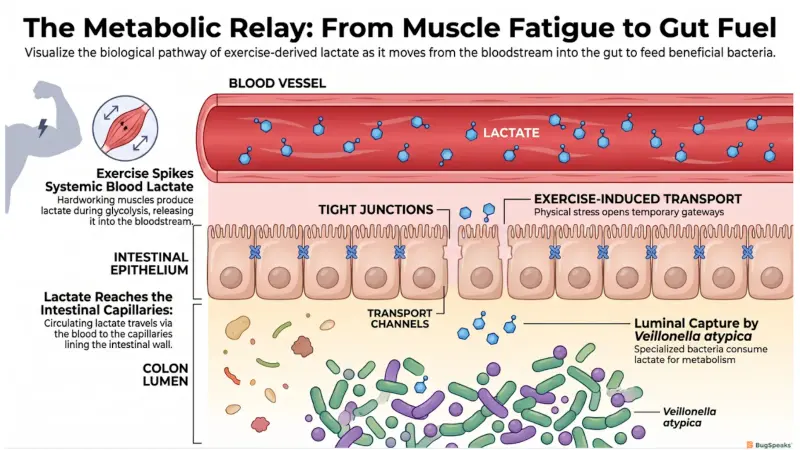
A tiny helper bacterium named Veillonella atypica catches muscle fatigue by absorbing the lactate that travels from your blood into your gutScheiman et al. (2019). This specialized microbe lives and grows naturally inside your digestive system and has evolved a unique appetite for this specific muscle byproduct. As you run harder, the concentration of this muscle chemical rises in your bloodstream to very high levels. Because the body wants to balance things out, the excess chemical is pushed across the thin intestinal barrier into your colonPrzewłócka et al. (2020). Once inside, the waiting bacteria quickly grab and digest this incoming molecule.
The movement of this muscle byproduct across the protective wall of your gut represents a crucial handoff in our athletic relay race. The protective physical wall of your gut is normally very selective about what it allows to pass through its tight junctionsXu and He (2025). However, the intense physical stress of a long football match opens up temporary pathways for this circulating chemical to cross over. This elegant crossing mechanism allows your systemic fatigue to enter the gut lumen, where the specialized bacteria reside. This process is a beautiful example of how our organs communicate directly with our microscopic residents.
This unique bacterium acts as the second runner in our biological race, standing ready to receive the chemical lactate message during a fast sprint. While most other gut microbes prefer to eat dietary fibers and sugars, this specialized microbe chooses this specific chemical as its primary food. It possesses specialized transport proteins in its outer membrane that pull the incoming chemical messages directly inside its single cellLouis et al. (2022). By consuming this molecule, the bacterium prevents the accumulation of excess acid, which directly helps to maintain a stable gut environment. This cooperative partnership ensures that both of the biological teammates benefit in the end.
How does this gut bacterium turn fatigue into fuel?
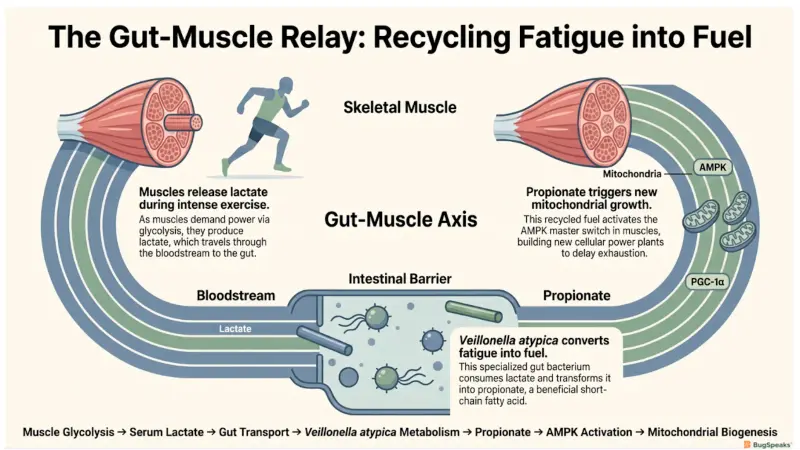
This gut bacterium turns fatigue into useful fuel by digesting lactate and converting it into a helpful energy molecule that your body can use, called propionateScheiman et al. (2019). Instead of just destroying the muscle byproduct, the microbe processes it through a sophisticated internal assembly line. This biological assembly line is a highly efficient series of chemical steps known as the methylmalonyl-CoA pathway systemLouis et al. (2022). The bacterium uses this specialized pathway to break down the incoming molecules and extract the remaining chemical energy for its own survival. As a result, the bacterium produces a valuable short-chain fatty acid.
This output represents the second chemical message in our metabolic relay race, which is ready and waiting for the next leg of the long journey. This new molecule is a tiny fat molecule that your body can easily absorb and use for various biological functions inside your musclesPrzewłócka et al. (2020). While other bacteria produce different types of short-chain fatty acids, this specific microbe focuses almost entirely on making this compound. The chemical conversion happens rapidly inside the bacterial cell, transforming a fatigue-causing byproduct into a performance-enhancing molecule. This recycling trick demonstrates how the microscopic world turns our physical waste into gold.
This biochemical transformation is highly beneficial for athletes because it prevents a dangerous condition known as localized lactic acidosisXu and He (2025). If too much acidic material accumulates in your digestive tract, it can lower the local pH and disrupt your entire microbiome ecosystem. A lower pH inhibits the growth of beneficial microbes and allows harmful pathogens to multiply and cause severe gut issues like stomach crampsLouis et al. (2022). By continuously recycling the incoming acid into a stable compound, the bacterium protects the delicate biological balance of your gut. This metabolic cooperation ensures that your digestive system remains healthy.
How does this new fuel make you run faster?
This new fuel makes you run faster by traveling back to your muscles and instructing them to build more cellular power plants. The newly created short-chain fatty acid leaves the gut lumen, crosses back into your bloodstream, and targets your active muscle tissuesFritz et al. (2025). Because this molecule bypasses the liver, it can travel directly to your working leg muscles to provide immediate metabolic support. Once it finally reaches the muscle cells, the molecule binds to specialized receptors that act as biological antennas on the cell surface. These antennas receive the signal and trigger a cascade of beneficial reactions.
This signal activates an important energy-sensing protein inside your muscle cells called AMP-activated protein kinase (AMPK) by doctors who study human sports medicineFritz et al. (2025). This sensor protein acts like a key master switch that monitors your cellular energy levels and manages metabolic resources. When the sensor detects the signal from the gut-derived fuel, it turns on pathways that increase energy production. This activation leads to the creation of new mitochondria, which are the microscopic power plants that generate ATP for muscle contractionPrzewłócka et al. (2020). Having more power plants means your muscles can produce more energy, delaying fatigue.
The host metabolism represents the ultimate finish line of this amazing relay race, where the recycled energy is finally used to move your body. By receiving the recycled fuel from your microscopic gut partners, your muscles can sustain high-intensity sprinting for a longer durationScheiman et al. (2019). This cooperative cycle allows a football player to make that crucial sprint in the eighty-fifth minute of a match. This elegant loop shows that athletic endurance is not just about your heart and lungs working harder on their own. It is a beautiful team effort that connects your muscles directly to your gut.
How can you feed your internal recycling engine?
You can feed your internal recycling engine by eating a diverse range of plant fibers that nourish your helpful gut microbes daily. These specialized plant fibers act as prebiotics, which are non-digestible carbohydrates that serve as the primary food for beneficial bacteriaZhao et al. (2026). When you consume foods like oats, bananas, onions, and asparagus, these complex fibers travel untouched to your large intestine. Once there, they provide the necessary raw materials for your friendly gut microbes to grow, multiply, and thrive easily. A well-fed microbial community is much more stable and better prepared to assist you during workouts.
A healthy and diverse diet directly supports a balanced microbiome, which is the community of trillions of microbes in your gutSales and Reimer (2022). Athletes who eat a wide variety of plants every week have a much higher diversity of beneficial microbes in their digestive systems. This rich microbial diversity ensures that you have plenty of specialized bacterial helpers ready to catch and recycle your muscle fatigue. If your diet is poor, these helpful microbial populations will shrink, leaving your muscle-recycling engine weak and highly inefficient. Therefore, eating for microbial diversity is just as important as monitoring your daily protein and carbohydrate intake.
By combining structured physical training with fiber-rich nutrition, you can optimize this natural gut-muscle connection over several weeks of trainingFritz et al. (2025). Regular aerobic exercise naturally increases the abundance of your helpful recycling microbes by providing them with a steady supply of lactate. When you feed these microbes with diverse fibers, you create a powerful synergy that enhances your overall athletic recovery. This integrated healthy approach allows you to build a more resilient physical body from the inside out, starting with your gut ecosystem. Taking care of your microscopic partners is the ultimate secret to unlocking peak athletic performance.
Visualize the process- https://youtu.be/SvR9Ax0GpqU
Reference
Scheiman, J., Luber, J. M., Chavkin, T. A., MacDonald, T., Tung, A., Pham, L. D., Wibowo, M. C., Wurth, R. C., Punthambaker, S., Tierney, B. T., Yang, Z., Hattab, M. W., Avila-Pacheco, J., Clish, C. B., Lessard, S., Church, G. M., & Kostic, A. D. (2019). Meta-omics analysis of elite athletes identifies a performance-enhancing microbe that functions via lactate metabolism. Nature medicine, 25(7), 1104–1109. https://doi.org/10.1038/s41591-019-0485-4
Louis, P., Duncan, S. H., Sheridan, P. O., Walker, A. W., & Flint, H. J. (2022). Microbial lactate utilisation and the stability of the gut microbiome. Gut microbiome (Cambridge, England), 3, e3. https://doi.org/10.1017/gmb.2022.3
Sales, K. M., & Reimer, R. A. (2023). Unlocking a novel determinant of athletic performance: The role of the gut microbiota, short-chain fatty acids, and "biotics" in exercise. Journal of sport and health science, 12(1), 36–44. https://doi.org/10.1016/j.jshs.2022.09.002
Li, Z., Li, Y., Wang, Y., Chen, J., & Liu, Y. (2025). The Athlete Gut Microbiome: A Narrative Review of Multi-Omics Insights and Next-Generation Probiotic Strategies. Nutrients, 17(20), 3260. https://doi.org/10.3390/nu17203260
Lustgarten M. S. (2019). The Role of the Gut Microbiome on Skeletal Muscle Mass and Physical Function: 2019 Update. Frontiers in physiology, 10, 1435. https://doi.org/10.3389/fphys.2019.01435
Przewłócka, K., Folwarski, M., Kaźmierczak-Siedlecka, K., Skonieczna-Żydecka, K., & Kaczor, J. J. (2020). Gut-Muscle AxisExists and May Affect Skeletal Muscle Adaptation to Training. Nutrients, 12(5), 1451. https://doi.org/10.3390/nu12051451
Xu, Y., & He, B. (2025). The gut-muscle axis: a comprehensive review of the interplay between physical activity and gut microbiota in the prevention and treatment of muscle wasting disorders. Frontiers in microbiology, 16, 1695448. https://doi.org/10.3389/fmicb.2025.1695448
Réka, F., Zsófia, B., Ádám, B., & Péter, F. (2025). The Gut-Muscle-Immune Axis in Motion: Mechanistic Synergies of SCFA Metabolism, Exercise, and Microbial Cross-Feeding. Nutrients, 17(23), 3786. https://doi.org/10.3390/nu17233786
Yao, S., Chai, H., Tao, T., Zhang, L., Yang, X., Li, X., Yi, Z., Wang, Y., An, J., Wen, G., Jin, H., & Tuo, B. (2024). Role of lactate and lactate metabolism in liver diseases (Review). International journal of molecular medicine, 54(1), 59. https://doi.org/10.3892/ijmm.2024.5383