Exploring the Gut-Skin Axis: Insights for Eczema and Psoriasis
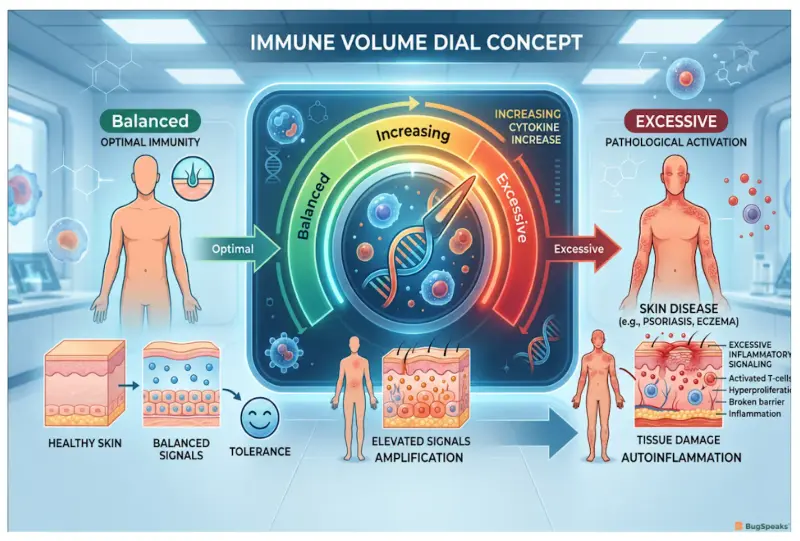
Why does an overactive immune system cause visible skin issues like eczema and psoriasis?
Visible skin issues like eczema and psoriasis occur when your body's immune system turns its volume dial up too high and overreacts to normal things around youLipska et al. (2026). Think of your defenses as a smart music controller that is supposed to play a soft, quiet song to keep you safe and healthyLipska et al. (2026). When your defenses stay calm, they tolerate everyday things like dust, pollen, or friendly skin bugs without any troubleAlia et al. (2026). But if the volume is cranked up too high, the cells start shouting, causing red, itchy, or painful skin changes that we can seeAlia et al. (2026).
To understand this loud signal, let us look at the first skin condition called atopic dermatitis, which most people simply call eczemaLipska et al. (2026). In eczema, the skin is like a dry, cracked wall that has lost its protective shield against the worldAlia et al. (2026). Because the barrier is broken, the body releases special alarm molecules called cytokines that act like loud speakers screaming for helpAlia et al. (2026). This loud signal tells your body to attack, making your skin incredibly dry, red, and itchy, which creates a hard-to-stop cycle of scratching and further irritation (Lipska et al., 2026). Now let us look at the second skin condition called psoriasis, which has a different loud signalWang et al. (2026). Instead of just being dry and cracked, the skin in psoriasis grows way too fast because of a locked volume knobWang et al. (2026). Your defense cells release different cytokines that tell your body to build new skin cells in just a few days instead of a whole monthWang et al. (2026). This rapid pile-up of cells creates thick, raised, red patches covered with silvery, scaly layers that show inflammation is stuck at maximum volumeWang et al. (2026).
How does the gut barrier act as a regulator for immune signals?
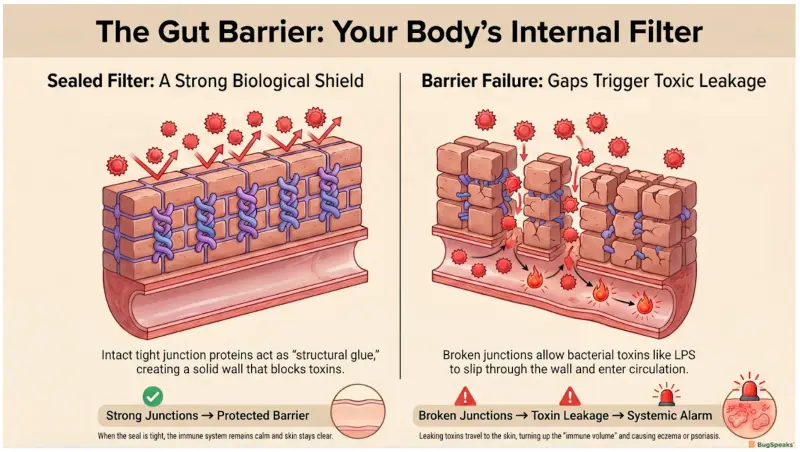
The gut barrier acts as a physical signal regulator by filtering what passes through your digestive tract, keeping harmful triggers out of your bloodstreamLipska et al. (2026). Your gut is lined with a single, paper-thin layer of cells that are held tightly together by special tight junction proteins that act like strong glueWang et al. (2026). This tight seal makes sure that nutritious food is let in, but scary invaders are safely kept outLipska et al. (2026). When this filter works perfectly, it always keeps the background music of your body quiet, peaceful, and balancedLipska et al. (2026).
However, if this paper-thin wall is damaged by a poor diet, stress, or medicine, the glue melts, and gaps open up, leading to intestinal permeabilityAlia et al. (2026). This open state is often called a leaky gut, and it allows tiny pieces of bacteria and toxins to slip insideLipska et al. (2026). A very loud bacterial toxin called lipopolysaccharide is one of these escapees, and it acts like a fire alarm once it enters your bloodLipska et al. (2026). Without a strong seal to block these toxins, they travel through your veins, sending emergency alarms everywhereLipska et al. (2026).
When these escaping toxins reach your skin, local cells pick up the signal and go into a state of high alarmAlia et al. (2026). This constant leak from your gut turns up the overall volume of your defense system, making your skin sensitive and soreWang et al. (2026). This shows that we cannot treat the skin as a separate piece, because its health is tied to your inner liningAlia et al. (2026). By fixing the leaks and keeping the physical filter strong, we can block the bad static and help the skin stay quiet and calmZhao et al. (2025).
How does the gut microbiome influence our immune system's volume dials?
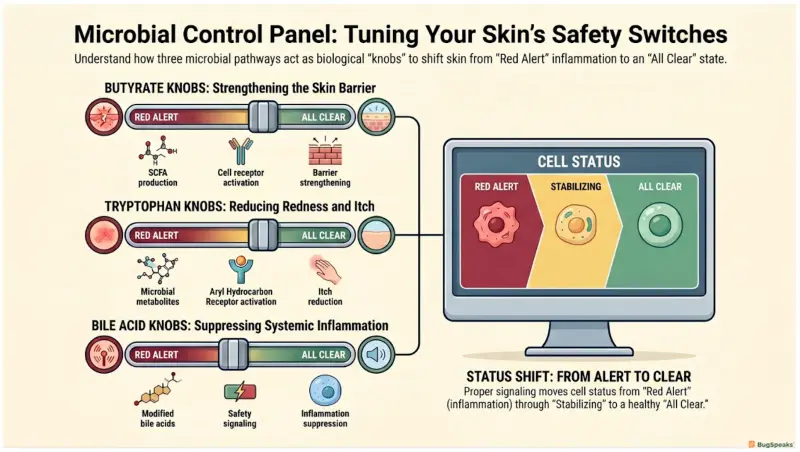
The gut microbiome influences your immune volume dials by using its trillions of tiny helpers to produce chemical compounds that tell your defenses to quiet downLipska et al. (2026). When you eat healthy plant fibers, your friendly gut bugs digest them and turn them into special messages called short-chain fatty acidsLipska et al. (2026). These friendly acids act like an essential cellular fuel for your gut cells, giving them energy and keeping the wall sealedAlia et al. (2026). This steady flow of good molecules keeps your background volume set to a steady state of immune homeostasis that never causes skin breakoutsAlia et al. (2026).
These friendly short-chain fatty acids also help create anti-inflammatory helper cells in your body called regulatory T cellsAlia et al. (2026). Think of these helper cells as the hand that slides the volume dial down whenever things get too loudAlia et al. (2026). These acids can also block a set of enzymes called histone deacetylases, which usually tell cells to activate genetic inflammatory pathways Alia et al. (2026). By shutting down these enzymes, your gut bugs make sure your defenses do not trigger inappropriate cellular alarms at harmless things, protecting your whole body from sudden and painful skin flare-upsAlia et al. (2026).
But if you lose these friendly gut bugs, your body loses its natural anti-inflammatory controls and dims entirely and enters a state of dysbiosisLipska et al. (2026). Without enough SCFA acid makers, the protective helper cells cannot do their job properly, and the pro-inflammatory signaling enzymes stay activeAlia et al. (2026). This loss of control lets your defenses shout without stopping, sending loud inflammatory signals straight through the blood to your outer skinWang et al. (2026). This constant, irritating static shows up as the red rashes of itchy eczema or the raised, scaly, and red plaques of psoriasisWang et al. (2026).
What role do bacterial metabolites play in stabilizing or amplifying skin reactions?
Bacterial metabolites act as direct chemical dial-turners that bind to cells and help your body control how loudly it reacts to skin irritationAlia et al. (2026). Besides fatty acids, your friendly gut bugs make other amazing chemical tools to keep things balancedAlia et al. (2026). When you eat healthy foods with an amino acid called tryptophan, your helpful bugs turn it into protective shield compoundsAlia et al. (2026). These compounds bind directly to a special cell switch called the aryl hydrocarbon receptor, which tells your skin cells to repair their barriers and stop being so itchyAlia et al. (2026).
Another set of chemical tools is made when your gut bugs recycle digestive liver fluids into secondary bile acids to protect your tissuesAlia et al. (2026). These modified acids travel through your body and bind directly to specific host receptors to suppress hyper-reactive inflammatory pathways Alia et al. (2026). This binding acts like a strong safety fuse that shuts down inflammatory signals before they can cause any damageAlia et al. (2026). By working together, tryptophan derivatives and these recycled acids make sure that your overall immune volume level is kept safe, stable, and completely quietAlia et al. (2026).
But if your gut is out of balance, these helpful metabolic switches are never turned on inside youWang et al. (2026). Losing friendly bugs means your body cannot process tryptophan or recycle liver fluids into protective compoundsAlia et al. (2026). Without these natural switches, your volume controller gets stuck, and your defenses release a huge flood of skin-inflaming chemical signalsWang et al. (2026). These signaling molecules travel directly to your skin, turning small, simple irritations into a painful, chronic flare-up of eczema or psoriasis that is very hard to soothe or resolve (Wang et al. (2026).
How can we target the gut-skin axis to restore balanced volume in skin conditions?
We can restore balanced volume to our immune system by using helpful bacterial therapies to rebuild a healthy, quiet gut ecosystemAlia et al. (2026). The first step is taking oral probiotics, which are live, friendly microbes that restock your damaged gut with good biological buildersAlia et al. (2026). These live bugs actively compete with bad microbes, seal up physical leaks, and lower oxidative cellular stress markersLipska et al. (2026). They also make helpful enzymes that protect your body from cellular wear and tear, helping slide your main volume controller back down to a balanced state of immune toleranceLipska et al. (2026).
To help these friendly bugs grow, we can feed them prebiotics, which are healthy plant fibers from foods that act as specialized fuelLipska et al. (2026). When we combine live bugs with their fiber food, we make synbiotics, which work together to guarantee the beneficial microbes survive and colonizeLipska et al. (2026). We can also use postbiotics, which are non-living bug parts and ready-made healthy acids that safely soothe your delicate gut liningLipska et al. (2026). These special tools help patch your physical barriers, blocking bad static and calming skin cells without introducing live bacteriaLipska et al. (2026).
In very severe skin cases, doctors can use a complete reset called fecal microbiota transplantation to replace your entire damaged gut communityAlia et al. (2026). This transplantation transfers a diverse, highly balanced microbial family from a healthy donor directly into the patient's digestive systemZhao et al. (2025). By quickly rebuilding the friendly population, this therapeutic procedure calms overactive skin signals and totally removes bad gut bugsAlia et al. (2026). This deep reset shuts down systemic static at all its sources, letting your skin finally heal and enjoy a quiet, healthy, and beautiful baseline lifeLipska et al. (2026).
Visualize the process- https://youtu.be/vMupP58EMw0
Reference
Wang B, Zhang Y, Lin L, Wang S and Yang S (2026) Psoriasis: microbiome dysbiosis and pathogenic mechanisms. Front. Immunol. 17:1714515. doi: 10.3389/fimmu.2026.1714515
Lipska, P., Łukańko, K., Sobczak, J., Lazarchuk, I., & Duda-Madej, A. (2026). From Dysbiosis to Inflammation: Gut Microbiota and Oxidative Stress in Atopic Dermatitis. Antioxidants, 15(3), 299. https://doi.org/10.3390/antiox15030299
Alia K, Khan H, Muzaffar H, Perveen N, Alrashedi S, Al Dhaheri Y, Waheed Y, Alam MT, Naseem M and Muhammad K (2026) Gut dysbiosis and microbial metabolites in atopic dermatitis: implications for immune regulation along gut-skin axis. Front. Microbiol. 17:1829876. doi: 10.3389/fmicb.2026.1829876
Zhao, Y., Yu, C., Zhang, J., Yao, Q., Zhu, X., & Zhou, X. (2025). The gut‑skin axis: Emerging insights in understanding and treating skin diseases through gut microbiome modulation (Review). International journal of molecular medicine, 56(6), 210. https://doi.org/10.3892/ijmm.2025.5651