Navigating the World of DNA Sequencing: A Beginner's Guide
What is the Magic of the "Reading" Phase?
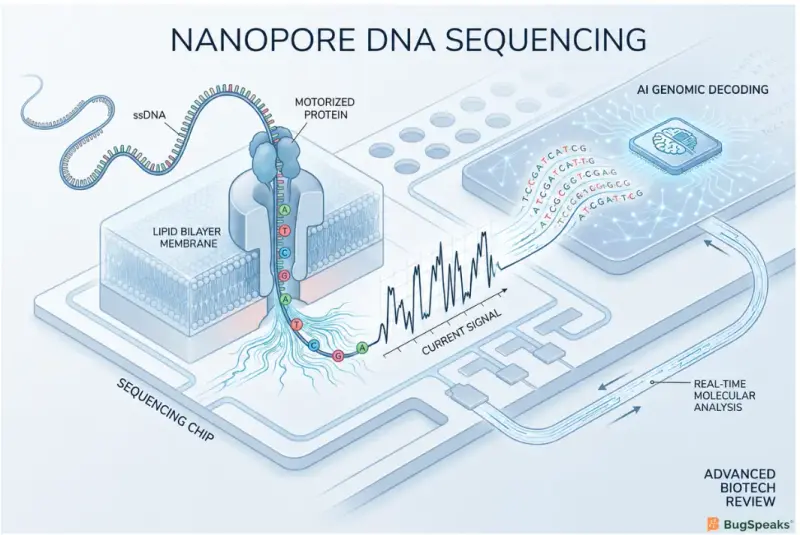
The magic of the "Reading" phase is the critical transition where we turn physical biological material into digital information that a computer can understand. In our previous adventure, we explored how Deoxyribonucleic Acid (DNA) is extracted from your gut, but it is this phase that translates the order of the Nucleotides into a high-definition digital map. This process bridges the gap between the wet world of biology and the precise world of data science by decoding the genetic code of every microbe living inside you. Decoding this complexity is the only way to perform surveillance on your Ecosystem, allowing us to spot the difference between a helpful citizen and a dangerous intruder.
Our primary goal during this phase is to use Bioinformatics to scan the millions of pages in your gut’s hidden library. Your gut is like a global monitoring network where tens of thousands of different species live together, often sharing space and even swapping genetic secrets. Because these species are so intermingled, we need to read their specific ID cards to know exactly who they are and what they are doing. This phase is transformative because it changes how we view human health; instead of guessing why someone feels unwell, we look at the raw evidence provided by the genetic code. By translating biological material into digital text, we give our researchers the clues they need to solve the mysteries of your metabolism.
The success of this entire process depends on the "satellites" we choose to use for our surveillance. In the past, our tools were like old, shaky telescopes that could only see the biggest buildings in the city. Today, we use the equivalent of a global satellite array that can zoom in close enough to see the color of a person’s shoes. By selecting the right sequencing methodology and the most powerful hardware, we can process terabytes of data which is like reading millions of books in a single afternoon. This high-definition view is what allows us to map the informational domain of your own biology with world-class precision, ensuring every citizen of your gut metropolis is accounted for.
Why has the Old Grainy Radar Been Retired?
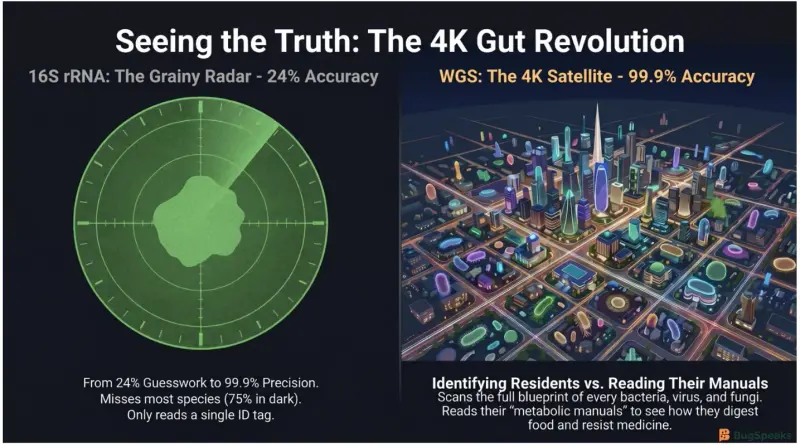
The old grainy radar, known as 16S Ribosomal Ribonucleic Acid (16S rRNA) sequencing, has been retired because it is too blurry and misses over 75% of the microbial species in your gut. This method only looked at one tiny part of a single gene that all bacteria share, much like a radar that can tell you a city exists but cannot show you the streets or the people. It relied on a process called Polymerase Chain Reaction (PCR) to copy and paste this tiny marker gene over and over again, which often introduced mistakes into the final map. This vision is too blurry for modern health needs, as it often fails to identify the exact species of a microbe required for accurate Taxonomy.
Studies have shown that 16S sequencing only gets the species right about 24% of the time, leading to a map with giant holes where important information should be. Most critically, the old radar is blind to the Phylogenetic functions of the microbes and what they are actually doing in your body. It can't see the "factories" where microbes make vitamins, nor can it see the "weapons" that harmful bacteria use to make us sick. Because 16S only looks at one tiny ID tag, it ignores the rest of the genome, which contains all the instructions for life. To truly understand health, we need to see the whole blueprint, not just the label on the front door.
Retiring the grainy radar allows us to embrace a future where every detail of the microbial city is visible. Imagine trying to find a specific person in a stadium using a radar that only shows you "humans" ; it's simply not detailed enough to make important health decisions. By moving away from this obsolete technology, we can ensure that our surveillance is both honest and complete. This shift is what separates basic gut tests from the world-class characterization provided by modern whole-genome methods. We are no longer satisfied with grainy outlines; we require the full-color, high-definition truth of your internal metropolis.
Table 1: Comparing the Surveillance Methods: Radar vs. Satellite
How Does a 4K Satellite View Change Everything?
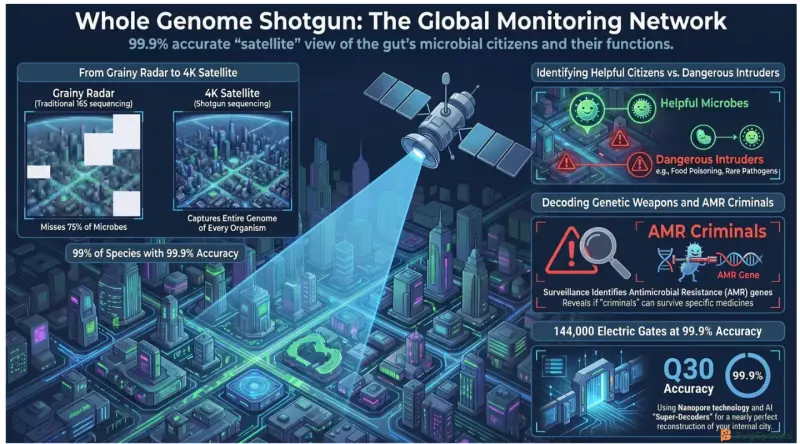
A 4K satellite view, technically called Whole Genome Shotgun (WGS) sequencing, changes everything by breaking all the DNA in a sample into millions of pieces to see the entire blueprint of every microbe. Instead of looking for a single gene, Shotgun Metagenomics captures every detail, from the tallest skyscraper to the smallest park bench, all at the same time. This high-definition view allows us to see things that were previously invisible, such as specific strains of bacteria that might be helpful friends or dangerous "criminals" that cause food poisoning.
Beyond just identifying the residents, WGS allows us to read their instruction manuals to see how they digest your food and communicate with your immune system. We can identify the specific genes they use for Antimicrobial Resistance (AMR), which tells us if your microbes can survive the medicines you might take. This links identity with action, showing us exactly how much "electricity" the microbial power plants are making for your body. This inclusive view even captures Eukaryotes, like complex fungi, and the "dark matter" viruses that hunt bacteria, ensuring no citizen of the gut is left off the map.
By sequencing everything indiscriminately, we create a complete and honest map of the intestinal landscape that transforms the gut from a mysterious "black box" into a transparent display of biological activity. This allows us to identify rare microbes that only appear in tiny amounts but might have a huge impact on your health. We are no longer limited by what we think might be in your gut; we sequence it all to find the hidden threats and the hidden heroes. This 4K view is the ultimate tool for precision medicine, ensuring that every recommendation we make is based on the full genetic truth of your internal metropolis.
How Do Tiny Electric Gates and Traffic Control Work?
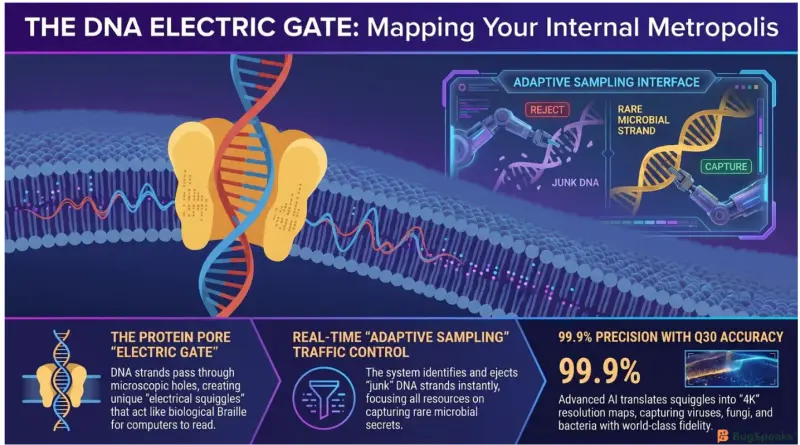
Tiny electric gates, known as Nanopore sequencing, read our DNA by measuring electrical squiggles as long strands of the molecule pass through microscopic holes in a thin membrane. We apply electricity to this membrane, creating a flow of energy through the hole, or Protein Pore. As the DNA moves through, it partially blocks the hole, causing the electricity to wiggle. Because each letter has a different shape, it creates a unique squiggle that we can record. To make sure the DNA doesn't move too fast, we use a motor protein called a Helicase that acts as a tiny biological brake.
To manage the massive amount of information, we use a traffic control system called Adaptive Sampling to decide which molecules are important. This system uses split-second logic to scan the first few letters of a strand; if it recognizes the strand as "junk" or something we have already seen enough of, it physically ejects the molecule from the gate. This ensures that 100% of our sequencing resources are focused on the rarest and most complex microbial secrets hidden in your gut. This efficiency is what allows us to find the "needle in the haystack" without getting buried in repetitive data.
This technology is a radical departure from older methods that relied on taking "photos" of glowing chemicals; instead, Nanopore sequencing "feels" the DNA as it moves. It’s like a blind person reading Braille with their fingertips. It's direct, fast, and incredibly accurate. One of the coolest things about this is its ability to see "sticky notes" on the DNA, which tell the cell which instructions to follow or ignore. This gives us a whole new layer of information about how your lifestyle and environment are marking your microbes’ genes. By reading these marks, we can see if your microbes are peaceful or preparing for trouble.
Table 2: Satellite Hardware Specs: The Monitoring Array
How Does Mission Control Build Your Health Map?
Mission control builds your health map by using powerful Artificial Intelligence (AI) to translate electrical squiggles into genetic text through a process called Basecalling. These signals are streamed in real-time to "Super-Decoders" in the cloud that filter out noise to reach a staggering Q30 Accuracy, meaning the results are 99.9% perfect. With this level of high-fidelity playback, we can perform De Novo Assembly, which is the process of reconstructing the entire blueprints of your gut inhabitants from scratch without needing any old reference guides.
This high-speed decoding allows us to build MAGs (Metagenome-Assembled Genomes), which are complete genomic "sentences" for even the rarest bacteria in your gut. At BugSpeaks, we use the Oxford Nanopore PromethION, which has 144,000 tiny electric gates working at the same time to watch the citizens of your gut. This power allows us to study entire populations with incredible speed, turning a slow lab experiment into an active tool for making quick health decisions. Because the data streams to our computers as it's being read, we can often find harmful "bad actors" in less than half an hour.
The final map we draw is a "hypothesis-free" look at your health, capturing everything even the things we didn't know we were looking for. This allows us to discover hidden viral threats and rare microbes that other tests would completely miss. We are moving into a future where we don't just read your microbiome; we understand it well enough to forecast problems before they happen. Don't settle for a grainy radar when you can have a full-color map of your internal metropolis. Order your BugSpeaks kit today and start your journey into the informational domain of your own biology!
Table 3: The PromethION Advantage: Speed and Accuracy
-Anthony Surya Prakash
Visualize the process- https://youtu.be/NhhSQP3PZJQ