The Ultimate Guide to Deep-Sea DNA Extraction
Why Is the Integrity of Our Submerged Data Tape the Ultimate Prerequisite for Success?
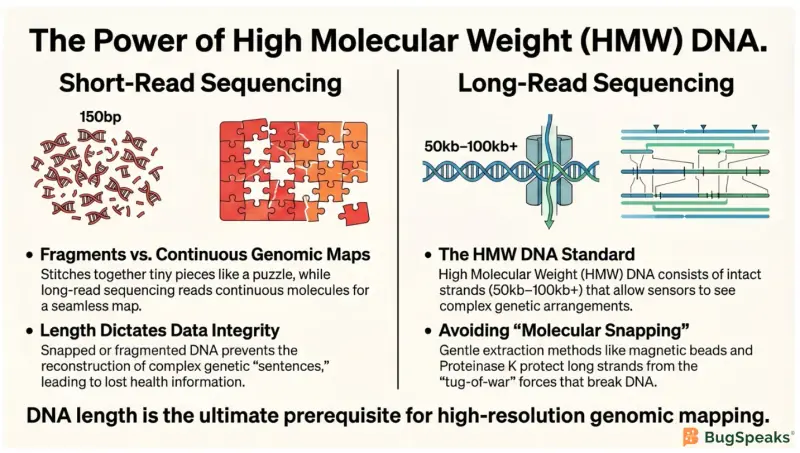
The integrity of our submerged data tape is the ultimate prerequisite for success because it ensures we recover the longest possible strands of Deoxyribonucleic Acid (DNA) to create a high-resolution map of your internal health. Imagine your stool sample is a Reinforced Titanium Capsule sitting at the crushing depths of the ocean floor, and inside is a continuous magnetic tape containing the genetic secrets of your gut microbiome. To read this data using our high-tech sequencing machine, we cannot simply provide shredded bits of tape; the sensors require long, continuous molecules to glide through them smoothly. If the tape is snapped into tiny fragments, the system cannot reconstruct the complex genetic "sentences" of your gut, leading to a failure of the retrieval mission.
High Molecular Weight (HMW) DNA is the industry standard for this continuous magnetic tape, representing strands that are dozens or even hundreds of thousands of letters long. While older, traditional sequencing methods could make do with shredded information by stitching small pieces together like a billion-piece jigsaw puzzle, modern third-generation sequencing reads the DNA exactly as it is delivered. This capability allows us to see complex genomic arrangements that were previously invisible, but it places an immense burden on the laboratory team to prevent the tape from rotting or snapping. To prevent decay, we apply a "Cryo-Lock" using stabilization reagents that immediately neutralize Deoxyribonucleases (DNases), which are aggressive enzymatic scavengers that try to chew up and destroy the genetic strands during transit.
The physical vulnerability of these long genetic molecules is dictated by a concept known as the Characteristic Fragment Length (CFL), which is the "safe zone" where the tape is short enough to avoid being torn apart by the liquid in our tubes. In any fluid environment, DNA is subjected to Hydrodynamic Shear, which are physical "pulling" forces that can physically snap the molecular backbone. Turbulence in our extraction buffers consists of tiny swirling patterns that act like "tape-snappers" during our operation. When a molecule’s length exceeds the size of these tiny swirls, it can get caught in two different patterns at once, creating a tug-of-war that snaps the strand in half. Our mission is to move with such care and precision that we circumvent these laws of physics, delivering the longest possible tape to the sequencing deck to ensure a perfect playback of your microbial history.
How Do We Breach the Titanium Hull Without Shredding the Information Inside?
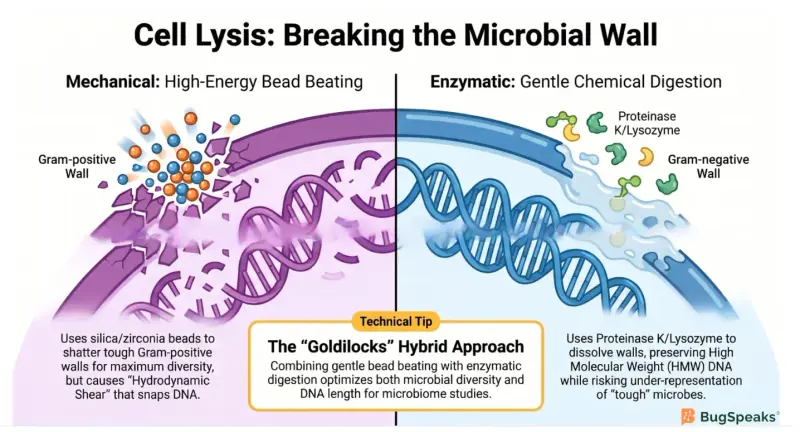
Breaching the titanium hull of a microbial cell is known scientifically as the Lysis phase, and it is the most violent part of the mission because we must rip open cell walls without destroying the magnetic tape inside. To get to the genetic data, we must break through the armor of the trillions of microbes living in your sample, which range from fragile bacteria to incredibly tough, armor-plated Gram-Positive organisms. If our breaching charge is too weak, the safe stays locked and we get no data; if it is too powerful, we destroy the very tape we are trying to save and lose your health information forever.
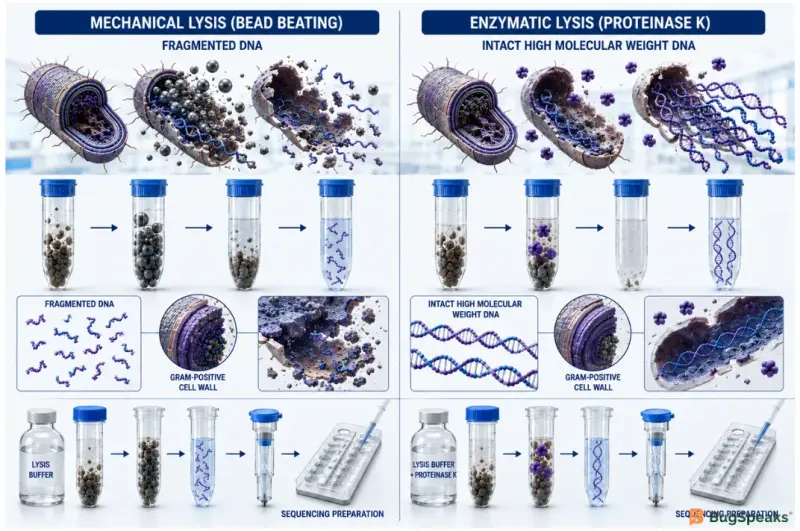
Bead Beating is the most aggressive tool in our arsenal, involving the use of small, hard beads to mechanically shatter cell walls through high-speed shaking. We place the sample into a chamber filled with dense beads and shake them violently, using the physical impact to crack open even the most stubborn titanium hulls. This is highly effective at ensuring we see every single inhabitant of your microbiome, from the weakest to the strongest. However, this method is essentially a controlled explosion; the violent collisions that break the cells also introduce massive amounts of turbulence, often shredding our magnetic tape into shorter pieces that are much harder for our sensors to read.
To protect the tape's length, we often use Proteinase K, a specialized biological "lockpicking" enzyme that chemically digests the proteins and structural components of the cell walls. By incubating the sample at specific temperatures, these enzymes dissolve the cell armor from the inside out, allowing the magnetic tape to float free without the chaotic shaking of mechanical methods. While this biological approach is significantly gentler and preserves the length of the tape, it can be slower and occasionally requires extra help to breach the most reinforced microbial structures. Our goal is to balance these techniques to ensure we capture a complete picture of your gut metropolis while keeping the genetic "tape" as long and readable as possible.
Table 1: The Salvage Equipment Inventory (Breach Comparison)
Who Are the Saboteurs Lurking in the Muck and How Do We Neutralize Them?
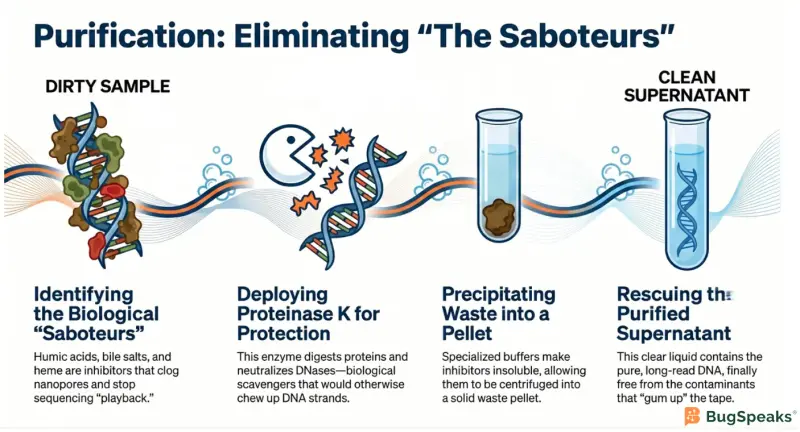
Neutralizing the corrosive Inhibitors in the stool sample is essential because these "saboteurs" can stick to the magnetic tape and blind the sequencing sensors. The gut is filled with deep-sea muck complex sugars, bile salts, and Heme compounds that are naturally occurring but highly destructive to our mission. If these contaminants are not removed, they will clog our sequencing gates, effectively stopping the "playback head" and causing the entire salvage mission to ground to a halt.
Cleaning these saboteurs requires a process of intensive washing using specialized chemical buffers. These buffers are designed to seek out and bind to the Inhibitors, trapping them in a complex chemical web so they can be separated from the valuable DNA. This ensures that the tape we eventually pull to the surface is pristine and free of the biochemical sludge that characterizes the human gut environment. Without this step, the genetic data would be too "dirty" to be processed by our high-tech sequencing tools. We use specialized technology to force all non-genetic material including proteins, fats, and salts to "crash" out of the liquid and form a solid pellet at the bottom of the tube.
This leaves our magnetic tape suspended in a clean, clear liquid called the Supernatant at the top of the container. If we skipped this aggressive cleaning, the Polysaccharides, or complex sugars, in the muck would "gum up" the tape, making it impossible for the sequencing pores to read the genetic code. It is a delicate balance of chemical warfare and physics; we must be aggressive enough to remove the contaminants but gentle enough to keep the genetic molecule intact. A clean tape is a readable tape, and in the world of microbiome science, cleanliness is the ultimate key to seeing the hidden details of your internal city.
What Are the Best Recovery Tactics for Hauling Our Cargo to the Surface?
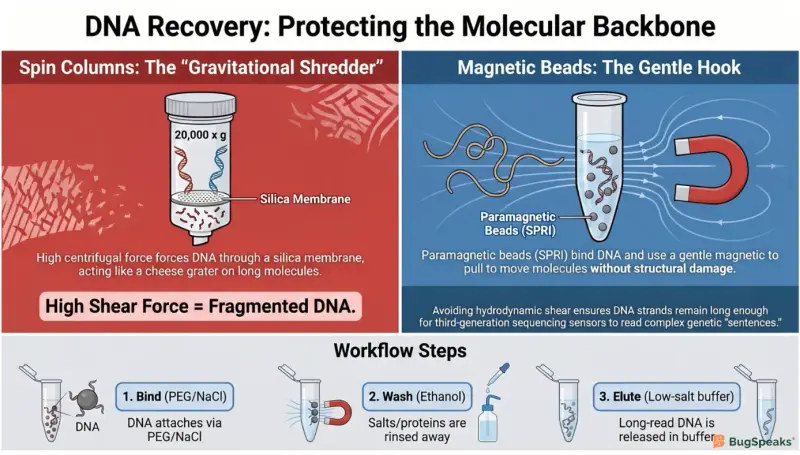
Hauling the cleaned DNA to the surface involves a process called separation, where we must physically pull the magnetic tape out of the cleaning solution and into a format we can use. This is the moment of truth for the length of our tape; the way we handle the genetic material here determines whether it reaches the sequencing deck in one piece or a thousand. Historically, the standard method has been the Spin-Column, which acts like a microscopic sieve that traps the DNA while letting the waste liquid pass through under high pressure.
Spin-Column devices use specialized salts to force the DNA to stick to a filter inside a small plastic tube. While this method is highly efficient, it requires us to spin the sample at incredibly high speeds up to 20,000 times the force of gravity. This forces our magnetic tape through the tiny holes of the sieve under immense pressure, which can act like a cheese grater for ultra-long DNA strands. For the high-resolution maps we create, this gravitational shredding is a risk we often prefer to avoid. Instead, we use a Size Selection sieve to selectively discard short fragments and "genetic shrapnel," ensuring the sequencing deck focuses entirely on high-value, long-read polymers.
The modern alternative is Magnetic Beads technology, where we use "magnetic hooks” , tiny metal-core particles to gently pull the DNA out of the liquid. These beads are engineered to have a surface that DNA loves to stick to; once the tape is "hooked," we simply use a powerful external magnet to pull the beads (and the DNA) to the side of the tube. We then perform a step called Elution, where we unstick the tape from the beads using a special liquid. Because the DNA is never forced through a membrane, the strands remain significantly longer. This preservation of length directly translates into better data, allowing us to see your gut microbiome in high definition.
Table 2: Recovery Tactics: Spin-Column vs. Magnetic Beads
How Do We Scale Our Salvage Fleet and Verify the Final Loot?
Scaling the salvage operation requires using an Automation fleet of robots to handle many data capsules at once, ensuring that every piece of DNA is treated with the exact same level of care. The human hand is too inconsistent and can introduce "accidental turbulence" that snaps our long DNA tape. Robotic liquid handlers can process dozens of samples simultaneously using precisely calibrated speeds that minimize risk. This standardization is the key to our mission at BugSpeaks, ensuring that every customer receives the same high-quality results from our MuDoGeR workflow.
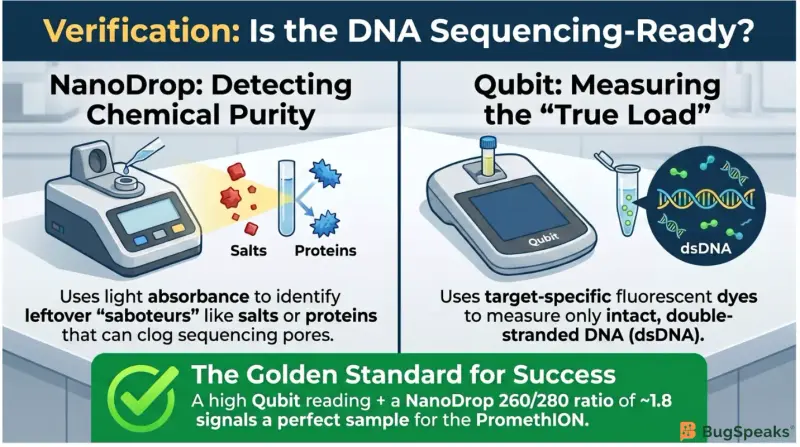
Once the magnetic tape is successfully pulled to the surface, we perform a final audit using Spectrophotometry and Fluorometry to verify the quality of the loot. Spectrophotometry uses light to check for the presence of leftover saboteurs like proteins or salts, telling us how "clean" our tape is. Fluorometry uses glowing dyes that only activate when they find a perfect, intact, double-stranded DNA tape, giving us the "true load" of usable genetic material. Finally, advanced Artificial Intelligence (AI) programs use a process called Basecalling to translate the raw electrical signals from our sensors into the four-letter genetic alphabet of life.
By combining these reports, we can guarantee that our deep-sea salvage operation has been a total success. This final decoding phase allows us to discover "Hidden Artisans" rare or previously unknown bacteria transforming raw electrical signals into a high-definition health blueprint. We are moving into a future where we don't just read the microbiome; we understand it well enough to forecast problems before they happen. Order your BugSpeaks kit today to start your personal salvage mission and unlock the secrets of your internal world! With our world-class technology, you can finally see the full genetic truth of your internal city.
Table 3: Harbor Cargo Logs (Final Audit & Decoding Comparison)
- Swetha T
Visualize the process- https://youtu.be/f21JZ4Txm5k