How does too much screen time mess up messages between your brain and gut?
Too much screen time sends constant, panicked stress alerts from your brain down into your stomach, which completely jams up their normal, healthy communicationFarrukh et al. (2025).
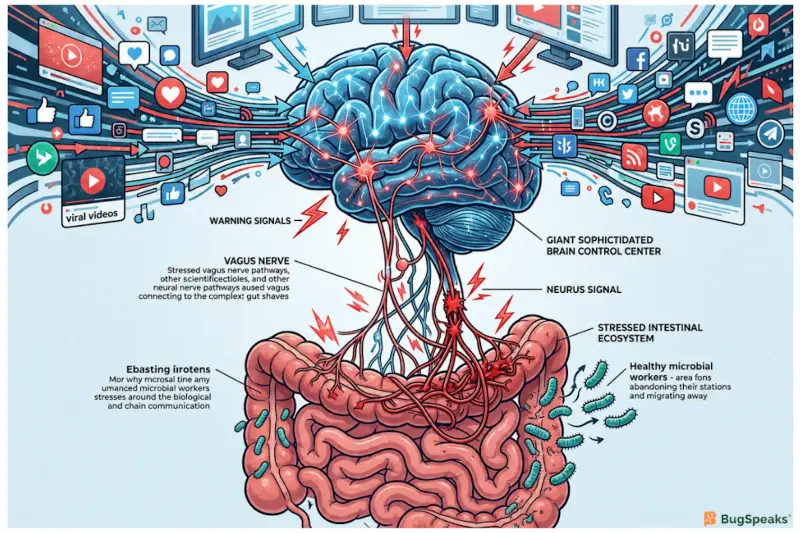
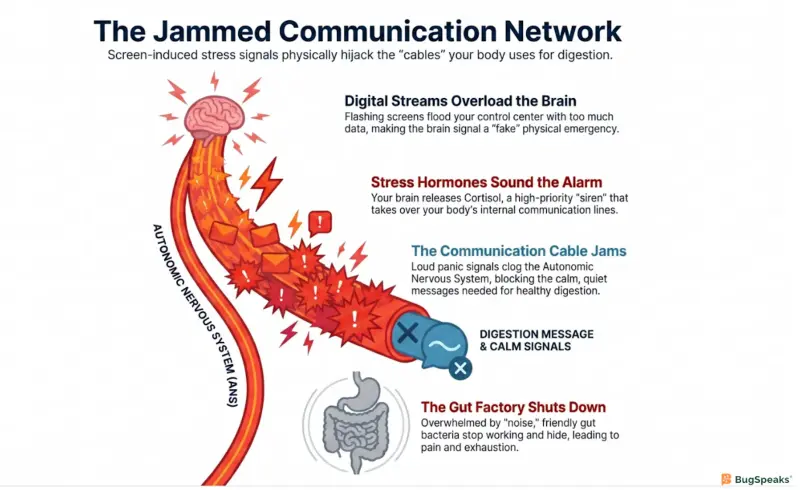
Your brain and your spinal cord make up your Central Nervous System (CNS). In our biological system, you can think of the CNS as the body's ultimate communication control center. This control center is designed to process information from the outside world and keep you safe. However, when you stare at smartphones, tablets, or computer screens for hours at a time, your brain receives continuous incoming signal streams. These are fast, flashing, and endless streams of data from video games, social media, and bright videos. This heavy digital traffic is simply too much for the control center to handle all at once. Because your brain gets totally confused and overwhelmed by all this rapid information, it starts to think you are in actual physical danger. To protect you, it starts sending out emergency priority alert messages, which scientists call stress hormonesFarrukh et al. (2025).
These intense chemical alerts travel very rapidly down your body's main communication network. This specific network of wires is called the Autonomic Nervous System (ANS). The ANS is a special part of your communication network that runs all the automatic things in your body, like making your heart beat and digesting your lunch, without you ever having to think about it. Normally, this network handles regular, calm daily messages smoothly. But when screens flood the network with loud priority alerts, the entire system gets stuck in a high-stress, emergency mode. The normal, quiet messages completely stop, and only the loud panic signals can get through.
When these panicked alerts finally reach your stomach and intestines, they crash into your Enteric Nervous System (ENS). The ENS is a special, local network of nerves located right inside your gut wall. Together with your gut bugs, they make up the downstream response systemsAtaei et al. (2026). The friendly bacteria working in your gut absolutely need calm, steady signals to digest your food and keep your body healthy properly. Instead, the constant barrage of emergency alerts from the brain makes your stomach feel tight, tense, and upset. The workers drop their tools and hide because the alarms are too loud. This biological traffic jam explains exactly why staring at screens for way too long can actually make your tummy hurt and leave you feeling completely exhaustedPetrut et al. (2025).
Why do screens change the good bacteria in your gut?
High stress from glowing screens creates a harsh, swollen environment inside your stomach where bad bacteria grow very quickly, and good bacteria die offAtaei et al. (2026).
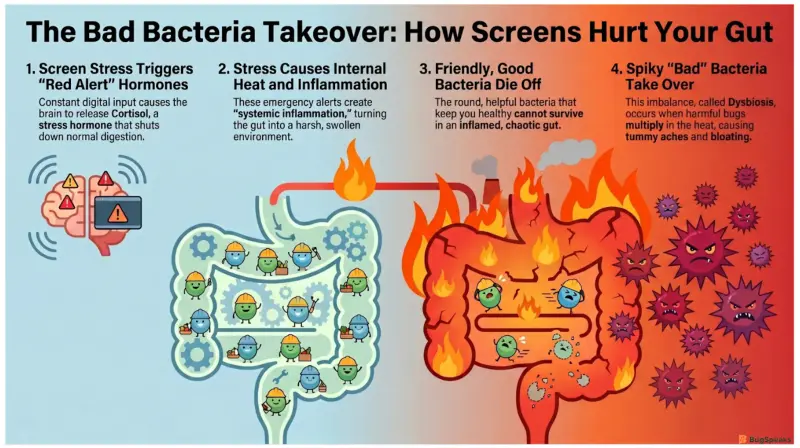
Inside your communication control center, there is a master alarm switch called the Hypothalamic-Pituitary-Adrenal (HPA) axis. This complex name just describes the specific brain-to-body system that manages how you biologically react to stress. When continuous incoming signal streams keep your brain locked in a state of digital panic, the HPA axis continuously pumps out Cortisol. Cortisol is your body's primary stress hormoneFarrukh et al. (2025). These priority alert messages are designed to help you run away from a wild animal, so they immediately take energy and blood flow away from your stomach muscles. At the same time, these alarms create swelling and heat deep inside your body, which scientists refer to as systemic inflammation. Your body starts producing warning proteins called C-Reactive Protein (CRP) and Interleukin-6 (IL-6) to deal with the imagined emergencyFarrukh et al. (2025).
This intense heat and swelling completely ruin the normal living conditions of your downstream response systems. You have trillions of tiny, friendly bacteria living in your gut that work hard to keep you healthy. However, these good bacteria simply cannot survive in a chaotic, inflamed place that is constantly blaring with stress alarms. As the good bacteria begin to die off and disappear, a different kind of bacteria steps in. These are bad, spiky bacteria that actually love chaos and heat. Because the good bacteria are gone, the bad bacteria begin to multiply very rapidly and take over the factory. This unhealthy, harmful imbalance between good and bad bacteria is called dysbiosis (Ataei et al. (2026).
When your gut experiences this massive biological takeover, the entire downstream response system breaks down. Because your good, friendly bacteria are missing, they cannot break down the healthy foods you eat or grab the vitamins your body needs to growPatil and Mehdi (2025). The bad bacteria that took their place do not know how to do this important work. Instead, they just create uncomfortable gas and even more swelling. This chain reaction perfectly explains why too much time playing games on a tablet or scrolling through videos leaves you with a bloated, upset stomach and a very cranky mood. Your gut factory has been completely taken over by the wrong workers.
How does turning off screens help fix your gut's security wall?
Taking a healthy break from digital devices stops the panic signals, giving your gut the quiet time it needs to repair its protective wall and keep harmful toxins out of your bloodFarrukh et al. (2025).
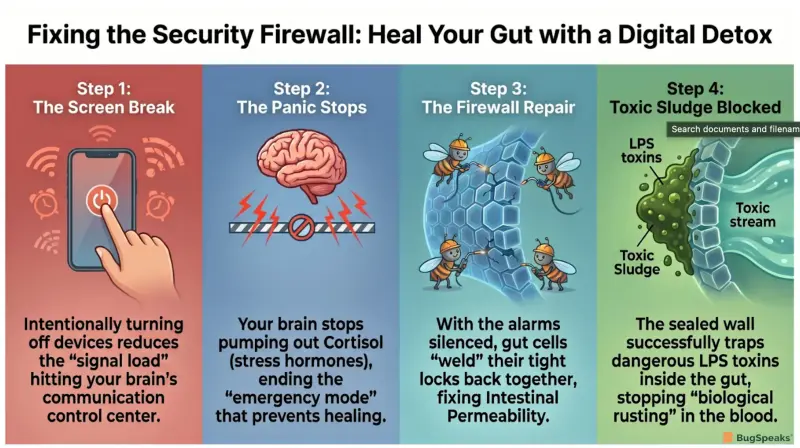
Your intestines have a super-thin, microscopic security firewall wrapped around them. This barrier is built from special cells that lock together very tightly. Under normal, calm conditions, this firewall keeps bad germs, undigested food chunks, and toxic waste safely trapped inside your gut while letting healthy water and vitamins pass through into your blood. However, when priority alert messages from too much screen time flood the communication network, this delicate wall physically breaks open. The tight locks between the cells pop apart. Scientists call this broken wall condition Intestinal Permeability, though many people simply call it "leaky gut"Ataei et al. (2026). When the wall breaks, dangerous bacterial toxins known as Lipopolysaccharides (LPS) leak out of the gut factory and spill into your body's main bloodstream.
The stress from the screens also causes a type of biological rusting inside your cells known as Oxidative Stress. This rusting causes serious wear and tear on your gut's security wall. Doctors can actually measure how badly your cells are rusting by looking for a specific warning sign in your blood called Malondialdehyde (MDA)Farrukh et al. (2025).
The best way to fix this biological problem is to do a digital detox. A digital detox is a perfect, natural form of signal load reduction. By intentionally turning off the continuous incoming signal streams from your bright devices, your communication control center immediately realizes that the emergency is over. It stops sending out those frantic priority alert messages. This gives your downstream response systems the essential quiet time they need to go to work and rebuild the broken wallFarrukh et al. (2025).
With the digital traffic finally cleared out of the way, the microscopic cells in your gut can safely weld their tight locks back together. The firewall seals up, successfully trapping the toxic LPS sludge on the inside where it belongs. Without those toxins leaking into your blood, the swelling in your body shrinks away, your brain fog lifts, and your system gets its energy back. Your body can finally stop fighting fake emergencies and go back to focusing on healthy, calm digestionPatil and Mehdi (2025).
Can taking a screen break help your gut make calming chemicals?
Yes, limiting your screen time lets your friendly bacteria safely create powerful calming chemicals that travel back up your nerve cables to deeply soothe your brainAtaei et al. (2026).
Your body's communication network is not just a one-way street; it is actually a massive, bidirectional biological highway. The main cable connecting your stomach to your brain is called the Vagus Nerve. Your downstream response systems do not just sit around listening to commands from the brain all day; they actively talk back. The good, friendly bacteria inside your gut factory work together to manufacture highly important chemical messengers. They build Serotonin, which is a special chemical that controls your mood and makes you feel happy. They also build Gamma-Aminobutyric Acid (GABA), which is a powerful calming chemical that actively stops you from feeling worried, panicked, or afraidAtaei et al. (2026).
When heavy digital traffic causes severe stress, the good bacteria inside your gut are far too busy just trying to survive the heat and inflammation to build any of these wonderful chemicals. However, when you practice signal load reduction by stepping away from your phone or tablet, the good bacteria quickly bounce back to life. As the factory cools down, they enthusiastically start making large amounts of GABA and Serotonin again. At the same time, they also digest the healthy fiber from your food to build Short-Chain Fatty Acids (SCFAs). These SCFAs are incredibly healthy helper molecules that protect the gut lining and keep the brain feeling sharp and focusedPatil and Mehdi (2025).
Once these friendly bugs pack up their freshly made GABA, Serotonin, and SCFAs, these soothing chemicals travel smoothly right up the Vagus Nerve. They float up the communication network until they reach the communication control center inside your head. When your brain receives these happy, peaceful return signals, it realizes that everything down below is running perfectly. The brain then decides to completely relax, turning off any leftover stress pathwaysPetrut et al. (2025). This exact biological feedback loop is why putting your device in another room and going for a walk outside makes your mind feel so incredibly clear, peaceful, and happy! It is a perfect example of how caring for your gut directly cares for your brain.
What happens inside your body when you do a digital detox?
A structured digital detox physically lowers your heart rate, drops your stress hormones, and helps your entire nervous system relax, recover, and healFarrukh et al. (2025).
Scientists wanted to know exactly what happens inside the human body when people stop looking at their screens so much. In a clinical study, researchers asked young medical students to take a strict two-week break from their extra digital devices. This created a massive, highly successful signal load reduction for their bodies. Because their communication control center was no longer getting bombarded by continuous incoming signal streams every single minute of the day, it finally stopped flooding their biology with priority alert messagesFarrukh et al. (2025). The results were amazing and could be clearly measured in their blood.
One of the biggest changes the doctors saw was in their Heart Rate Variability (HRV). HRV is a very precise measurement of the tiny, microscopic changes in the amount of time between each of your individual heartbeats. While it might sound strange, having a higher HRV score is actually a fantastic thing for your health! A high HRV clearly proves that your communication network is very relaxed, flexible, and capable of handling normal daily life without panicking. During the digital detox, the students' HRV scores went way up, proving that their bodies were finally finding profound biological peaceFarrukh et al. (2025).
At the same time, the students' levels of Cortisol and their markers of internal swelling, like CRP and IL-6, dropped rapidly. This proved that the heat and inflammation inside their gut factories were finally cooling off. By simply choosing to turn off their screens, the downstream response systems got the uninterrupted quiet they desperately needed. The good, friendly bacteria were able to grow back to their normal, healthy numbers. Their digestion improved significantly, their stomachs stopped hurting, and their entire biological system returned to a calm, happy, and balanced stateAntush et al. (2024). Taking a break from digital traffic is one of the smartest things you can do for your biology. It allows the natural healing systems inside your stomach to completely reset themselves. When you give your brain a rest from flashing lights and loud notifications, you are giving your gut bacteria the ultimate gift of a safe, healthy home to live in.
-Varsha V
Visualize the process- https://youtu.be/LJlSnMn4F08
Reference
Antush, M.T., Balemba, O.B., Hendricks, S.A., Flynn, M., Geidl, R., & Vella, C.A. (2024). Associations of Sedentary Behavior and Screen Time with Human Gut Microbiome Composition and Diversity. Life, 14.
Farrukh, S., Reza, S., Babar, S., Alam, M. F., & Imtiaz, M. (2025). From screens to serenity: evaluating the effect of digital detox on mental and physiological health. BMC medical education, 25(1), 1738. https://doi.org/10.1186/s12909-025-08267-4
Ataei P, Kalantari H, Bodnar TS and Turner RJ (2026) The gut–brain connection: microbes’ influence on mental health and psychological disorders. Front. Microbiomes 4:1701608. doi: 10.3389/frmbi.2025.1701608
Patil, S., & Mehdi, S. S. (2025). The Gut-Brain Axis and Mental Health: How Diet Shapes Our Cognitive and Emotional Well-Being. Cureus, 17(7), e88420. https://doi.org/10.7759/cureus.88420
Petrut, S.-M., Bragaru, A. M., Munteanu, A. E., Moldovan, A.-D., Moldovan, C.-A., & Rusu, E. (2025). Gut over Mind: Exploring the Powerful Gut–Brain Axis. Nutrients, 17(5), 842. https://doi.org/10.3390/nu17050842