# Dairy and Acne: Exploring the Gut-Skin Axis Connection
Author: Varsha V
Author URL: https://www.bugspeaks.com/blog/author/varsha-v
Published: 2026-09-04
Category: skin health
Category URL: https://www.bugspeaks.com/blog/category/skin-health
Meta Title: Dairy and Acne: Gut-Skin Axis Explained | BugSpeaks
Meta Description: Explore dairy and acne through the gut-skin axis. Learn how the gut microbiome, IGF-1, insulin, and fermented dairy may influence breakouts. Read more!
Tags: acne, Diary Product, gut-skin axis
Tag URLs: acne (https://www.bugspeaks.com/blog/tag/acne), Diary Product (https://www.bugspeaks.com/blog/tag/diary-product), gut-skin axis (https://www.bugspeaks.com/blog/tag/gut-skin-axis)
URL: https://www.bugspeaks.com/blog/diary-products-acne-gut-skin-axis
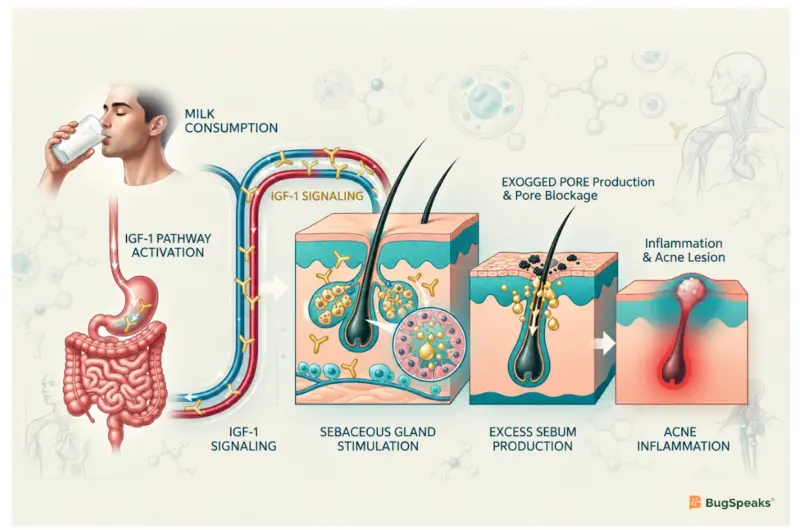
## **W** hy does milk cause pimples in some people but not others?
Cow's milk causes pimples in some people because it starts a chain reaction that wakes up the oil makers in your [skin](https://www.bugspeaks.com/blog/sheet-mask-skin-microbiome-health). When you drink milk, your body treats this food like a fast train entering a busy transit station. This dairy train is packed with natural growth signals that tell your body's cells to grow and multiply quickly. These growth signals immediately shift onto a fast-moving rail line called Track A, which represents a chemical messenger [known](https://www.bugspeaks.com/blog/thyroid-gut-health-hashimoto) as Insulin-like Growth Factor-1 (IGF-1). This chemical messenger travels directly to your sebaceous glands, which act as the oil-producing terminals of your skin.
At these skin oil terminals, the incoming growth signals tell the machinery to pump out extra grease, which can clog your pores. For most children, these terminals function normally, but in others, the dairy train causes a massive traffic jam in the skin. The extra oil blocks the tiny openings, creating a perfect hiding place for skin bacteria to grow and cause red bumps. This explains why milk doesn't affect everyone the same way, since everyone has a different track layout. Some people have very quiet oil terminals that do not react to these incoming signals.
Scientists have shown that teenagers who struggle with severe breakouts often have much higher levels of these growth signals in their blood. Clinical studies confirm that drinking milk regularly is linked to having more of these active signals moving through your body's transport lines [Ismail et al. (2012)](https://doi.org/10.1186/1471-5945-12-13). When these signals remain high, your skin cells stick together inside your pores instead of shedding normally [Melnik (2012)](https://doi.org/10.4161/derm.19828). This sticking action forms a tight plug that traps the oil inside, which soon leads to the inflamed red bumps we call pimples on our face and skin. Keeping these transport pathways clear helps prevent breakouts from starting in the first place.
**Biological Entity**
**Simulation Equivalent**
**Function in Station**
Bovine Milk Proteins
Dairy Train Cargo
Incoming freight carrying growth signals
IGF-1 Signaling
Track A
Fast-moving rail line to oil terminals
Insulin Response
Track B
Parallel bypass track activated by sugar
[Gut](https://www.bugspeaks.com/blog/mouth-ulcer-vitaminb12-gut-mouth-axis) Microbiome
Local Line Regulator
Switch controller deciding train routing
Sebaceous Glands
Downstream Terminals
Final oil factories producing sebum
Acne vulgaris
Terminal Congestion
Clogged tracks and blocked exit ports
**Insulin-like Growth Factor-1 (IGF-1)**\- A natural chemical messenger in our body that tells cells to grow.
**Sebaceous glands**\- Small oil-producing factories in our skin that make sebum to keep our skin moist.
**Bovine Milk Proteins**\- Natural building blocks in cow's milk (like whey and casein) that carry growth messages to our body.
## How does the sugar in our food change how milk affects our skin?
Eating sugary foods along with dairy makes your body produce more insulin, which acts like an accelerator pedal for skin breakouts. When you eat sweet foods or white bread, your sugar levels rise fast. This sudden sugar surge forces your body to release a large amount of a hormone called insulin. This hormone acts like a helper that rushes to clear the sugar, but it also signals other lines. This reaction switches on the insulin signaling pathway, which speeds up the dairy train's growth signals and sends them straight to your skin's oil terminals.
When the insulin signaling pathway is active, your body also produces more of its own natural hormones like androgens, which makes the skin even more sensitive. These androgens act like extra workers that turn up the heat in the oil factories, making them produce even more sebum. High-sugar foods and dairy work together in a bad partnership, causing twice as much oil production as either food would cause alone. This dangerous combination explains why drinking a sweet milkshake or eating ice cream often leads to much faster breakouts than drinking plain, unsweetened milk from a glass. This dual signal system is a powerful driver of skin problems.
A major study of young adults found that those with severe breakouts consumed a diet with a much higher sugar load [Ismail et al. (2012)](https://doi.org/10.1186/1471-5945-12-13). Eating sweets and milk at the same time raises your insulin levels much higher than eating them on different days. This double signal tells your skin cells to divide too quickly, which makes the walls of your pores thick and narrow. This narrowing makes it very easy for the extra oil to get trapped, which is why sugary dairy foods are so powerful at causing painful pimples. Understanding this connection helps us make better food choices for our skin every day.
**Insulin**\- A helper hormone that your body makes to manage sugar levels in your blood.
**Hormones**\- Chemical messengers that travel through your body to tell your organs how to work.
**Androgens**\- Natural hormones in our body (like testosterone) that act like extra workers to turn up the heat in our skin's oil factories.
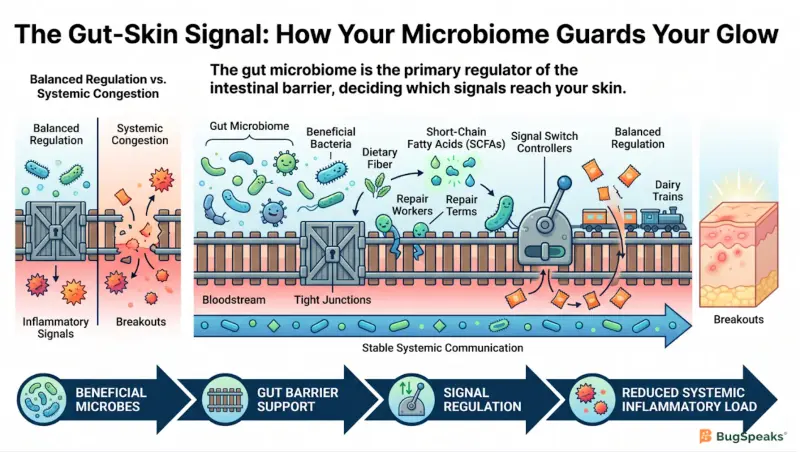
## Can the helpful bacteria in your gut change how milk affects your face?
The helpful bacteria such as Lactobacillus and Bifidobacterium in your gut can change how milk affects your face by acting as a safety gate that blocks inflammation. Your gut contains trillions of tiny living microbes that form a huge community called the microbiome. This community acts like a local line regulator, checking every train that passes through your digestive system. When your gut has plenty of friendly bacteria, they keep the gut wall strong and healthy, like a secure boundary fence. This strong fence prevents harmful food particles and irritating signals from escaping into your blood and traveling up to your skin. A healthy gut is key for clear skin.
When these friendly microbes digest the fiber from vegetables and fruit, they produce helpful chemical signals called short-chain fatty acids (SCFAs). These chemical signals act like microscopic repair workers that fix leaks in your gut wall and calm down your body's immune system. If your gut is calm, your skin is much less likely to become red and swollen when you drink regular milk. However, if your gut is missing these helpful bacteria, the boundary fence starts to break down, allowing irritating signals to leak out into your body. This leak can quickly lead to swelling on your face.
Scientists have discovered that people with severe breakouts often have a weaker gut wall that lets unwanted signals pass through easily [Bowe and Logan (2011)](https://doi.org/10.1186/1757-4749-3-1). When these irritating signals escape into your bloodstream, they travel directly to your skin and make your oil glands highly sensitive. This means that even a small dairy intake can trigger a massive breakout because your skin is already on high alert. Keeping your gut bacteria happy with healthy foods is a smart way to help protect your face and skin from dairy. A strong, healthy gut barrier is always your skin's best natural defense against breakouts.
**Microbiome**\- The massive community of trillions of tiny, helpful microbes living inside your gut.
**Short-Chain Fatty Acids (SCFAs)**\- Healthy chemical signals made by gut bacteria that soothe swelling and fix leaks.
## What is the main master switch that controls skin oil production?
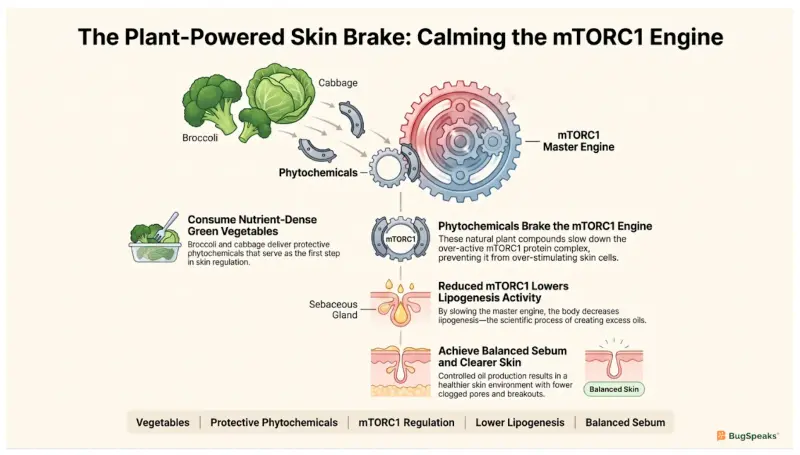
The main master switch that controls skin oil production is a tiny cell engine called mTORC1. This microscopic engine, officially named mTORC1 (mechanistic target of rapamycin complex 1), sits inside your skin cells and senses when food arrives. When you eat high-energy foods, like dairy proteins and sugar, this cell engine turns on like a roaring turbine. It takes the signals from the Insulin-like Growth Factor-1 (IGF-1) signaling pathway and the insulin signaling pathway and uses them to start a process called lipogenesis, which is the scientific name for oil making. This process makes your skin shiny and oily. This engine controls the growth of your skin cells.
When this cell engine is over-activated, it tells your sebaceous glands to grow much larger and produce massive amounts of grease. The engine also tells the skin cells inside your pores to multiply too quickly, which narrows the exit tubes. This combination of extra oil and narrow tubes is the exact recipe needed to create a painful breakout. Scientists have found that a Western diet, which is high in milk, meat, and sugar, keeps this cell engine running at maximum speed for too long [Melnik (2013)](https://doi.org/10.1586/erd.13.50). This constant high speed causes your skin's tiny pores to become blocked and clogged very easily.
To quiet this busy cell engine, doctors recommend eating more vegetables and fruits, which contain natural blockers that slow down the engine's speed [Melnik (2012)](https://doi.org/10.4161/derm.19828). These green foods act like brakes that prevent the engine from over-activating your skin's oil factories. When the engine slows down, your skin cells stop sticking together, and your oil factories go back to their normal, quiet pace. This is why changing what you eat can have such a powerful, direct effect on clearing up your skin over time. Eating fresh, green foods is a great way to protect your skin and keep it healthy.
**mTORC1 (mechanistic target of rapamycin complex 1)**\- A tiny sensor engine in your cells that controls growth and oil production.
**Lipogenesis**\- The scientific process of making fats and oils inside our body's cells.
**Insulin-like Growth Factor-1 (IGF-1) signaling pathway**\- A fast-moving chemical highway in our body that carries growth signals directly to our skin's oil factories.
**Insulin signaling pathway**\- A chemical pathway that gets switched on when we eat sugary foods, telling our body to manage sugar and speed up skin oil production.
## Why does fermented yogurt not cause the same breakouts as regular milk?
Fermented yogurt does not cause the same breakouts as regular milk because the tiny bacteria inside yogurt consume the growth signals during fermentation. When milk goes through the process of fermentation to become yogurt, friendly bacteria like Lactobacilli are added to the liquid. These helpful microbes are very hungry, and they eat up a large portion of the growth signals like Insulin-like Growth Factor-1 before you even take a bite. This means the dairy train arriving at your station is much smaller and carries far fewer signals to activate the Insulin-like Growth Factor-1 (IGF-1) signaling pathway inside your skin [Bowe and Logan (2011)](https://doi.org/10.1186/1757-4749-3-1). This makes yogurt much safer for your face.
Because yogurt has fewer growth signals, it does not wake up your skin's oil terminals or trigger the same heavy traffic jams. Yogurt also helps protect your digestive system from a problem called intestinal permeability, which is the medical term for a leaky gut wall. When your gut wall is strong and healthy, it keeps harmful signals locked away where they cannot do any damage to your body. This is why many people who get breakouts from drinking regular liquid milk can eat fermented yogurt without any skin issues. A strong, healthy gut wall protects your skin from the inside.
Clinical studies have shown that drinking fermented milk can actually help improve your skin by reducing the amount of grease on your face. Fermented milk helps reduce skin grease because its friendly bacteria and protective proteins (like lactoferrin) lower the amount of fatty compounds (triglycerides) on your skin surface, which directly slows down your skin's oil factories. The helpful bacteria in yogurt help calm your body's immune system, which prevents your skin from getting red and swollen. By choosing fermented dairy foods instead of regular milk, you can enjoy dairy while keeping your skin's transport lines clear. This simple food choice helps keep your gut happy and your skin glowing and free of painful breakouts every day. Choosing fermented dairy over regular liquid milk is a very smart way to eat for your skin.
**Incoming Food**
**Track Routing**
**Skin Oil Outcome**
**Breakout Risk**
Regular Skim Milk
High Track A load
Heavy traffic to oil terminals
High
Sweet Milkshake
Double Track A & B load
Over-stimulated terminals, clogged ports
Very High
Fermented Yogurt
Bypasses Track A (eaten by microbes)
Clear lines, quiet oil terminals
Very Low
**Fermentation**\- A process where friendly bacteria eat up sugars and growth signals to transform a food like milk.
**Intestinal permeability**\- The medical name for a leaky gut wall that lets unwanted signals slip into your blood.
Visualize the process- [https://youtu.be/c2eKzivDtjQ](https://youtu.be/c2eKzivDtjQ)
### Reference
Melnik B. Dietary intervention in acne: Attenuation of increased mTORC1 signaling promoted by Western diet. Dermatoendocrinol. 2012 Jan 1;4(1):20-32. doi: 10.4161/derm.19828. PMID: 22870349; PMCID: PMC3408989.
Melnik, B. C. (2013). The role of mTORC1 in acne pathogenesis and treatment. _Expert Review of Dermatology_, _8_(6), 617-622.
Ismail, N. H., Manaf, Z. A., & Azizan, N. Z. (2012). High glycemic load diet, milk and ice cream consumption are related to acne vulgaris in Malaysian young adults: a case control study. _BMC dermatology_, _12_(1), 13.
Bowe WP, Logan AC. Acne vulgaris, probiotics and the gut-brain-skin axis - back to the future? Gut Pathog. 2011 Jan 31;3(1):1. doi: 10.1186/1757-4749-3-1. PMID: 21281494; PMCID: PMC3038963.
Zhao Y, Yu C, Zhang J, Yao Q, Zhu X, Zhou X. The gut‑skin axis: Emerging insights in understanding and treating skin diseases through gut microbiome modulation (Review). Int J Mol Med. 2025 Dec;56(6):210. doi: 10.3892/ijmm.2025.5651. Epub 2025 Oct 3. PMID: 41041846; PMCID: PMC12494302.
## FAQs
Q: Why does skim milk cause breakouts if it contains less fat than whole milk?
A: Skim milk actually contains concentrated whey and casein proteins, which carry a heavy cargo of growth signals. Even though it lacks cream, these proteins travel straight to Track A, over-activating the cell engine mTORC1 and causing grease production.
Q: Can taking probiotics protect my skin from milk-related pimples?
A: Yes, helpful probiotics act like extra switch controllers in your gut. They repair leaks in your boundary fence and produce short-chain fatty acids that calm inflammation, preventing dairy signals from reaching your skin's oil terminals.
Q: Why does eating chocolate with milk make breakouts so much worse?
A: Chocolate's high sugar content triggers a sudden insulin release, which activates Track B. This bypass track speeds up the dairy train's signals, doubling the speed of the cell engines that make skin oil.
Q: How long does it take for my skin to clear up after reducing regular milk?
A: It typically takes between four to six weeks for your skin's oil terminals to quiet down after changing your diet. This gives your gut wall enough time to rebuild its secure boundary fence and clear away the traffic jam.
Q: Is butter just as likely to cause pimples as liquid milk?
A: Butter is mostly pure fat and has very few milk proteins, meaning it carries very little growth cargo to Track A. However, eating highly processed foods with butter can still raise your insulin, so moderate intake is best.
---
This blog is powered by Superblog. Visit https://superblog.ai to know more.
---