Managing Diabetes: How Your Microbial DNA Affects Blood Sugar Control
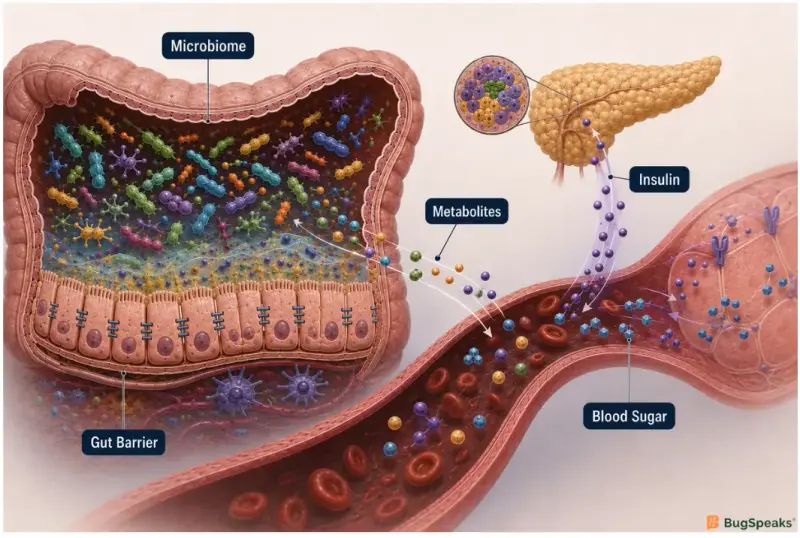
Is Your DNA the Only Thing That Decides If You Get Diabetes?
No, your Deoxyribonucleic Acid (DNA) is not the only decider because your gut microbes act as a Master Saucier that can change how your body reads its internal recipe book every day. While you inherit a specific recipe from your parents, your microbiota, the massive community of trillions of tiny guests living in your gut, determine how that recipe is seasoned to maintain a healthy balance. These microbes use special chemical messengers called metabolites to adjust your genes without changing the code itself, a process known as epigeneticsLei et al. (2025). This interaction happens through a critical communication line called the Microbiota-Derived Metabolites–Epigenetic (MDME) axis, and when this talk between the gut chefs and your code breaks down, it can lead to the metabolic chaos seen in Type 2 Diabetes Mellitus (T2DM)Alzahrani (2026).
Imagine that your Deoxyribonucleic Acid (DNA) is a giant, ancient library containing the instructions for every single thing your body does. The microbial Master Saucier is the head librarian who decides which books stay open and which books get tucked away on the highest shelves where your cells can't reach them. If the Saucier is happy and well-fed, they keep the "Sugar Management" manuals right on the front desk so your body can find them instantly. But if the Saucier is unhappy, they might hide those important recipes or even smudge the ink, making it impossible for your body to know how to handle the sugar from your meals. This "hidden recipe" situation is what eventually leads to high blood sugar.
The relationship between your gut and your genes is a 24-hour conversation that never stops for a break. Every time you eat a snack, the Master Saucier tastes the ingredients and sends a chemical text message to your library. If you eat something the Saucier loves, like a fiber-rich bean, they send a positive message that keeps the library organized. If the Saucier gets nothing but junk food, they stop sending helpful messages and might even start "locking" the library doors out of frustration. By understanding the Microbiota-Derived Metabolites–Epigenetic (MDME) axis, we can finally see that we aren't just stuck with the genes we were born with; we have a team of living chefs that we can train to keep our internal library perfect

What Special Tools and Antennas Do These Tiny Gut Chefs Use?
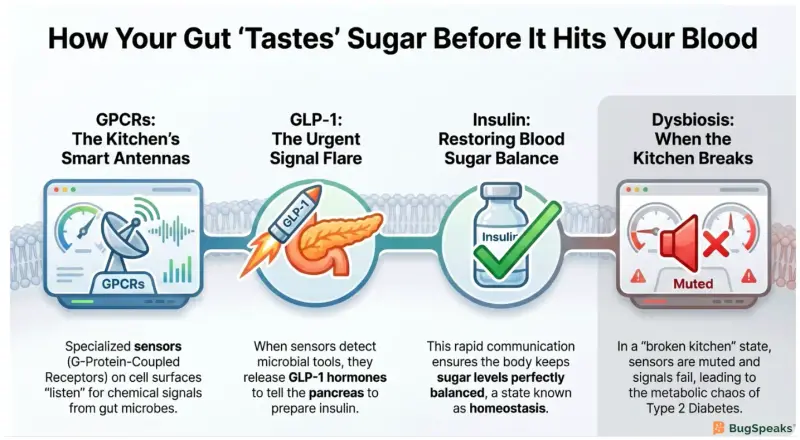
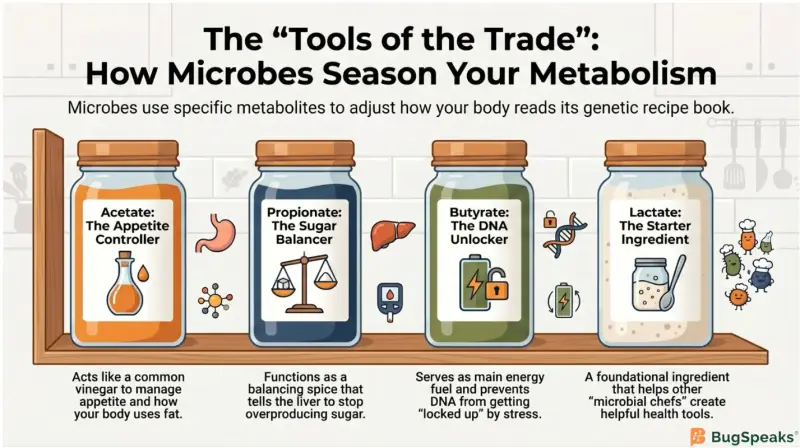
The Master Saucier’s most powerful tools are Short-Chain Fatty Acids (SCFAs), which are like healthy vinegars created through the natural process of fermentation when your microbes eat fiber. These molecules, such as acetate and butyrate, are forged deep in your gut when you eat foods like beans and whole grainsJin et al. (2025). In a healthy gut kitchen, these tools travel into your cells to give your instructions the signal to stay relaxed and functional. If you stop eating fiber, a state of dysbiosis occurs where these helpful tools disappear, leaving your body unable to process energy or listen to the signals it needs to stay healthy.
To listen to these tools, your gut uses specialized antennas called G-Protein-Coupled Receptors (GPCRs) that pick up the chemical signals to immediately adjust your metabolism. These antennas act like the kitchen’s surveillance system, and when they detect microbial tools, they trigger the release of a hormone called Glucagon-Like Peptide-1 (GLP-1)Jin et al. (2026). This hormone acts like an urgent message to the pancreas to release insulin and lower blood sugar. If the kitchen is under too much stress, these antennas can be muted or broken, making it very hard for the body to keep sugar levels stable. This communication blackout is one of the main reasons blood sugar starts to climb out of control.
The way these signals get out of the cells and into your blood is through a biological process where the cell "spits out" important messages. But when the kitchen is messy, the messages get stuck inside the cells, and the pancreas never hears the signal to help out. This state of dysbiosis effectively cuts the phone lines in your body, leaving the Master Saucier unable to warn the rest of the system about incoming sugar. A healthy kitchen depends on a steady supply of fiber to keep the butyrate flowing and the antennas sharpChaudhry & Sif (2026). By keeping the staff well-fed, you ensure that every tool and antenna in the kitchen is working perfectly to keep you fit and energized.
Table 1: The Master Saucier’s Culinary Tools and Signals
How Does a Tiny Microbe Reach Inside Your DNA to Place Stickers?
Microbes reach your Deoxyribonucleic Acid (DNA) by blocking specific enzymes that act like padlocks, helping to keep your recipe book open so healthy instructions can be read. Inside your cells, the code is wrapped around tiny spools called histones, and if it is wrapped too tightly, your body cannot read the pages. Helpful tools like butyrate prevent the padlocks from closing the book, allowing the code to enter a state of acetylation where the instructions are unspooled and easy to useAlzahrani (2026). This open state makes it easy for the cell to build tight junctions, which are the waterproof seals that keep your gut lining strong.
In some cases, bacteria act as a biological factory that creates the ink used to add chemical stickers to your genetic pages. This ink is used in a process called DNA methylation, where a chemical mark is placed on a gene to tell it to "stop working"Jin et al. (2025). In a healthy gut, these stickers are placed only in specific areas to keep the body balanced, but if the gut chefs are missing, the body might put stickers in the wrong places, turning off the genes that protect you from diabetes. Your genetic library is filled with chromatin, which is the mixture of code and proteins that makes up your chromosomes. Think of it like a giant ball of yarn; if the yarn is knotted up and messy, you can't knit a sweater.
The Master Saucier uses their tools to keep the yarn smooth and organized. When the yarn is smooth, your body can quickly find the recipe for insulin sensitivity and make sure your cells know how to use sugar for energy. But when the gut is out of balance, the yarn gets knotted, and the insulin recipe gets lost in the mess, leading to the high sugar levels we see in diabetes. This unspooling through acetylation is the ultimate goal of a healthy diet. Every time you eat fiber, you are providing the "WD-40" ( Fiber-eating microbes create butyrate, a "biological WD-40" that prevents HDACs the tiny "padlock" enzymes that zip up your genes from rusting shut and hiding the DNA recipes your body needs to manage sugar). that keeps the genetic padlocks from rusting shut. By keeping the chromatin loose and readable, your microbes ensure that your body is ready to respond to the sugar in your blood.
What Happens to the Liver Juices and the RNA Whispers?
The bacteria in your gut take the digestive juices from your liver and turn them into powerful keys that tell your body to speed up its energy use. Your liver makes bile acids to help you digest the fats in your food, but specialized gut bacteria use an enzyme to transform them into secondary bile acidsAlzahrani (2026). These transformed juices act like keys that fit into FXR units, which are protein locks that control how the body handles sugar. When the right bacteria are present to turn these keys, the body burns sugar faster and stays sensitive to insulin, preventing the climb toward diabetes.
Bacteria also "whisper" to your cells using tiny molecules called miRNA that can stop a genetic message even after the recipe has been read from the book. In a healthy gut, these whispers act like a helpful to-do list that tells the body to stay calm. However, in a diabetic kitchen, the bacteria might whisper bad messages that trigger apoptosis, a process where your gut cells accidentally destroy themselves because they think they are damagedChaudhry & Sif (2026). These whispers ensure that the communication between your gut and your body stays clear, helping to protect your walls from the internal fires of inflammation.
This conversation goes both ways; your body also whispers back to the bacteria to tell them how to behave. If your body is stressed and sends out panic signals, the Master Saucier might get confused and stop making the healthy tools you need. This is why managing diabetes is about more than just what you eat; it is about making sure the "radio tower" in your gut is sending and receiving clear signals. When the bile acids are recycled correctly and the secondary bile acids are turning the right keys, your metabolism runs like a well-oiled machine, keeping your energy high and your sugar low. By supporting the microbial specialists who handle these liver juices, you are ensuring that your body's power switch is always in the right position.
Table 2: The Gut’s Communication and Control Logic
Can We Reset the "Metabolic Memory" and Fix the Kitchen?
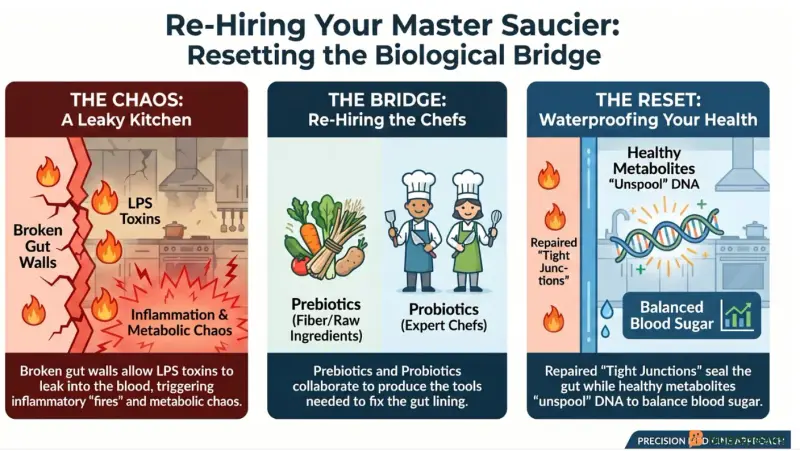
We can fix a broken gut kitchen by using prebiotics and probiotics to re-hire the Master Saucier and reset the chemical stickers on your genetic pages. By providing the right ingredients and the right microbial workers, we can restore the communication between your gut and your code to manage diabetes at its rootJin et al. (2025). This is part of a move toward precision medicine, where healthcare is custom-made for your unique body and microbial makeup. In some cases, we can even perform a total "Kitchen Reset" to replace a failing team with a healthy one to fix a broken metabolism.
When the gut kitchen becomes a disaster, the walls get leaky and allow a toxin called endotoxemia to spill into your blood, creating a state of permanent inflammation. This stress can cause the body to develop a "metabolic memory," where your code keeps "bad stickers" from previous years of poor eating. Resetting this memory is a marathon; it takes time for the kitchen staff to perform a "Deep Cleaning" and erase the old stickers. Consistent healthy habits provide the tools the Saucier needs to slowly scrub the ink off the pages and start fresh. Hiring a fresh crew of probiotics and feeding them plenty of prebiotics gives your kitchen the best chance to succeed.
Finally, the gut kitchen follows a strict "Shift Schedule" known as the circadian rhythm. Your microbes and your code use internal clocks to coordinate when to burn sugar and when to store energy. If you eat late at night, it causes "Shift Lag," where the chefs are trying to prep ingredients while the cells have already clocked out for the night. By eating at the same time every day and getting good sleep, you synchronize the Saucier with the rest of your body. precision medicine allows us to see exactly which chefs are missing and which schedules are out of sync. Once the endotoxemia is cleared and the Master Saucier is back on the job, your blood sugar will naturally start to stabilize.
Table 3: The Future of the Master Saucier’s Kitchen
-Varsha V
Visualize the process- https://youtu.be/6MUor9hAmaI
Reference
https://www.frontiersin.org/journals/microbiology/articles/10.3389/fmicb.2026.1805937/full Alzahrani SS (2026) Gut microbiome–epigenetic crosstalk in obesity and type 2 diabetes: mechanisms, evidence, and translational opportunities. Front. Microbiol. 17:1805937. doi: 10.3389/fmicb.2026.1805937
https://pmc.ncbi.nlm.nih.gov/articles/PMC12936327/ Chaudhry, M., & Sif, S. (2026). Epigenetic regulation in type II diabetes: linking molecular mechanisms to clinical management. Journal of diabetes and metabolic disorders, 25(1), 82. https://doi.org/10.1007/s40200-025-01831-1
https://pmc.ncbi.nlm.nih.gov/articles/PMC12842411/ Jin, X., Chen, X., Chen, H., & Hong, X. (2026). Gut Microbiota and Type 2 Diabetes: Genetic Associations, Biological Mechanisms, Drug Repurposing, and Diagnostic Modeling. International journal of molecular sciences, 27(2), 1070. https://doi.org/10.3390/ijms27021070
https://pmc.ncbi.nlm.nih.gov/articles/PMC12712342/ Jin, Q., Li, X., Liu, Z., Qi, T., Xiao, D., & Yang, W. (2025). The interaction between gut microbiota and host DNA methylation in the pathogenesis and therapy of inflammatory bowel disease. Frontiers in microbiology, 16, 1718358. https://doi.org/10.3389/fmicb.2025.1718358
https://pubmed.ncbi.nlm.nih.gov/41047314/ Lei, J., Wang, X., & Liu, X. (2025). Microbiota-derived metabolites in the epigenetic regulation of the host. Science bulletin, 70(21), 3667–3678. https://doi.org/10.1016/j.scib.2025.09.030