A Comprehensive Guide to Understanding Dandruff: Fungal-Bacterial Imbalance Explained
What is the Scalp Population Regulation System?
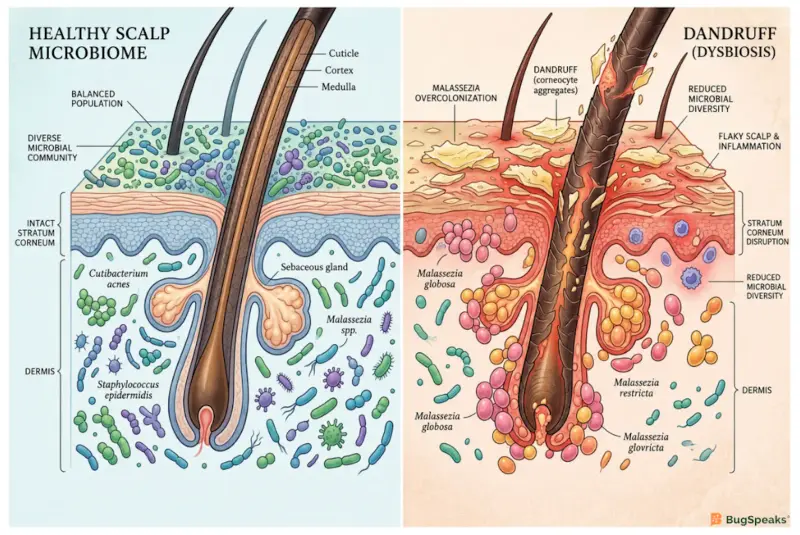
The scalp population regulation system is a biological mechanism managing microscopic communities of fungi and bacteria on our skin while keeping skin cells renewing at a normal, healthy pace. In this system, your scalp acts as a living regulatory zone, maintaining a delicate balance among its microscopic residents. The outermost layer of your skin, the stratum corneum [SC], serves as a renewing surface, like a brick wall of flat skin cells bound together by a protective mortar of lipids. In a balanced state, these cells shed individually and invisibly, indicating an intact, self-stabilizing barrier. This beautiful natural barrier protects your body from outside micro-organisms.
The entire biological community on your skin is powered by a natural skin oil called sebum, which serves as the primary growth resource for the organisms living in this zone. Sebum is secreted by tiny sebaceous glands situated in the terminal hair follicles of your scalp, which mature and begin producing these rich lipid mixtures during pubertyTurner et al. (2012). In a well-regulated environment, this oily growth resource is distributed evenly and metabolized in controlled amounts by beneficial microbes, ensuring no single population can grow excessively and throw the delicate biological ecosystem out of balance. This even distribution maintains healthy scalp conditions.
Living within this zone are two competing but cooperative groups of microorganisms: a resident population of lipophilic fungi and a co-resident population of bacteria. The primary resident fungi are yeasts belonging to the genus Malassezia, which are obligate lipid-dependent organisms. Because these yeasts lack the genes needed to manufacture their own fatty acids, they must reside in lipid-rich regions where they can feed on sebumTurner et al. (2012). Alongside these fungi, beneficial bacterial commensals like Cutibacterium acnes [C. acnes] and Staphylococcus epidermidis [S. epidermidis] establish their own distinct ecological niches, maintaining a peaceful co-existence that supports the host's overall skin health.
Why do fungi and bacteria need to co-exist on a healthy scalp?
Fungi and bacteria must live in a balanced ratio on our scalp because their mutual interactions keep each other's populations in check and prevent any single group from taking over. In a healthy living regulation zone, the resident population of Malassezia and the co-resident population of bacteria are constantly negotiating for space and resources. This micro-ecological co-existence is vital because these organisms occupy the same biological niches and use similar sebum-derived lipids. If one population were to be completely eradicated, the other would expand rapidly to consume the unoccupied growth resource, causing massive bacterial or fungal overgrowth and disrupting the whole system.
On the bacterial side, a delicate balance must be maintained between the two primary species, Cutibacterium acnes and Staphylococcus epidermidis. In a healthy living regulation zone, Cutibacterium acnes is the dominant bacterial resident, living deep within the hair follicles and keeping Staphylococcus epidermidis populations in checkMaître et al. (2025). This relationship is highly antagonistic; C. acnes can secrete specialized protective elements, such as antimicrobial thiopeptides, that limit the overgrowth of Staphylococcus speciesMaître et al. (2025). This protective dynamic keeps Staphylococcus under control, preventing barrier damage, dryness, and irritation that can lead to scaling, redness, and visible flakes on the hair.
Simultaneously, the fungal population must maintain its own internal balance, particularly between the two dominant species, Malassezia restricta [M. restricta] and Malassezia globosa [M. globosa]. Clinical studies of the scalp microbiome have shown that a healthy scalp is characterized by a low ratio of Malassezia restricta to Malassezia globosaSaxena et al. (2021). On a healthy scalp, M. globosa is relatively abundant, and it can even secrete beneficial enzymes, such as aspartyl proteases, that block the formation of harmful bacterial biofilmsMayser et al. (2024), protecting the scalp from pathogenic species and ensuring the living regulation zone remains stable, healthy, and completely free from flakes.
What happens biologically during a regulation failure?
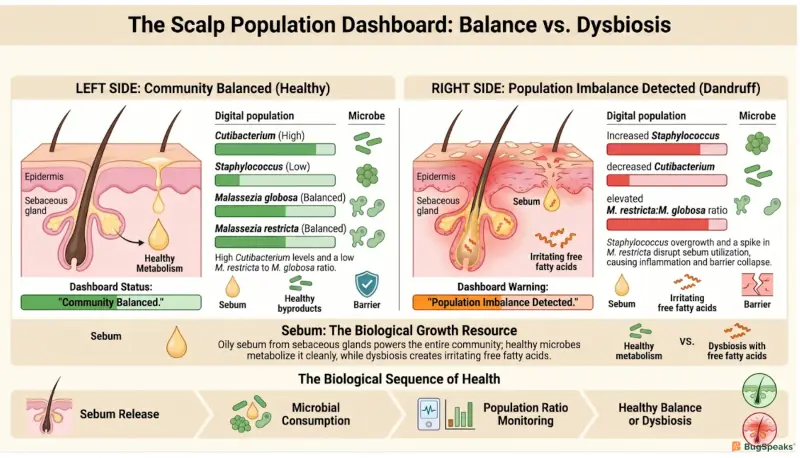
A regulation failure, commonly experienced as dandruff, occurs when the balance between your scalp's resident microbes and renewing surface collapses, causing skin shedding, barrier damage, and irritation. During this systemic collapse, the living regulation zone undergoes a major shift called dysbiosis, where the healthy ratios of microbes are completely turned upside down. On the bacterial side, the protective populations of Cutibacterium acnes decline significantly, while the populations of Staphylococcus epidermidis swell to abnormal levelsMaître et al. (2025). This shift compromises the scalp's overall protection, making it highly sensitive to external irritants and causing the entire biological population management system to break down completely.
On the fungal side, the ratio of Malassezia restricta to Malassezia globosa increases, with M. restricta becoming highly dominantSaxena et al. (2021). As these microbial populations grow out of control, they begin to damage the renewing surface of the scalp. Malassezia globosa and Malassezia restricta produce extracellular lipases, such as the preformed lipase LIP1, to digest the triglycerides in your sebumTurner et al. (2012). However, because these fungi have an incomplete oxidation pathway, they leave behind large amounts of irritating free fatty acids on the skin surface, which trigger the body's natural defense responses, leading to unwanted inflammation.
These leftover free fatty acids, such as oleic acid, are highly irritating and penetrate deep into the stratum corneum [SC], disrupting the organized lipid layers and depleting essential barrier lipids like ceramidesTurner et al. (2012). The physical breakdown of these lipid layers destroys the epidermal permeability barrier [EPB], allowing water to escape from the scalp. This water loss is measured clinically as an elevated rate of transepidermal water loss [TEWL]Turner et al. (2012). When your scalp loses water, the skin dries and cannot renew properly. This dehydration makes clumps of dead skin cells peel off as highly visible dandruff flakes.
How do external growth resources like oils or biobased esters impact the population?
External lipids can either disrupt or support your scalp's population regulation system depending on their specific molecular structure and how they interact with resident microbes. For generations, traditional natural oils have been applied to the hair and scalp to maintain softness and split-end repair. When pure coconut oil is introduced, it acts as a physical shield over the renewing surface of the scalp, helping to seal in moisture and reduce the rate of transepidermal water loss [TEWL]Saxena et al. (2021). By physically reinforcing the skin barrier, natural oils can help restore the physiological conditions that are necessary for the scalp's resident microbes.
The biological impact of coconut oil goes far beyond simple physical moisturizing, as it actively reshapes the microbial populations. Coconut oil is rich in lauric acid, a medium-chain fatty acid known to possess natural, selective antimicrobial propertiesSaxena et al. (2021). In a landmark 16-week clinical trial, researchers observed that regular application of coconut oil significantly increased the abundance of beneficial bacteria, such as Cutibacterium acnes, while lowering the populations of Staphylococcus epidermidisSaxena et al. (2021). This shift helps to rebalance the entire living regulatory zone. This protective rebalancing acts as a natural shield, allowing beneficial microbes to thrive while keeping pathogenic bacteria from irritating the skin.
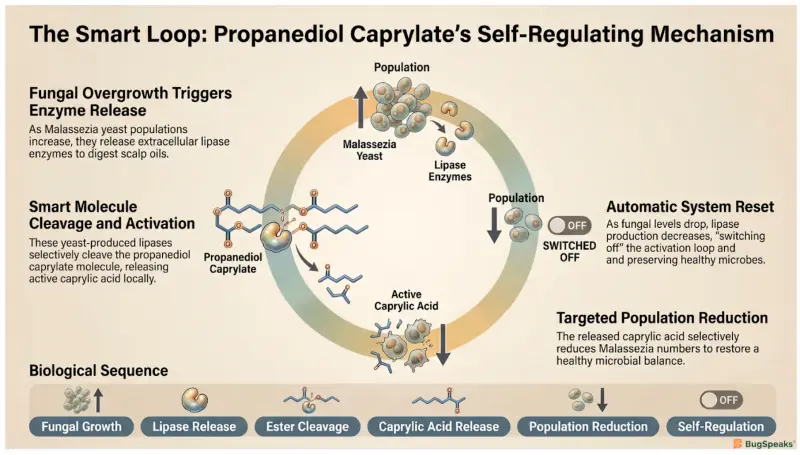
To improve upon traditional oils, cosmetic scientists have recently developed a smart, biobased ester called propanediol caprylate that acts as an auto-regulating population control systemMayser et al. (2024). When applied to the scalp, propanediol caprylate is rapidly cleaved by the extracellular lipases and hydrolases produced by Malassezia yeastsMayser et al. (2024). This cleavage reaction releases caprylic acid, a medium-chain fatty acid with potent, natural antifungal properties, directly in the external milieuMayser et al. (2024). This elegant auto-regulating system targets only excess yeasts. When the fungi decrease, the lipase levels drop, automatically turning off the active acid and preserving the healthy, natural microbes on your head.
How can we restore homeostatic regulation without resorting to harsh system wipes?
Restoring your scalp's living population balance requires mild, targeted treatments that selectively reduce overgrown species while directly replenishing the protective skin barrier. Traditional anti-dandruff therapies often rely on strong, non-selective chemical antimicrobials combined with harsh anionic surfactants. While these treatments are effective at temporarily knocking down fungal levels, they act as a blunt system wipe that strips the renewing surface of its essential structural lipids, causing dryness, irritation, and tight-feeling skinTurner et al. (2012). Furthermore, because these harsh formulas do not repair the underlying skin barrier, users experience a rapid relapse where flakes return as soon as active treatment stops.
To achieve long-lasting control, modern dermatological treatments use synergistic combinations of gentle, targeted active agents. A clinical study evaluating a novel antiseborrheic shampoo containing piroctone olamine, ciclopirox olamine, and the anti-inflammatory compound beta-glycyrrhetinic acid demonstrated excellent results in patients with mild-to-moderate seborrheic dermatitis [SD]Maître et al. (2025). The intensive use of this shampoo significantly reduced clinical dandruff, redness, and itching while promoting a healthy re-diversification of the scalp microbiotaMaître et al. (2025). This helps the living regulation zone to recover its natural strength. By gently managing the overgrown microbial populations instead of wiping them out, this gentle treatment supports the restoration of a healthy and balanced scalp environment.
Moreover, the clinical use of smart biobased esters like propanediol caprylate has revealed a highly unique, long-lasting wash-out effect that prevents the typical return of dandruff. Shampoos containing propanediol caprylate achieved an anti-dandruff efficacy comparable to traditional benchmarks like climbazole and piroctone olamineMayser et al. (2024). Remarkably, when active treatment ended and subjects reverted to a neutral shampoo, the dandruff scores in the propanediol caprylate group continued to decrease during the wash-out phaseMayser et al. (2024). This represents a breakthrough in long-term scalp population management. This durable effect ensures your scalp's protective barrier remains stable, keeping flakes away even when you use neutral shampoos.
Visualize the process- https://youtu.be/l91bhCOIC_E
Reference
Saxena, R., Mittal, P., Clavaud, C., Dhakan, D. B., Roy, N., Breton, L., ... & Sharma, V. K. (2021). Longitudinal study of the scalp microbiome suggests coconut oil to enrich healthy scalp commensals. Scientific reports, 11(1), 7220.
Mayser, P., Genrich, F., Meunier, L., & Nordzieke, S. (2024). Scalp Microbiome and Dandruff—Exploring Novel Biobased Esters. Cosmetics, 11(5), 174. https://doi.org/10.3390/cosmetics11050174
Maître, M., Baradat, S., Froliger, M., Turlier, V., Simcic-Mori, A., Gravier, E., Géniès, C., Lauze, C., Huyghe, C., Noustens, A., Alvarez-Georges, S., Marinescu, R., Reygagne, P., Bessou-Touya, S., Mengeaud, V., & Duplan, H. (2025). Scalp Microbiome Dynamics Can Contribute to the Clinical Effect of a Novel Antiseborrheic Dermatitis Shampoo Containing Patented Antifungal Actives: A Randomized Controlled Study. Dermatology and therapy, 15(8), 207
7–2097. https://doi.org/10.1007/s13555-025-01408-z
Turner, G. A., Hoptroff, M., & Harding, C. R. (2012). Stratum corneum dysfunction in dandruff. International journal of cosmetic science, 34(4), 298–306. https://doi.org/10.1111/j.1468-2494.2012.00723.x
Yin, C. S., Minh Nguyen, T. T., Yi, E. J., Zheng, S., Bellere, A. D., Zheng, Q., Jin, X., Kim, M., Park, S., Oh, S., & Yi, T. H. (2024). Efficacy of probiotics in hair growth and dandruff control: A systematic review and meta-analysis. Heliyon, 10(9), e29539. https://doi.org/10.1016/j.heliyon.2024.e29539