# The Science of Curd Rice: Crafting the Perfect Dish for Gut Health
Author: Varsha V
Author URL: https://www.bugspeaks.com/blog/author/varsha-v
Published: 2026-08-13
Category: Indian Series
Category URL: https://www.bugspeaks.com/blog/category/indian-series
Meta Title: Curd Rice for Gut Health & Probiotics | BugSpeaks
Meta Description: Discover how curd rice supports gut health with probiotics and resistant starch. Learn the science behind this traditional Indian comfort food and nourish your gut.
Tags: Curd Rice, Gut Health
Tag URLs: Curd Rice (https://www.bugspeaks.com/blog/tag/curd-rice), Gut Health (https://www.bugspeaks.com/blog/tag/gut-health)
URL: https://www.bugspeaks.com/blog/curd-rice-gut-health-south-indian-food
## Why does our digestive system require a physical reset after severe physiological stress?
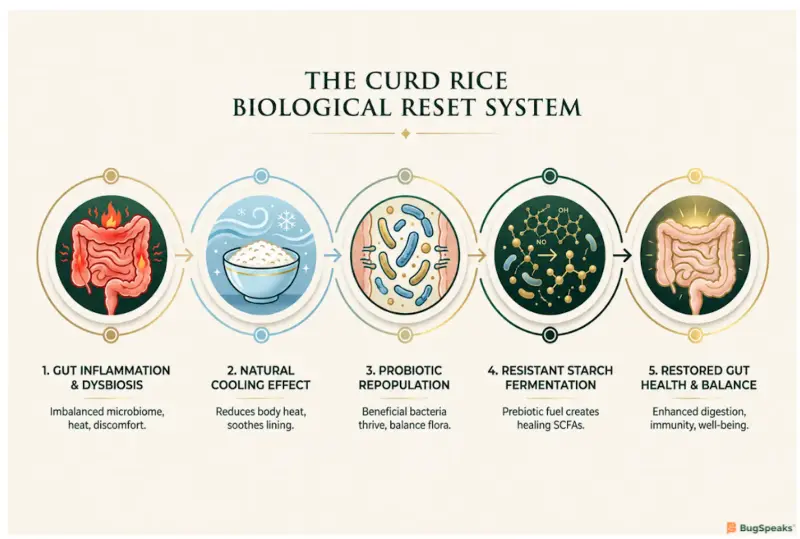
Our digestive system needs a complete physical reset after major stress because inflammation and heat damage the gut wall, causing dangerous leaks. When you experience high body heat, uncomfortable diarrhea, or eat very spicy food, your body goes into a high-emergency status. This stress activates a danger switch inside your cells called nuclear factor-kappa B, which starts a wave of swelling and irritation. Special sensors on your gut lining, known as Toll-like receptors, detect this distress and begin releasing irritating chemicals. These chemical signals cause the tight seals between your gut cells to open up, allowing harmful things to pass into your bloodstream. [Shadnoush (2013)](https://www.ncbi.nlm.nih.gov/pmc/articles/PMC3920683/)
This open wall is like a broken defense line, allowing unwanted waste and bacteria to leak through into other tissues. This leakage causes your immune system to stay on high alert, which creates more swelling and elevates C-reactive protein in your blood. At the same time, the local temperature in your intestines rises, creating a hot environment that makes it hard for your healthy microbes to live. Your friendly gut bacteria cannot function well in this overheated, inflamed environment, and they begin to die off quickly. This leaves your digestive tract completely vulnerable, sluggish, and in desperate need of a calming recovery meal. [Shadnoush (2013)](https://www.ncbi.nlm.nih.gov/pmc/articles/PMC3920683/)
To fix this broken defense line, the body must fully transition from this emergency state back into a balanced, gentle, and stable state. This is why traditional cultures used a simple reset meal to cool the tract, soothe the walls, and restore order. By lowering the heat and supplying gentle nutrients, you can help the cells turn off their emergency signals and rebuild. This cooling process is the very first step of the biological reset system, which prepares the gut to receive active helpers. Without this initial cool down, the lining remains too inflamed and irritated for any healthy recovery to begin. [Shadnoush (2013)](https://www.ncbi.nlm.nih.gov/pmc/articles/PMC3920683/)
**Inflammation**\- A protective swelling response that occurs when cells are damaged or under stress.
**Nuclear factor-kappa B** ( **NF-κB**)\- A tiny molecular switch that triggers swelling and inflammation inside your body cells.
**Toll-like receptors** ( **TLRs**)\- Microscopic alarm sensors on the outer walls of cells that detect stress or bad germs.
**C-reactive protein** ( **CRP**)\- A special chemical found in your blood that increases when your body has active swelling.
**Biological reset system**\- A step-by-step process of cooling, soothing, and repairing the gut to bring it back into balance.
## How does curd rice act as the ultimate biological reset meal?
Curd rice acts as the ultimate biological reset meal by creating a thick, cooling protective shield that calms down gut inflammation. This simple food combination works like a thick, gentle biological coating that coats the inside of your hot, irritated digestive tract. This coating immediately reduces local heat and prevents harsh stomach acid from rubbing against the raw, damaged areas. As this protective layer settles over the gut cells, it begins to lower the level of a swelling marker called interleukin-1 beta. This soothing action prevents cells from panicking and initiates the transition from an active emergency to a healing phase. [Shadnoush (2013)](https://www.ncbi.nlm.nih.gov/pmc/articles/PMC3920683/)
In addition to coating the gut, this meal significantly lowers harmful swelling markers like tumor necrosis factor-alpha and raises helpful, calming markers. The primary helpful, calming markers are Interleukin-10 (IL-10) and Interleukin-6 (IL-6). This shift helps your immune system calm down, which reduces the level of unnecessary C-reactive protein circulating in your blood. As the helpful immune cells stop fighting, they begin to release more of a protective, anti-inflammatory chemical called interleukin-10. This special chemical works like a peaceful message that travels throughout your entire digestive tract, telling your body that the danger is over. This calm state allows the body to focus its energy on repairing the damaged lining. [Shadnoush (2013)](https://www.ncbi.nlm.nih.gov/pmc/articles/PMC3920683/)
This healing process is further supported because the meal activates a special pathway for a protective signaling chemical called interleukin-6. When this chemical travels through its anti-inflammatory classic pathway, it helps heal and rebuild the layer of cells that line your stomach and intestines. Instead of causing more swelling, it acts like a team of builders repairing the broken spots and tissue on your gut wall. This cooling transition lowers the stress on your tissues, making it the perfect environment for friendly bacteria to settle down and multiply. This cooling step completes the initial physical reset, setting the stage for deep biological recovery. [Shadnoush (2013)](https://www.ncbi.nlm.nih.gov/pmc/articles/PMC3920683/)
**Phase**
**Biological Meaning**
**Core System Transition**
Phase 1: Disrupted State
Digestive upset caused by stress, spicy foods, or travel.
The intestinal defense line breaks down, causing local heat, swelling, and leaks.
Phase 2: Reset Meal
Consume curd rice as a functional protective shield.
The thick layer immediately cools local heat, coats raw spots, and stops irritation.
Phase 3: Active Helpers
Probiotics in curd (dahi) settle along the gut wall.
Friendly bacteria take up vital space and flush out pathogens (competitive exclusion).
Phase 4: Microbial Feast
Retrograded starch feeds helpful microbes in the colon.
Amylose and amylopectin realign during cooling to provide slow-release energy.
Phase 5: Balanced System
Restoring dynamic stability and strong cellular seals.
Rebuilding tight junction proteins and regulatory T cells to stop leaks and inflammation.
**Interleukin-1 beta** ( **IL-1β**)\- A powerful swelling signal released by cells when they are in distress or injured.
**Tumor necrosis factor-alpha** ( **TNF-α**)\- A main immune chemical that causes severe swelling and redness during an emergency.
**Interleukin-10** ( **IL-10**)\- A natural calming chemical that tells immune cells to stop fighting and start healing.
**Interleukin-6** ( **IL-6**)\- A unique messenger chemical that can either cause swelling or help rebuild tissue depending on its path.
**Classic pathway**\- A safe, protective cellular route that helper chemicals use to repair and heal tissue.
**Interleukin-10 (IL-10)**\- A natural calming chemical that acts like a peaceful message, instructing your immune cells to stop fighting and begin the healing process.
**Interleukin-6 (IL-6)**\- A unique messenger chemical that acts like a biological repair crew to rebuild and heal the cells lining your gut when it follows its protective, anti-inflammatory classic pathway.
## What is the role of live probiotics as active biological contributors to the reset process?
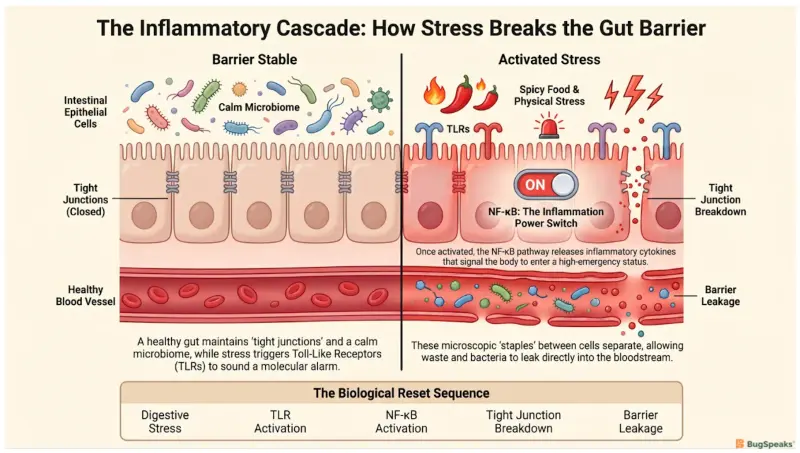
Live probiotics act as active biological contributors by instantly crowding out harmful pathogens and producing natural germ-fighting chemicals in your gut. The fresh, highly beneficial curd used in this meal is packed with billions of friendly bacteria that act like a protective cleanup crew. These friendly microbes enter the digestive tract and immediately find empty spaces along your intestinal walls where they can settle. By attaching to these walls, they block bad germs from sticking to your cells and causing more infections or irritation. This process is a key part of returning your digestive system to a safe and healthy state. [Samantaray (2026)](https://doi.org/10.3390/foods15040687)
This helpful crowding out is scientifically known as competitive exclusion, which simply means the good guys take up all the vital space. With no room left to attach, harmful bacteria are rapidly and safely flushed out of your body before they can cause any trouble. At the same time, these friendly microbes produce helpful organic acids that lower the pH of your gut, making it slightly acidic. This mild acidity is perfect for friendly and healthy bacteria but is very uncomfortable for bad germs, which stops them from multiplying. This action keeps the gut safe and secure during the recovery process. [Samantaray (2026)](https://doi.org/10.3390/foods15040687)
To make this defense extremely strong, the friendly bacteria release special natural weapons called bacteriocins to destroy any remaining bad germs. These natural germ-fighting compounds target and break down the walls of harmful bacteria, keeping the gut clean and fully protected. By eliminating bad germs, these probiotics allow your intestinal lining to heal without being constantly attacked or disturbed by invaders. This active protection is like having a microscopic security team working around the clock to maintain peace in your belly. After the unwanted invaders are removed, your gut can focus entirely on absorbing food and regaining its strength. [Samantaray (2026)](https://doi.org/10.3390/foods15040687)
**Probiotics**\- Friendly, live bacteria that live inside your gut and help you digest food and fight off bad germs.
**Curd**\- A traditional fermented yogurt from India that contains billions of natural, health-promoting live cultures.
**Competitive Exclusion**\- A biological defense where friendly bacteria occupy all the space so bad germs have no room to land.
**Bacteriocins**\- Natural germ-fighting chemicals made by good bacteria to selectively break down and destroy harmful germs.
## How does cooled rice provide both gentle energy and essential microbial nourishment?
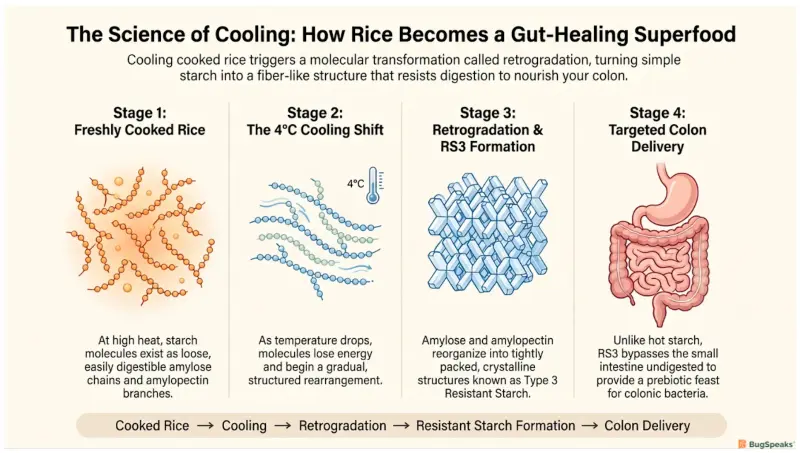
Cooled rice provides gentle, slow-release energy for your body while delivering tightly packed starch that feeds the friendly bacteria in your colon. When cooked rice is left to cool down, a natural process called starch retrogradation completely changes how the food behaves. When you cook rice, the starch chains are loose and messy, making them very easy for your body to turn into sugar quickly. However, when that rice cools down, these chains find each other and pack together into tight, neat "crystal" grids. Because they are so tightly packed, your stomach's "cutting tools" (enzymes) cannot break them apart, so the rice passes through you slowly and safely to feed the good bacteria in your colon. The heating and cooling cause the two main types of starch, called amylose and amylopectin, to realign and pack together tightly. Because they are so tightly packed, your normal digestive enzymes cannot easily break them down in your stomach or small intestine. This allows a large portion of the rice to travel completely and safely into your large intestine. [Chen (2024)](https://doi.org/10.1016/j.fochx.2024.101118)
This special, highly beneficial, tightly packed starch that resists your stomach enzymes is known to scientists as Type 3 resistant starch. Instead of being digested quickly and causing a sudden sugar rush, this starch behaves exactly like helpful dietary fiber. This [slow digestion](https://www.bugspeaks.com/blog/triphala-ancient-wisdom-gut-health) process is highly beneficial because it lowers the overall glycemic index of the curd rice meal. A lower glycemic index means that energy is released into your bloodstream slowly and steadily, rather than in one rapid sugar spike. This steady flow provides your body with reliable energy without stressing your essential metabolism or causing a sudden crash. [Chen (2024)](https://doi.org/10.1016/j.fochx.2024.101118)
When this resistant starch completely reaches your colon, it becomes a rich feast that feeds your beneficial gut bacteria. These friendly microbes are hungry for this specific food, which they break down and ferment to stay strong and healthy. This steady supply of nourishment allows your protective microbial community to grow larger, stronger, and much more resilient against future stress. In this way, cooled rice acts as a powerful prebiotic, working together with the curd to build a healthy intestinal ecosystem **.** This simple Temperature-shift methodturns a basic carb into a powerful tool for your long-term metabolic health. [Chen (2024)](https://doi.org/10.1016/j.fochx.2024.101118)
**Metric**
**Hot Cooked Rice (Before Cooling)**
**Cooled Curd Rice (After Retrogradation)**
Biochemical Form
Loose, highly accessible starch chains.
Tightly packed, recrystallized Type 3 resistant starch.
Digestion Speed
Rapidly broken down in the stomach and small intestine.
Resists upper enzymes and travels safely to the large intestine.
Metabolic Effect
High glycemic index, causing rapid sugar spikes.
Lower glycemic index, offering slow, steady energy release.
Primary Benefit
Quick calorie absorption.
Prebiotic fuel that feeds beneficial colonic bacteria.
Gut Barrier Role
Minimal effect on cellular seals.
Fermentation yields short-chain fatty acids that heal the gut wall.
**Resistant starch**\- A special type of carbohydrate that avoids digestion in your stomach and feeds your gut microbiome.
**Retrogradation**\- The cooling process where starch molecules rearrange themselves into tight, highly resistant structures.
**Amylose**\- A straight-chain plant starch molecule that crystallizes easily during the cooling process.
**Amylopectin**\- A branched-chain starch molecule that contributes to the final structure of cooled, retrograded grains.
**Glycemic index** ( **GI**)\- A scale that measures how fast a food releases sugar into your bloodstream.
## How does the gut return to dynamic balance and cellular stability after a biological reset?
The gut returns to dynamic balance and cellular stability when friendly bacteria ferment resistant starch to produce healing compounds called short-chain fatty acids. These beneficial compounds, which include butyrate, acetate, and propionate, act as the primary fuel source that powers your intestinal cells. About seventy percent of the energy your gut lining needs to rebuild itself comes directly from these helpful microbial fermentation products. By feeding on this important fuel, your gut cells can work fast to repair any physical damage, sealing up any leaks or cracks. This process allows your digestive system to return to [normal, healthy operations](https://www.bugspeaks.com/blog/periodic-fasting-gut-health). [Chen (2024)](https://doi.org/10.1016/j.fochx.2024.101118)
These healing short-chain fatty acids travel directly into your gut cells and trigger the production of protective tight junction proteins. These important proteins work like strong, microscopic staples that bind your gut cells together, forming an extremely tight, leak-proof barrier. This barrier acts like a secure wall, completely stopping harmful particles and bad germs from escaping into your bloodstream. By rebuilding this physical wall, the body successfully and completely repairs the leaks caused by stress, heat, or infection from bad food. This barrier repair is a critical step in restoring your gut's natural strength and protecting your overall health. [Chen (2024)](https://doi.org/10.1016/j.fochx.2024.101118)
These protective microbial compounds interact with your immune cells to produce calming, protective cells called regulatory T cells. These highly specialized immune cells help stop any remaining swelling and prevent your body's defense system from accidentally attacking itself. This comforting immune response helps lower overall stress and ensures that your whole body stays in a stable and balanced state. By combining cooling rice, active probiotics, and healing starches, curd rice completes a full reset of your [digestive system](https://www.bugspeaks.com/blog/copper-vessel-gut-health). This ancient probiotic comfort food is a scientifically proven system that helps your gut return to a state of perfect balance. [Chen (2024)](https://doi.org/10.1016/j.fochx.2024.101118)
**Short-chain fatty acids** ( **SCFAs**)\- Extremely beneficial, healing compounds produced by friendly gut bacteria when they ferment resistant starches.
**Butyrate**\- A specific type of fatty acid that acts as the primary energy source for your colon cells.
**Tight junction proteins**\- Microscopic molecular staples that lock gut cells together to form a leak-proof structural barrier.
**Regulatory T cells** ( **Tregs**)\- Peaceful immune cells that specialize in turning off inflammation and maintaining metabolic harmony.
Visualize the process- [https://youtu.be/WnYiHnUTTMM](https://youtu.be/WnYiHnUTTMM)
### Reference
Samantaray, P., & Saha, S. (2026). Decoding the Microbial Diversity of Indian Fermented Foods: Integrating Ethnobiology, Multi-Omics and Functional Insights. _Foods (Basel, Switzerland)_, _15_(4), 687. [https://doi.org/10.3390/foods15040687](https://doi.org/10.3390/foods15040687)
Chen, Z., Liang, N., Zhang, H., Li, H., Guo, J., Zhang, Y., Chen, Y., Wang, Y., & Shi, N. (2024). Resistant starch and the gut microbiome: Exploring beneficial interactions and dietary impacts. _Food chemistry: X_, _21_, 101118\. [https://doi.org/10.1016/j.fochx.2024.101118](https://doi.org/10.1016/j.fochx.2024.101118)
Shadnoush, M., Shaker Hosseini, R., Mehrabi, Y., Delpisheh, A., Alipoor, E., Faghfoori, Z., Mohammadpour, N., & Zaringhalam Moghadam, J. (2013). Probiotic yogurt Affects Pro- and Anti-inflammatory Factors in Patients with Inflammatory Bowel Disease. _Iranian journal of pharmaceutical research : IJPR_, _12_(4), 929–936.
Santa, D., Huch, M., Stoll, D. A., Cunedioglu, H., Priidik, R., Karakaş-Budak, B., Matalas, A., Pennone, V., Girija, A., Arranz, E., Syrpas, M., Mukherjee, A., Cotter, P. D., Mojsova, S., Chassard, C., Praćer, S., Vergères, G., & Kütt, M. L. (2025). Health benefits of ethnic fermented foods. _Frontiers in nutrition_, _12_, 1677478\. [https://doi.org/10.3389/fnut.2025.1677478](https://doi.org/10.3389/fnut.2025.1677478)
## FAQs
Q: Can people with chronic gut issues like Inflammatory Bowel Disease eat curd rice?
A: Yes, curd rice is highly beneficial for people with chronic gut disorders such as inflammatory bowel disease (IBD). Clinical trials show that consuming probiotic dahi leads to a significant decrease in inflammatory cytokines like TNF-α and IL-1β while boosting protective IL-10 levels Shadnoush (2013). This shift helps calm down the immune system, reduces the overall severity of symptoms during remission phases, and promotes a balanced gut environment Shadnoush (2013).
Q: Why must the rice be cooled down before adding curd?
A: Cooling the rice is essential for two critical reasons. First, mixing live curd with hot rice will instantly kill the beneficial probiotics, destroying the protective dahi culture Samantaray (2026). Second, cooling cooked rice for several hours triggers starch retrogradation, which significantly increases the level of Type 3 resistant starch, turning the grain into an effective prebiotic that nourishes your colon Chen (2024).
Q: How does curd rice help with metabolic health and blood sugar levels?
A: Unlike hot rice, cooled curd rice has a significantly lower glycemic index Samantaray (2026). The resistant starch formed during cooling escapes upper digestion, preventing rapid glucose spikes Chen (2024). Additionally, when beneficial bacteria ferment this starch in your colon, the resulting short-chain fatty acids stimulate metabolic hormones that increase feelings of fullness and improve overall insulin sensitivity Chen (2024).
Q: Does curd rice help improve the absorption of minerals?
A: Yes, the natural fermentation process used to make dahi helps break down anti-nutritional compounds like phytates Samantaray (2026). Phytates normally bind to essential minerals and prevent your body from absorbing them. By degrading these blockers, curd rice significantly enhances the bioavailability of vital minerals such as calcium, iron, and zinc, supporting overall bone and blood health Samantaray (2026).
Q: What is the optimal temperature and time for starch retrogradation?
A: To maximize resistant starch formation, freshly cooked rice should be cooled to room temperature and then refrigerated at around 4 degrees Celsius for at least twelve to twenty-four hours Chen (2024). This temperature range provides the perfect thermodynamic environment for amylose and amylopectin chains to recrystallize into tightly packed, enzyme-resistant structures Chen (2024).
---
This blog is powered by Superblog. Visit https://superblog.ai to know more.
---