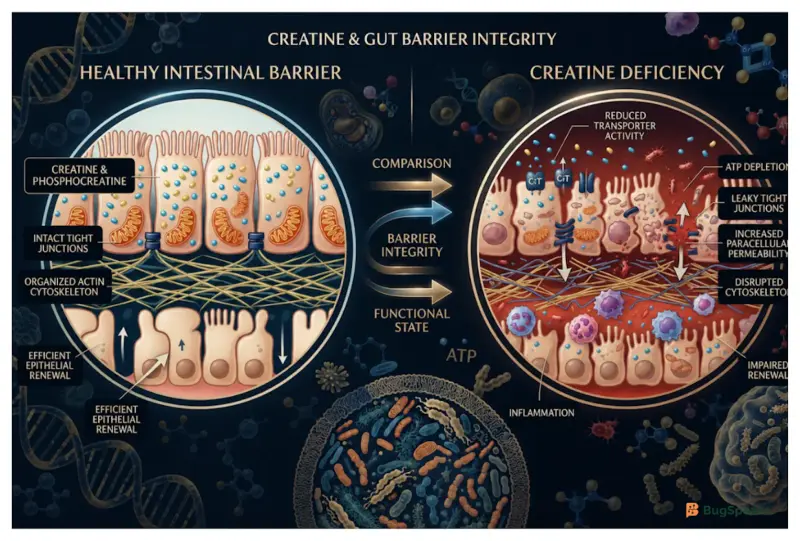
Why is your gut wall compared to a hardworking runner?
Your intestinal mucosal barrier is considered the hardest-working athlete in your body because its cells must run a non-stop marathon of self-renewal every three to five days while keeping out harmful germs. This rapid turnaround represents one of the most energy-demanding processes in your bodyKeely and Barrett (2022). In this busy environment, gut cells act like runners who constantly rebuild their structures and copy their deoxyribonucleic acid (DNA). These cell runners form a protective wall that lets good nutrients in while keeping bad things out. To win this race, the cells must stay strong, relying on an inner skeleton called the actin cytoskeleton.
This inner skeleton is not a stiff frame but a highly active network that constantly changes shape to repair tiny injuriesHall et al. (2020). Just like a human runner needs a lot of food during a long race, keeping this cellular frame in top shape requires a massive amount of energy. In fact, studies show that maintaining this skeletal structure alone uses up one-fifth of the cell's total energyHall et al. (2020). The main fuel for this workout is adenosine triphosphate (ATP), which acts like pure cellular cash. When cells run out of this cash, the wall breaks, and the athlete fails.
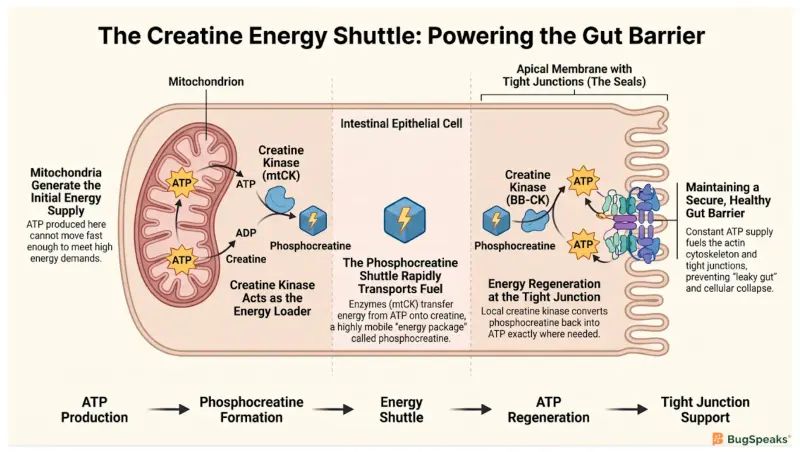
To prevent a total collapse, the gut wall uses a shared energy reserve that works like a quick-release fuel tank. While ATP is the immediate energy, its supply is very small and cannot move fast enough to fuel the active skeletonHall et al. (2020). This is where the creatine-phosphocreatine cycle steps in to help. Cells use a special enzyme to turn creatine into phosphocreatine, which charges the molecule like a battery by storing a high-energy phosphate group, creating a tiny, highly mobile energy package, which is a tiny, highly mobile energy packageBonilla et al. (2021). This package travels extremely fast, delivering fresh energy directly to the cell borders to keep the protective walls sealed tightly.
How does a special gatekeeper pump fuel into your gut cells?
The creatine transporter acts as the intake manager for your gut cells by pulling in fresh fuel from your food to keep the cell runners strong. Known scientifically as solute carrier family 6 member 8 (SLC6A8), this tiny pump is located on the outer edges of your gut cellsWallimann et al. (2021). It works non-stop to drag creatine into the cells against a steep gradient. In a healthy gut, this active pump ensures that the cells have plenty of raw materials to build their backup energy pools. This process keeps the cell runners fully loaded for their daily marathon race.
The exact placement of this fuel pump is very important because it sits right next to the cell's tight junctionsHall et al. (2020). Because these seals require a lot of energy to stay closed, having the pump right next to them means ATP is made exactly where it is needed. This setup allows the gut to quickly fix minor leaks and stay strong. We can measure this wall strength in a lab by testing the transepithelial electrical resistance (TEER) of the cell layer.
When these pumps are missing, the cell runners suffer from severe energy drops that lead to a leaky gut wall. This fuel crisis is commonly seen in patients with inflammatory bowel disease (IBD), who have much fewer transporters than healthy peopleHall et al. (2020). Without these pumps, the cells cannot absorb creatine from food, which breaks their energy cycle and leaves the wall weak. This makes the gut wall easily damaged by painful inflammation, swelling, and irritation. Giving these patients extra creatine can help them rebuild their energy reserves, repair the wall, and restore their strong, healthy gut barrier.
What happens when your gut cells run out of their natural energy?
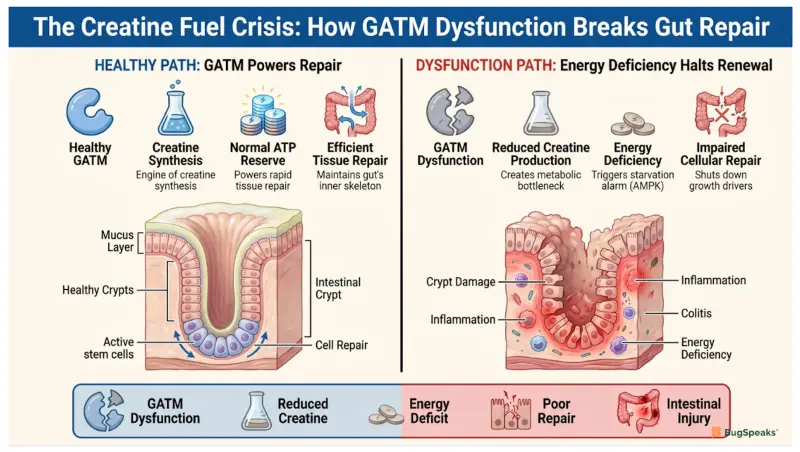
The cellular energy factory inside our gut experiences a metabolic bottleneck when your cells cannot make their own creatine fuel, which leads to cell death and wall collapse. While cells can import fuel, they also rely on a tool called glycine amidinotransferase (GATM) to make creatine from scratchTurer et al. (2017). This tool is the first and most important step in the cell's fuel-making process. If this tool is broken due to a genetic error, the cells run out of energy. This deep, dangerous fuel shortage makes the gut wall extremely vulnerable to daily stress, damage, and painful swelling.
Without a steady fuel supply, the gut cells are unable to grow or divide to fix normal wear and tear. When researchers use a chemical called dextran sodium sulfate (DSS) to stress the gut, creatine-deficient cells quickly die. Normally, a healthy gut responds to injury by multiplying cells to plug the leaks. But without creatine, the cells do not have the massive energy needed to divide. The repair process stops entirely, the wall breaks, and bad germs flood into the body. This shows how vital creatine is for keeping our gut cells alive, active, and safe.
This major energy crisis is detected by the cell's internal alarm system, known as adenosine monophosphate-activated protein kinase (AMPK). This alarm goes off to tell the cell it is starving, which shuts down growth to save energy. Specifically, this alarm turns off a growth driver called mammalian target of rapamycin (mTOR), which normally helps the gut repair itself. Fortunately, this energy block can be easily fixed by eating more creatine through pure supplement powder or foods like meat and fish. This simple step bypasses the broken tool, turns off the alarm, and allows the cell runners to grow, multiply, and repair the barrier to stay safe.
How do eating times and tiny gut bugs coach these cell runners?
Training conditions like oxygen levels and feeding schedules coach these cellular athletes by triggering natural survival pathways that boost energy and protect the gut wall. Because the lower gut naturally has very little oxygen, cells must adapt to these tough conditionsWallimann et al. (2021). Under low oxygen, the cells activate special helpers called hypoxia-inducible factors (HIF). These helpers act like coaches, instructing the cells to build more fuel pumps and local energy creators. Specifically, they produce more brain-type creatine kinase (BB-CK) and mitochondrial creatine kinase (mtCK), which work together to keep the gut wall strong, active, and fully fueled.
In addition to oxygen, eating schedules like daytime time-restricted feeding (DTRF) act as great coaches by changing your gut bugs to increase creatine. In animal studies, restricting food to an eight-hour day window led to a massive nine-fold increase in gut creatineHe et al. (2025). This simple schedule reshaped the gut microbiome, meaning it multiplies friendly bacteria called Bifidobacterium pseudolongum. These friendly bugs act as helpful partners, producing the raw ingredients that your cells use to make creatine. This shows how simple eating habits can help your gut bugs create protective, muscle-supporting fuel to support you every single day.
This microbially produced creatine is then taken up by your gut cells, acting as a shield against extreme and dangerous tissue damage. In studies, giving mice this friendly bacterium or direct creatine protected them from lethal radiation damage, which normally destroys the gut wallHe et al. (2025). By keeping the cell runners fueled, the creatine maintains the gut's physical structure and keeps its doors closed tight. This stops dangerous, toxic waste from leaking into the blood, showing how our daily habits and gut bugs work together to keep our entire body safe.
How does a backup fuel tank save your gut cells from popping?
The shared energy reserve protects our gut athletes from cellular collapse by using creatine to stop cells from popping under extreme stress. When cells experience severe damage or swelling, they can undergo a modern form of cell death called ferroptosisHe et al. (2025). This type of death is driven by iron and causes the fats in the cell's outer skin to rust and break. When energy levels drop, the cell cannot maintain the systems that protect these fats. Fortunately, having a steady, reliable supply of creatine keeps energy levels high, which protects the cell's skin from popping and breaking.
The exact way creatine protects the cell involves a chain reaction that stops the production of weak, easily damaged fats. Under stress, creatine triggers an active signal that turns off a fat-building tool called acetyl-coenzyme A carboxylase (ACC)He et al. (2025). Turning off this tool immediately stops the cell from making polyunsaturated fatty acids (PUFA). Because these specific fats have very weak chemical bonds, they are the main targets for iron-driven rusting. By reducing these weak, fragile, and sensitive fats, creatine starves the cell, ensuring that the cell's outer skin remains completely safe and fully intact to protect you.
By stopping the build-up of these weak fats, creatine completely blocks the cell death process and keeps the physical gut wall intact. Confocal microscopy shows that creatine prevents iron from piling up, reduces fat rusting, and lowers death markers like acyl-coenzyme A synthetase long-chain family member 4 (ACSL4)He et al. (2025). When researchers block the active creatine transporter, this cell-saving protection is completely lost. This proves that our gut cells depend on this shared energy pool to maintain their physical structure, prevent cell popping, and survive in the face of lethal stress, keeping us feeling very healthy.
Visualize the process- https://youtu.be/r4gjgKSISCM
Reference
Wallimann, T., Hall, C. H. T., Colgan, S. P., & Glover, L. E. (2021). Creatine Supplementation for Patients with Inflammatory Bowel Diseases: A Scientific Rationale for a Clinical Trial. Nutrients, 13(5), 1429. https://doi.org/10.3390/nu13051429
Hall, C. H. T., Lee, J. S., Murphy, E. M., Gerich, M. E., Dran, R., Glover, L. E., Abdulla, Z. I., Skelton, M. R., & Colgan, S. P. (2020). Creatine Transporter, Reduced in Colon Tissues From Patients With Inflammatory Bowel Diseases, Regulates Energy Balance in Intestinal Epithelial Cells, Epithelial Integrity, and Barrier Function. Gastroenterology, 159(3), 984–998.e1. https://doi.org/10.1053/j.gastro.2020.05.033
Keely, S. J., & Barrett, K. E. (2022). Intestinal secretory mechanisms and diarrhea. American journal of physiology. Gastrointestinal and liver physiology, 322(4), G405–G420. https://doi.org/10.1152/ajpgi.00316.2021
Bonilla, D. A., Kreider, R. B., Stout, J. R., Forero, D. A., Kerksick, C. M., Roberts, M. D., & Rawson, E. S. (2021). Metabolic Basis of Creatine in Health and Disease: A Bioinformatics-Assisted Review. Nutrients, 13(4), 1238. https://doi.org/10.3390/nu13041238
He, Y., Zhao, G., Ouyang, X., Wang, S., Chen, Y., Li, C., He, Y., Gao, J., Han, S., Zhao, J., Wang, J., & Wang, C. (2025). Creatine-mediated ferroptosis inhibition is involved in the intestinal radioprotection of daytime-restricted feeding. Gut microbes, 17(1), 2489072. https://doi.org/10.1080/19490976.2025.2489072
Turer, E., McAlpine, W., Wang, K. W., Lu, T., Li, X., Tang, M., Zhan, X., Wang, T., Zhan, X., Bu, C. H., Murray, A. R., & Beutler, B. (2017). Creatine maintains intestinal homeostasis and protects against colitis. Proceedings of the National Academy of Sciences of the United States of America, 114(7), E1273–E1281. https://doi.org/10.1073/pnas.1621400114
Wax, B., Kerksick, C. M., Jagim, A. R., Mayo, J. J., Lyons, B. C., & Kreider, R. B. (2021). Creatine for Exercise and Sports Performance, with Recovery Considerations for Healthy Populations. Nutrients, 13(6), 1915. https://doi.org/10.3390/nu13061915