Copper Vessel Myth: Benefits of Drinking Water from Copper Pots
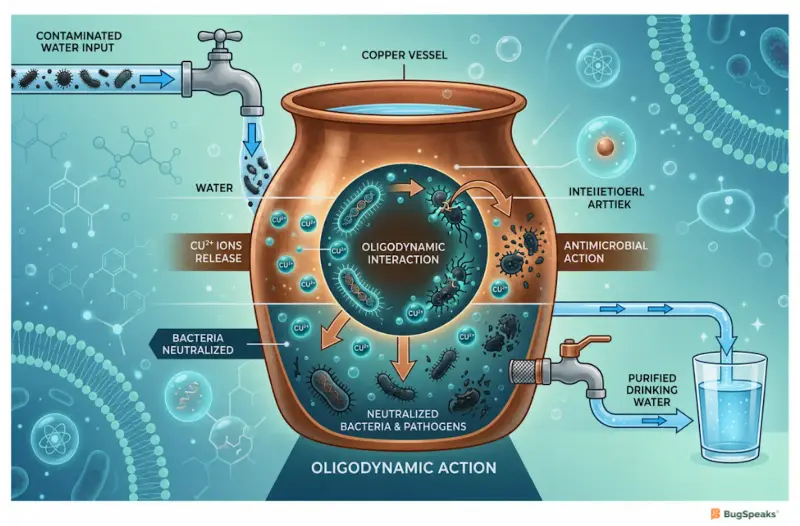
Does storing water in a copper vessel actually purify it from harmful bacteria?
Storing dirty water inside a copper pot actually purifies it because copper metal slowly releases microscopic particles that wipe out dangerous bacteria. This natural germ-killing process is called oligodynamic action, and it was first discovered by a Swiss scientist named Karl Wilhelm von Nägeli back in the year 1893Praveen Dhar (2019). When these tiny, invisible copper pieces float into the water, they act like a shield against invaders, making the water clean, pure, and safe to drink. This ancient technology fits the rules of biology perfectly, turning a simple metallic pot into a highly effective water-purifying machine for families worldwide.
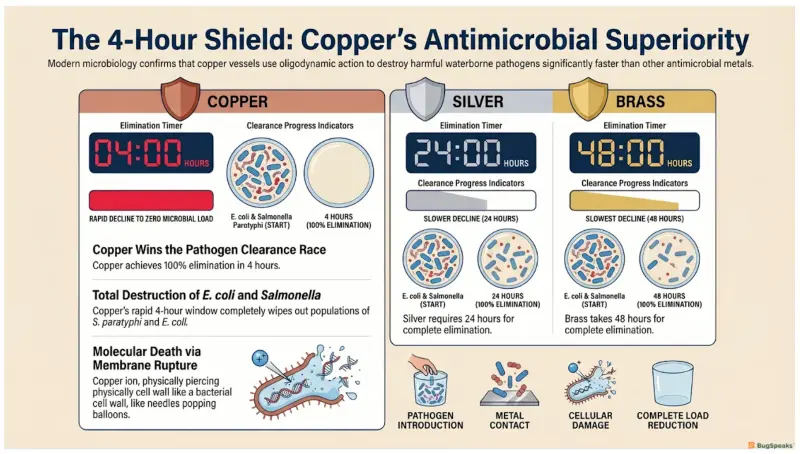
Modern scientific testing shows that copper pots clean water much faster than pots made of silver or brass. In laboratory experiments, researchers contaminated clean water with dangerous stomach bugs such as Escherichia coli (E. coli) and Salmonellaparatyphi (S. paratyphi) (Shrestha et al., 2009). The copper vessels destroyed these harmful bacteria in just four hours of holding time, whereas silver and brass took much longer to achieve the same results. This important study proves that traditional household water storage is not just an old myth, but a highly effective biological testing platform that yields measurable, life-saving outcomes for everyday people.
Our history-meets-microscope tool helps us see how this historical observation matches up with modern microbiology to protect human health. By storing water in a copper pot, we are using a smart physical filter that targets bad enteric pathogens, which are simply microscopic bugs that make your tummy hurt. This simple purification system is inexpensive, easy to use, and helps people in rural areas stay safe from contaminated drinking water. By mapping these ancient habits to modern science, we can easily verify that some historical traditions are excellent, practical tools for keeping our tiny gut bugs happy and healthy.
How does copper destroy microbial cells on a molecular level?
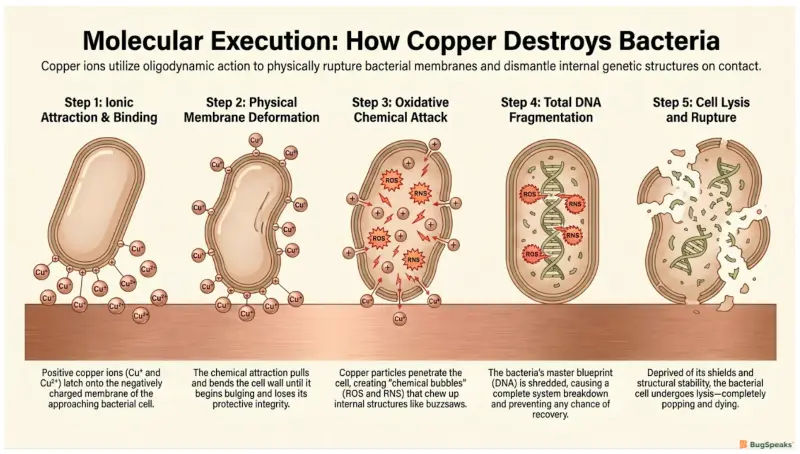
Copper destroys bacteria on a molecular level by physically tearing their outer protective membranes and causing their delicate cellular insides to collapse. When a bacterial cell bumps into a copper surface, the positive electrical charges of copper ions latch onto the negative charges on the bacterial cell wallPraveen Dhar (2019). This powerful chemical attraction physically pulls and bends the wall until it ruptures, much like popping a water balloon with a sharp metal needle. This rapid destruction of membrane integrity ensures that the invading pathogen loses all of its protective shields and dies almost instantly in the stored water.
Once copper particles get inside the bacteria, they create highly destructive chemical bubbles called reactive oxygen species (ROS) and reactive nitrogen species (RNS). These chemical bubbles act like tiny, spinning buzzsaws that chew up the microbe's internal parts, including its vital deoxyribonucleic acid (DNA)Lu et al. (2026). The bacteria can no longer read their genetic instructions, leading to a complete system breakdown inside the cell. To make matters worse, copper also drains a key helper molecule called glutathione (GSH), which is the cell's main shield against chemical damage, leaving the invader completely defenseless and unable to recover from the attack.
To survive this chemical attack, some bacteria have developed special defensive pumps and shields controlled by genes like copA and cueO. The copA gene builds tiny exit tunnels that pump excess copper out of the cell, while the cueO gene turns highly toxic copper into a much safer formLu et al. (2026). These defenses are especially strong in multi-drug resistant (MDR) bacteria, which are stubborn superbugs that resist multiple antibioticsShrestha et al. (2009). Because these superbugs have stronger pumps, storing water in copper vessels requires a longer holding time to destroy them and keep your family safe.
How does our digestive system absorb and handle copper from water and food?
Our digestive system absorbs copper using a highly specialized cellular transport system in our intestines to ensure we get exactly what we need while preventing any toxic buildup. When copper from our water and food enters our stomach, it is mainly absorbed in a section of the small intestine called the duodenumLu et al. (2026). The human body acts as a strict border control agent, scanning every single copper particle that tries to enter. This precise pathway is absolutely crucial because our bodies require a small amount of copper to stay alive, but too much can cause serious cellular damage in our organs.
Before dietary copper can enter our intestinal cells, a special family of surface proteins called six-transmembrane epithelial antigen of the prostate (STEAP) converts copper into a usable cuprous form. Once converted, a high-affinity importer protein called copper transport protein 1 (CTR1) opens a gateway and pulls the copper insideLu et al. (2026). Inside the cell, copper is never allowed to float around freely because of its high chemical reactivity. Instead, a protective protein buffer called metallothionein (MT) quickly binds to the copper, holding it safely like asulfur-rich atomic shield that binds and neutralizes metalsuntil the body is ready.
When the body needs copper, a specialized export pump called ATPase copper transporting alpha (ATP7A) moves the copper out of the gut cells and into the healthy bloodstream. This exporter protein continuously recycles between cell compartments to maintain a perfect metal balanceLu et al. (2026). If we do not have enough working ATP7A proteins in our body, our intestines cannot absorb copper, which leads to a severe genetic disease called Menkes disease (MD). By keeping this complex exit gateway working smoothly, our intestines act as the primary, high-security guardians of our body's entire copper supply, distribution, and overall biological health.
What role does copper play in maintaining the health of our gut barrier and local microbiome?
Copper plays a crucial role in maintaining our gut barrier by serving as an indispensable spark plug for essential enzymes that lock our intestinal cells tightly together. These key proteins create a secure wall that keeps harmful living waste and bacteria from leaking out into our bloodstreamLu et al. (2026). When we consume healthy, low-dose levels of copper, we help our body build a sturdy, biological protective fence. This fence protects our entire digestive tract from daily wear and tear, ensuring that our gut lining remains strong, resilient, and always ready to absorb important nutrients from our daily meals.
Our intestinal cells use copper to activate a powerful team of cuproenzymes, including cytochrome c oxidase (CCO) and superoxide dismutase 1 (SOD1). The CCO enzyme acts as a miniature cellular power plant, converting oxygen into energy to keep our gut wall repaired, active, and growingLu et al. (2026). Meanwhile, the SOD1 enzyme acts like a tiny vacuum cleaner, sweeping away harmful free radicals that would otherwise damage our cells. These enzymes work together to support other helper proteins like diamine oxidase (DAO), which breaks down irritating histamines to prevent uncomfortable stomach inflammation, swelling, and chronic gut pain in our bodies.
There is a strictly regulated homeostatic thresholdbetween our dietary copper intake and the health of our local gut microbiome. At safe copper supports friendly probiotic bacteria like Lactobacillus and Lactococcus, which help our bodies digest food and produce beneficial short-chain fatty acids (SCFAs) like butyrateLu et al. (2026).
There is a delicate, U-shaped relationship (describes a situation where both extremes having too little or too much of a substance are harmful, while a moderate, balanced amount in the middle is ideal for health) between our dietary copper intake and the health of our local gut microbiomeLu et al. (2026). At a safe, physiological level of 2 mg/L in our drinking water, copper supports friendly probiotic bacteriaZhao et al. (2024). These tiny microbes help our bodies digest food and produce beneficial short-chain fatty acids (SCFAs) like butyrateLu et al. (2026). Butyrate serves as the primary fuel source to keep our colon cells healthy. However, if we drink an excess level of 4 mg/L or higher, it quickly kills off these helpful microbes, completely stops butyrate production, and damages our protective gut barrier.
How does copper influence our gut immune system and what happens when copper levels are unbalanced?
Copper influences our gut immune system by acting as a natural, highly useful volume control dial, helping our important defense cells fight pathogens while keeping harmful inflammation from getting out of hand. Our body uses copper to train and arm our intestinal immune cells, ensuring they can spot and destroy invaders quicklyLu et al. (2026). When our copper levels are perfectly balanced, our immune system operates in a state of calm readiness. This prevents the defense system from accidentally attacking its own healthy tissues while maintaining a strong, active defense against any dangerous stomach infections or harmful invaders that enter our bodies.
During an active infection, immune chemical messengers like interferon-gamma (IFN-γ) signal our body's defender cells, called macrophages, to wage a targeted metal war against harmful invaders. The macrophages actively pull copper from the blood and pump it directly into their cellular stomachs, creating a toxic, copper-rich trapLu et al. (2026). This clever process, known as nutritional immunity, uses copper as a natural weapon to zap trapped pathogens. If macrophage cells lack proper copper-exporting proteins, their ability to kill swallowed bacteria drops significantly, making it much harder for your body to fight off infections, protect the gut, and fully recover.
When our copper levels become severely unbalanced, it can lead to serious and dangerous health problems like Wilson disease or a unique cell-death process called cuproptosis. In Wilson disease, genetic mutations in the ATPase copper transporting beta (ATP7B) protein cause toxic copper to build up in the liver and brainLu et al. (2026). Conversely, extreme copper overload can trigger cuproptosis, where copper binds directly to metabolic proteins in the mitochondria inside the cells, causing them to clump together and destroy the cell. Keeping copper levels in a safe, healthy range is essential for our survival, growth, long-term health, and immune defense.
-Varsha V
Visualize the process- https://youtu.be/c6zb_oLp9cg
Reference
Shrestha, R., Joshi, D. R., Gopali, J., & Piya, S. (2009). Oligodynamic action of silver, copper and brass on enteric bacteria isolated from water of Kathmandu Valley. Nepal Journal of Science and Technology, 10, 189-193.
Dhar, T. P. (2019). Oligodynamic Effects Copper Against Water Borne Pathogens. J. Environ. Nanotechnol, 8(4), 08-09.
Lu, F., Wang, X., Xue, X., Liu, L., Li, D., Liu, A., Qin, S., & Liu, L. (2026). Multifaceted Role of Copper Homeostasis in Gut Health: From Molecular Mechanisms to Therapeutic Interventions. Cells, 15(6), 545. https://doi.org/10.3390/cells15060545