Exploring the Connection Between Cleanliness and Food Intolerances
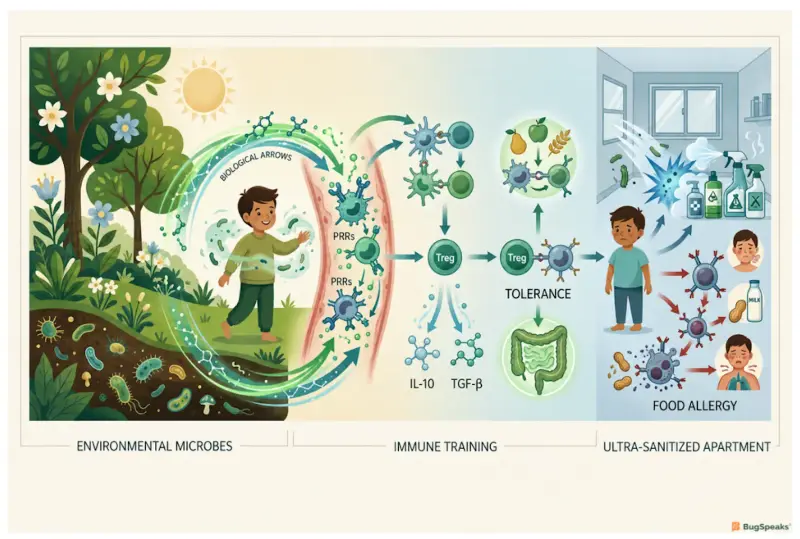
Why does living in an ultra-sanitized home increase our risk of developing unexpected food allergies?
Living in highly sanitized homes increases our risk of food allergies because our immune systems do not get enough contact with environmental microbes to learn how to stay calm. Think of your immune system as a high-tech calibration system that needs training data to work properly. Just like a smartphone screen needs calibration to detect where your finger touches, your body needs to adjust its calibration mechanism to recognize safe substances. Microbes from the dirt act as these calibration inputs, telling the immune system what is normal in the outside world. When we clean too much, we delete this vital training data.
Without environmental microbes, our immune system becomes confused and begins targeting harmless dietary proteins, leading to a state called atopic sensitization. When you eat, your digestive tract is introduced to food particles called antigens, which are completely harmless to your body. However, an untrained calibration mechanism cannot recognize these safe targets and misinterprets them as dangerous invaders. It begins to produce specialized proteins called immunoglobulin E (IgE), which are allergy antibodies designed to fight off infections. This incorrect response marks the beginning of a major immunological mistake where your system wrongly identifies harmless foods as future tolerance targets, causing a reaction.
These allergy antibodies attach themselves to specialized defense units called mast cells, which are scattered throughout your body tissues. When you eat that food again, the antigens bind to the antibodies on the mast cells, causing them to explode and release a strong chemical called histamine. This sudden chemical release causes itchy skin, swelling, stomach pain, or even severe breathing problems, which we recognize as a food allergy (FA). Ultimately, what we call an allergy is just a calibration mismatch, where the immune system uses its heaviest weapons against safe foods because it lacks the necessary training from the natural environment.
How does the lack of environmental microbes shift our internal tuning dials?
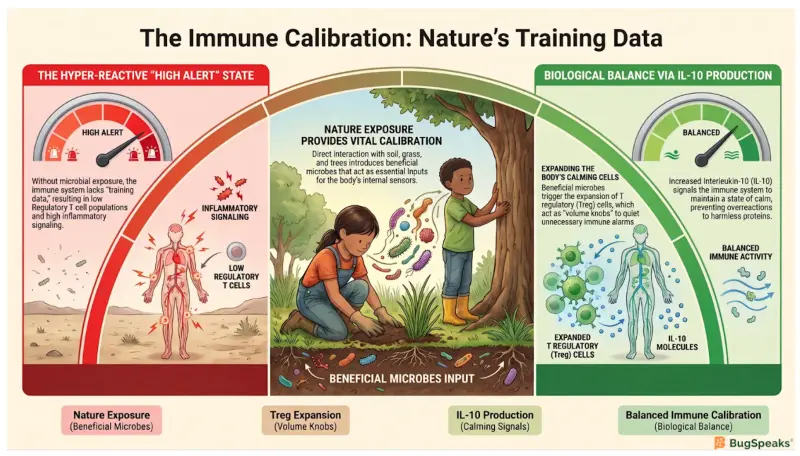
The lack of environmental microbes shifts our internal tuning dials toward hyper-reactivity by depriving our bodies of the vital training inputs needed to expand our calming cells. These calming cells are called T regulatory (Treg) cells, and they act like the volume knobs of our immune system to keep things quiet. When we live in ultra-sanitized buildings, we do not get enough microbial contact to turn these calming dials up. Consequently, the immune system fails to release protective chemical messengers that guide the system. These soothing messengers help to build smooth tolerance curves that prevent the body from overreacting.
The scientific explanation for this protective effect is known as the biodiversity hypothesis, which shows how our health is connected to natureHanski (2012). Living in built areas with little green space or agricultural land reduces the natural variety of bacteria on our skin and in our guts. In healthy children, having a wide variety of these natural bacteria on their skin helps the body produce interleukin-10 (IL-10), a crucial anti-inflammatory cytokine. This vital chemical signals the immune system to maintain a state of calm and prevents the system from triggering unnecessary defense reactions.
When our bodies lack these microbial inputs, we also fail to produce another essential soothing chemical called transforming growth factor-beta (TGF-β). Together with other regulatory cytokines, this compound helps the immune system's calibration mechanism to run smoothly and ignore harmless food targets. Without these natural chemical buffers, our immune system remains in a state of high alert, unable to shut down inappropriate responses. This shows that we cannot separate our immunological health from the natural world. Sanitizing our surroundings too much disables the very systems designed to keep us healthy and free of food intolerances, which are very painful.
What role does the gut microbiome play in feeding calibration data to our immune cells?
Your gut microbiome acts as a vital calibration contributor by supplying your immune cells with important daily signals to keep your digestive tract strong and healthy. This collection of trillions of tiny microbes lives inside your digestive tract, helping to digest the food you swallow. When these helpful gut bacteria are healthy, they digest fibers and produce important chemical messengers called short-chain fatty acids (SCFAs), including acetate, propionate, and butyrateLozupone (2012). These molecules act like building blocks that strengthen your intestinal mucosal barrier, making it tough and leak-proof so that food particles do not slip through into your bloodstream.
In a healthy gut, these special fatty acids act as crucial data packets that increase what scientists call transepithelial electrical resistance (TEER), which is a measure of barrier tightness. These chemicals tell your body to produce calming cells and soothing cytokines to prevent unnecessary immune alarmsMares (2025). Specifically, butyrate helps the body produce calming cells by causing epigenetic changes that stabilize regulatory genes responsible for maintaining long-term immunological peace. This active cellular training ensures that your body learns to ignore safe dietary proteins and builds a high threshold against unwanted allergic reactions.
However, when we live in overly sanitized homes, our gut bacteria can suffer from a state of dysbiosis, where helpful species disappear. This loss of protective microbes means your gut produces fewer calming fatty acids, causing a rapid drop in TEER and making the barrier leakyMares (2025). When food antigens slip through this leaky lining, they directly encounter the active immune cells waiting in your gut-associated lymphoid tissue (GALT). These immune cells panic and begin producing allergy antibodies, leading to a permanent calibration mismatch, which causes serious food problems for your body.
How do modern lifestyle choices and sanitized buildings cause a calibration mismatch with harmless targets?
Modern lifestyle choices and highly sanitized buildings cause a calibration mismatch by separating our bodies from the natural microbial inputs that are required for normal immune training. According to the old friends hypothesis, our immune systems co-evolved with a wide variety of helpful microbes, soil bacteria, and mild parasites that we must encounter to develop properlyStiemsma (2015). Modern apartments built with synthetic materials are biologically simplified, preventing these ancient allies from entering our spacesAdams (2016). This deprives our cells of the essential raw data needed to train our defense systems.
We must look at how our cells detect microbes using pattern recognition receptors (PRRs). These specialized sensor proteins, including intracellular toll-like receptors (TLRs), are designed to recognize harmless microbial structures and send calming signals to the immune systemRook (2023). Under normal conditions, repeated low-dose contact with these bacterial signals teaches the system to stay relaxed. In an ultra-sanitized home, however, these receptors remain completely inactive, leaving the body's calibration mechanism in a state of high alert that misinterprets harmless food proteins as dangerous invaders.
This critical lack of training is made worse by the widespread use of chemical detergents and household sprays. These powerful cleaning agents do not just kill bacteria; they physically destroy the lipid membranes and tight junctions of our skin and gut barriersRook (2023). This physical damage causes a massive drop in electrical resistance, allowing food proteins to leak unchecked into our tissues. When these tissues are damaged by harsh chemicals, they release cellular distress signals that act as strong pro-allergic adjuvants, triggering a permanent calibration mismatch against harmless targets and making our bodies react to safe foods.
How can we safely recalibrate our biological tolerance system in a sanitized world?
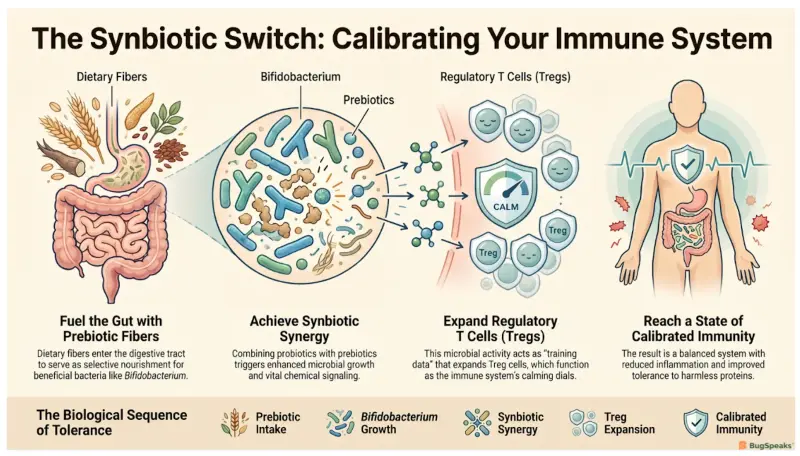
We can safely recalibrate our biological tolerance system by intentionally reintroducing targeted microbial inputs that act as safe, effective training data for our immune cells. In our bodies, this is achieved by supplementing our daily diets with beneficial bacteria and fibers. These biological tools are called probiotics and prebiotics, and they work together to rebuild a depleted gut ecosystem. When combined as synbiotics, they provide a powerful synergistic effect that promotes the expansion of calming cells and increases protective chemical signaling. This important process helps our immune system to recognize harmless foods and stay completely calm in our daily lives.
For people who have already developed a food allergy, combining these beneficial microbes with gradual exposure is a highly successful clinical strategy. In modern medicine, doctors use oral immunotherapy (OIT) to safely desensitize the immune system to common food proteinsMares (2025). When patients undergoing cow's milk immunotherapy are given specific strains like Lactiplantibacillus plantarum or Bifidobacterium breve, their tolerance develops much faster. These helpful bacteria act as key calibration contributors, teaching the system's sensors to secrete interleukin-10 and other soothing cytokines that permanently prevent allergic reactions to safe foods on our dinner plates.
In young babies who cannot be breastfed, using special formulas fortified with prebiotics like galactooligosaccharides and fructooligosaccharides can safely guide early immune developmentCukrowska (2020). These non-digestible oligosaccharides feed helpful infant bacteria such as Bifidobacterium, helping them multiply quickly. These friendly bacteria strengthen the intestinal mucosal barrier, increase electrical resistance, and drive the expansion of calming regulatory cells throughout the body. By supplying our growing young children with these synbiotics, we can successfully program their developing immune systems toward permanent tolerance and fully protect them from unexpected food allergies in our sanitized world.
Visualize the process- https://youtu.be/BhEoRbfmbMQ
Reference
Hanski, I., von Hertzen, L., Fyhrquist, N., Koskinen, K., Torppa, K., Laatikainen, T., Karisola, P., Auvinen, P., Paulin, L., Mäkelä, M. J., Vartiainen, E., Kosunen, T. U., Alenius, H., & Haahtela, T. (2012). Environmental biodiversity, human microbiota, and allergy are interrelated. Proceedings of the National Academy of Sciences of the United States of America, 109(21), 8334–8339. https://doi.org/10.1073/pnas.1205624109
Adams, R. I., Bhangar, S., Dannemiller, K. C., Eisen, J. A., Fierer, N., Gilbert, J. A., ... & Bibby, K. (2016). Ten questions concerning the microbiomes of buildings. Building and Environment, 109, 224-234.
Cukrowska, B., Bierła, J. B., Zakrzewska, M., Klukowski, M., & Maciorkowska, E. (2020). The Relationship between the Infant Gut Microbiota and Allergy. The Role of Bifidobacterium breve and Prebiotic Oligosaccharides in the Activation of Anti-Allergic Mechanisms in Early Life. Nutrients, 12(4), 946. https://doi.org/10.3390/nu12040946
Mareș, R. C., Săsăran, M. O., & Mărginean, C. O. (2025). Gut Microbiota and Food Allergy: A Review of Mechanisms and Microbiota-Targeted Interventions. Nutrients, 17(18), 3009. https://doi.org/10.3390/nu17183009
Lozupone, C. A., Stombaugh, J. I., Gordon, J. I., Jansson, J. K., & Knight, R. (2012). Diversity, stability and resilience of the human gut microbiota. Nature, 489(7415), 220–230. https://doi.org/10.1038/nature11550
Stiemsma, L. T., Reynolds, L. A., Turvey, S. E., & Finlay, B. B. (2015). The hygiene hypothesis: current perspectives and future therapies. ImmunoTargets and therapy, 4, 143–157. https://doi.org/10.2147/ITT.S61528
Rook G. A. W. (2023). The old friends hypothesis: evolution, immunoregulation and essential microbial inputs. Frontiers in allergy, 4, 1220481. https://doi.org/10.3389/falgy.2023.1220481
Chiu, K., Warner, G., Nowak, R. A., Flaws, J. A., & Mei, W. (2020). The Impact of Environmental Chemicals on the Gut Microbiome. Toxicological sciences : an official journal of the Society of Toxicology, 176(2), 253–284. https://doi.org/10.1093/toxsci/kfaa065