Exploring the Link Between Gut Health and Chronic Fatigue Syndrome
What is Myalgic Encephalomyelitis/Chronic Fatigue Syndrome and how do our body systems work together?
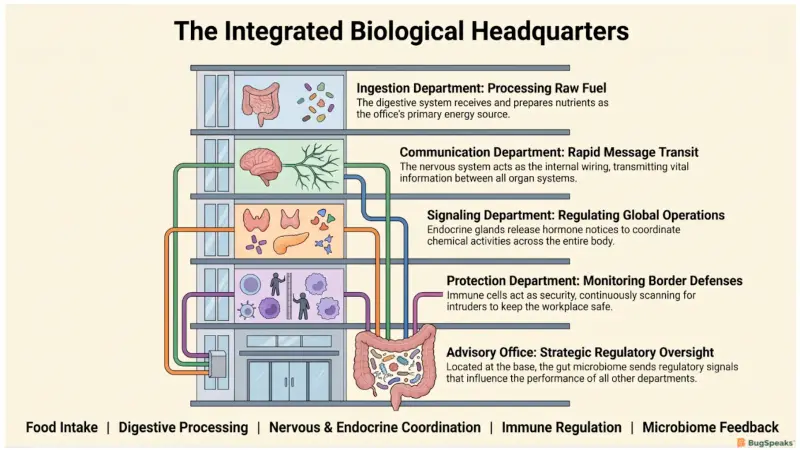
Myalgic Encephalomyelitis/Chronic Fatigue Syndrome, which we call ME/CFS, is a long-lasting illness that unbalances multiple connected systems inside our bodies, causing severe tiredness that sleep cannot fix. Imagine your body as a large corporate office where different teams must cooperate perfectly to keep everything running smoothly. Your digestive system is the Ingestion Team, preparing raw materials, while the nervous system is the Communication Team, sending messages everywhere. The immune system acts as the Protection Team, keeping out harmful invaders. Finally, the endocrine system is the Signaling Team, sending hormone messages to regulate operations across the entire office.
In a healthy office, these teams share resources and communicate constantly to keep the business active and successful. In patients with ME/CFS, a breakdown in this vital cooperation causes the entire workplace to struggle, resulting in extreme exhaustion. The main problem is not just one lazy worker, but rather a widespread lack of coordination between different departments. For example, when the Protection Team gets too excited, it can accidentally disrupt the Communication Team's linesChe et al. (2025). This widespread team confusion makes it difficult for the body to manage energy, leaving the person feeling completely drained even after resting for many hours.
The gut microbiome, which is the collection of trillions of tiny microbes in our digestive system, acts as an Advisory Partner to this office. This partner is very important for suggesting healthy strategies, but it is still just one contributor among many in the whole company. In ME/CFS, this partner can become unhappy, sending poor advice that affects other departmentsNagy-Szakal et al. (2017). However, because our body systems are so closely linked, we must look at how all these teams interact. When we examine this partnership, we see how even small misunderstandings can spread across the entire office.
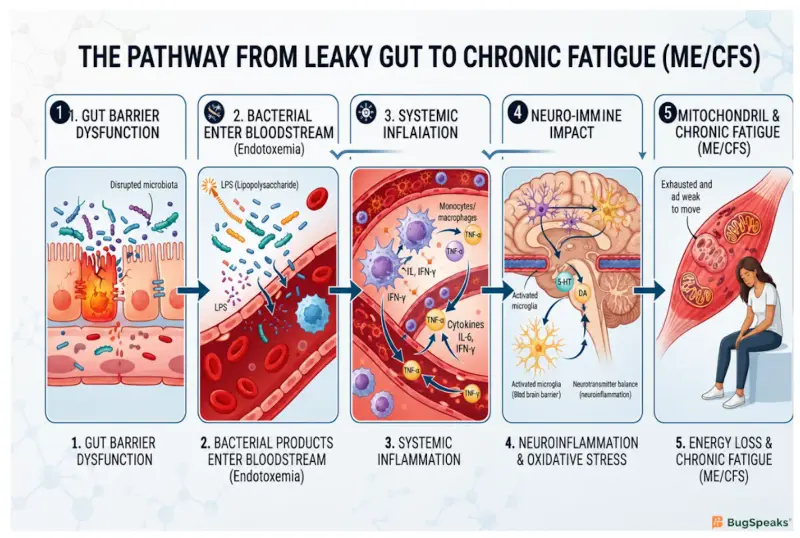
How does a leak in our gut wall trigger a defense warning in ME/CFS?
A leak in our gut wall allows bacterial components to enter our blood, triggering an overactive defense response in patients with ME/CFS. This process is called intestinal permeability, where the tight protective border of our Ingestion Team becomes weak and allows items to pass through. When the border leaks, pieces of bacterial cell walls, known as lipopolysaccharide or LPS, slip into the bloodstreamGiloteaux et al. (2016). Once these bacterial wall fragments escape, they travel through the blood and act as unauthorized intruders. This leak forces the Protection Team to go on high alert, thinking that the entire office is under attack.
The Protection Team uses specialized alarm receivers, called soluble cluster of differentiation 14 or sCD14, and LPS-binding protein to detect these leaking bacterial pieces. In a normal body, these scanners only activate occasionally, but in patients with ME/CFS, they are constantly detecting leaked particles. Scientists find that levels of sCD14 and LBP are much higher in ME/CFS patients than in healthy individualsGiloteaux et al. (2016). These high scanner readings confirm that microbial translocation, which is the movement of bacteria or their pieces across the damaged gut barrier, is happening regularly and keeping these security alarms ringing through the halls.
This constant state of alarm causes widespread, long-term inflammation, which makes the person feel like they are fighting a permanent flu. Because the security alarms never turn off, they drain resources from the rest of the body, leading to physical fatigue. This continuous security alert also interferes with the Communication Team, making it hard to think clearly. The body spends so much energy on this fake internal war that it has very little power left for daily activities. Therefore, a leaky border is a major trigger that keeps the entire body in an exhausted state. This protective team imbalance prevents normal daily activities.
What does the high-resolution microbial map reveal about the gut ecosystem in ME/CFS?
The high-resolution microbial map reveals that patients with ME/CFS have a severe imbalance in their gut bacteria, with a major loss of helpful species. This imbalance is called dysbiosis, representing a state where the Advisory Partner is highly disorganized. To see exactly who is working inside this partner team, scientists use a highly advanced tool called shotgun metagenomic sequencingNagy-Szakal et al. (2017). This tool acts like a high-resolution camera, taking a detailed inventory of every single microbe present. The map shows that key peaceful advisers, which normally keep the office calm and healthy, have gone missing.
The most critical missing adviser is Faecalibacterium prausnitzii, a beneficial bacterium that produces helpful anti-inflammatory compounds to soothe the gut barrier. In healthy individuals, this bacterium is abundant, acting like a peace-keeping assistant that prevents unnecessary conflicts. However, in patients with ME/CFS, this peaceful adviser is significantly reduced, leaving the gut lining unprotectedGiloteaux et al. (2016). Without this soothing influence, the gut lining is more prone to irritation and leaks. This loss of peaceful workers represents a major step in the breakdown of communication between the gut and other body systems. This adviser shortage weakens the company.
As peaceful advisers decline, pro-inflammatory Proteobacteria can multiply and cause trouble inside the Ingestion Team. These noisy microbes act like disruptive workers who ignore company rules, creating irritation and stimulating the Protection TeamGiloteaux et al. (2016). The high-resolution audit reveals that this bacterial shift turns a once-peaceful department into a source of constant disturbance. This bacterial imbalance does not just affect digestion; it changes the signals sent to the brain, illustrating how a compromised gut microbiome can impact the entire multi-system corporate network. The company struggles when these noisy workers take control of the main offices.
How do altered bacterial metabolic pathways block our cellular energy generators in ME/CFS?
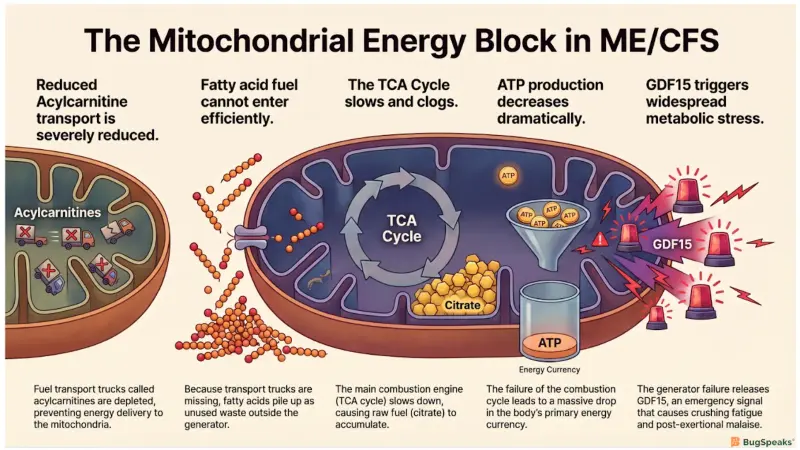
Altered bacterial metabolic pathways block our cellular energy generators by starving them of fuel and causing stress signals to build up, especially after physical activity. Our mitochondria are the Power Generators of our body, converting raw fuel into energy for all other departments. In ME/CFS, altered bacterial activities disrupt how these generators get and use fuelChe et al. (2025). This fuel block is particularly severe during post-exertional malaise, which is a severe flare-up of symptoms and extreme energy crashes that happen after simple physical tasks. It is as if the generators stall when asked to do extra work.
To understand this power stall, scientists studied the fuel trucks, called acylcarnitines, which transport fatty acids to the Power Generators. After exercise, patients with ME/CFS have a significant depletion of acylcarnitines, meaning the generators cannot receive their required fuelChe et al. (2025). Instead of being burned for energy, these fatty acids pile up as unused waste in the body. Because the fuel delivery trucks are missing, the Power Generators must slow down their operations. This fuel delivery failure is one of the main reasons why even minor physical efforts result in such long-lasting, deep physical exhaustion. The Power Generators starve.
Because the fuel cannot enter the generators, the main combustion cycle, called the tricarboxylic acid cycle, gets clogged up. This causes raw fuel, known as citric acid, to accumulate as waste after exercise, whereas healthy individuals use it upChe et al. (2025). This clog triggers a mitochondrial stress marker, called growth differentiation factor 15 or GDF15, which acts like an emergency whistle. High levels of GDF15 correlate directly with severe fatigue after exerciseChe et al. (2025). This stress signal warns the entire office to shut down, causing the crushing fatigue of ME/CFS. This energy barrier stops all normal office work.
How does irritable bowel syndrome co-morbidity rewrite the biological subgroups of ME/CFS?
Irritable bowel syndrome co-morbidity divides patients with ME/CFS into distinct biological subgroups by introducing unique bacterial imbalances and gut irritation that change how the whole body responds. This means that patients with irritable bowel syndrome, which we call IBS, represent a distinct team style with different operational rulesNagy-Szakal et al. (2017). To visualize these differences, scientists use topological data analysis, which is a multidimensional mapping tool that maps complex office networks. This mapping tool reveals that IBS co-morbidity is the absolute strongest driving factor in dividing patients into separate biological networks. This helps organize different departments.
The mapping tool shows that the biological subgroup with IBS has a massive overgrowth of unclassified Alistipes bacteria, which acts as a prominent biomarkerNagy-Szakal et al. (2017). In contrast, the subgroup without IBS is marked by an increase in unclassified Bacteroides and a decrease in Bacteroides vulgatus. These distinct bacterial profiles mean that a single treatment will not work for everyone, as different branches have different underlying issues. Recognizing these subgroups helps us understand that ME/CFS is not a simple, single-issue disease, but a complex network of different multi-system problems. Each sub-branch team needs its own unique solutions.
Furthermore, the subgroup with IBS exhibits unique metabolic changes, such as reduced levels of amino acid biosynthesis pathways, which further impacts the Signaling Team. These chemical shortages affect how different departments talk to each other, altering hormone messages throughout the entire bodyNagy-Szakal et al. (2017). This subgroup division demonstrates that gut-level events can restructure the entire corporate network of our body. By studying these distinct departments and their specific bacterial members, we can design better, more personalized strategies to help our body systems work in harmony again. This important corporate teamwork helps everyone in the entire office succeed.
Visualize the process- https://youtu.be/GV2VcVWEguw
Reference
Giloteaux L, Goodrich JK, Walters WA, Levine SM, Ley RE, Hanson MR. Reduced diversity and altered composition of the gut microbiome in individuals with myalgic encephalomyelitis/chronic fatigue syndrome. Microbiome. 2016 Jun 23;4(1):30. doi: 10.1186/s40168-016-0171-4. PMID: 27338587; PMCID: PMC4918027.
Nagy-Szakal D, Williams BL, Mishra N, Che X, Lee B, Bateman L, Klimas NG, Komaroff AL, Levine S, Montoya JG, Peterson DL, Ramanan D, Jain K, Eddy ML, Hornig M, Lipkin WI. Fecal metagenomic profiles in subgroups of patients with myalgic encephalomyelitis/chronic fatigue syndrome. Microbiome. 2017 Apr 26;5(1):44. doi: 10.1186/s40168-017-0261-y. PMID: 28441964; PMCID: PMC5405467.
Morris G, Berk M, Carvalho AF, Caso JR, Sanz Y, Maes M. The Role of Microbiota and Intestinal Permeability in the Pathophysiology of Autoimmune and Neuroimmune Processes with an Emphasis on Inflammatory Bowel Disease Type 1 Diabetes and Chronic Fatigue Syndrome. Curr Pharm Des. 2016;22(40):6058-6075. doi: 10.2174/1381612822666160914182822. PMID: 27634186.
Hrncir T. Gut Microbiota Dysbiosis: Triggers, Consequences, Diagnostic and Therapeutic Options. Microorganisms. 2022 Mar 7;10(3):578. doi: 10.3390/microorganisms10030578. PMID: 35336153; PMCID: PMC8954387.
Che X, Ranjan A, Guo C, Zhang K, Goldsmith R, Levine S, Moneghetti KJ, Zhai Y, Ge L, Mishra N, Hornig M, Bateman L, Klimas NG, Montoya JG, Peterson DL, Klein SL, Fiehn O, Komaroff AL, Lipkin WI. Heightened innate immunity may trigger chronic inflammation, fatigue and post-exertional malaise in ME/CFS. NPJ Metab Health Dis. 2025 Sep 3;3(1):34. doi: 10.1038/s44324-025-00079-w. PMID: 40903540; PMCID: PMC12408823.
Ansari F, Neshat M, Pourjafar H, Jafari SM, Samakkhah SA, Mirzakhani E. The role of probiotics and prebiotics in modulating of the gut-brain axis. Front Nutr. 2023 Jul 26;10:1173660. doi: 10.3389/fnut.2023.1173660. PMID: 37565035; PMCID: PMC10410452.