How does chewing food alter the biological resources delivered to your gut?
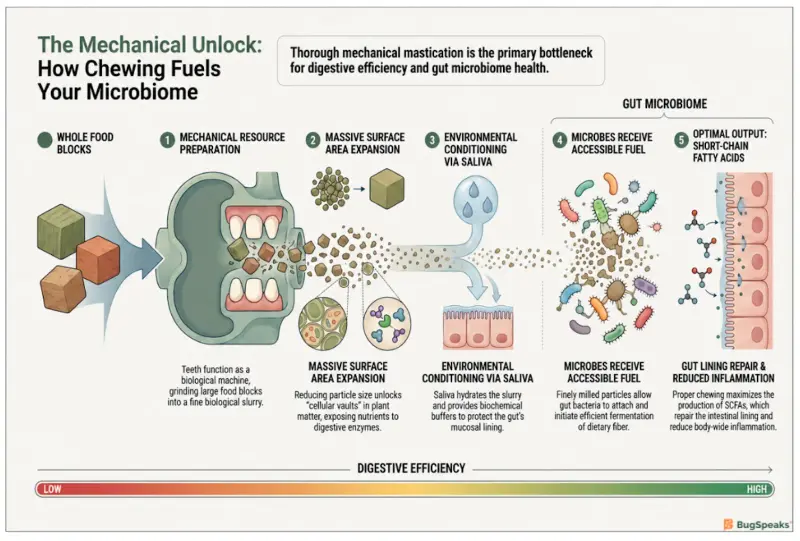
Chewing mechanically fractures large dietary components into microscopic fragments, massively increasing the physical surface area necessary for digestive enzymes and intestinal bacteria to extract nutrients. Within the biological framework of the Food Particle Transformation Ecosystem, mastication serves as the mandatory stage of resource preparation. Every bite you ingest represents raw ecosystem resources that your body cannot utilize in bulk. By grinding these materials, teeth convert large structural masses into a fine biological slurry. This physical reduction is essential because stomach enzymes and intestinal microbes require exposed surfaces to initiate chemical breakdown. Without this mechanical processing, downstream biological machinery remains highly inefficient.
The mechanics of chewing actively communicate with lower digestive organs to orchestrate the pacing of nutrient delivery. Clinical research demonstrates that mastication actively suppresses initial gastric emptying by modulating the stomach's electrical rhythms, specifically altering gastric myoelectrical activity [Ohmure (2012)]. This physiological mechanism proves that thorough chewing intentionally delays the rate at which the stomach releases food into the small intestine. By slowing this transfer, the resource preparation stage ensures the stomach has ample time to bathe the ecosystem resource inputs in acid and enzymes, preventing the fragile intestinal ecosystem from being overwhelmed by a sudden influx of undigested matter.
When this resource preparation stage is bypassed through rapid eating, the entire biological supply chain suffers. Studies indicate compromised mastication directly reduces the diversity of the intestinal microbiome and exacerbates systemic inflammation throughout the body [Zhang (2026)]. If food is swallowed in unchewed chunks, the ecosystem resource inputs remain largely inaccessible. The protective cellular walls of plant-based foods stay intact, trapping vitamins, minerals, and carbohydrates inside. These trapped resources bypass the upper digestive tract unabsorbed, eventually fermenting improperly in the lower bowel. Over time, poor chewing drives individuals toward soft, processed foods deficient in essential proteins, minerals, and complex fibers, starving beneficial bacteria and triggering a state of biological imbalance known as dysbiosis [Azzolino (2025)].
Why is saliva critical for conditioning the microbial environment?
Saliva lubricates incoming food for safe transport, initiates the chemical breakdown of carbohydrates, and acts as a biochemical buffer to protect the mucosal lining of the gastrointestinal tract. Functioning as the primary environmental conditioning factor within the Food Particle Transformation Ecosystem, saliva prepares the mechanical slurry for its downward journey. Humans swallow roughly 600 times a day, ingesting 1 to 1.5 liters of saliva daily [Li (2025)]. As teeth mill the ecosystem resource inputs during the resource preparation stage, this continuous fluid flow thoroughly hydrates the particles. Proper hydration prevents abrasive damage to delicate tissues and creates a fluid medium where digestive enzymes, like salivary amylase, can immediately dismantle starches.
Beyond hydration, this environmental conditioning factor serves as a highly specialized biological transport system. The oral cavity is a massive reservoir of microscopic life, and saliva acts as the river carrying these organisms downward. Trillions of resident oral bacteria are continuously washed into the gastrointestinal tract [Xu (2025)]. While the stomach utilizes harsh gastric acid to neutralize incoming microbes, the structural composition of saliva actively shields certain microbial populations. This protective buffering allows specific bacteria to survive the highly acidic stomach environment and successfully transit into the lower intestines.
The quality and volume of this environmental conditioning factor are heavily dependent on the mechanical effort exerted during eating. Vigorous, sustained chewing stimulates salivary glands to produce higher volumes of fluid, ensuring the ecosystem resource inputs are optimally coated. If food is bolted down quickly, salivary production remains low. This leads to poorly conditioned food masses entering the stomach, forcing the digestive system to work significantly harder to secrete enough gastric juices to compensate for the missing moisture and alkaline buffers.
Moreover, this fluid contains critical antimicrobial proteins and buffering agents that maintain a stable pH throughout the digestive pathways [Azzolino (2025)]. A well-regulated pH is necessary to prevent harmful, acid-loving bacteria from overpowering healthy microbial communities. When individuals chew thoroughly, they maximize the integration of these protective salivary compounds into the food mass. This meticulous environmental conditioning ensures that by the time nutrients reach the intestines, they are perfectly calibrated to support beneficial microbes while suppressing opportunistic pathogens.
How does the physical size of food particles affect microbial fermentation?
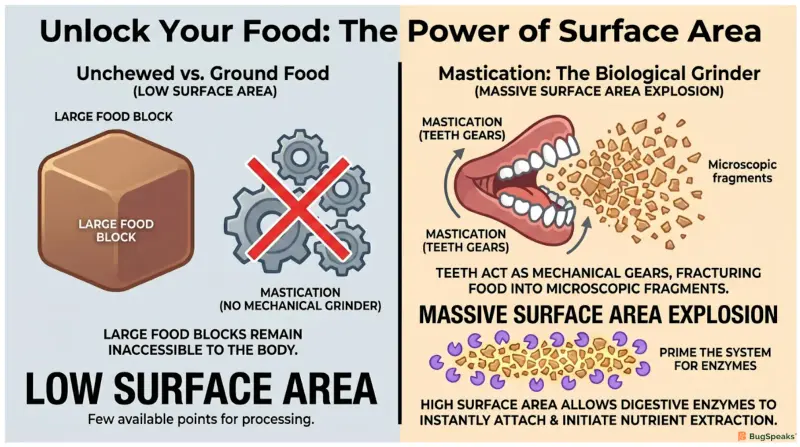
The physical dimensions of ingested food directly determine how efficiently intestinal bacteria can attach to, break down, and extract energy from complex plant structures. Deep within the architecture of the large intestine, trillions of gut microbes function collectively as resource-utilizing communities. These microscopic populations lack teeth or mechanical grinders; they rely entirely on the host to deliver properly sized ecosystem resource inputs. When a person chews thoroughly, they generate a vast amount of exposed surface area on the food particles. This expanded surface area provides essential attachment sites for bacteria to latch onto and initiate microbial fermentation, the chemical process by which bacteria digest complex carbohydrates that human enzymes cannot process.
The most critical resource required by these communities is dietary fiber, which serves as the indispensable long-term microbial fuel of the ecosystem. Plant-based foods are naturally locked inside highly durable cellular vaults. If the resource preparation stage is rushed, this long-term microbial fuel remains trapped inside massive, unchewed chunks of plant matter. Because the resource-utilizing communities can only ferment what they can physically reach, low surface area means that the vast majority of the fiber passes through the digestive tract completely unfermented. Thorough chewing essentially unlocks these cellular vaults, granting the microbiome full access to the nutrients required for survival.
The importance of delivering highly accessible fiber is highlighted by clinical metrics like the Dietary Index for Gut Microbiota (DI-GM). This scientific index assesses diet quality based specifically on its ability to support and nourish a healthy microbiome [Zhang (2026)]. Diets scoring high on the Dietary Index for Gut Microbiota (DI-GM) are universally rich in complex, fibrous plant foods. However, the biological benefits of these high-quality foods are strictly bottlenecked by the mechanics of chewing. Consuming a diverse, fiber-rich diet yields minimal ecological benefits if the physical size of the food particles prevents the resource-utilizing communities from successfully executing microbial fermentation.
When the ecosystem resource inputs are properly sized, the resource-utilizing communities thrive, maintaining a highly competitive environment that physically crowds out dangerous pathogens. Conversely, when large, poorly chewed particles dominate the lower intestine, they often undergo putrefaction rather than clean fermentation. This creates a toxic local environment that damages the intestinal lining and shifts population dynamics away from beneficial bacteria toward harmful, inflammatory strains.
What are the ecosystem-generated outputs of well-chewed dietary fiber?
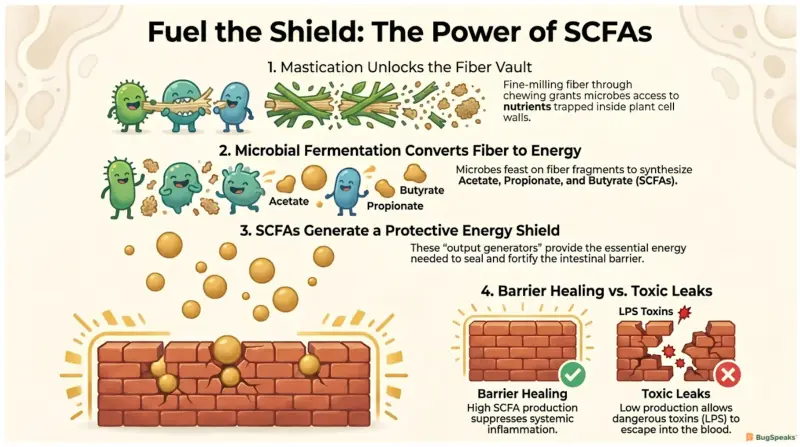
When intestinal bacteria successfully ferment finely chewed dietary fiber, they produce highly beneficial metabolic byproducts that suppress systemic inflammation, regulate metabolism, and repair the intestinal lining. Within the simulation of the Food Particle Transformation Ecosystem, these potent byproducts are known as Short-Chain Fatty Acids (SCFAs), operating as the ultimate ecosystem-generated outputs. The primary forms of these outputs are acetate, propionate, and butyrate [Azzolino (2025)]. These molecules are synthesized exclusively when the resource-utilizing communities have unrestricted access to long-term microbial fuel. Because meticulous chewing maximizes the exposed surface area of fiber, it directly amplifies the volume of ecosystem-generated outputs that the bacteria can produce, creating a deeply resilient biological environment.
These ecosystem-generated outputs serve critical functional roles far beyond the boundaries of the colon. Locally, butyrate acts as the primary energy source for the cells lining the intestinal wall, ensuring that the physical barrier between the gut and the bloodstream remains tightly sealed against dangerous toxins. Systemically, Short-Chain Fatty Acids (SCFAs) are absorbed into the blood, where they exert profound anti-inflammatory effects and regulate metabolic pathways in the liver and muscle tissues. Studies indicate that high levels of these outputs successfully mitigate the inflammatory cascades responsible for chronic tissue destruction, linking proper fiber fermentation directly to lower risks of metabolic disorders [Zhang (2026)].
If the resource preparation stage is rushed and food is poorly chewed, the production of these essential ecosystem-generated outputs crashes. Without adequate Short-Chain Fatty Acids (SCFAs) to provide cellular energy, the intestinal barrier physically weakens, resulting in microscopic leaks. This barrier failure allows toxic bacterial components, specifically Lipopolysaccharides (LPS), to escape the gut and enter the systemic circulation [Li (2026)]. Lipopolysaccharides (LPS) are dangerous structural fragments of Gram-negative bacteria that aggressively activate the immune system. Once in the bloodstream, they bind to receptors like Toll-Like Receptor 4 (TLR4), triggering aggressive, body-wide inflammatory responses that damage distant organs, including the liver and cardiovascular system [Xu (2025)].
The presence of robust ecosystem-generated outputs also directly correlates with the prevention of severe localized inflammatory diseases. Research shows a strong biological link between low microbial diversity and the onset of periodontitis, a destructive inflammatory disease of the gums and oral bone [Zhang (2026)]. Because the mouth and gut operate as a connected biological axis, the failure to chew properly not only starves the gut of protective compounds but also accelerates the decline of oral tissues.
How does the speed of eating influence the entire digestive ecosystem?
Eating slowly and chewing deliberately regulates the autonomic nervous system, ensuring a steady, synchronized release of nutrients into the gastrointestinal tract and preventing digestive overload. The speed at which the resource preparation stage is executed dictates the operational stability of the entire Food Particle Transformation Ecosystem. Clinical monitoring of humans during meals demonstrates that active, deliberate chewing triggers immediate, calming responses in the autonomic nervous system. Specifically, the physical act of chewing causes a measurable decrease in the high-frequency power of heart rate variability, which coincides directly with the suppression of stomach contractions [Ohmure (2012)]. This neurological feedback mechanism proves that thorough chewing actively signals the downstream organs to pause, synchronize, and prepare for the incoming ecosystem resource inputs.
Rushing through meals aggressively bypasses this critical biological synchronization. When food is rapidly bolted, the stomach is abruptly flooded with massive, mechanically unprepared ecosystem resource inputs. This sudden biological avalanche overrides the natural, protective delay in gastric emptying, forcing the stomach to prematurely dump large, unbroken food masses into the sensitive small intestine. This rapid influx completely overwhelms the digestive enzymes and severely disrupts the environmental conditioning factor established by saliva. As a result, the downstream resource-utilizing communities are bombarded with chaotic, poorly processed materials that they cannot efficiently convert into long-term microbial fuel.
The consequences of eating too quickly extend deeply into systemic health and body weight regulation. The relationship between rapid eating, poor chewing, and an elevated Body Mass Index (BMI) is strongly established in clinical literature. Research indicates that a higher Body Mass Index (BMI) actively mediates the relationship between poor dietary microbial support and the worsening of severe inflammatory conditions like periodontitis [Zhang (2026)]. When individuals eat too fast, they routinely consume excess calories before the brain can register satiety, leading to weight gain. This excess weight increases systemic inflammation, further damaging the microbial ecosystems in both the mouth and the gut.
Mindful eating, often quantified by the benchmark of chewing 32 times per bite, restores total ecological harmony. By deliberately slowing down the resource preparation stage, the host ensures that the ecosystem resource inputs are perfectly sized, thoroughly buffered by saliva, and delivered at a pace the stomach can easily manage. This precise pacing allows the resource-utilizing communities to execute flawless microbial fermentation, generating maximum nutritional value and protective outputs.
Visualize the process- https://youtu.be/ktU-iAiR6tw
Reference
Li, Y., Xin, Y., Zong, W., & Li, X. (2025). The role of oral microbiota in digestive system diseases: current advances and perspectives. Journal of oral microbiology, 17(1), 2566403.https://doi.org/10.1080/20002297.2025.2566403
Ohmure, H., Takada, H., Nagayama, K., Sakiyama, T., Tsubouchi, H., & Miyawaki, S. (2012). Mastication suppresses initial gastric emptying by modulating gastric activity. Journal of dental research, 91(3), 293–298.https://doi.org/10.1177/0022034511433847
Li, C., Fan, Y., & Chen, X. (2026). Oral microbiota-driven immune modulation along the oral-gut axis: from local signals to systemic inflammation. NPJ biofilms and microbiomes, 12(1), 46.https://doi.org/10.1038/s41522-026-00912-0
Zhang, X., Lv, X., Zhang, L., Jia, T., & Zhao, S. (2026). Association between a novel Dietary Index for Gut Microbiota and periodontitis: a cross-sectional study. Frontiers in nutrition, 13, 1714913.https://doi.org/10.3389/fnut.2026.1714913
Xu, Q., Wang, W., Li, Y., Cui, J., Zhu, M., Liu, Y., & Liu, Y. (2025). The oral-gut microbiota axis: a link in cardiometabolic diseases. NPJ biofilms and microbiomes, 11(1), 11.https://doi.org/10.1038/s41522-025-00646-5
Azzolino, D., Carnevale-Schianca, M., Santacroce, L., Colella, M., Felicetti, A., Terranova, L., Castrejón-Pérez, R. C., Garcia-Godoy, F., Lucchi, T., & Passarelli, P. C. (2025). The Oral-Gut Microbiota Axis Across the Lifespan: New Insights on a Forgotten Interaction. Nutrients, 17(15), 2538.https://doi.org/10.3390/nu17152538