# Breastfeeding vs. Formula Feeding: A Gut Health Perspective
Author: BugSpeaks
Author URL: https://www.bugspeaks.com/blog/author/bugspeaks
Published: 2026-07-20
Category: Nutrition
Category URL: https://www.bugspeaks.com/blog/category/nutrition
Meta Title: Breast Milk vs Formula: Gut Microbiome | BugSpeaks
Meta Description: Compare breast milk vs formula gut microbiome development. Discover how HMOs, beneficial bacteria, and feeding shape infant gut health and immunity.
Tags: Early Gut Health, Breastfeeding, Formula Feeding
Tag URLs: Early Gut Health (https://www.bugspeaks.com/blog/tag/early-gut-health), Breastfeeding (https://www.bugspeaks.com/blog/tag/breastfeeding), Formula Feeding (https://www.bugspeaks.com/blog/tag/formula-feeding)
URL: https://www.bugspeaks.com/blog/breastfeeding-formulafeed-gut-health
## How does breast milk function as a biological instruction manual?
Breast milk functions as a biological instruction manual by delivering active [maternal instructions](https://www.bugspeaks.com/blog/earlynutrition-guthealth-gutmicrobiome) that teach a baby's developing gut how to defend itself against harmful germs [Trofin et al. (2026)](https://doi.org/10.3390/microorganisms14030719). This amazing manual is much more than simple food; it carries active signals that guide the baby's brand-new body [Trofin et al. (2026)](https://doi.org/10.3390/microorganisms14030719). One key part of these maternal instructions is secretory immunoglobulin A (sIgA), which is a special protective protein made by the mother [Trofin et al. (2026)](https://doi.org/10.3390/microorganisms14030719). These antibodies act like microscopic shields, coating friendly bacteria to protect them while blocking bad germs in the child's gut [Trofin et al. (2026)](https://doi.org/10.3390/microorganisms14030719).
These protective maternal instructions survive digestion to safely shield the baby and help the intestinal lining grow [Trofin et al. (2026)](https://doi.org/10.3390/microorganisms14030719). They work alongside another super ingredient called lactoferrin to build a strong wall that keeps out invaders [Trofin et al. (2026)](https://doi.org/10.3390/microorganisms14030719). This team is continuously updated when breastfeeding triggers a maternal neuroendocrine cascade, which is a special nerve and hormone signaling path [Trofin et al. (2026)](https://doi.org/10.3390/microorganisms14030719). The baby's feeding encourages the mother's posterior pituitary gland, a gland in the brain, to release oxytocin, a bonding hormone [Trofin et al. (2026)](https://doi.org/10.3390/microorganisms14030719). This release increases milk flow and adds extra protective proteins into the milk [Trofin et al. (2026)](https://doi.org/10.3390/microorganisms14030719).
The baby's stomach is a busy learning environment where friendly bacteria act as the developing recipients of maternal messages [Trofin et al. (2026)](https://doi.org/10.3390/microorganisms14030719). Through these maternal instructions, breast milk teaches these newborn bacteria where to colonize and how to multiply [Song et al. (2026)](https://doi.org/10.1080/19490976.2026.2649456). This selective training stops bad bacteria from taking over the intestinal surface [Trofin et al. (2026)](https://doi.org/10.3390/microorganisms14030719). By building this early shield, the manual helps the baby's immune system transition safely from a sterile womb into a world full of microbes [Trofin et al. (2026)](https://doi.org/10.3390/microorganisms14030719). This cooperative coaching forms a solid foundation for long-term infant growth and healthy metabolism [Trofin et al. (2026)](https://doi.org/10.3390/microorganisms14030719).
**Secretory Immunoglobulin A** ( **sIgA**)\- A special protective protein made by mothers that acts like a microscopic shield, protecting good gut bacteria and keeping out bad germs.
**Lactoferrin**\- A powerful protective protein in breast milk that stops bad germs from sticking to the walls of the baby's stomach.
**Neuroendocrine cascade**\- A friendly communication pathway that uses nerves and hormone signals to connect the baby's suckling to the mother's milk production.
**Posterior pituitary gland**\- A tiny gland at the base of the brain that acts as a control center to release helpful hormones into the body.
**Oxytocin**\- A natural bonding hormone that acts as a chemical messenger, telling the mother's body to release breast milk and strengthening the bond with the baby.
## What is the difference in the bacterial communities seeded by breast milk versus formula?
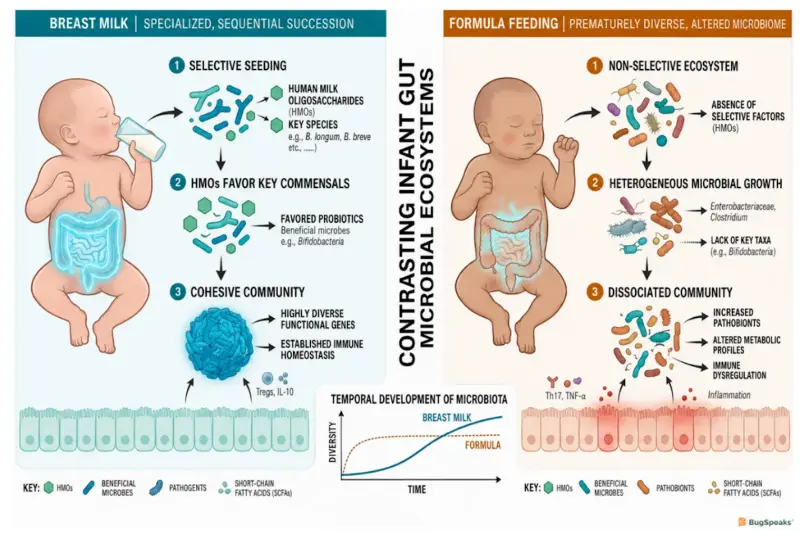
Breast milk seeds a specialized, low-diversity bacterial community dominated by Bifidobacterium, whereas standard formula seeds a highly diverse, mature-looking community too early [Trofin et al. (2026)](https://doi.org/10.3390/microorganisms14030719). For breastfed infants, the gut is mostly filled with [helpful bacteria](https://www.bugspeaks.com/blog/on-prebiotics/) like Bifidobacterium longum [Song et al. (2026)](https://doi.org/10.1080/19490976.2026.2649456). Keeping this bacterial count simple is actually a healthy state for newborn babies [Trofin et al. (2026)](https://doi.org/10.3390/microorganisms14030719). In contrast, formula-fed infants have gut communities that look like those of older children too quickly [Liu et al. (2026)](https://doi.org/10.1017/gmb.2026.10020). This premature mix brings complex bacteria into the stomach before the baby's immune system is ready to interact with them [Trofin et al. (2026)](https://doi.org/10.3390/microorganisms14030719).
The missing maternal instructions in standard formula allow other types of bacteria to inhabit the baby's gut [Trofin et al. (2026)](https://doi.org/10.3390/microorganisms14030719). Without the selective protection of breast milk, bacteria such as Enterobacteriaceae, Streptococcus, and Lachnospiraceae grow rapidly [Liu et al. (2026)](https://doi.org/10.1017/gmb.2026.10020). These bacteria belong in an older person's gut, and their premature growth can cause mild irritation inside the baby's tummy [Baumann-Dudenhoeffer et al. (2018)](https://doi.org/10.1038/s41591-018-0216-2). This premature growth lacks the specialized protection provided by a bifidobacteria-dominated community [Trofin et al. (2026)](https://doi.org/10.3390/microorganisms14030719). Formula-fed infants, therefore do not receive the personalized maternal coaching that naturally coordinates immune development [Trofin et al. (2026)](https://doi.org/10.3390/microorganisms14030719).
This split in colonization shows how early nutrition acts as the primary driver of bacterial seeding [Trofin et al. (2026)](https://doi.org/10.3390/microorganisms14030719). While breastfed babies maintain a very stable family of helpful sugar-eating bacteria, formula-fed babies experience highly variable communities [Trofin et al. (2026)](https://doi.org/10.3390/microorganisms14030719). This variability is influenced heavily by the specific prebiotics and ingredients used in different formula brands [Trofin et al. (2026)](https://doi.org/10.3390/microorganisms14030719). These early differences help scientists design better formulas to improve future infant health [Liu et al. (2026)](https://doi.org/10.1017/gmb.2026.10020).
**Feature / Measure**
**Breastfed Gut Environment**
**Formula-Fed Gut Environment**
Primary Microbes
Dominated by Bifidobacterium and Bacteroides
Enriched in Enterobacteriaceae and Streptococcus
Overall Diversity
Low (specialized and appropriate success state)
High (prematurely mature, resembling older children)
Ecological Stability
High (highly stable across early months)
Low (high variability across different formula brands)
Inflammation Risk
Very Low (due to selective screening by sIgA)
Moderate (due to earlier expansion of facultative anaerobes)
**Bifidobacterium longum**\- A highly beneficial, sugar-loving family of friendly gut bacteria that keeps the baby's tummy healthy and happy.
**Bifidobacterium**\- A large group of good bacteria that help digest protective milk sugars and keep bad germs away.
**Enterobacteriaceae**\- A family of complex bacteria that is common in formula-fed tummies and can cause mild irritation if they grow too early.
**Streptococcus**\- A type of bacteria that usually lives in older guts but can expand quickly in formula-fed infants.
**Lachnospiraceae**\- A family of mature-looking bacteria that digests fibers and is found in high amounts in formula-fed babies.
## How do human milk oligosaccharides act as guidance signals in the gut learning environment?
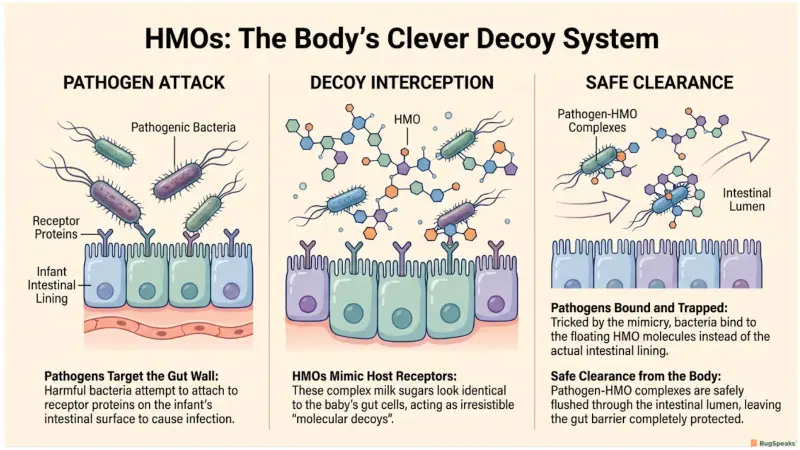
Human milk oligosaccharides act as molecular guidance signals by selectively feeding beneficial bacteria and blocking harmful germs in the baby's gut [Song et al. (2026)](https://doi.org/10.1080/19490976.2026.2649456). These complex sugars, known as HMOs, are the third most abundant part of breast milk [Song et al. (2026)](https://doi.org/10.1080/19490976.2026.2649456). Although infants cannot digest these sugars, they reach the colon fully intact to serve as food for good bacteria [Song et al. (2026)](https://doi.org/10.1080/19490976.2026.2649456). Here, HMOs are selectively consumed by friendly bacteria like Bifidobacterium longum subsp. infantis [Song et al. (2026)](https://doi.org/10.1080/19490976.2026.2649456). This selective feeding enables friendly microbes to multiply rapidly and dominate the baby's gut [Song et al. (2026)](https://doi.org/10.1080/19490976.2026.2649456).
These smart signals also act as clever decoy receptors to physically protect the baby from dangerous infections in the gut [Song et al. (2026)](https://doi.org/10.1080/19490976.2026.2649456). Many bad germs must bind to sugar structures on the baby's intestinal cells to make them sick [Song et al. (2026)](https://doi.org/10.1080/19490976.2026.2649456). Because HMOs mimic these cell structures, they attract and bind the germs instead [Song et al. (2026)](https://doi.org/10.1080/19490976.2026.2649456). This smart biochemical trick catches the germs, which are then safely flushed out of the body [Song et al. (2026)](https://doi.org/10.1080/19490976.2026.2649456). This protective system significantly reduces the baby's risk of catching stomach bugs and respiratory infections [Song et al. (2026)](https://doi.org/10.1080/19490976.2026.2649456).
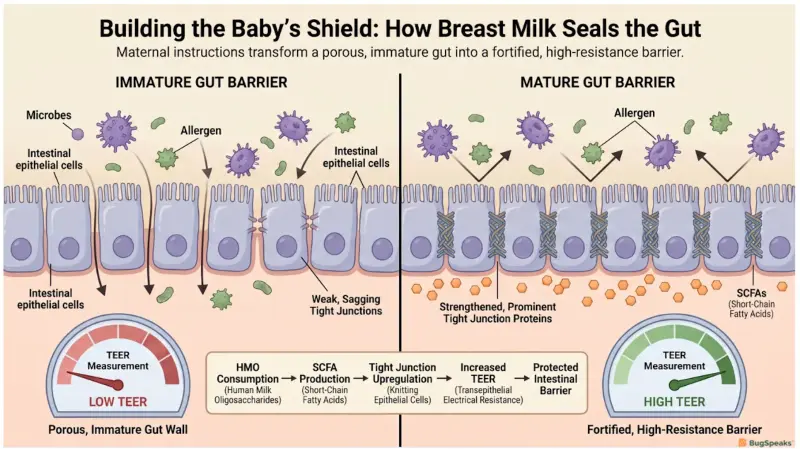
When friendly microbes eat these sugars, they produce helpful short-chain fatty acids (SCFAs) like acetate in the stomach [Song et al. (2026)](https://doi.org/10.1080/19490976.2026.2649456). These protective SCFAs act as a key fuel that directly strengthens the baby's gut wall [Song et al. (2026)](https://doi.org/10.1080/19490976.2026.2649456). Specifically, they increase the Transepithelial Electrical Resistance (TEER) of the gut wall, which is a test measure of how leak-proof the gut is [Song et al. (2026)](https://doi.org/10.1080/19490976.2026.2649456). A high TEER shield prevents foreign allergens and bad germs from crossing into the baby's blood to trigger immune alarms [Song et al. (2026)](https://doi.org/10.1080/19490976.2026.2649456).
**HMO Category**
**Key Molecular Beacons**
**Core Biological Functions / Lessons**
Fucosylated Glycans
2'-fucosyllactose (2'-FL), 3-fucosyllactose (3-FL)
Direct Bifidobacterium colonization and block pathogen binding
Sialylated Glycans
3'-sialyllactose (3'-SL), 6'-sialyllactose (6'-SL)
Fuel brain development and support immune balance
Neutral Nonfucosylated
Lacto-N-tetraose (LNT), Lacto-N-neotetraose (LNnT)
Upregulate tight junction proteins to increase TEER values
**Human Milk Oligosaccharides** ( **HMOs**)\- Special complex sugars in breast milk that do not feed the baby directly, but instead serve as food for good gut bacteria.
**Bifidobacterium longum subsp. Infantis**\- A highly specialized friendly bacteria that is uniquely equipped to digest the complex sugars in breast milk.
**Decoy receptors**\- Clever sugar traps that look exactly like the baby's stomach cells, tricking harmful germs into binding to them so they get flushed away safely.
**Short-Chain Fatty Acids** ( **SCFAs**)\- Helpful organic acids produced by good bacteria that serve as energy to strengthen the baby's gut lining.
**Transepithelial Electrical Resistance** ( **TEER**)\- A scientific measurement used to test how strong, tight, and leak-proof the protective gut barrier is.
## Why do some formulas guide the infant gut down an alternative developmental pathway?
Formulas guide the infant gut down an alternative developmental pathway because they lack natural human milk oligosaccharides and maternal signals, which changes how bacterial communities grow [Trofin et al. (2026)](https://doi.org/10.3390/microorganisms14030719). To help fix this major problem, formulas are often supplemented with artificial prebiotic fibers like galacto-oligosaccharides (GOS) and fructo-oligosaccharides (FOS) [Baumann-Dudenhoeffer et al. (2018)](https://doi.org/10.1038/s41591-018-0216-2). Although these ingredients do help friendly Bifidobacterium multiply, they activate very different metabolic lifestyles in the gut [Baumann-Dudenhoeffer et al. (2018)](https://doi.org/10.1038/s41591-018-0216-2). Instead of matching the natural chemistry of breastfed babies, these formula fibers create a unique, alternative metabolic trajectory for gut microbes [Baumann-Dudenhoeffer et al. (2018)](https://doi.org/10.1038/s41591-018-0216-2).
Other ingredients in alternative formulas further steer the gut learning environment away from its ideal path [Baumann-Dudenhoeffer et al. (2018)](https://doi.org/10.1038/s41591-018-0216-2). For example, commercial soy-based formulas can cause big shifts, such as increasing the abundance of Lachnospiraceae bacteria [Baumann-Dudenhoeffer et al. (2018)](https://doi.org/10.1038/s41591-018-0216-2). This specific soy-loving family triggers fermentation actions that can lead to dysbiosis, which is a state of imbalanced and irritated gut bacteria [Baumann-Dudenhoeffer et al. (2018)](https://doi.org/10.1038/s41591-018-0216-2). This environment is very different from the calm, low-stress environment made by breast milk [Baumann-Dudenhoeffer et al. (2018)](https://doi.org/10.1038/s41591-018-0216-2). These differences show that even minor changes in formula ingredients can alter the delicate bacterial community inside the baby [Baumann-Dudenhoeffer et al. (2018)](https://doi.org/10.1038/s41591-018-0216-2).
This alternative guidance system shifts the core chemical lessons of the baby's gut completely [Trofin et al. (2026)](https://doi.org/10.3390/microorganisms14030719). While breastfed babies develop microbes specialized in building essential protein blocks, formula-fed babies bypass these crucial developmental settings [Baumann-Dudenhoeffer et al. (2018)](https://doi.org/10.1038/s41591-018-0216-2). Standard cow's milk formulas contain static levels of these protein blocks, which fail to adapt to a growing infant's daily requirements [Baumann-Dudenhoeffer et al. (2018)](https://doi.org/10.1038/s41591-018-0216-2). Without the adaptive feedback of natural mother's milk, the formula-fed gut must rely on a different set of instructions [Baumann-Dudenhoeffer et al. (2018)](https://doi.org/10.1038/s41591-018-0216-2). This altered chemistry can program the baby's system to handle nutrients differently [Baumann-Dudenhoeffer et al. (2018)](https://doi.org/10.1038/s41591-018-0216-2).
**Galacto-oligosaccharides** ( **GOS**)\- Artificial prebiotic fibers added to the formula to help good bacteria grow, though they work slightly differently from natural milk sugars.
**Fructo-oligosaccharides** ( **FOS**)\- Plant-derived prebiotic fibers used in commercial formulas to help friendly bacteria multiply in the baby's stomach.
**Dysbiosis**\- An imbalance in the gut bacterial community where helpful bacteria are pushed out, leading to tummy irritation.
## What are the long-term health consequences of these different microbial instructions?
The long-term health consequences of these different microbial instructions include changes in how the child's immune system matures, impacting allergy, asthma, and obesity risks later in life [Trofin et al. (2026)](https://doi.org/10.3390/microorganisms14030719). When the gut microbiota does not get the proper early colonisation, it can develop a delayed maturation pattern [Liu et al. (2026)](https://doi.org/10.1017/gmb.2026.10020). This delay is linked to allergic disorders, including atopic dermatitis, which causes itchy skin [Liu et al. (2026)](https://doi.org/10.1017/gmb.2026.10020). Helpful gut bacteria like Dialister can act as protective shields, reducing the risk of a cow's milk allergy (CMA) [Liu et al. (2026)](https://doi.org/10.1017/gmb.2026.10020). Without this protective training, the body may overreact to harmless dietary proteins [Liu et al. (2026)](https://doi.org/10.1017/gmb.2026.10020).
Furthermore, a lack of specialized maternal instructions can leave highly vulnerable infants exposed to severe intestinal diseases [Song et al. (2026)](https://doi.org/10.1080/19490976.2026.2649456). For example, premature infants are at high risk of developing necrotizing enterocolitis (NEC), which is a severe and life-threatening bowel disease [Song et al. (2026)](https://doi.org/10.1080/19490976.2026.2649456). A specific breast milk sugar called disialyllacto-N-tetraose (DSLNT) represents a crucial biological instruction for preventing this terrible condition [Song et al. (2026)](https://doi.org/10.1080/19490976.2026.2649456). By promoting healthy gut colonization and reducing dangerous inflammation, these sugar instructions keep the fragile intestinal barrier safe and intact [Song et al. (2026)](https://doi.org/10.1080/19490976.2026.2649456). Formulas lacking these advanced molecules cannot provide this high level of protection [Song et al. (2026)](https://doi.org/10.1080/19490976.2026.2649456).
Additionally, maternal factors like gestational weight gain (GWG) during pregnancy can interact with early feeding modes to program the child's long-term metabolism [Baumann-Dudenhoeffer et al. (2018)](https://doi.org/10.1038/s41591-018-0216-2). Gaining too much weight predicts persistent alterations in the baby's microbial carbohydrate digestion and vitamin pathways [Baumann-Dudenhoeffer et al. (2018)](https://doi.org/10.1038/s41591-018-0216-2). These altered instructions can influence how the infant extracts energy from food, potentially leading to childhood obesity [Baumann-Dudenhoeffer et al. (2018)](https://doi.org/10.1038/s41591-018-0216-2). This connection highlights how prenatal maternal health and early infant feeding choices work together to guide long-term metabolic health [Baumann-Dudenhoeffer et al. (2018)](https://doi.org/10.1038/s41591-018-0216-2). Protecting this early developmental window is essential for building a healthy life [Trofin et al. (2026)](https://doi.org/10.3390/microorganisms14030719).
**Atopic dermatitis**\- An allergic skin condition, commonly known as eczema, which causes dry, red, and itchy skin patches.
**Dialister**\- A friendly type of gut bacteria that acts as a protective shield to help prevent food allergies.
**Cow's milk allergy** ( **CMA**)\- A condition where the immune system overreacts to proteins in cow's milk, causing stomach pain or skin rashes.
**Necrotizing enterocolitis** ( **NEC**)\- A highly dangerous and severe gut disease that causes painful swelling and damage to the bowel, mostly affecting premature babies.
**Disialyllacto-N-tetraose** ( **DSLNT**)\- A vital protective breast milk sugar that keeps the baby's fragile gut lining safe from severe diseases.
**Gestational weight gain** ( **GWG**)\- The amount of weight a mother gains during pregnancy, which can influence the baby's long-term metabolism.
-Varsha V
Visualize the process- [https://youtu.be/0GZMcRTfrlU](https://youtu.be/0GZMcRTfrlU)
### Reference
Trofin, F., Badescu, A. C., Iancu, L. S., Buzila, E. R., Anton-Păduraru, D. T., Sima, C. M., Temneanu, O. R., Matei, A., Bilha, S. C., Benea, I. A., & Dorneanu, O. S. (2026). Seeding the Future: How Feeding Mode Shapes the Infant Gut Microbiota. _Microorganisms_, _14_(3), 719. [https://doi.org/10.3390/microorganisms14030719](https://doi.org/10.3390/microorganisms14030719)
Chia Liu, T., Rojas-Velazquez, D., Kidwai, S., Hogenkamp, A., Garssen, J., Kraneveld, A. D., & Lopez-Rincon, A. (2026). Machine learning identifies differences between breast milk and formula in the gut microbiome. _Gut microbiome (Cambridge, England)_, _7_, e7. [https://doi.org/10.1017/gmb.2026.10020](https://doi.org/10.1017/gmb.2026.10020)
Song, J., Ding, M., Joyce, P. W. S., Pi, X., Zhang, B., & Li, B. (2026). Decoding the HMO‒microbiome axis: bridging maternal milk to infant health outcomes. _Gut microbes_, _18_(1), 2649456. [https://doi.org/10.1080/19490976.2026.2649456](https://doi.org/10.1080/19490976.2026.2649456)
Baumann-Dudenhoeffer, A. M., D'Souza, A. W., Tarr, P. I., Warner, B. B., & Dantas, G. (2018). Infant diet and maternal gestational weight gain predict early metabolic maturation of gut microbiomes. _Nature medicine_, _24_(12), 1822–1829. [https://doi.org/10.1038/s41591-018-0216-2](https://doi.org/10.1038/s41591-018-0216-2)
## FAQs
Q: Why is having fewer types of bacteria actually a good thing for a breastfed baby's gut?
A: In adults, a highly diverse gut microbiome is healthy, but infants are different. A healthy breastfed baby's gut is designed to be a highly specialized, low-diversity environment dominated almost completely by Bifidobacterium Trofin et al. (2026). This specialized colonization is a developmentally appropriate success state because it ensures the gut is filled with friendly, sugar-digesting microbes that lower gut pH, keep out dangerous pathogens, and properly train the immune system Trofin et al. (2026).
Q: What are HMOs, and why can't human babies digest them?
A: Human milk oligosaccharides, or HMOs, are complex, structurally diverse sugars made by the mother that are unique to human breast milk Song et al. (2026). Human babies lack the specific digestive enzymes needed to break down these complex glycans, meaning they pass through the stomach completely untouched Song et al. (2026). This occurs because HMOs are not meant to feed the baby directly; instead, they are selectively deployed as guidance signals to feed beneficial gut microbes like Bifidobacterium Song et al. (2026).
Q: How does the mother's body know to change the breast milk recipe?
A: The composition of breast milk is regulated by a dynamic physiological feedback loop between the mother and her baby. When the infant suckles, mechanical stimulation triggers a neuroendocrine reflex that releases hormones like oxytocin in the mother, which directly upregulates the synthesis of active components in the mammary gland cells Song et al. (2026). In addition, leukocytes and immune cells actively traffic to mammary tissue to modify the milk's immunological manual based on real-time environmental exposures Song et al. (2026).
Q: Can formula be made to do the exact same job as breast milk?
A: While modern infant formulas are highly advanced and supplemented with prebiotic fibres like GOS and FOS, they cannot fully replicate the dynamic biological complexity of human milk Trofin et al. (2026). Formulas lack the active antibodies, customized cells, and real-time hormonal feedback loops that allow breast milk to adapt daily to an infant's needs Trofin et al. (2026). Prebiotics in formula promote a distinct microbial pathway compared to the highly coordinated, co-evolved instruction manual of breast milk Baumann-Dudenhoeffer et al. (2018).
Q: How does a mother's weight during pregnancy affect her baby's gut microbes?
A: A mother's gestational weight gain (GWG) during pregnancy can persistently influence her baby's gut microbiome development up to eight months after birth Baumann-Dudenhoeffer et al. (2018). High weight gain is linked to alterations in the infant's microbial carbohydrate degradation and vitamin synthesis pathways, which can affect metabolic programming Baumann-Dudenhoeffer et al. (2018). This suggests that prenatal health works together with postnatal feeding mode to establish the baseline settings for the baby's long-term metabolism Baumann-Dudenhoeffer et al. (2018).
---
This blog is powered by Superblog. Visit https://superblog.ai to know more.
---