Unlocking Your Mind: The Role of Gut Health in Cognitive Clarity
How does a slow gut make your brain feel cloudy?
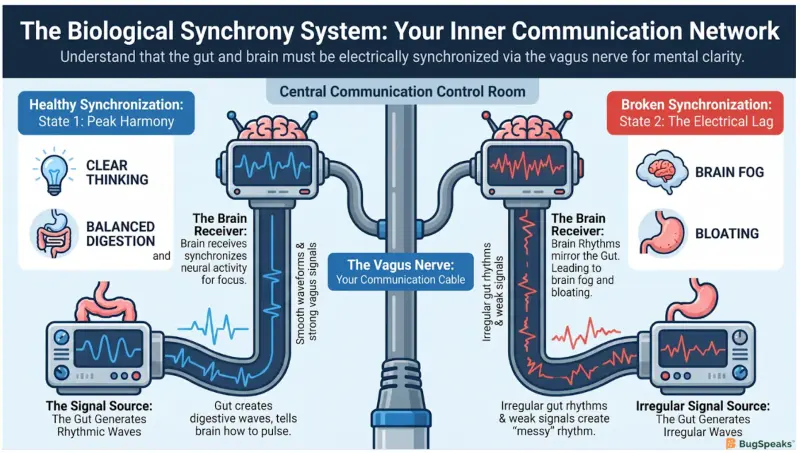
A sluggish gut slows down your brain because they are physically connected by a fast communication highway that coordinates their biological clocksBonaz (2019). This superfast highway is the vagus nerve, which acts as a heavy-duty power cable linking your central nervous system (CNS) to your enteric nervous system (ENS). When your gut gets bloated and digestion slows to a crawl, the electrical signals traveling up this cord become weak. Instead of a clear, steady nerve signal that keeps your mind awake, your brain receives a messy, sluggish rhythm. This electrical lag directly throws off your focus, turning normal thinking into a slow, frustratingly cloudy experience.
To keep this inner band playing in perfect harmony, your body relies on a special cooling dial called the cholinergic anti-inflammatory pathwayCryan (2019). This pathway is like an automatic volume controller that keeps immune system alarms from getting too loud or disruptive. In healthy bodies, the autonomic nervous system (ANS) uses this network to send calming chemical signals that soothe irritation. However, when bloating disrupts your digestion, these soothing electrical messages stop properly flowing. Without this calming signal, the brain's main processor, located in the nucleus tractus solitarii, gets overwhelmed by chaotic background noise and loses its thinking rhythm, making you feel very tired.
Doctors are now testing special electronic tuning devices to help restart this broken connection through a treatment called vagus nerve stimulation (VNS)Bonaz (2019). This device sends gentle, low-frequency electrical waves directly into the neck to help the main wire find its steady beat again. These therapeutic waves travel down to help restore biological homeostasis, which means a perfectly balanced and stable internal environment. When this electrical wire is successfully tuned, it quickly cools down the swelling and lets the brain waves slide back into their clean, synchronized rhythms. For children and adults alike, keeping this wire clear is the secret to a sharp mind.
What are the chemical keys that unlock your brain's growth?
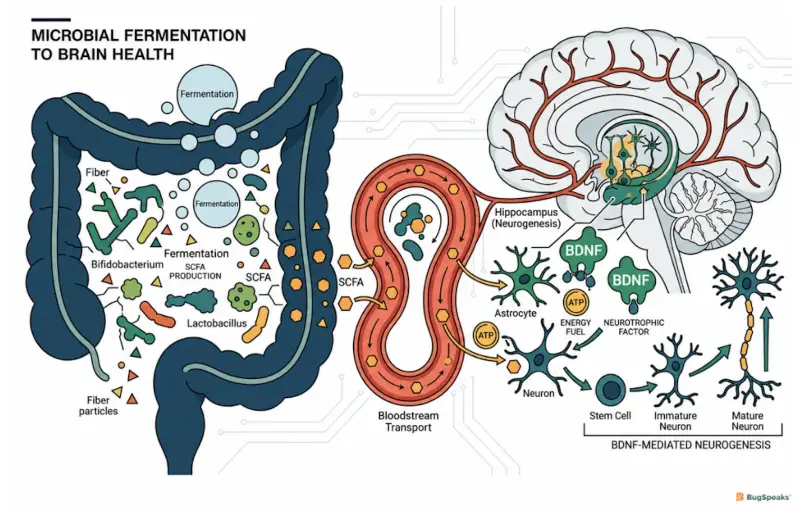
Friendly gut microbes help you think clearly by fermenting fiber to produce special chemical keys that unlock your brain's growthCryan (2019). These important keys are called short-chain fatty acids (SCFAs), which are tiny fuel blocks made by your microbes when they eat plant food. The three main chemical keys are butyrate, propionate, and acetate. Each of these keys travels through your blood to help your body run smoothly and keep your cells energized. When your gut becomes sluggish, your microbes stop producing enough of these vital keys. This lack of fuel leaves your brain cells starved of the clean energy they need to work.
These chemical keys work their magic in the brain through a process known as histone deacetylase inhibition, which opens your genetic blueprintMolska (2024). This process is like opening a locked instruction book so your brain cells can read the recipes for growth and repair. When these genetic recipes are unlocked, your brain starts making a special brain-growing protein called brain-derived neurotrophic factor (BDNF). This protein acts like a rich plant food for your mind, keeping your brain cells healthy, strong, and highly active. Without enough of this special growth protein, your brain cells cannot communicate well, which leaves you feeling extremely foggy.
By keeping your growth proteins high, your brain can easily build new cells through a process called adult neurogenesisMolska (2024). This process is the brain's natural way of growing brand-new brain cells, especially in the areas of your mind that handle memory. When your gut rhythm is synchronized and healthy, your brain grows new cells constantly to keep your thinking fast and sharp. However, when a sluggish gut stops making those chemical keys, the brain-growing process slows down to a complete crawl. To keep your mind healthy, you must feed your gut microbes the right foods every day.
Why does a leaky gut trigger brain fog?
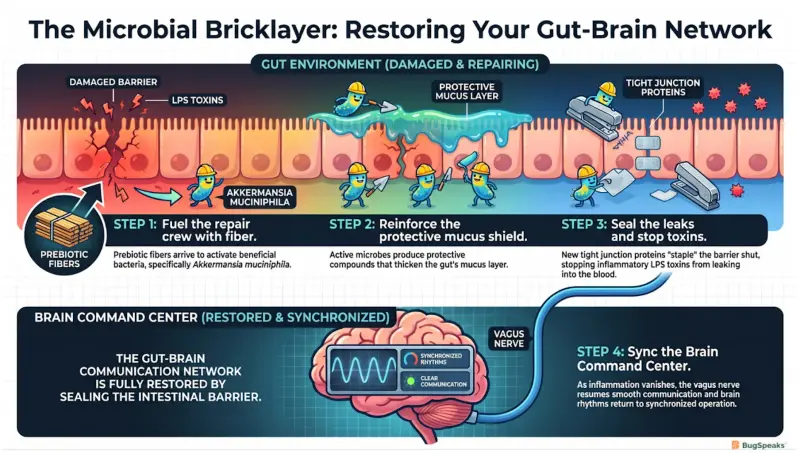
A leaky gut triggers brain fog because harmful toxins escape from your belly and cause irritation in your headCryan (2019). When your gut is healthy, it is lined with tight barriers that only let good nutrients pass through into your blood. This protective barrier is held together by special tight junction proteins that act like tiny, strong staples. But when your gut becomes sluggish and bloated, these staples break apart, creating a painful condition called intestinal permeability, or leaky gut. This allows microscopic gaps to open up along your digestive walls, letting bad things slip into your bloodstream and float up toward your head.
The main troublemaker that escapes from a leaky gut is a toxic bacterial shield called a lipopolysaccharide (LPS)Batista (2019). These toxic shields are part of the outer skin of bad bacteria, and they act like tiny inflammatory firecrackers. When these firecrackers leak into your bloodstream, they travel up to the protective barrier of your brain, called the blood-brain barrier (BBB). This brain barrier is supposed to keep your brain's internal environment stable and protected, but toxic firecrackers weaken its walls and cause leaks. This leak allows irritation to cross over into your brain tissue, directly causing the slow thinking we call brain fog.
Once these toxic firecrackers enter your brain, they activate your brain's resident defense cells, called microglia (Batista, 2019). In a healthy brain, these defense cells act like healthy cleanup cells that clean up waste and trim your cell connections. But when they sense the leaking toxins, they transform into highlyreactive immune cells, releasing irritating chemicals that cause neuroinflammation, or brain swelling. This swelling disrupts your brain's electrical rhythms, making it hard for your cells to send clear, fast messages to each other. This chaotic defense response is exactly what you experience as a heavy, cloudy, and sluggish mind in your busy daily life.
How does stress disrupt your body's master clock?
Stress ruins your biological rhythms because it sends emergency signals that disrupt the direct connection between your gut and headCryan (2019). When you get stressed, your body activates a major alarm system called the hypothalamic-pituitary-adrenal (HPA) axis. This alarm system acts like a loud siren that forces your brain and gut to enter survival mode. Your body then releases a strong stress hormone called cortisol, which floods your system to help you run from danger. But this high hormone level acts like a sledgehammer to your digestion, slowing it down and causing bloating.
This stress response directly harms your friendly microbes, causing a major imbalance in your gut called intestinal dysbiosisCryan (2019). When your gut is out of balance, the friendly bacteria that help you stay calm and happy begin to disappear. These helpful bacteria are responsible for making a chemical called serotonin, which regulates your sleep and mood. To make this happy chemical, your body must first use a building-block protein called tryptophan. But when stress and bloating take over, your body wastes this building block on inflammatory pathways instead of using it to make the happy chemicals you need.
Without enough happy chemicals, your body's master sleep timer, known as your circadian rhythm, gets completely turned upside downCryan (2019). This master sleep timer is like an internal clock that tells your brain and gut when to rest and when to wake up. When this clock is broken, you cannot get deep sleep, which is when your brain washes away harmful waste and resets its rhythms. This lack of deep rest means your gut and brain stay desynchronized, foggy, and tired the very next day. To keep your mind clear, you must protect your body's daily schedule from stressful and chaotic interruptions.
How can you tune your gut to clear your mind?
You can easily tune your gut and brain rhythms by feeding your friendly microbes the special foods required to growCryan (2019). To help your natural gut bacteria play in perfect sync, you can take helpful bacteria called probiotics, which act like supportive bacteria. These helpful microbes, like those from the Bifidobacterium family, help restore order to your gut and soothe inflammation. When you add these good bacteria to your gut, they quickly start cleaning up the neighborhood and calming down bloating. This gut restoration process allows the slow electrical signals to speed up again, sending clear, happy waves directly to your waiting brain to clear your mind.
To help these supportive bacteria stay strong, you must feed them special fibers called prebiotics, which act like fertilizerMolska (2024). Prebiotics are non-digestible foods, like soluble fiber, that pass through your stomach to feed the good bacteria living deep in your gut. Two of the best microbial fertilizers are fructooligosaccharides (FOS) and galactooligosaccharides (GOS). When your good bacteria eat these special fibers, they grow very strong and produce the chemical keys that fuel your brain. Feeding your microbes this healthy fiber is like giving your natural gut bacteria the perfect high-energy bar to keep them playing beautifully, staying perfectly synchronized, and working together so you feel absolutely awesome.
One of the most important protective bacteria you can grow with this fiber is called Akkermansia muciniphilaCryan (2019). This special helper bacterium works like a skilled bricklayer, building a thick, strong mucus wall that stops toxins from leaking out. When this mucus wall is thick and healthy, your gut staples stay strong, and your leaky gut is fully repaired. This means no more toxic firecrackers can escape into your blood to cause brain fog and swelling. By eating fiber and protecting these helpful bricklayers, you keep your gut and brain rhythms perfectly synchronized for fast, clear thinking and long-term health.
Visualize the process- https://youtu.be/zwpAc00hi3A
Reference
Cryan, J. F., O'Riordan, K. J., Cowan, C. S. M., Sandhu, K. V., Bastiaanssen, T. F. S., Boehme, M., Codagnone, M. G., Cussotto, S., Fulling, C., Golubeva, A. V., Guzzetta, K. E., Jaggar, M., Long-Smith, C. M., Lyte, J. M., Martin, J. A., Molinero-Perez, A., Moloney, G., Morelli, E., Morillas, E., O'Connor, R., … Dinan, T. G. (2019). The Microbiota-Gut-Brain Axis. Physiological reviews, 99(4), 1877–2013.https://doi.org/10.1152/physrev.00018.2018
Batista, C. R. A., Gomes, G. F., Candelario-Jalil, E., Fiebich, B. L., & de Oliveira, A. C. P. (2019). Lipopolysaccharide-Induced Neuroinflammation as a Bridge to Understand Neurodegeneration. International journal of molecular sciences, 20(9), 2293.https://doi.org/10.3390/ijms20092293
Molska, M., Mruczyk, K., Cisek-Woźniak, A., Prokopowicz, W., Szydełko, P., Jakuszewska, Z., Marzec, K., & Trocholepsza, M. (2024). The Influence of Intestinal Microbiota on BDNF Levels. Nutrients, 16(17), 2891.https://doi.org/10.3390/nu16172891
Bonaz, B., Sinniger, V., & Pellissier, S. (2019). Vagus Nerve Stimulation at the Interface of Brain-Gut Interactions. Cold Spring Harbor perspectives in medicine, 9(8), a034199.https://doi.org/10.1101/cshperspect.a034199