Understanding Berberine: A Comprehensive Guide to Its Effects on Gut Health
Why is berberine called a metabolic partner instead of just a simple medicine?
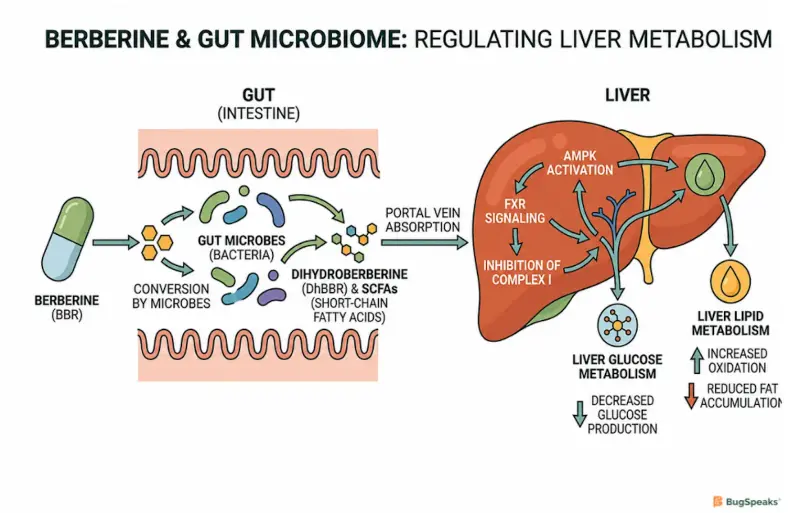
Berberine is called a metabolic partner because it achieves its health benefits primarily by working in coordination with the gut microbiome rather than acting alone inside human cells. Berberine (BBR) is a natural, bright yellow compound found in the roots of traditional plants such as goldenseal (Wang et al., 2022). It is a highly active isoquinoline alkaloid, but oral intake exhibits very low bioavailability, less than 1% (Zhang et al., 2021). Since almost the entire compound remains in your intestines, the plant compound relies on your gut microbiota to execute its metabolic work.
This cooperation completely shifts how we think about managing common metabolic health problems like metabolic syndrome and type 2 diabetes mellitus (T2DM). Instead of rushing straight into your bloodstream like an ordinary pharmaceutical pill, berberine remains in your intestinal cavity to meet millions of tiny microbes that act as co-processorsZhang et al. (2021). These microbes consume and process this natural plant substance, generating helpful downstream signals that improve how your body regulates energyChen et al. (2026). Because berberine relies so heavily on these microscopic helpers, its clinical success depends on having active, supportive partners to establish a highly integrated and balanced response.
This unique cooperative system operates through three primary biological pathways that bridge your digestive tract and internal organs like the liver. First of all, the friendly bacterial partners transform berberine into a special state that is much easier for your body to absorb. The "special state" is a converted, temporary chemical version of berberine called dihydroberberine (dhBBR). Helpful gut bacteria use their enzymes to add hydrogen atoms to the berberine molecule, physically changing its structure so that it is no longer blocked by the gut lining Wang et al. (2022). Second, these partners ferment dietary fibers to build small fatty acid messengers that soothe swelling and protect your delicate tissuesZhang et al. (2012). Third, the plant compound shifts how microbes handle digestive bile acids, which are crucial communication tools that tell your liver how to regulate and manage fatsSun et al. (2017), specifically and safely.
How does berberine improve glucose regulation without being absorbed into human blood?
Berberine improves glucose regulation by triggering gut microbes to produce metabolic signals like short-chain fatty acids and converting itself into an absorbable form with the help of specialized bacterial enzymes. Inside your gut, friendly bacterial partners make special protein tools called nitroreductases (NRs)Wang et al. (2022). These smart tools change berberine into a temporary form called dihydroberberine (dhBBR), which passes through your gut walls five times faster than normal berberine Normal berberine carries a positive electrical charge. Because cell membranes in your gut wall are made of fats (lipids), they act like a closed gate to electrically charged molecules. When friendly bacteria use their nitroreductase enzymes on berberine, they neutralize this electrical charge, making the converted molecule (dihydroberberine) uncharged and fat-soluble. Because it is fat-soluble and has no charge, it can slip directly through the fatty walls of your gut cells five times faster than normal berberine. Once it crosses into the blood, it loses those extra hydrogens and turns back into active, blood-sugar-regulating berberine Yang et al. (2023). Once dhBBR safely slips into your circulating blood, it quickly turns back into standard, active berberine to help your liver regulate glucose easily and efficientlyWang et al. (2022).
At the same time, berberine acts as a superfood that feeds beneficial microbial groups to generate valuable short-chain fatty acids (SCFAs)Zhang et al. (2012). These helpful fatty acid messengers include butyrate, acetate, and propionate, which are produced when your metabolic partners ferment fibers from your mealsZhang et al. (2020). These acids act as chemical keys that unlock hormone release valves inside your gut wallsWang et al. (2022). By nourishing these specific bacterial partners, berberine dramatically boosts the flow of these protective signaling molecules, helping to keep your energy regulation balanced and strongZhang et al. (2012).
These small fatty acids stimulate your gut cells to secrete a powerful metabolic hormone called glucagon-like peptide-1 (GLP-1)Wang et al. (2022). This hormone flows through your body to tell your pancreas to release insulin precisely when needed, while stopping the liver from making unnecessary sugarZhang et al. (2021). This targeted hormone flow helps reduce insulin resistance, which is a state where your cells ignore insulin and leave glucose stuck in your bloodWang et al. (2021). Berberine keeps your metabolic engine running smoothly without ever needing to flood your blood in large amounts.
Does berberine kill your friendly gut bacteria along with the harmful ones?
Berberine does not randomly kill your good bacteria, but instead acts as a selective master key that suppresses inflammatory, disease-promoting opportunistic pathogens while actively encouraging the growth of beneficial, protective metabolic partners. Some people worry that oral berberine acts like a harsh, generic antibiotic that completely wipes out your whole gut microbiomeZhang et al. (2012). In reality, berberine acts as a highly selective biological shield. It specifically targets and suppresses bad Gram-negative bacteria that produce a toxic, inflammatory substance called lipopolysaccharide (LPS)Wang et al. (2022). This toxic compound is also known as bacterial endotoxinWang et al. (2022).
When toxic bacterial products escape a weak gut wall and enter your bloodstream, they cause a state of constant, low-grade irritation called metabolic endotoxemiaZhang et al. (2012). This quiet irritation can trigger systemic inflammation throughout your tissues, which eventually damages your insulin receptors and worsens metabolic problemsZhang et al. (2012). Berberine stops this dangerous leak by acting as an invisible barrier shield that reinforces your gut's physical boundariesGong et al. (2017a). It helps lower the amount of bad, irritating molecules floating in your blood, making sure your internal organs stay safe, protected, and secure.
To rebuild these physical walls, berberine feeds a friendly, protective gut partner called Akkermansia muciniphila, which eats the outer mucus layers of your intestineWang et al. (2022). This chewing trick actually prompts your endocrine cells to build a fresh, thick defensive layer called mucin-2Zhang et al. (2021). At the same time, berberine boosts critical tight-junction barrier proteins like occludin and zonula occludens-1 (ZO-1), which act like tiny, physical staples to lock the cells togetherWang et al. (2022). These protective molecular staples seal the gaps tightly so that nothing bad or harmful can leak into your blood.
How do bile acids act as communication molecules in this partnership?
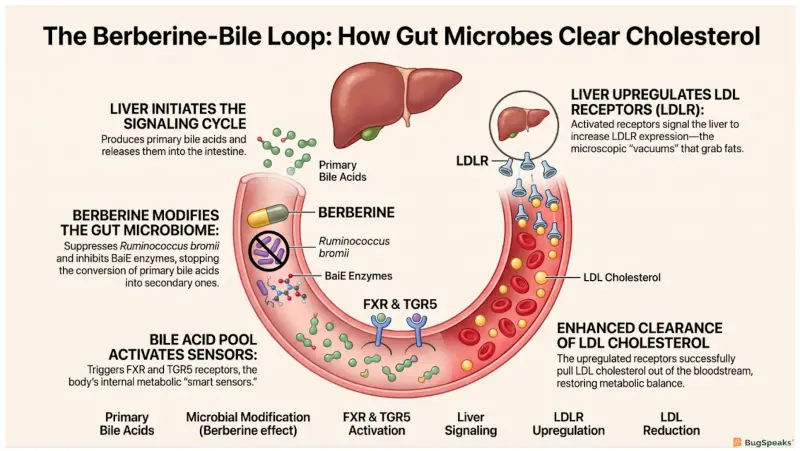
Bile acids act as crucial communication molecules by carrying biochemical signals from gut microbes to cellular receptors in the liver and intestine to regulate lipid and cholesterol metabolism. Your liver produces primary bile acids to help break down fats, but these must be modified by your microbial partners to act as signaling channelsSun et al. (2017). Helpful microbes use an enzyme called bile salt hydrolase (BSH) to start this processZhang et al. (2021). In our bodies, these modified chemicals are turned into secondary bile acids like deoxycholic acid (DCA)Zhang et al. (2020). When you take berberine, it selectively limits this conversion.
This enzymatic shift changes the activation of biological sensors in your cells, particularly the farnesoid X receptor (FXR) and other fat-sensing channelsWang et al. (2022). These cellular sensors act like receiving stations that translate bacterial chemical signals into actionSun et al. (2017). When berberine alters the bile acid signals, these sensors tell the liver to clean up fat and sugar levels, which prevents them from building up in your bloodYang et al. (2023). It is like sending a direct text message from your gut partners to your liver, asking it to clean up the bloodstream.
At the same time, this signal tells your liver cells to create more of a special fat-clearing tool called the low-density lipoprotein receptor (LDLR)Zhang et al. (2021). This helpful cell receptor acts like a microscopic vacuum cleaner that pulls bad cholesterol and fats directly out of your bloodKong et al. (2004). By simply altering the way your gut microbes talk directly to your liver, berberine dramatically cleans your blood and protects your heartChen et al. (2026). This chemical communication loop shows that local action inside your gut creates a helpful, body-wide wave of health benefits.
How does a combined probiotic intervention optimize this metabolic partnership?
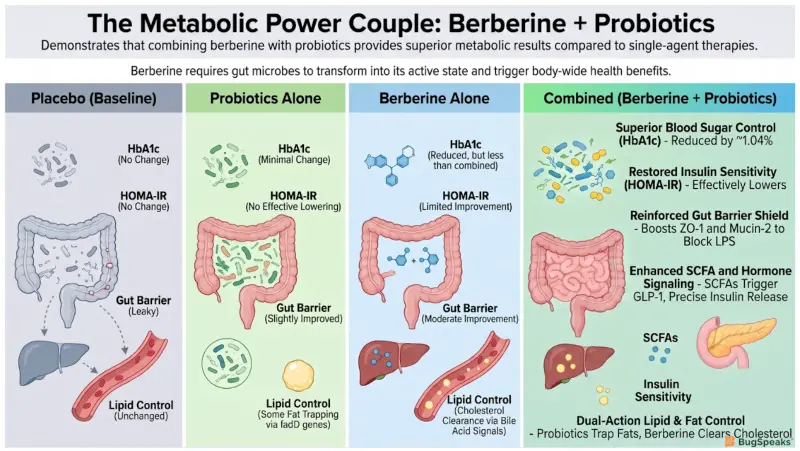
A combined probiotic intervention optimizes the metabolic partnership by replenishing key beneficial bacteria that might otherwise be temporarily suppressed by berberine's natural antimicrobial actions, leading to a more stable and effective integrated response. In the famous PREMOTE clinical trial, researchers tested whether adding live helper bacteria could make berberine work even better for diabetic patientsZhang et al. (2020). Because berberine has bacteriostatic powers, it can sometimes temporarily quiet down your good native bacteria while cleaning out the bad onesZhang et al. (2020). Taking live probiotics alongside berberine acts as a comforting cushion, keeping the metabolic partnership fully staffed with active micro-processors.
This dual teamwork has shown great success, especially in older adults whose natural microbial systems are less resilientZhang et al. (2020). While berberine alone lowers glycated hemoglobin (HbA1c), which tracks average blood sugar, adding live probiotics provides a powerful, noticeable extra boostZhang et al. (2020). In clinical trials, this combined pair significantly lowered homeostasis model assessment of insulin resistance (HOMA-IR) valuesZhang et al. (2020). This means the body’s cells become much more sensitive to insulin, allowing them to sweep up glucose effortlessly and keep your energy levels steady and strong without causing extra strain on your cell walls.
This partnership works through tiny chemical receptors and genes that process fats inside the bacteria. For example, probiotic strains like Bifidobacterium breve carry special, protective genes that produce the acyl-CoA synthetase enzyme, which actively absorbs fatty acidsYang et al. (2023). When berberine is around, it actively upregulates these genes to help the bacteria capture and trap free fats directly inside the gutYang et al. (2023). By safely locking away these excess fats, the team significantly reduces dietary fat absorption and helps clear high cholesterol from the body, showing how friendly bacteria and plant compounds create a beautiful, highly integrated response.
Visualize the process- https://youtu.be/F4ZIZk8d8dA
Reference
Zhang L, Wu X, Yang R, Chen F, Liao Y, Zhu Z, Wu Z, Sun X, Wang L. Effects of Berberine on the Gastrointestinal Microbiota. Front Cell Infect Microbiol. 2021 Feb 19;10:588517. doi: 10.3389/fcimb.2020.588517. PMID: 33680978; PMCID: PMC7933196.
Chen Y, Chen T, Tian S, Tao L, Fan F, Yang Y and Shen X (2026) Berberine-gut microbiota interactions based on CiteSpace: current research status and hotspots. Front. Microbiol. 17:1751887. doi: 10.3389/fmicb.2026.1751887
Zhang X, Zhao Y, Zhang M, Pang X, Xu J, Kang C, Li M, Zhang C, Zhang Z, Zhang Y, Li X, Ning G, Zhao L. Structural changes of gut microbiota during berberine-mediated prevention of obesity and insulin resistance in high-fat diet-fed rats. PLoS One. 2012;7(8):e42529. doi: 10.1371/journal.pone.0042529. Epub 2012 Aug 3. PMID: 22880019; PMCID: PMC3411811.
Wang H, Zhang H, Gao Z, Zhang Q, Gu C. The mechanism of berberine alleviating metabolic disorder based on gut microbiome. Front Cell Infect Microbiol. 2022 Aug 25;12:854885. doi: 10.3389/fcimb.2022.854885. PMID: 36093200; PMCID: PMC9452888.
Yang F, Gao R, Luo X, Liu R, Xiong D. Berberine influences multiple diseases by modifying gut microbiota. Front Nutr. 2023 Aug 3;10:1187718. doi: 10.3389/fnut.2023.1187718. PMID: 37599699; PMCID: PMC10435753.
Wang FX, Zhu N, Zhou F, Lin DX. Natural Aporphine Alkaloids with Potential to Impact Metabolic Syndrome. Molecules. 2021 Oct 10;26(20):6117. doi: 10.3390/molecules26206117. PMID: 34684698; PMCID: PMC8540223.