How to Space Your Antibiotics and Probiotics for Maximum Effectiveness
Why does timing decide if probiotics survive your antibiotics?
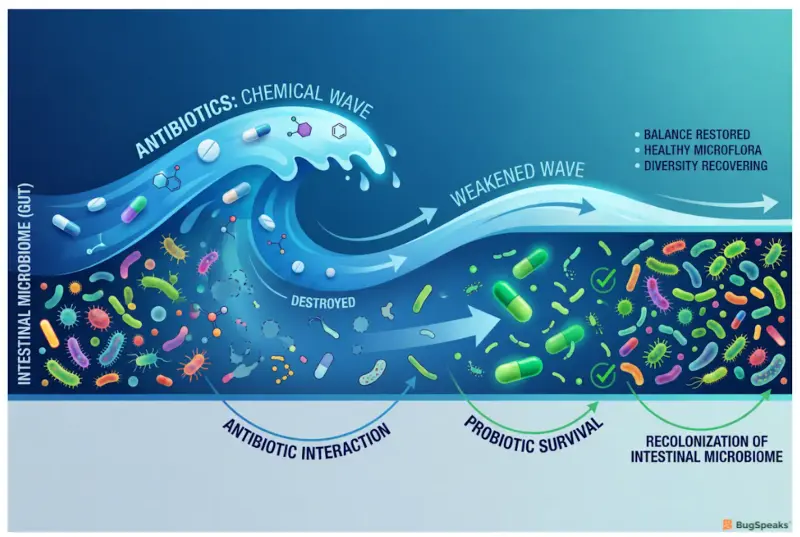
Taking probiotics during your antibiotic treatment can either protect your body or be a complete waste of money, depending entirely on your biological timingMatera et al. (2026). When you swallow an antibiotic pill, it creates a powerful chemical wave that sweeps through your gut, which acts as the primary interaction environment. If you take your probiotic at the same moment, this harsh wave will instantly destroy the friendly live bacteria before they can help you. Therefore, these protective biological interventions can only succeed if they are carefully spaced out to avoid the peak of the antibiotic wave, giving the friendly bacteria a real chance to survive.
Antibiotics are designed to seek and destroy bacterial cells, meaning they cannot tell the difference between harmful invaders and your helpful resident microbesKopacz et al. (2022). Every dose of these medications acts as a sudden disruption event that temporarily clears out large areas of your gut ecosystem. Spacing your doses correctly is the secret to keeping your friendly bacteria alive because it allows the antibiotic wave to weaken before the new helpers arrive in your system. By understanding how these chemical forces move, we can prevent a common side effect known as Antibiotic-Associated Diarrhea (AAD) (Esmaeilinezhad et al. (2025).
Without a smart schedule, the beneficial bacteria you swallow are wiped out before they can support your weakened gut barrierKopacz et al. (2022). This gut barrier is a thin, delicate shield of cells linked together by tiny molecular locks called tight junctions. When antibiotics weaken this barrier, bad microbes can leak through and cause painful inflammation. Spacing your probiotic correctly ensures a successful timing outcome, meaning the live cells survive and help repair these locks. A smart timing schedule turns a potentially wasted probiotic supplement into an active biological shield that protects your digestive health during recoveryMatera et al. (2026).
How can we build a perfect synchronization plan for our daily doses?
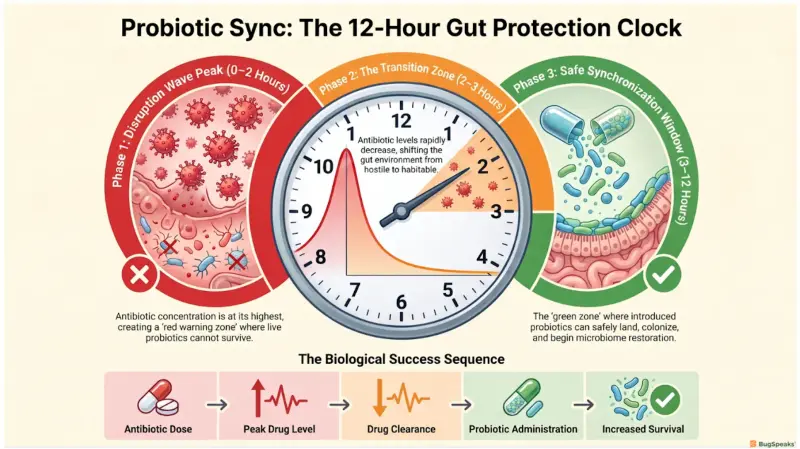
A perfect synchronization plan requires you to wait at least two to three hours after taking your antibiotic before swallowing your probioticMatera et al. (2026). This simple delay is the foundation of your dosing schedule, ensuring the two treatments never cross paths in your gut. When you take the antibiotic, its concentration in your blood and gut rises rapidly to a peak. By waiting a few hours, you allow this peak to pass and the antibiotic wave to descend into a trough. This safe timing window is exactly when your newly introduced probiotic strains can land safely and survive without being destroyed.
If you fail to follow this synchronization plan, the incoming probiotic bacteria will land directly in the middle of a chemical stormKopacz et al. (2022). This chemical storm is highest during the first two hours after your antibiotic dose, making microbial survival almost impossible for delicate strains. Waiting for the drug levels to drop ensures that the interaction environment is much more welcoming. This simple clock-based strategy dramatically improves your timing outcome, turning an otherwise wasted supplement into an effective shield. Protecting these live bacteria allows them to perform their essential jobs of supporting your digestive system and keeping you comfortable.
Furthermore, a synchronized dosing schedule helps protect your gut from dangerous opportunistic pathogens to take over when your resident bacteria are wiped outEsmaeilinezhad et al. (2025). One of the most dangerous invaders is a bacterium called Clostridioides difficile, which causes severe Clostridioides difficile-Associated Diarrhea or CDAD. When probiotics survive their journey by avoiding the antibiotic wave, they can crowd out these bad germs and prevent them from multiplying. Spacing your doses is therefore a critical, highly effective, and very simple way to ensure a healthy recovery and avoid serious medical complications that frequently send
Why do some friendly microbes not need a special schedule to survive?
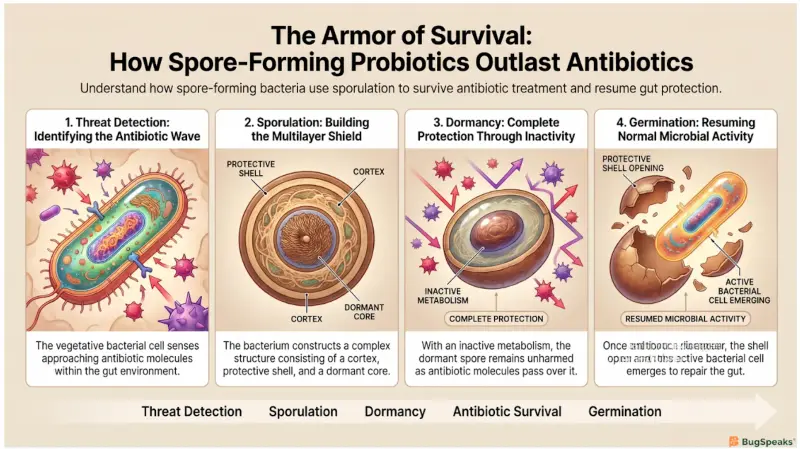
Some friendly microbes do not need a special schedule to survive because they possess natural structural shields or are completely unaffected by antibacterial chemicalsMatera et al. (2026). For example, the popular probiotic yeast called Saccharomyces boulardii is a eukaryote, which means it has the cell structure of a plant or animal rather than a bacteriumKopacz et al. (2022). Because antibiotics are designed to target only bacterial structures, they are completely blind to this yeast. This unique biological trait gives the yeast complete functional insensitivity to antibacterial drugs, allowing it to survive and protect your gut even if swallowed at the same moment as your antibiotic.
Another class of schedule-free helpers is spore-forming bacteria, such as Bacillus clausii and Clostridium butyricumMatera et al. (2026). When these bacteria detect the threat of an antibiotic wave, they can wrap themselves in tough, armor-like shells and enter a deep sleep called sporulation. In this protective state of quiescence, their internal engines are completely turned off, making them invisible to antibiotics that target active cell growth. Once the chemical wave passes through the gut, these sleeping giants wake up, shed their protective armor, and begin producing helpful substances to support your gut health and protect you from other infections.
Some bacteria also have species-wide, non-transferable armor that makes them naturally resistant to certain drugsMatera et al. (2026). A great example is Lactiplantibacillus plantarum, a lactic acid-producing bacterium that has a unique cell wall structure. This special cell wall lacks the binding sites that the powerful antibiotic vancomycin needs to attach and destroy the cell. Because this intrinsic resistance is built into their DNA, these bacteria can easily survive vancomycin treatment without any risk of passing dangerous resistance genes to other germs. This natural shielding makes them excellent candidates for protecting your gut during specific, high-pressure therapies, ensuring a safe timing outcome.
What happens inside your gut when you take probiotics after antibiotics?
Taking a multi-strain probiotic after you finish your antibiotics actually delays the natural recovery of your gut's resident friendly bacteriaSuez et al. (2018). While this timing plan is popular, deep medical testing shows that the introduced probiotic strains. They fill up the empty spaces in your gut and release chemical factors that actively block your native microbes from returning. This surprising delay can keep your gut ecosystem in an unbalanced state for several months, proving that post-antibiotic probiotic use can sometimes hinder your long-term recovery and delay your body's natural healing.
In stark contrast, a personalized treatment called Autologous Fecal Microbiome Transplantation or aFMT restores your gut to normal within just a few daysSuez et al. (2018). This advanced method involves collecting a sample of your own healthy microbiome before you start your antibiotics, storing it safely, and putting it back after your treatment is over. Because these are your own native bacteria, they fit perfectly into their original homes like matching puzzle pieces. This personalized intervention achieves a near-perfect recovery, demonstrating that your own resident microbes are always the absolute best candidates for restoring your gut's health and metabolic balance.
Scientific tests show that a five-species probiotic mix of Lactobacillus releases soluble chemicals that directly stop other friendly bacteria from growingSuez et al. (2018). This mixture contains Lactobacillus acidophilus, Lactobacillus casei, Lactobacillus paracasei, Lactobacillus plantarum, and Lactobacillus rhamnosus. When these five probiotic strains bloom inside your gut, they create a hostile environment for your returning native microbes, especially those from the Clostridiales family. This family is incredibly important because it produces essential molecules that keep your gut lining healthy. By blocking these key helpers, standard probiotics can accidentally prolong your gut's weakness and slow down your natural healing process.
How do we safely select and test the best microbes for our recovery?
We can safely select and test the microbes by using advanced genetic screening to ensure they cannot pass dangerous resistance genes to other bacteriaMatera et al. (2026). This screening is a vital safety step because bacteria can swap genes like trading cards in your gut. If a probiotic strain carries a mobile antibiotic resistance gene, it might accidentally hand that gene to a dangerous pathogen, creating a drug-resistant superbug. By carefully auditing the probiotic's genome, scientists can ensure that any resistance traits are strictly non-transferable, keeping both the patient and the wider community safe from dangerous antibiotic outbreaks.
A brilliant example of a screened, highly safe probiotic is a specific strain called Bifidobacterium breve PRL2020Matera et al. (2026). While most members of this bacterial family are easily wiped out by common beta-lactam antibiotics like amoxicillin, this unique strain has a special, extra-thick outer coat that blocks the drug from entering. This protective barrier gives the strain high-level functional insensitivity without using any transferable resistance genes. This means it can safely survive alongside your amoxicillin treatment, protecting your gut ecosystem from collateral damage without posing any risk of spreading drug resistance to other bacteria in your body. It is completely safe.
Ultimately, the future of gut health lies in personalized mapping rather than using one-size-fits-all probiotic pillsSuez et al. (2018). Because every human has a highly unique microbiome, a probiotic strain that colonizes one person's gut might be completely rejected by another's.By matching the right strains to your specific body, we can build highly effective recovery plans that protect your gut during antibiotic treatment and ensure a rapid, healthy, and complete return to long-term balance. These personalized plans keep your body feeling strong and energetic.
Visualize the process- https://youtu.be/Lzj1wkLjoQQ
Reference
Esmaeilinezhad, Z., Ghosh, N. R., Walsh, C. M., Steen, J. P., Burgman, A. M., Mertz, D., & Johnston, B. C. (2025). Probiotics for the prevention of Clostridioides difficile-associated diarrhea in adults and children. The Cochrane database of systematic reviews, 9(9), CD006095.https://doi.org/10.1002/14651858.CD006095.pub5
Kopacz, K., & Phadtare, S. (2022). Probiotics for the Prevention of Antibiotic-Associated Diarrhea. Healthcare (Basel, Switzerland), 10(8), 1450.https://doi.org/10.3390/healthcare10081450
Suez, J., Zmora, N., Zilberman-Schapira, G., Mor, U., Dori-Bachash, M., Bashiardes, S., Zur, M., Regev-Lehavi, D., Ben-Zeev Brik, R., Federici, S., Horn, M., Cohen, Y., Moor, A. E., Zeevi, D., Korem, T., Kotler, E., Harmelin, A., Itzkovitz, S., Maharshak, N., Shibolet, O., … Elinav, E. (2018). Post-Antibiotic Gut Mucosal Microbiome Reconstitution Is Impaired by Probiotics and Improved by Autologous FMT. Cell, 174(6), 1406–1423.e16.https://doi.org/10.1016/j.cell.2018.08.047
Matera, M., Biagioli, V., Leo, S., & Drago, L. (2026). Probiotics and Antibiotics: From Empirical Practice to a Biological Rationale for Targeted Choice During Antibiotic Therapy. Microorganisms, 14(4), 763.https://doi.org/10.3390/microorganisms14040763