Understanding How Alcohol Damages Your Gut: A Comprehensive Guide
How Does Alcohol Physically Damage the Cells of Your Gut Lining?
Alcohol and its toxic metabolic byproducts physically damage the cells of the gut lining by generating oxidative stress that weakens and destroys the physical barrier of your intestines.
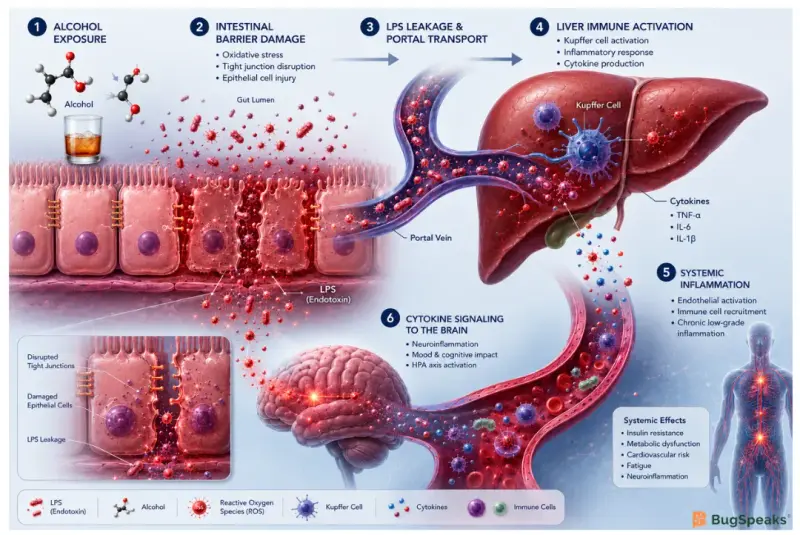
To understand this process, imagine your gastrointestinal tract as a large coastal flood barrier system protecting a vulnerable city from a dangerous ocean environment. The intestinal epithelial cells act as the primary coastal flood barrier walls. These walls carefully regulate what can safely enter the body while keeping dangerous debris and contaminants outside. When alcohol moves through the digestive tract, it washes directly over these delicate barrier cells. Although the liver handles most alcohol metabolism, the intestinal lining also contains a local enzyme called Alcohol Dehydrogenase. This enzyme attempts to process alcohol locally, but it converts the alcohol into a toxic chemical called acetaldehydeBishehsari et al. (2017).
As alcohol exposure increases, the local barrier cells activate a secondary emergency system involving an enzyme called Cytochrome P450 2E1. This backup pathway produces unstable chemical byproducts known as Reactive Oxygen SpeciesJung et al. (2022). Inside the coastal flood barrier system, these unstable molecules behave like corrosive chemical runoff splashing against the protective walls. They damage healthy cell membranes through oxidative reactions that gradually weaken the structure of the intestinal liningBernhardt et al. (2024).
The mitochondria inside these cells, which function as tiny energy factories, become overwhelmed by this chemical stress. Once they lose the ability to produce enough energy, the cells begin breaking apart and detaching from the intestinal lining. This direct structural damage increases transepithelial permeability, a condition where physical gaps begin forming in the gut barrierBishehsari et al. (2017).
As sections of the coastal flood barrier walls weaken, harmful substances can pass more easily into the tissue below. The body must then redirect energy toward repair and inflammation control. For many individuals, this contributes to digestive discomfort, fatigue, irritation, and chronic low-grade inflammation throughout the gastrointestinal tract.
Why Does Alcohol Cause a “Leaky” Gut?
Alcohol causes a “leaky” gut by weakening the specialized protein seals that hold intestinal cells tightly together, allowing harmful material to leak through the barrier.
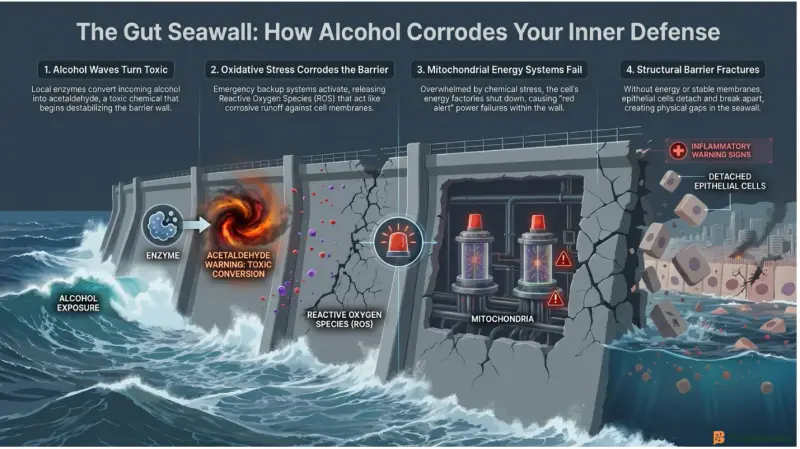
If the intestinal epithelial cells are the concrete sections of the coastal flood barrier walls, the tight junctions function as the reinforced water seals connecting those walls together. These microscopic protein structures create a tightly regulated border that controls what can move between neighboring cells. Under healthy conditions, the water seals allow nutrients to pass safely into circulation while blocking toxins, bacteria, and undigested debris.
When alcohol is broken down into acetaldehyde, this toxic chemical begins damaging the integrity of these protective seals. Research shows that acetaldehyde destabilizes proteins such as claudin and occludin while also weakening the internal cytoskeleton, the structural framework that helps each cell maintain its shape and stabilityBishehsari et al. (2017).
Alcohol also interferes with the body’s ability to repair the barrier. It increases production of MicroRNAs, small regulatory molecules that suppress genes responsible for rebuilding damaged tight junctionsBernhardt et al. (2024). As repair systems slow down, the old water seals gradually break apart while fewer new proteins are produced to replace them.
Over time, spaces begin forming between intestinal cells. This condition is known as paracellular permeability, commonly referred to as “leaky gut”Jung et al. (2022). Inside the coastal flood barrier system, this creates severe barrier leakage, allowing contaminated material from the digestive tract to pass directly into circulation. The immune system must constantly respond to these intrusions, contributing to inflammation, food sensitivities, skin irritation, and ongoing fatigue.
How Does Alcohol Alter the Balance of Your Gut Microbiome?
Chronic alcohol consumption alters the gut microbiome by suppressing beneficial bacteria while promoting the overgrowth of harmful, inflammatory microbes.
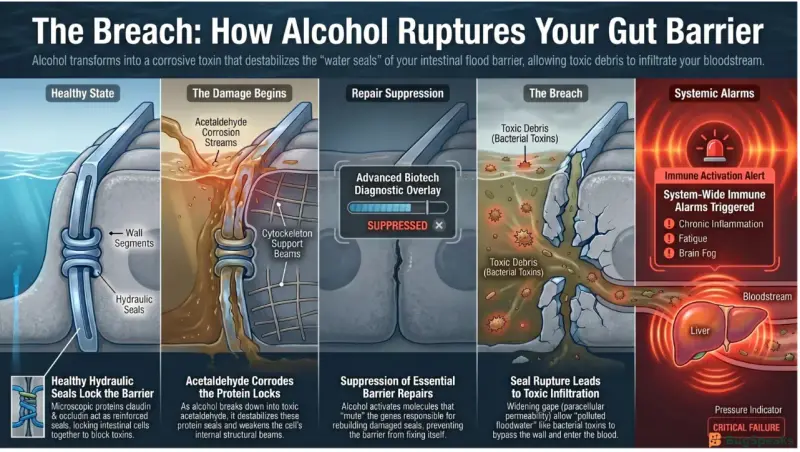
Inside a healthy coastal flood barrier system, the surrounding ecosystem remains stable because of a highly organized maintenance ecosystem made up of beneficial gut microbes. Organisms such as Lactobacillus, Bifidobacterium, and Akkermansia muciniphila help regulate inflammation, digest dietary fibers, and support the protective mucus layer covering the intestinal wall. These microbes also produce Short-Chain Fatty Acids, important compounds that nourish the intestinal lining and strengthen the barrierJew & Hsu (2023).
Alcohol rapidly disrupts this balance. Beneficial microbes struggle to survive in the increasingly toxic environment, allowing harmful organisms to expand more aggressively. This microbial imbalance is known as dysbiosis. One major bacterial group that increases during alcohol exposure is Proteobacteria, a category associated with inflammation and toxin productionMutlu et al. (2012).
At the same time, fungal organisms such as Candida albicans may begin overgrowing and irritating the surrounding tissue. As the healthy ecosystem weakens, the protective mucus layer covering the coastal flood barrier walls becomes thinner and less stable. This leaves the intestinal lining more vulnerable to chemical and inflammatory damage.
These microbial changes also affect the nervous system through the Gut-Brain Axis, the communication network linking the gut and brain. Healthy microbes help regulate neurotransmitters involved in mood stability, stress response, and emotional balance. One example is Gamma-Aminobutyric Acid (GABA), a calming neurotransmitter influenced by gut microbial activityKoutromanos et al. (2024). When harmful organisms dominate the ecosystem, stress signaling patterns become disrupted, contributing to anxiety, brain fog, irritability, and stronger alcohol cravings.
Table 1: Microbial Shifts During Alcohol Exposure
What Happens When Gut Toxins Escape into the Bloodstream?
When toxins escape through a damaged intestinal barrier, they travel through the bloodstream to trigger inflammation in the liver, brain, and immune system.
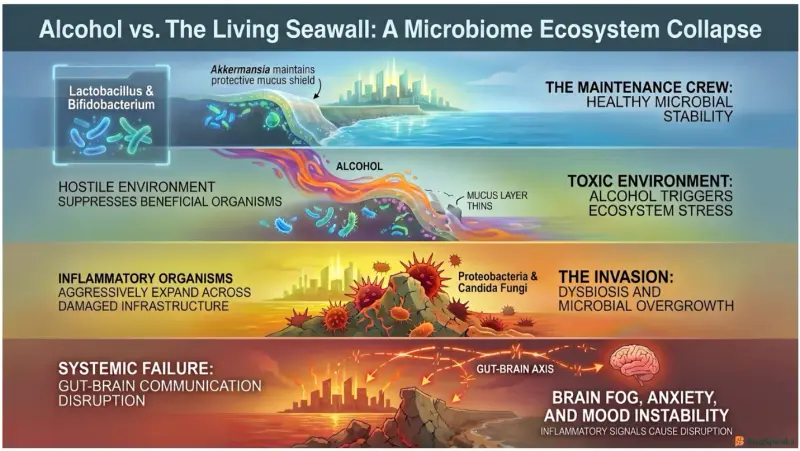
Many harmful bacteria release toxic molecules called Lipopolysaccharides. Under healthy conditions, the intestinal barrier prevents these molecules from entering circulation. However, once alcohol weakens the water seals, these toxins leak through the damaged sections of the coastal flood barrier walls and enter the portal vein, the major blood vessel connecting the digestive tract directly to the liverJung et al. (2022).
Inside this environment, the leaking toxins behave like contaminated polluted floodwater escaping into the city’s internal water system. Once this material reaches the liver, it encounters specialized immune cells known as Kupffer cells. These immune sentries contain receptors called Toll-Like Receptor 4, which detect the presence of bacterial toxins and trigger an inflammatory responseBernhardt et al. (2024).
The liver responds by releasing cytokines, immune signaling molecules that coordinate the body’s broader emergency flood response. While inflammation is designed to protect the body, persistent activation can damage healthy tissues when the system remains chronically stimulated. Repeated alcohol-related barrier leakage may therefore contribute to fatty liver disease, liver scarring, and metabolic dysfunction over time.
These inflammatory signals also travel beyond the liver. Cytokines moving through circulation influence the nervous system and may disrupt normal brain functionKoutromanos et al. (2024). This helps explain why alcohol-related gut damage is often associated with fatigue, brain fog, anxiety, poor concentration, and mood instability. Modern research increasingly shows that the gut, liver, brain, and immune system operate as interconnected biological systems rather than isolated organs.
How Can You Rebuild Your Gut Barrier After Alcohol Exposure?
You can rebuild your gut barrier by reducing alcohol exposure and supporting the repair of the intestinal lining with targeted nutritional and microbial therapies.
The first and most important step is reducing or stopping alcohol intake. Continued alcohol exposure keeps damaging the coastal flood barrier walls, prevents repair systems from functioning normally, and continuously feeds inflammatory microbes. Once alcohol exposure decreases, the intestinal environment becomes more capable of restoring structural stability.
Researchers continue studying probiotics, beneficial live microbes that may help rebuild the damaged maintenance ecosystemKoutromanos et al. (2024). Certain probiotic strains can help support tighter water seals, reduce inflammatory signaling, and compete against harmful bacteria. Some strains may also encourage recovery of the protective mucus layer covering the intestinal lining.
Another important strategy involves prebiotics, specialized dietary fibers that beneficial microbes use as fuel. These fibers stimulate production of Short-Chain Fatty Acids, which nourish intestinal cells and strengthen the protective mucus barrierJung et al. (2022). As the maintenance ecosystem recovers, the coastal flood barrier system becomes more stable and resilient against future damage.
For severe cases of microbiome disruption, researchers are also investigating Fecal Microbiota Transplantation as a possible restoration strategyJew & Hsu (2023). This procedure introduces a healthy microbial ecosystem into a damaged intestinal environment to help restore microbial diversity and reduce chronic barrier leakage. Over time, improving gut health may support better digestion, sleep quality, cognitive clarity, emotional balance, and reduced alcohol cravings.
Table 2: The Arsenal of Gut Repair
-Varsha V
Visualize the process- https://youtu.be/VUrePwFSMuo
Reference
Bishehsari, F., Magno, E., Swanson, G., Desai, V., Voigt, R. M., Forsyth, C. B., & Keshavarzian, A. (2017). Alcohol and Gut-Derived Inflammation. Alcohol research : current reviews, 38(2), 163–171. https://doi.org/10.35946/arcr.v38.2.02
Koutromanos, I., Legaki, E., Gazouli, M., Vasilopoulos, E., Kouzoupis, A., & Tzavellas, E. (2024). Gut microbiome in alcohol use disorder: Implications for health outcomes and therapeutic strategies-a literature review. World journal of methodology, 14(1), 88519. https://doi.org/10.5662/wjm.v14.i1.88519
Jew, M. H., & Hsu, C. L. (2023). Alcohol, the gut microbiome, and liver disease. Journal of gastroenterology and hepatology, 38(8), 1205–1210. https://doi.org/10.1111/jgh.16199
Vidya Bernhardt G, Shivappa P, R. Pinto J, KS R, Ramakrishna Pillai J, Kumar Srinivasamurthy S and Paul Samuel V (2024) Probiotics—role in alleviating the impact of alcohol liver disease and alcohol deaddiction: a systematic review. Front. Nutr. 11:1372755. doi: 10.3389/fnut.2024.1372755
Jung, J. H., Kim, S. E., Suk, K. T., & Kim, D. J. (2022). Gut microbiota-modulating agents in alcoholic liver disease: Links between host metabolism and gut microbiota. Frontiers in medicine, 9, 913842. https://doi.org/10.3389/fmed.2022.913842