Exploring the Relationship Between Air Conditioning and Microbiome Diversity
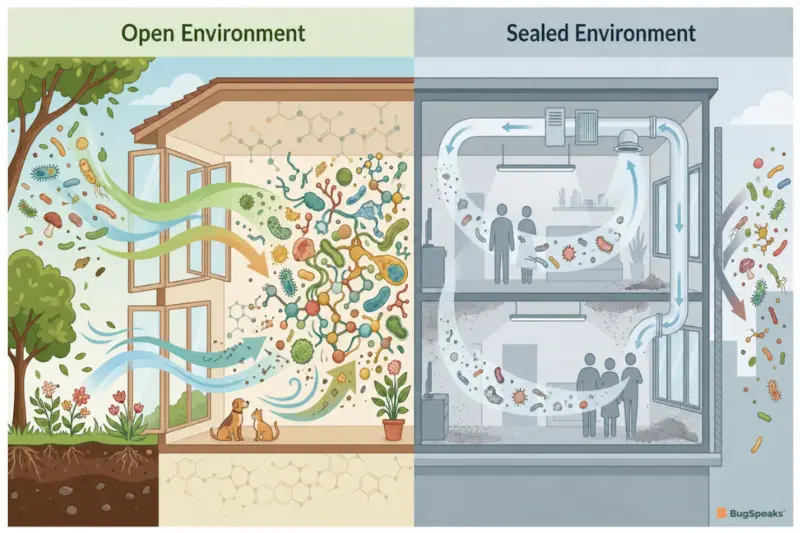
What happens to your microbial wealth when you live in a sealed, climate-controlled room?
Spending all of your time in sealed, air-conditioned rooms can starve your body of the natural germs. In our Biological Exposure Portfolio, every day we collect thousands of tiny germ exposures from the world around usHaahtela et al. (2013). Think of these germs as helpful coins that build your long-term health rather than bad things that make you sick. In modern cities, people spend almost ninety percent of their lives inside a built environment (BE), which is completely separated from natural spacesRaju et al. (2020).
When we spend all of our time inside these climate-controlled buildings, we create a highly unbalanced biological reserve that is missing its most important savings. A healthy human microbiome is like a well-diversified savings account filled with many different kinds of tiny germ assets that help us growHaahtela et al. (2013). When we seal ourselves indoors, we lock out the natural flow of outdoor microbes that our bodies have lived with since the beginning of human historyHanski et al. (2012). Instead of collecting high-value assets from trees and soil, we just swap the same skin germs with family members.
This long-term indoor isolation is leading to a major silent health problem for children and adults who live in big cities. Scientific studies show that a general lack of diverse germs is a big reason why many city people develop confused immune systemsHaahtela et al. (2013). When we live in microbe-poor spaces, our bodies suffer from dysbiosis. This is especially true for families who move from green countryside areas into highly polished city apartments. Spending your life in a sealed room makes your body forget how to handle normal natural things.
How do outdoor environmental assets build a high-value biological portfolio?
Playing outside in wild spaces like forests and gardens lets you collect high-value germ assets that teach your body how to stay healthy. According to the "biodiversity hypothesis," human beings must have regular contact with many different plants, animals, and soil germs to train their immune systemsHanski et al. (2012). Outdoors, nature acts like a giant treasury of wonderful germs. Healthy dirt is a high-value source of tiny saprophytic bacteria, while trees and flowers are active contributors that sprinkle good germs into the air. Touching these green plants adds helpful biological assets, helping you stay strong.
Scientists have discovered that children who play in dirt have special types of protective bacteria on their skin called gammaproteobacteria. These outdoor bacteria are very important because they send friendly signals to our body's defense guardsHanski et al. (2012). Specifically, having a soil germ named Acinetobacter on your skin makes your blood cells create a special molecule called interleukin-10 (IL-10). This molecule is a helpful anti-inflammatory cytokine. It tells your immune system to relax and not overreact to pollen, keeping your body's defense guards stable, so that your skin does not get red and swollen.
If we do not get enough of these helpful outdoor signals, our bodies can easily suffer from a problem called atopic sensitization. This means your body is highly likely to develop allergies, asthma, or itchy skin because your defense guards are confused Hanski et al. (2012). Children who grow up on traditional farms with animals and soil have a highly diversified germ portfolio, so they rarely get allergies. Spending time in nature ensures we keep receiving these essential messages, which helps our body maintain a strong, healthy, and peaceful relationship with the natural green world around us every single day.
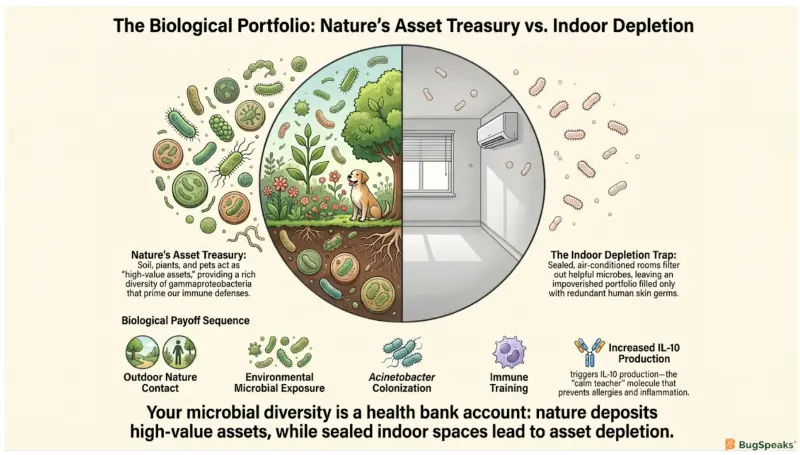
Why does mechanical air conditioning deplete your environmental exposure assets?
Mechanical air conditioning systems actively deplete your biological portfolio by filtering out the helpful outdoor germs and trapping you with indoor dust. In our home spaces, the air system acts as a strict manager that decides which germs are allowed to enter our living areasAdams et al. (2016). Open windows allow a rich, natural flow of soil and plant germs to drift inside, keeping our indoor air diverse and healthy. In contrast, sealed buildings rely on mechanical Heating, Ventilation, and Air Conditioning (HVAC) systems that use fine paper filters to block these natural visitors, leaving our rooms biologically empty and sad.
Without the fresh flow of outside microbes, your air-conditioned room quickly becomes filled with a single type of human skin germ. Studies show that sealed offices and homes have very few outdoor-associated bacteria, which are replaced by skin germs that fall off our bodiesAdams et al. (2016). This means your room is no longer a natural ecosystem, but rather a mirror of your own skin sheddingLax et al. (2014). Your immune system fails to build strong, healthy tolerance because it only meets the same skin microbes over and over instead of learning from the great natural world outside of the house.
Furthermore, if air conditioning systems are not kept clean and dry, they can become dangerous breeding grounds for toxic indoor molds. Damp filters and wet ducts allow molds to grow and release tiny spores, along with smelly microbial volatile organic compounds (MVOCs)Adams et al. (2016). Instead of inhaling protective, friendly forest bacteria, building occupants breathe in these irritating fungal particles and gases, which can cause bad headaches, coughing, and worsen asthmaRaju et al. (2020). This shows why sealed air systems must be managed very carefully to prevent a healthy home from turning into a dirty, harmful, and unsafe space.
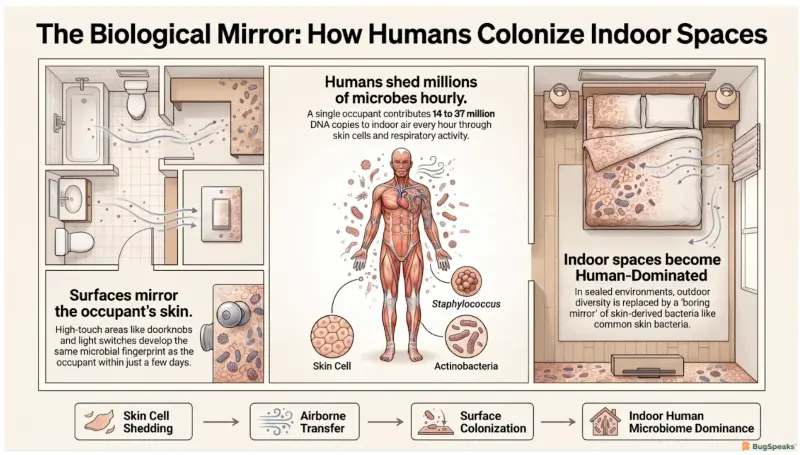
How do human occupants redistribute skin-derived assets on indoor surfaces?
Human occupants are the primary biological vectors in sealed indoor spaces, continuously shedding and redistributing their own skin-derived microbial assets across high-touch surfaces. Within an air-conditioned room, the dynamic exchange of microbes is driven by human contact, skin shedding, and respiratory activitiesLax et al. (2014). Every hour, a single human occupant sheds millions of skin cells and contributes between 14 to 37 million Deoxyribonucleic Acid (DNA) copies to the indoor airAdams et al. (2016). These particles settle onto surfaces, forming a personalized microbial cloud that acts as a distinctive biological fingerprint of the household.
This rapid redistribution of human-associated microbes has been extensively mapped in longitudinal studies such as the Home Microbiome Project. Researchers found that when a family moves into a clean new house, their skin germs completely cover the door handles, light switches, and kitchen counters in just a few daysLax et al. (2014). Our bodies are constantly exporting skin bacteria to our surroundings, leaving a biological trace wherever we go. This creates a highly personal germ signature, but it also means our indoor surfaces are missing the wider diversity of the outdoor world, leaving our immune systems underprepared for daily life.
Fortunately, household pets like dogs can act as helpful couriers that bring the lost wealth of nature back into our homes. Dogs love to run in the dirt, collecting high-value soil and plant microbes on their fur, paws, and nosesLax et al. (2014). When they come inside, they share these outdoor germs with us, which significantly increases the microbial diversity of our indoor dustRaju et al. (2020). This pet-mediated asset transfer helps balance our indoor portfolio, making our immediate living areas much richer, far less redundant, and much healthier for our immune system to study every single day.
What long-term health outcomes are linked to an impoverished exposure portfolio?
A lack of a diverse community of commensal microbesover a long period can confuse your body's immune guards, leading to chronic allergies and asthma. When children grow up in sealed, air-conditioned rooms, their bodies do not receive the normal microbial signals that teach them how to behaveHaahtela et al. (2013). Without these friendly natural messages, our T regulatory cells (Tregs) do not mature properly. These special cells are supposed to produce anti-inflammatory cytokines that keep our bodies calmHanski et al. (2012). Without this training, our immune system becomes hyperreactive to harmless things, causing chronic inflammation and serious diseases like pediatric asthma.
A balanced and rich range of environmental exposures is also necessary to keep our skin and lung barriers healthy and strong. In healthy kids, touching natural dirt bacteria triggers friendly alerts that tell our body's barriers to repair themselves and stay closedHaahtela et al. (2013). When we live in sealed indoor boxes, this helpful signaling stops, and our epithelial barriers can become weak and leakyHanski et al. (2012). This barrier breakdown lets dust and pollen leak deep inside, causing painful swelling, asthma, runny noses, and itchy eczema. Our body's protective walls are left completely broken, fragile, and highly vulnerable to any outside elements.
To protect our health, we should make a habit of getting outside, playing in the dirt, and avoiding over-sterilized rooms. We can also build better buildings with open windows and indoor plants to help restore a diverse and protective microbiome indoorsJoseph et al. (2025). Simple choices like playing with pets, walking in forests, and eating fresh vegetables can easily help us rebuild our lost biological wealth and protect our bodies. At the architectural scale, we must move toward bio-informed building designs with operable windows and indoor plantsJoseph et al. (2025). By actively playing with pets, walking in green forests, and diversifying our lifetime biological germ portfolio, we can help our immune system stay incredibly smart, calm, and strong for many years to come.
Visualize the process- https://youtu.be/crpQGgJZq9E
Reference
Haahtela T, Holgate S, Pawankar R, Akdis CA, Benjaponpitak S, Caraballo L, Demain J, Portnoy J, von Hertzen L; WAO Special Committee on Climate Change and Biodiversity. The biodiversity hypothesis and allergic disease: world allergy organization position statement. World Allergy Organ J. 2013 Jan 31;6(1):3. doi: 10.1186/1939-4551-6-3. PMID: 23663440; PMCID: PMC3646540.
Hanski I, von Hertzen L, Fyhrquist N, Koskinen K, Torppa K, Laatikainen T, Karisola P, Auvinen P, Paulin L, Mäkelä MJ, Vartiainen E, Kosunen TU, Alenius H, Haahtela T. Environmental biodiversity, human microbiota, and allergy are interrelated. Proc Natl Acad Sci U S A. 2012 May 22;109(21):8334-9. doi: 10.1073/pnas.1205624109. Epub 2012 May 7. PMID: 22566627; PMCID: PMC3361383.
Lax S, Smith DP, Hampton-Marcell J, Owens SM, Handley KM, Scott NM, Gibbons SM, Larsen P, Shogan BD, Weiss S, Metcalf JL, Ursell LK, Vázquez-Baeza Y, Van Treuren W, Hasan NA, Gibson MK, Colwell R, Dantas G, Knight R, Gilbert JA. Longitudinal analysis of microbial interaction between humans and the indoor environment. Science. 2014 Aug 29;345(6200):1048-52. doi: 10.1126/science.1254529. PMID: 25170151; PMCID: PMC4337996.
Adams, R. I., Bhangar, S., Dannemiller, K. C., Eisen, J. A., Fierer, N., Gilbert, J. A., ... & Bibby, K. (2016). Ten questions concerning the microbiomes of buildings. Building and Environment, 109, 224-234.
Joseph TM, Abdulmaksoud S, Mortula MM, Beheiry S and Zareen N (2025) Microbiomes of the built environment: a systematic literature review. Front. Built Environ. 11:1657297. doi: 10.3389/fbuil.2025.1657297
Raju S, Siddharthan T, McCormack MC. Indoor Air Pollution and Respiratory Health. Clin Chest Med. 2020 Dec;41(4):825-843. doi: 10.1016/j.ccm.2020.08.014. PMID: 33153698; PMCID: PMC7665158.